
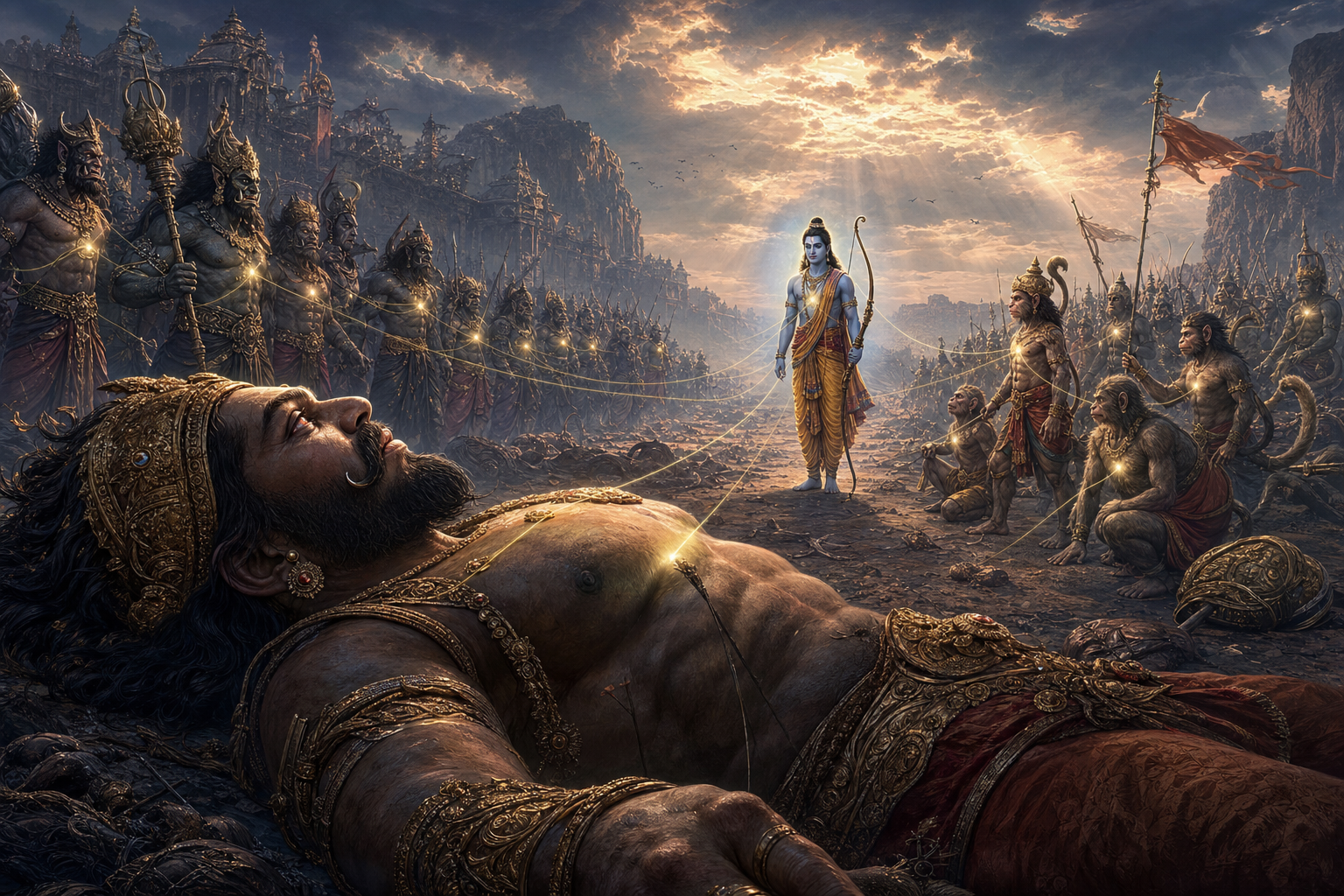
You may have encountered a striking claim: at the end of his life, Kumbhakarna saw Rama in vanara and asura alike. Is that vision really present in the Valmiki Ramayana? Does it make Kumbhakarna an Advaitin? And if one reality pervades both armies, does the distinction between dharma and adharma disappear?
The careful answer preserves both the spiritual force of the scene and the differences among Hindu traditions. Kumbhakarna’s final recognition can be read as a disclosure of oneness, but the narrative foundation, devotional amplification and Vedantic interpretation are not identical claims. Once you separate them, the episode becomes more useful: it teaches how to recognize the One without becoming vague about duty.
Begin with Kumbhakarna’s divided moral vision
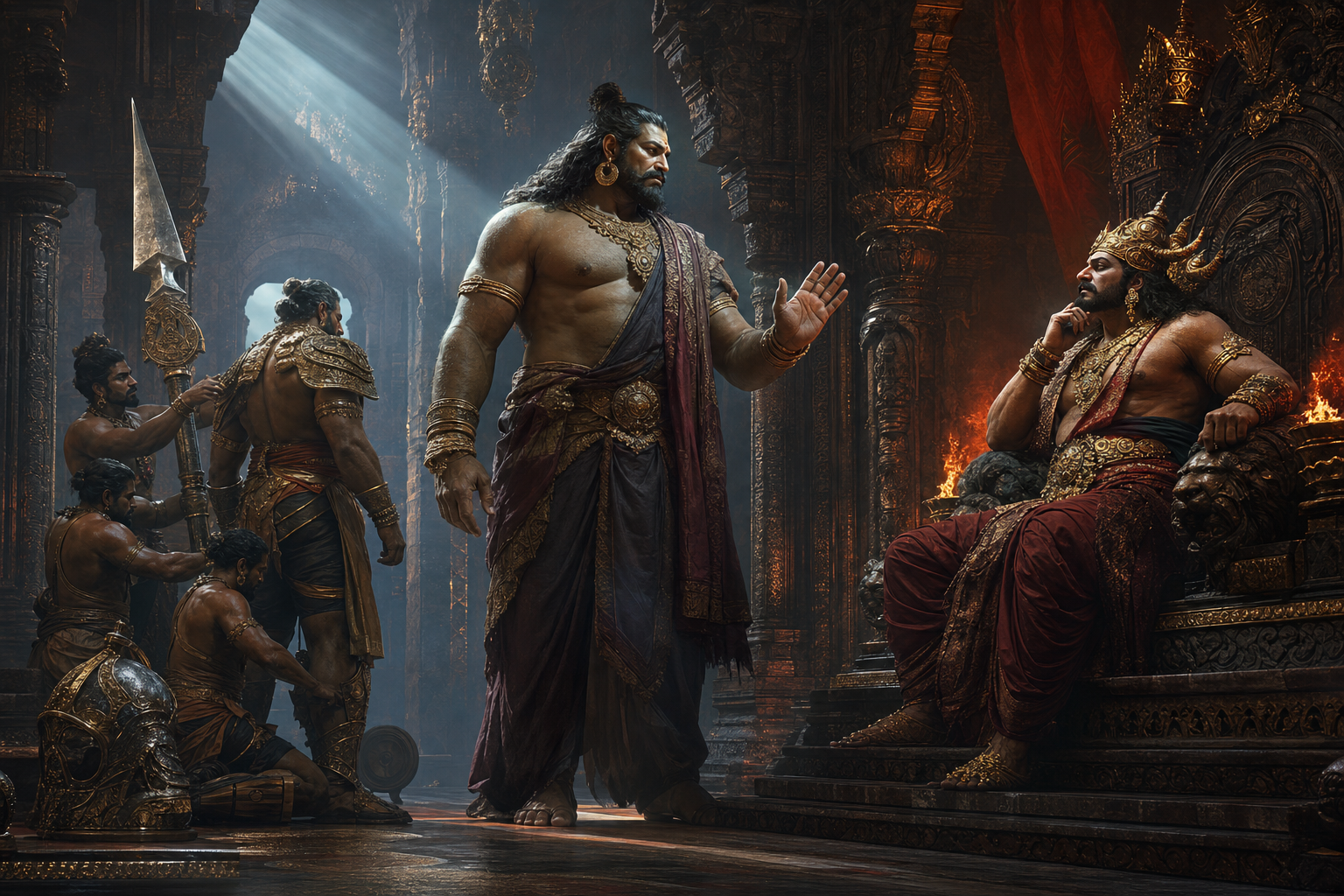
Kumbhakarna is not compelling because he is secretly innocent. He is compelling because he can see much of the truth and still remain bound to a disastrous allegiance. Once awakened, he diagnoses Ravana’s position with unusual clarity. He recognizes the consequences of adharma, understands that Lanka faces an exceptional adversary and does not share his brother’s confidence that brute strength will settle the matter.
Yet he goes to battle. Loyalty to Ravana, warrior obligation and acceptance of fate draw him into a cause whose corruption he already understands. That tension must remain visible. Otherwise, his story becomes either a flat tale about a demon who deserved defeat or a sentimental tale in which loyalty excuses participation in adharma. Neither reading does justice to him.
The first lesson, then, comes before non-duality: insight is not the same as alignment. You can correctly identify an injustice while continuing to serve the arrangement that produces it. You can speak honestly to a relative, leader or institution and still lend your strength to the wrong course. Before admiring loyalty, ask what that loyalty protects. Before treating self-awareness as transformation, look at the action that follows it.
Kumbhakarna’s battlefield encounter brings that divided consciousness to its limit. The opponent before him is no longer merely a human prince. Rama stands as the power restoring an order Ravana has violated. Kumbhakarna’s recognition therefore has two inseparable dimensions: he sees who Rama is, and he sees what his own side has become.
Separate the epic episode from the full oneness interpretation
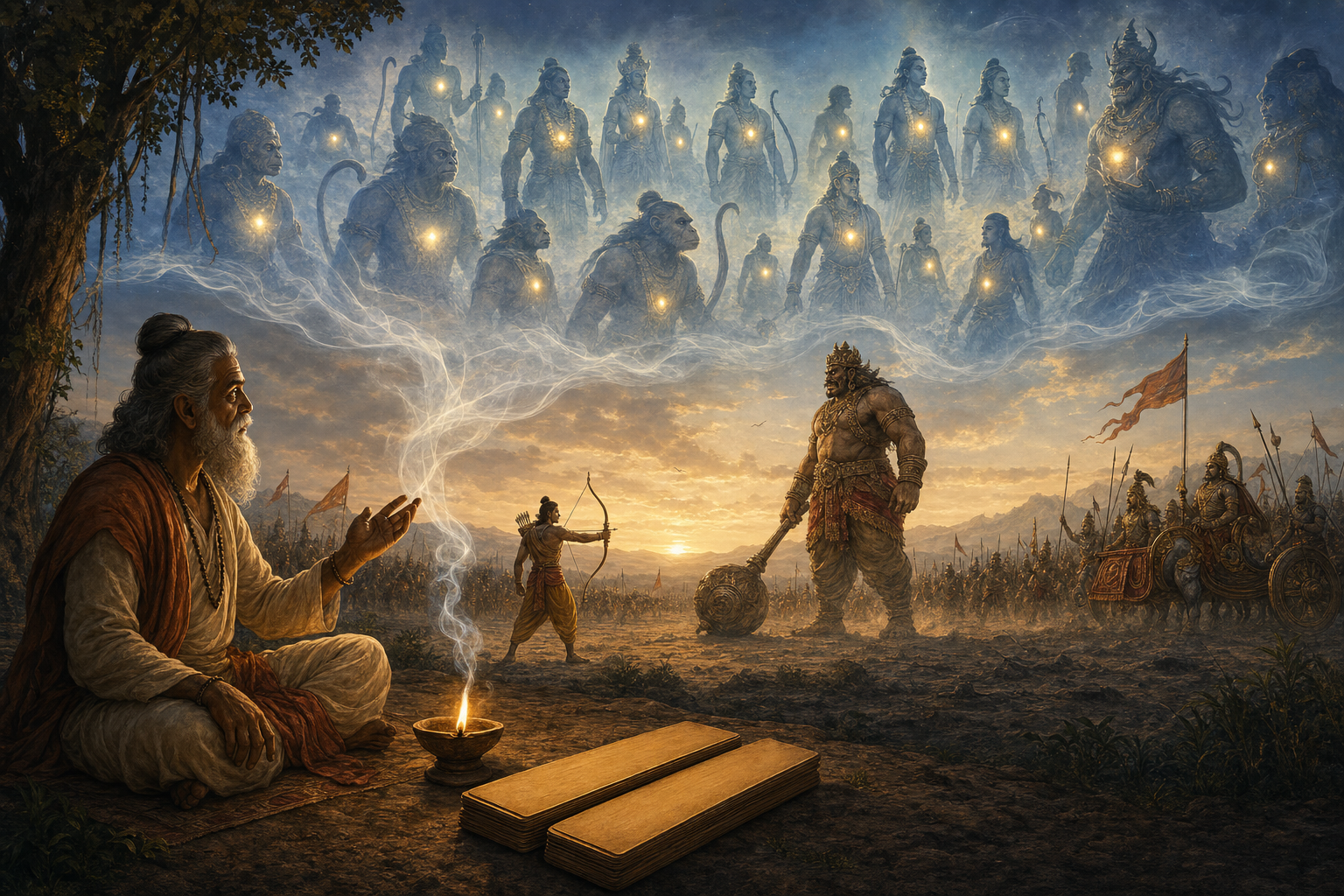
The phrase sarvam Rama-mayam means that the whole field is filled, permeated or constituted by Rama’s presence. Applied to Kumbhakarna’s last battle, it pictures an extraordinary reversal of ordinary perception. The categories of our army and their army remain visible, but they no longer define the ultimate reality of those who stand within them.
It is important, however, not to present that devotional formula as an undisputed verbatim line from every telling of the Ramayana. The distinction between Valmiki’s narrative foundation and the later vision of Rama pervading the battlefield is essential to an honest reading.
- The narrative foundation: Within the Valmiki Ramayana, Kumbhakarna is discerning and valiant. He recognizes Rama’s exceptional nature and the force of fate gathering around Lanka.
- The devotional amplification: Through later Ramayana reception, that recognition ripens into surrender and an all-pervading vision of Rama. Within the Kamba Ramayanam, Kumbhakarna’s discernment and final submission receive particular emphasis. Within the Adhyatma Ramayana’s explicit theology, Rama is the supreme Brahman.
- The philosophical articulation: Vedantic language explains the vision as a movement from bheda-buddhi, consciousness governed by division, to abheda-drishti, a way of seeing grounded in non-separation.
Keep those three levels separate when you teach, discuss or share the episode. It is accurate to say that the Valmiki narrative supports a theological deepening. It is less careful to place sarvam Rama-mayam in Kumbhakarna’s mouth as an exact quotation unless you can identify the recension and passage. This distinction does not diminish the living tradition. It prevents a meaningful interpretation from being mistaken for a philological claim.
The Puranic Jaya-Vijaya framework adds another layer. Ravana and Kumbhakarna are understood as births of Vishnu’s gatekeepers, who descend as adversaries of the Lord across three eras. Their opposition is therefore enclosed within a larger movement back toward Vishnu. The idea of vaira-bhakti, Godward absorption through enmity, explains how confrontation with the Divine can culminate in release.
That exceptional framework is not a recommendation to cultivate hatred. The liberating element is not hostility considered by itself. It is the total encounter with the Lord and the exhaustion of an adversarial role within a divinely ordered narrative. A practitioner should imitate Kumbhakarna’s recognition, not his decision to remain on Ravana’s side.
A traditional derivation, ramate iti Rama, associates the name Rama with that in which beings rejoice or abide in delight. This gives the battlefield vision an unexpected depth. Beneath terror, division and death, Kumbhakarna encounters the ground of being, awareness and ananda in the form of the prince standing before him. The terrible field has become a place of disclosure.
Ask which Vedantic claim you are actually making
Non-duality is often used as though it named one doctrine accepted in one way by every Vedantic school. It does not. Advaita, Vishishtadvaita and Dvaita can all find spiritual meaning in Kumbhakarna’s recognition, but they disagree about what the One is and whether the many possess ultimate distinction.
| Vedantic lens | What Kumbhakarna recognizes | Status of difference | Practical emphasis |
|---|---|---|---|
| Advaita | The single reality of Brahman shines through Rama, vanara, asura and the witnessing self. | Plural forms are experienced, but they do not possess final, independent reality apart from Brahman. | Move from fragmented perception to abheda-drishti; loosen the absolute division between self and other. |
| Vishishtadvaita | Rama is the personal supreme Brahman who pervades, sustains and gives unity to all beings. | Souls and the world remain real within an organic unity wholly dependent on the Lord. | Recognize divine indwelling, surrender to Rama and serve the whole without erasing its diversity. |
| Dvaita | Rama is the supreme Lord whose sovereignty governs both armies and Kumbhakarna’s fate. | The Lord, individual souls and the world remain genuinely distinct, although every soul depends on the Lord. | Abandon defiance, accept divine supremacy and seek grace without claiming identity with God. |
The wording of the vision does not settle the debate by itself. To say that Rama is in all beings can indicate divine pervasion without claiming that the beings are identical to Rama. To say that all is Rama sounds stronger, yet a devotional exclamation still need not carry every technical commitment of strict Advaita.
Two questions will locate your reading more precisely. First, is plurality ultimately real, provisionally experienced or real only as dependent existence? Second, is the relation between Rama and beings one of identity, organic inclusion or eternal Lord-servant distinction? Advaita answers through identity at the level of Brahman. Vishishtadvaita answers through unity that includes real difference. Dvaita answers through real difference under absolute divine sovereignty.
This is why Kumbhakarna’s recognition can unite Vaishnava reflection without making the Vedantic schools interchangeable. All three readings can affirm that his ordinary perception has broken open. All three can affirm Rama’s supremacy and the possibility of grace. They part company when explaining the metaphysics of what he sees.
Non-duality does not make Rama and Ravana morally equal
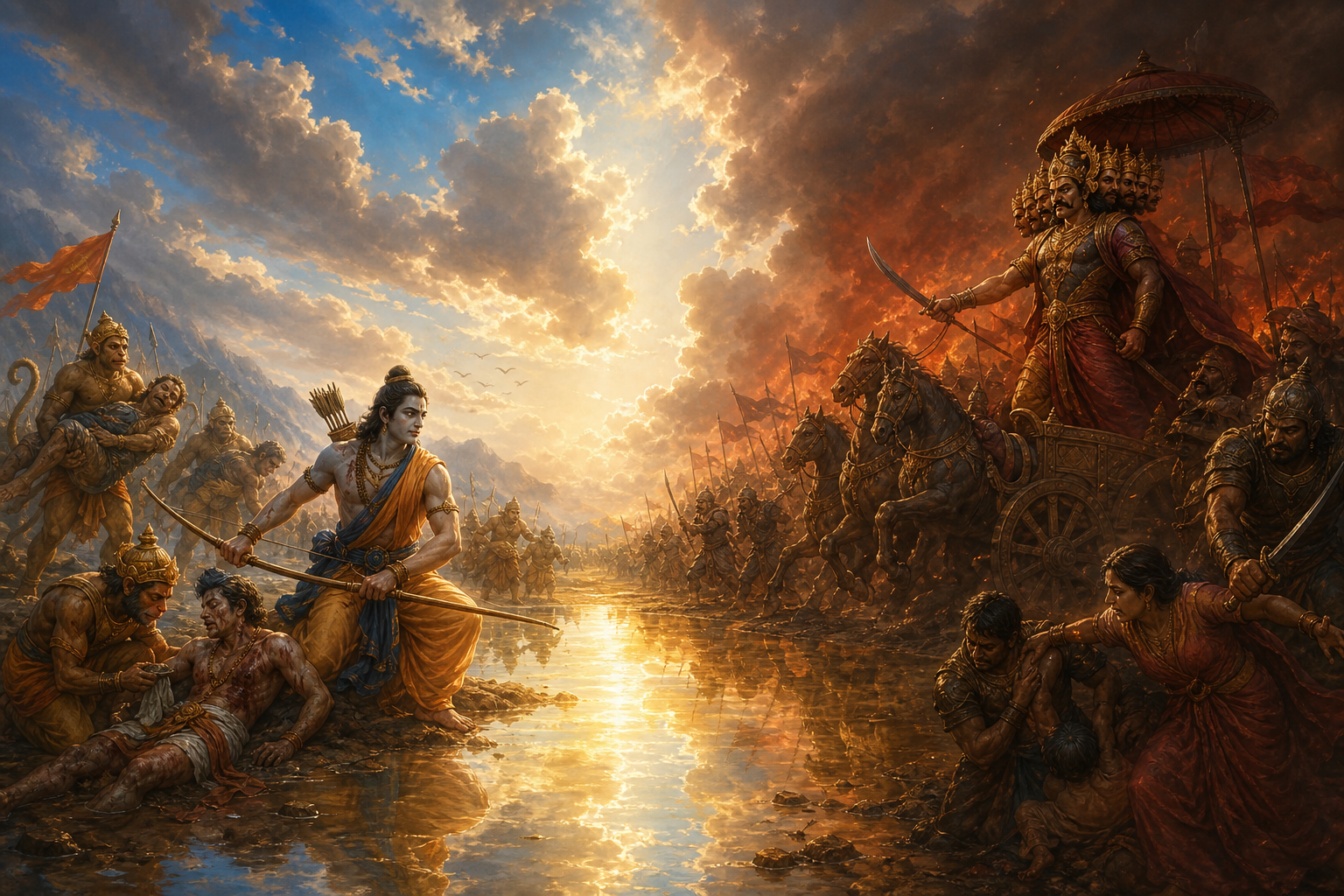
The most damaging misuse of oneness is moral flattening. If Rama pervades everyone, someone may ask, why resist Ravana? If Brahman alone is real, why distinguish a protector from an aggressor? This confuses the ground of existence with the ethical quality of conduct.
No being stands outside the One, but actions still move toward dharma or away from it. Ravana’s dignity as a being does not sanctify abduction, arrogance or refusal to repair wrong. Rama’s recognition of a common spiritual ground does not require him to leave Sita captive or Lanka under an adharmic order. Oneness removes the fantasy that an opponent is metaphysically disposable; it does not remove responsibility.
This is where the battlefield setting matters. The recognition does not occur after all conflict has been avoided. It arises in the middle of unavoidable consequence. Kumbhakarna can perceive Rama’s divinity and still be struck down. Rama can oppose him decisively while honouring courage and recognizing the person beneath the hostile role. Compassion changes the manner of action; it does not always change the required action.
A sound reading should pass three tests:
- It preserves moral discrimination. Ravana’s adharma and Rama’s restoration of order cannot be treated as equivalent choices.
- It reduces contempt without reducing accountability. You may oppose conduct firmly without imagining that its agent exists outside the sacred ground of life.
- It strengthens proportionate duty. A genuine vision of unity should make action more measured, truthful and restrained, not passive or careless.
This also clarifies the meaning of grace in adversarial encounters with the Divine. Deliverance at Rama’s hands does not retroactively turn Kumbhakarna’s allegiance into righteousness. Grace reveals that a being is more than the final error through which we encounter him. Dharma judges and stops the error; grace refuses to make the error the being’s ultimate identity.
Resonance across Dharma does not mean identical doctrine
Other Dharmic traditions also weaken the hard boundary between self and other, but they do so through their own vocabularies. Buddhist advaya and insight into shunyata support compassion without positing Vedanta’s Brahman. Jain anekantavada disciplines the impulse to absolutize a single viewpoint and supports ahimsa, but it is not Advaita expressed in different words. Sikh Ik Onkar affirms the One divine reality and gives ethical force to sarbat da bhala, the welfare of all.
The shared resonance is practical: a person who no longer treats the other as wholly alien should become less cruel, less arrogant and more concerned with the good of all. The metaphysical explanations remain distinct. Respect grows when those differences are understood rather than erased.
Turn the battlefield vision into a daily discipline
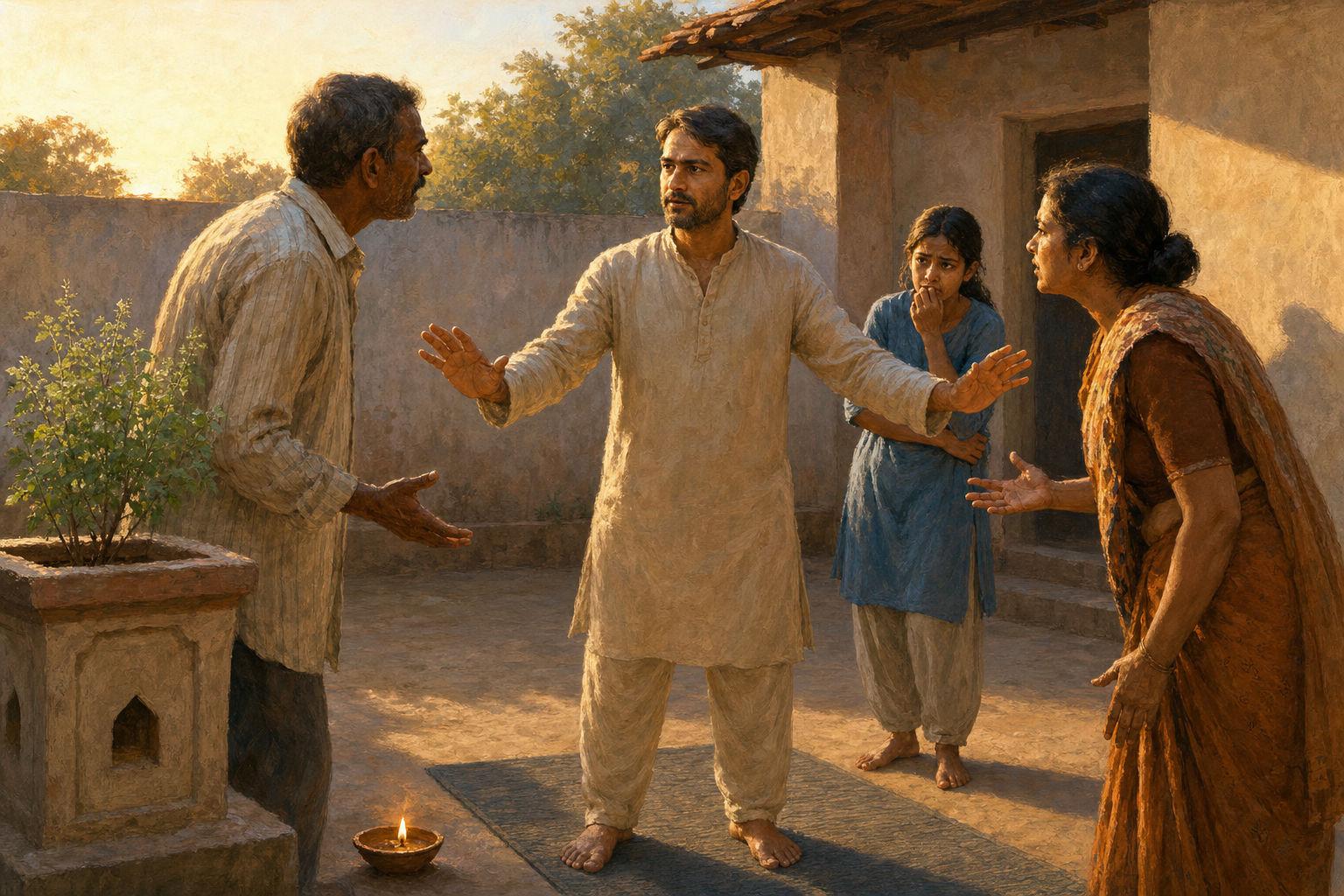
You do not need a dramatic mystical experience to test the episode’s insight. Use it at the moment when conflict compresses another person into a label: enemy, fool, traitor, obstacle or lost cause. The practice is especially useful before sending an angry reply, entering a family dispute or exercising authority over someone who has acted wrongly.
- Name the conduct, not the entire person. Describe the observable act in one sentence. Replace claims such as he is evil with the specific promise broken, harm done or duty neglected.
- Name your own dharma. Ask what you are actually responsible for protecting, correcting or restoring. Do not substitute the desire to win for the duty the situation places before you.
- Recall the pervading presence. Silently use sarvam Rama-mayam or Isavasyam idam sarvam. Include yourself, the other person and everyone affected by the dispute. Do not reserve sacred presence for your side.
- Hold unity and discrimination together. Say inwardly: this being is not outside the One, and this conduct may still be adharmic. If you can hold only one of those truths, wait before acting when circumstances allow.
- Choose a proportionate response. Speak the truth, set a boundary, refuse cooperation, correct an error or use legitimate authority as the situation requires. Choose the response that protects dharma without adding humiliation for its own sake.
- Examine what remains afterward. If the practical issue is settled but you still want the other person degraded, your action may have been necessary while your perception remains divided. Return to the contemplation without pretending the original wrong did not occur.
This is not a technique for becoming agreeable. Kumbhakarna’s recognition belongs to a battle, not to a fantasy in which every disagreement vanishes. Its practical sign is clarity without dehumanization. You may still say no. You may still withdraw trust. You may still enforce a boundary. Oneness does not require proximity, reconciliation or exposure to danger. Where safety is at stake, create distance and seek legitimate help; do not use spiritual unity to dismantle necessary safeguards.
Nor should you measure the practice by whether anger disappears immediately. A better test is whether you can state the wrong accurately, choose a response proportionate to it and let go of the need to make the offender less than human. That is the movement from reactive division toward integral sight.
Key takeaways
- Kumbhakarna’s discernment is rooted in the epic narrative, while the complete sarvam Rama-mayam vision is a theological interpretation developed through the Ramayana’s wider reception.
- His story warns that recognizing adharma does not absolve you when your strength continues to serve it.
- Advaita, Vishishtadvaita and Dvaita can all receive the battlefield recognition, but they explain unity and difference in distinct ways.
- Seeing Rama in all beings does not make all conduct righteous. Metaphysical unity must be joined to moral discrimination.
- The practical discipline is to oppose wrong without turning its agent into an ontological outsider.
At your next point of conflict, hold two sentences together: this action may be wrong, and this being is not outside the One. Then do the duty in front of you with firmness, proportion and no appetite for contempt. That is how Kumbhakarna’s final clarity can become your present practice.