
If you need to plan puja, a vrata, or an auspicious beginning on Thursday, May 7, 2026, the day’s decisive change comes early. For the working schedule used here, Krishna Paksha Panchami ends at 6:51 AM and Krishna Paksha Sashti follows.
That gives you a clear devotional sequence, but it does not give every city the same ready-made muhurat. Treat 6:51 AM as the planning baseline, complete Panchami-specific practices before the locally confirmed boundary, and calculate sunrise-based intervals for the place where the observance will actually occur.
Key takeaways for May 7, 2026
- May 7 is Thursday, or Guruvara, and begins with Krishna Paksha Panchami before shifting to Krishna Paksha Sashti at 6:51 AM in the working schedule.
- If you intend to perform a Panchami-specific practice, place it early and finish before the confirmed local transition rather than aiming for the final minute.
- After the transition, Sashti-oriented worship may focus on Skanda, Kartikeya, or Subrahmanya, with an emphasis on discipline, courage, and protection.
- Thursday adds the traditional influence of Brihaspati, making study, respect for teachers, measured charity, and Vishnu or Brihaspati worship natural choices.
- Abhijit Muhurat, Rahu Kalam, Yamaganda, and Gulika must be calculated from local daylight. Exact Nakshatra, Yoga, Karana, and Moon Rashi transitions also require a city-specific panchang.
Plan your worship around the Panchami-Sashti boundary
A tithi does not wait for midnight. It is determined by the changing angular separation of the Moon and Sun, with each 12-degree segment forming one lunar day. The Moon’s motion is not uniform, so a tithi can end at an inconvenient civil-clock time, including shortly after sunrise or even before sunrise in some locations.
The astronomical transition is one instant, but the clock reading used to describe it depends on the time zone. Its ritual significance may also depend on its relationship to local sunrise. This is why copying 6:51 AM into a calendar without checking the city can create a practical error even when the underlying tithi sequence is correct.
Before 6:51 AM: keep Panchami practice simple and complete
Krishna Paksha Panchami supports a quiet beginning: mantra japa, scriptural reading, lamp lighting, or an unhurried household puja. If your sankalpa is specifically tied to Panchami, confirm that your local transition occurs after the required starting point, especially when the observance depends on sunrise.
Do not plan to finish at exactly 6:51 AM. Preparation, a longer-than-expected recitation, or a delayed family member can carry the rite across the boundary. Leave a practical margin before the locally verified end time. The point is not anxiety over a minute; it is to avoid knowingly placing a tithi-specific act on the wrong side of the change.
After 6:51 AM: move into Sashti and Guruvara
Once Sashti begins, the rest of the day can be oriented toward Skanda, also worshipped as Kartikeya or Subrahmanya. A household may recite the Skanda Shashti Kavacham, offer a direct prayer to Subrahmanya, or make discipline itself the observance by keeping a commitment carefully and without display.
Guruvara gives that Sashti discipline an additional direction. Brihaspati is associated with knowledge, ethical judgement, generosity, and reverence for the guru. You can express those qualities concretely: set aside time for study, help a child with learning, acknowledge a teacher or mentor, make measured dana, or include Vishnu or Brihaspati prayer in the household routine.
You do not need to force Panchami and Sashti into one elaborate ceremony. A short contemplative practice before the transition and a steady Sashti-Thursday practice afterward respects both parts of the day without turning the panchang into a burden.
A shubh muhurat belongs to a place, not just a date
The most common mistake in date-only muhurat planning is borrowing clock times from another city. Abhijit Muhurat is centered on local solar noon and extends for roughly 24 minutes on either side. Local solar noon is not automatically 12:00 PM on the civil clock, so subtracting and adding 24 minutes around ordinary noon can produce the wrong interval.
Rahu Kalam, Yamaganda, and Gulika are also daylight-dependent. The period from local sunrise to local sunset is divided into eight equal portions, and weekday rules assign particular portions to these traditionally avoided windows. When sunrise and sunset change, the portions change with them. A Thursday timing copied from a distant city may therefore begin or end too early for your location.
Use this sequence before fixing a time:
- Choose the actual city of the ceremony, not the city where the organiser or priest happens to live.
- Confirm the local time zone, sunrise, sunset, and solar-noon-based Abhijit interval for May 7.
- Confirm the local Panchami-to-Sashti clock time and note whether the relevant rite must occur before or after it.
- Mark Rahu Kalam, Yamaganda, and Gulika before selecting an otherwise convenient interval.
- Overlay Nakshatra, Yoga, Karana, and Moon Rashi transitions, together with any regional rules your family follows.
- Place the intended beginning and ending safely inside the chosen window instead of pressing against a transition.
Abhijit Muhurat is a broadly auspicious interval, while Rahu Kalam, Yamaganda, and Gulika are derived from local daylight. That does not make Abhijit a blanket override for every observance. A rite with its own tithi, Nakshatra, or family-tradition requirements still needs those requirements checked.
What Nakshatra, Yoga, Karana, and Rashi add
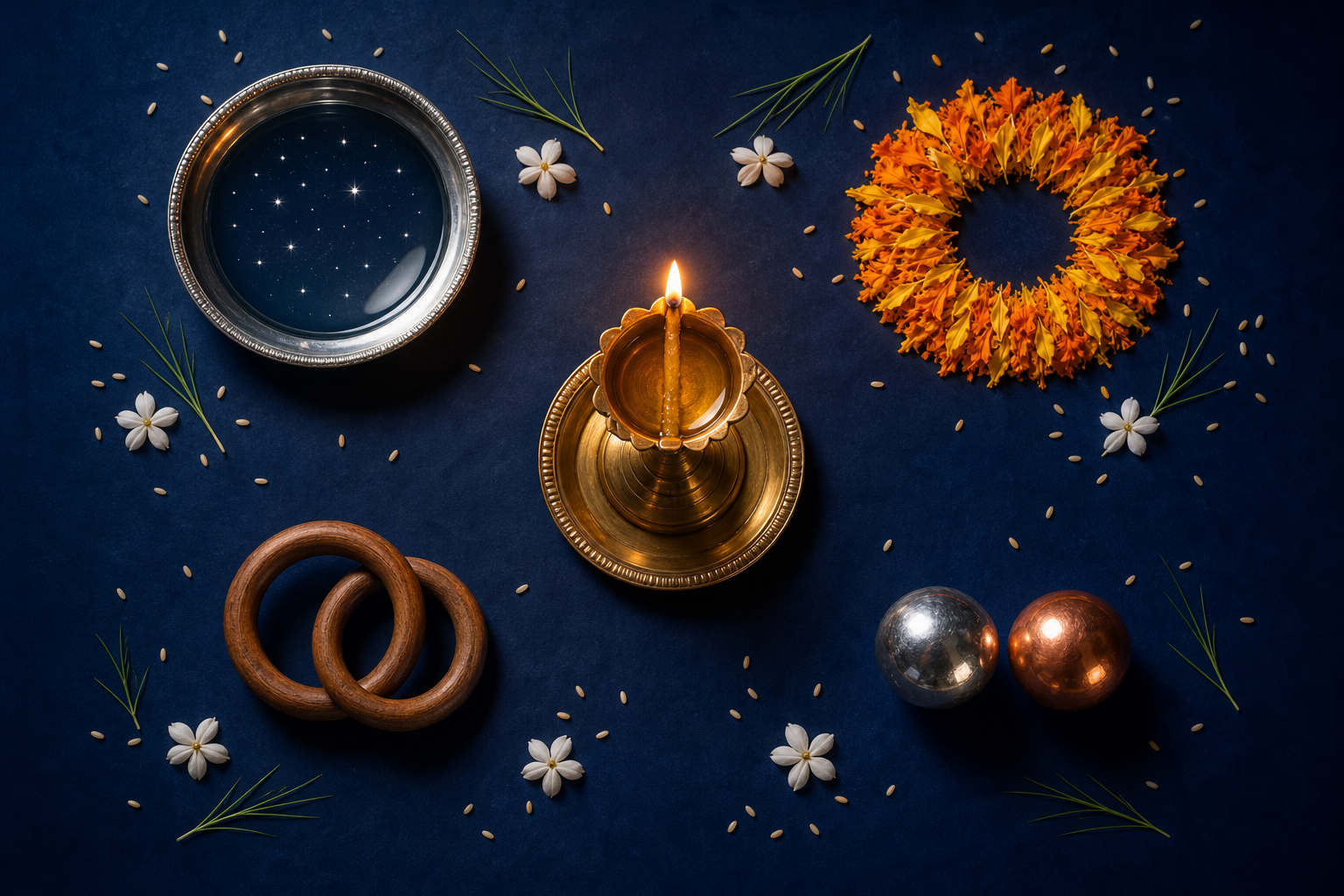
Tithi tells you only one part of the day. The remaining panchang limbs can change at different times, which is why a bare statement such as “May 7 is auspicious” is too broad for an important ceremony. Each layer answers a different planning question.
| Layer | Astronomical basis | How it refines the decision |
|---|---|---|
| Nakshatra | The Moon’s position among 27 lunar sectors | Helps assess whether the lunar mansion suits the intended kind of activity |
| Yoga | The combined solar and lunar longitudes in a 27-part cycle | Adds another quality to the day’s working conditions |
| Karana | One half of a tithi | Narrows suitability within the Panchami or Sashti period itself |
| Moon Rashi | The zodiac sign occupied by the Moon | Adds short-term lunar context and may matter in regional selection systems |
An exact Nakshatra or Rashi name should not be guessed from the civil date alone. Ask the local panchang for the name active at your intended time and for any transition occurring during the planned rite. Do the same for Yoga and Karana. A transition that happens after your ceremony is irrelevant to its start; one that cuts through the ceremony may require you to select a cleaner interval.
Your regional calendar may also use Choghadiya, Tarabalam, or another family-specific framework. These do not replace the five basic panchang limbs; they add another filter. For a major ceremony, decide which system governs before comparing times. Mixing the most favourable fragment from several traditions can create the appearance of precision without a coherent rule behind it.
Do not be alarmed if two calendars use different month names. North Indian Purnimanta and South Indian Amanta conventions can label the surrounding lunar month differently while preserving the same Krishna Paksha Panchami-to-Sashti sequence. May 2026 may also be identified as Vikram Samvat 2083 or Shaka Samvat 1948. When comparing calendars, match the locality, paksha, tithi, and transition time before treating a difference in the month label as a contradiction.
For ordinary home worship, you can now make a sensible provisional plan: mark 6:51 AM as the Panchami-Sashti boundary, place contemplative worship before it, and reserve the later day for Sashti and Guruvara practices. Before confirming a significant rite, replace every provisional time with the calculation for your city and keep the ceremony comfortably inside the chosen window.