
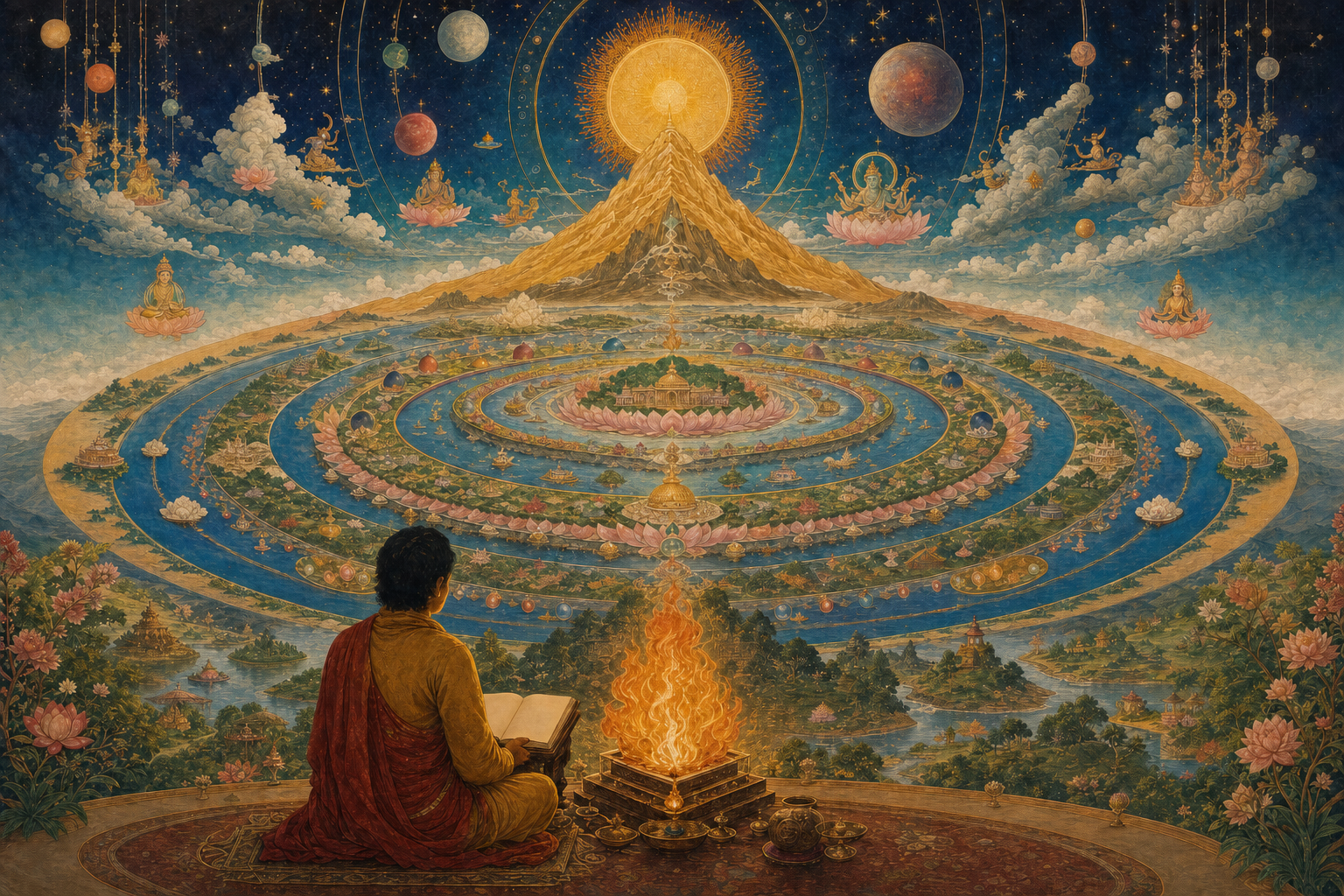
You open a Purāṇa and encounter a jeweled island beyond the fourteen lokas. Then you turn to a Vedic hymn in which crimson radiance appears as earthly fire, the sun, creative power, and cosmic order. What kind of truth are you being asked to receive: geography, theology, ritual instruction, meditation, or poetry?
The strongest reading does not force you to pick only one. Hindu sacred cosmology often connects several levels of reality through a single image. Your task is to identify those connections without reducing the image to modern astronomy, dismissing it as decorative myth, or turning a traditional symbol into whatever you want it to mean.
A sacred map works on several registers

A modern map usually answers one question: where is something located? A sacred map may also ask what sustains a realm, what principle it embodies, how it is approached in worship, and what transformation makes it accessible. Place, deity, ritual, philosophy, and consciousness can therefore occupy the same cosmological design.
| Register | Question to ask | What to notice | What you should do |
|---|---|---|---|
| Cosmic | How is reality arranged? | Worlds, oceans, directions, cities, enclosures, suns, fires, and centers | Sketch the arrangement before interpreting it. |
| Ritual | How does a worshipper participate in that arrangement? | Altars, offerings, mantra, yantra, sacred speech, and prescribed movement | Find the practice that constrains the meaning of the image. |
| Philosophical | Which powers or principles does the arrangement express? | Consciousness, Śakti, tattvas, prāṇa, creative heat, light, and ṛta | Translate objects into functions only where the tradition supports the correspondence. |
| Contemplative and ethical | What must change in the person approaching the sacred center? | Attention, discernment, speech, conduct, order, devotion, and freedom from fragmentation | Form one disciplined application without pretending that your application exhausts the text. |
These registers are related, but they are not interchangeable. A city of the Goddess does not cease to be an object of devotion because its walls correspond to philosophical principles. Fire does not cease to be ritual fire because it also reveals solar and cosmic power. The outer form carries the inner meaning; it is not disposable packaging.
This distinction also explains why Hindu scripture does not behave like one standardized atlas. A luminous Vedic power, a Purāṇic world, and a Śrīvidyā maṇḍala can disclose cosmic order through different forms. Apparent difference is not automatically contradiction. Before trying to harmonize two descriptions, ask whether they are even organizing the same dimension of reality.
A repeatable way to read any cosmic image

You can make a difficult cosmological passage much clearer by reading it in a fixed sequence. This method works especially well when a passage moves quickly among places, deities, ritual actions, and metaphysical claims.
- Name the textual and theological setting. Record whether you are reading a Vedic hymn, a Purāṇic cosmography, or a later ritual and contemplative tradition. Do not move a Śrīvidyā interpretation into a Vedic hymn without identifying it as a later comparison.
- Inventory the visible images. Write down the actual nouns before assigning meanings: island, ocean, wall, city, palace, point, sun, fire, breath, support, or throne. This prevents an attractive interpretation from erasing what is present.
- Mark the relationships. Words such as beyond, within, around, at the center, supported by, and identical with often matter more than the objects themselves. Sacred cosmology is carried by relationships.
- Separate explicit correspondence from personal reflection. If a tradition links a set of enclosures to tattvas or links earthly fire with solar fire, you have a grounded correspondence. If a jeweled wall reminds you of emotional resilience, that may be useful contemplation, but it is not automatically a scriptural doctrine.
- Locate human participation. Ask how the cosmology enters embodied life. It may be enacted through an altar, worship, sacred speech, visualization, ethical order, or the disciplined direction of attention.
- State the smallest defensible conclusion. Prefer a precise claim such as, “This image joins terrestrial and celestial fire,” over a sweeping claim such as, “All Hindu deities are symbols of the same thing.” Precision protects the integrity of each tradition.
- Choose one application and label it honestly. A contemplative application can guide your conduct without being presented as the only meaning of the passage. If you cannot establish a symbolic connection from the tradition, call it your reflection rather than a settled teaching.
Three labels can keep your notes honest: explicit, traditional, and reflective. Use explicit for what the passage directly presents, traditional for a correspondence supplied by its interpretive or ritual setting, and reflective for your own application. That small discipline prevents most overreading.
Keep important Sanskrit terms visible until you understand their role. Translating loka only as a physical planet, tattva only as an object, ṛta only as a rule, or bindu only as a dot can make the English look simple while removing the idea that gives the cosmology its structure. A short working gloss is useful; a premature replacement is not.
Two worked readings show the method in action

Manidweepa: sacred geography that becomes inward pilgrimage
Begin with the stated geography. Manidweepa is a jeweled island situated in the Ocean of Nectar and placed beyond the fourteen lokas. At its heart stands Śrī Nagara, the city of the Goddess, with the Chintāmaṇi residence at the sacred center. The remoteness of the island establishes transcendence: this is not merely another district inside ordinary conditioned existence.
Now mark the organizing relationships. The island contains a city; the city is approached through enclosing structures; the center contains the presence of Tripurā Sundarī with Kāmeśvara. The image therefore directs attention from circumference to center, from multiplicity to unity, and from manifested power to the indivisibility of Śakti and Śiva.
The traditional correspondences prevent arbitrary symbolism. Some accounts emphasize twenty-five fortifications associated with the twenty-five Sāṃkhya tattvas. Śrīcakra-oriented interpretation instead foregrounds nine enclosures, or āvaraṇas. These enumerations should not be casually fused into one count. They are distinct ways of disclosing the ordered passage from manifest plurality toward the sacred center.
The ninefold sequence is Trailokya-mohana, Sarvāśā-paripūraka, Sarva-saṃkṣobhaṇa, Sarva-saubhāgyadā, Sarvārtha-sādhaka, Sarva-rakṣākara, Sarva-rogahara, Sarva-siddhipradā, and Sarvānandamayā. If you are studying a Śrīcakra illustration, first verify the order of its enclosures. Then follow the movement toward the bindu, where the graded journey reaches nondual awareness. This is more reliable than assigning a spontaneous psychological meaning to each circuit.
The central Chintāmaṇi residence also corrects a common misreading. Wish fulfillment here should not be flattened into the promise of unrestricted consumption. At the center, the Goddess grants wisdom, and the Pañcabrāhmāsana places the five Brahmas beneath Her sovereignty. Brahmā, Viṣṇu, Rudra, Īśvara, and Sadāśiva signify modalities of manifestation resting in the Supreme Śakti.
Ritual gives the cosmology an enacted form. The Śrīcakra, its nine āvaraṇas, mantra, nyāsa, offering, and Navāvaraṇa pūjā align the worshipper’s subtle embodiment with cosmic order. The surrounding Vāgdevīs, sixteen Nityās, sixty-four Yoginīs, and directional guardians are not ornamental population. They establish protected and initiatory circles of sacred power, speech, rhythm, and insight.
This is also where a practical boundary matters. Pañcadaśī and Ṣoḍaśī mantra practice, technical nyāsa, and the full Navāvaraṇa procedure belong within qualified initiation and lineage instruction. You can study the public cosmological structure, contemplate the movement from dispersion toward the bindu, and approach the Goddess with ordinary devotion. Do not improvise a lineage-bound ritual from a diagram and a list of names.
A sound personal application stays modest: notice where your attention is scattered, gather it through successive layers of responsibility, and act from a steadier center. That use reflects Manidweepa’s contemplative movement, but it does not replace the island’s theological, devotional, or ritual reality.
Rohita: cosmology expressed as light, fire, and order
Rohita requires a different kind of map. In Book 13 of the Atharva Veda, the crimson power of dawn and dusk gathers Agni, Sūrya, Savitar, and Prajāpati into a unifying luminous principle. Instead of moving through walls toward a palace, you trace one power across several manifestations.
Start with the visible sign: redness at the threshold between darkness and daylight. Its function is emergence. The hue evokes tejas, creative potency, and the disclosure of a world becoming perceptible. Crimson therefore does more than identify Rohita’s appearance; it tells you how the power acts.
Next, follow the relation between earthly and celestial fire. Agni burns at the altar and carries sacrifice. Sūrya shines in the sky, orders time, and sustains life. Rohita connects them as expressions of one current. The ritual flame is therefore neither identical to an ordinary combustion event nor detached from the visible world. It is the terrestrial point at which a larger cosmic power becomes participatory.
Ṛta supplies the ethical and cosmological test. Light discloses pattern, while order makes life and right action possible. The regularity of days and seasons, the integrity of speech and rite, and the legitimacy of sovereign power belong to one grammar of alignment. Strength that departs from ṛta does not become sacred merely because it is strong.
Nearby Atharvan visions keep this luminous account from becoming an exclusive formula. Skambha in Book 10 presents cosmic support, while prāṇa in Book 11 presents pervasive life-breath. Rohita in Book 13 presents light, heat, and order. You do not have to make support, breath, and crimson radiance into competing substances. They are different apertures through which pervasive reality can be contemplated.
A later Sāṃkhya association between red and rajas can help you notice activity, becoming, and transformation, but chronology must remain visible. The comparison is a later philosophical resonance, not proof that the Atharvan hymn was secretly teaching the completed Sāṃkhya system. This distinction lets a later framework illuminate an earlier image without claiming ownership of it.
For personal contemplation, picture the first crimson light as a demand for intelligibility: see clearly, speak truthfully, and bring action into order. That is an application of Rohita’s luminous grammar. It should lead to a definite correction in conduct, not merely appreciation of a beautiful sunrise.
Manidweepa and Rohita thus train different faculties. Manidweepa offers sacred architecture and a movement toward the center. Rohita offers a dynamic identity among light, fire, creative power, and order. One is spatial and mandalic; the other is luminous and processual. Their common value lies in showing how visible form, divine power, ritual participation, and inner understanding can meet without erasing their distinctions.
Mistakes that make sacred cosmology unreadable

- Demanding modern astronomy from every sacred location. A cosmography can make a real theological or ontological claim without supplying modern measurements. Do not convert lokas, oceans, and divine cities into physical coordinates unless the material itself gives you a defensible basis for doing so.
- Calling everything merely metaphorical. Manidweepa is worshipped as the abode of the Goddess, while its geometry is embodied in Śrīcakra practice. Rohita is invoked through a Vedic theology of fire, solar radiance, creation, and order. Psychological usefulness does not cancel devotional or ritual reality.
- Forcing every enumeration into one blueprint. The twenty-five Sāṃkhya-related fortifications and the nine Śrīcakra enclosures disclose different patterns. Preserve the interpretive system attached to each number before asking how the patterns may relate.
- Reading later ideas back into earlier texts without a label. A later concept may clarify a family resemblance, but resemblance is not textual identity. Use phrases such as later resonance or subsequent interpretation when chronology matters.
- Assuming comparison means doctrinal sameness. Buddhist Pure Lands, Jain Jambūdvīpa, Sikh recognition of Ik Onkar, and Hindu sacred realms may share a dharmic concern with accessible and transformative reality. Their deities, metaphysics, practices, and accounts of liberation remain distinct.
- Collecting symbols without accepting their discipline. A center, flame, mantra, or sacred diagram is not a spiritual accessory. Ask what order of attention, speech, worship, or conduct the symbol demands from you.
When you are unsure whether an interpretation is strong, test it with a few direct questions:
- Does it explain why this particular image appears, rather than substituting a generic spiritual meaning?
- Does it preserve the passage’s textual, sectarian, and ritual setting?
- Does it account for relationships such as center and circumference, earth and sky, or manifestation and source?
- Does it distinguish an explicit teaching from a later interpretation and from your personal reflection?
- Does it produce disciplined attention or conduct without claiming more authority than the passage supports?
If your reading cannot pass those tests, narrow the claim. Sacred cosmology becomes clearer when you resist the urge to solve the entire Hindu universe from one image.
Key takeaways
- Read a sacred cosmology as cosmic arrangement, ritual field, philosophical teaching, and contemplative discipline before deciding that only one register is real.
- Interpret relationships before isolated objects. Beyond, within, around, at the center, and identified with are often the decisive clues.
- Keep explicit correspondence, traditional commentary, and personal reflection in separate categories.
- Preserve differences among Vedic, Purāṇic, philosophical, and Śrīvidyā settings; do not manufacture agreement by removing context.
- Use Manidweepa to study ordered movement from manifestation toward the bindu, and Rohita to study one luminous power across fire, sun, creation, and ṛta.
- Respect initiation boundaries. Public study and modest contemplation do not authorize improvised mantra, nyāsa, or advanced ritual.
- Let the interpretation reach conduct. A cosmology of centered awareness should reduce fragmentation; a cosmology of light and order should make your speech and action more truthful and reliable.
Choose one cosmic image the next time you read scripture. Make a single-page record with four fields: the image, its relationships, its tradition-supported meaning, and one honest implication for practice. Leave a field blank when you do not know. That blank is an invitation to study further, not permission to invent.
References
- DharmaRenaissance Blog — Manidweepa Unveiled: Inside the Jeweled Island of the Mother Goddess and Cosmic Consciousness
- DharmaRenaissance Blog — Rohita in the Atharva Veda: The Crimson Sun-Fire as Supreme Principle of Creation and Order