
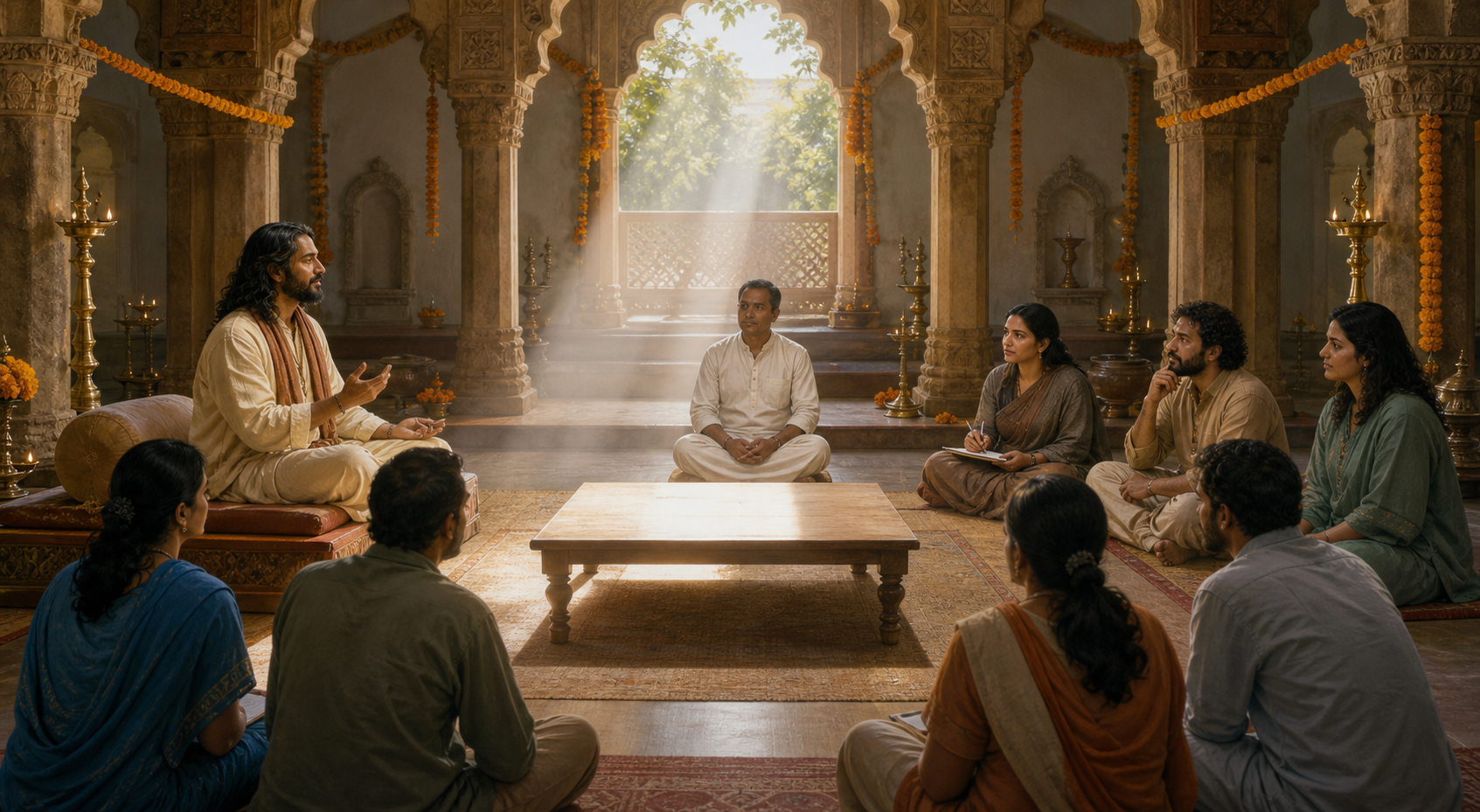
You may be a devotee troubled by mockery, a skeptic wary of manipulation, or simply someone who watched a darbar clip and cannot tell what it establishes. You do not have to choose between instant belief and instant ridicule. A serious public claim deserves serious attention, and every person in a sacred setting deserves dignity.
The question became especially concrete when Dhirendra Krishna Shastri invited critics to attend the Bageshwar Dham darbar and witness what he describes as divine knowledge. An invitation is not evidence by itself, but it creates an opportunity for a better kind of public inquiry: define what is being claimed, observe it fairly, protect the participants, and draw no conclusion stronger than the evidence allows.
Define the claim before deciding whether it succeeded

The phrase divine knowledge can refer to several very different things. It may mean knowledge of an external fact, insight into a person’s inner condition, spiritual guidance, a statement about karma, or a prediction. Those claims cannot be evaluated by the same method.
Begin with the narrowest possible question: What exactly does the claimant say is happening? If nobody can state that in one sentence before the encounter begins, nobody will be able to tell afterward whether the claim was supported. A moving experience may still occur, but it should not be confused with a defined demonstration.
| Type of claim | What can be examined | What remains limited |
|---|---|---|
| Present or past external fact | Whether a specific statement was recorded before feedback and independently corroborated | Accuracy alone does not identify how the information was obtained |
| Private memory or inner state | Whether the participant recognizes a precise description and whether any external corroboration exists | Personal resonance is meaningful to the participant but may not be independently verifiable |
| Future event | Whether a definite event occurs by a stated deadline under conditions fixed in advance | Open-ended or symbolic predictions can be reinterpreted indefinitely and therefore establish little |
| Karmic or spiritual condition | Coherence with the tradition, the quality of counsel, and its ethical effects | Such a judgment is usually outside short-term public verification |
| Practical spiritual outcome | Whether conduct, relationships, distress, harmful habits, or service change over time | A beneficial outcome does not by itself prove extraordinary cognition |
This distinction prevents a common category error. If the claim is that people receive comfort and useful counsel, follow-up with the people who received it is relevant. If the claim is that precise facts were known without an ordinary information channel, comfort is not the test. Information access, timing, specificity, accuracy, and repetition are.
Before an event, put the following on a one-page claim card:
- The exact claim, written without devotional praise or skeptical accusation.
- Whether the statement is meant literally, symbolically, spiritually, or as practical advice.
- Which ordinary information channels are permitted and which are supposed to be absent.
- What will count as an exact match, a partial match, an error, or an unverifiable statement.
- How the result will be corroborated without exposing private information.
- Which conclusion the observation could support, and which larger conclusions it could not support.
An ordinary darbar can show you that an encounter occurred and that it affected a participant. It does not automatically isolate the cause. A controlled demonstration is needed only when the public claim concerns the mechanism itself, such as acquiring specific information without normal access. Saying which kind of encounter you witnessed is already a major improvement in clarity.
Use Dharmic epistemology as a method, not an exemption
Dharmic traditions do not require you to abandon disciplined inquiry at the temple door. Hindu philosophical schools repeatedly work with pratyaksha, anumana, and shabda: direct perception, inference, and authoritative testimony. Some also recognize specialized forms of cognition associated with contemplative discipline or immediate realization. Recognizing such a category as possible, however, is not the same as certifying every particular claim made in its name.
Pratyaksha asks what you actually observed. Did the claimant write a detailed fact before the participant spoke, or did the detail emerge through conversation? Did you see the entire selection process, or only the striking final exchange? Your interpretation is not itself direct perception. Keep the sequence separate from the meaning you assign to it.
Anumana asks what reasonably follows. List ordinary possibilities before reaching for an extraordinary one: information supplied during registration, publicly available biographical details, verbal or non-verbal cues, broad statements that fit many people, or details added after feedback. This does not prove that any such route was used. It identifies alternatives that a fair test must control or document.
Shabda gives testimony an important place, but not the place of an intellectual blank cheque. A guru, acharya, scripture, lineage, participant, and community may all provide testimony of different kinds. Within a responsible Hindu framework, authority is weighed alongside dharma, reason, character, context, and the kind of knowledge being conveyed. Testimony can justify trust without turning every externally verifiable statement into something beyond examination.
The allied Dharmic traditions add useful disciplines without becoming interchangeable. Buddhist reasoning generally gives special weight to direct observation and inference while asking whether a practice produces compassionate consequences. Jain Anekantavada and Syadvada train you to qualify a conclusion by standpoint and conditions. Anekantavada does not mean that every contradictory account is equally correct; it warns against mistaking a partial view for the whole. Sikh thought directs attention toward the Shabad Guru, rehat, sangat, seva, and the overcoming of ego. In that register, knowledge matters most when it ennobles conduct and serves others.
You can combine these insights in four moves: describe what was directly observed, test the inferences, place testimony in its proper context, and examine the ethical fruit. This is unity in spiritual diversity as a working method rather than a slogan.
Keep two judgments separate throughout. One concerns factual performance: was specific information stated accurately under documented conditions? The other concerns spiritual worth: did the encounter cultivate truthfulness, courage, compassion, restraint, reconciliation, or seva? Ethical fruit can make a practice spiritually meaningful without proving an extraordinary mechanism. Conversely, one surprising factual performance does not establish liberation, moral authority, or the truth of every teaching associated with the performer.
Build a fair observation that protects the participant

A useful public examination does not begin by trying to catch someone. It begins by making the conditions clear enough that supporters, critics, and neutral observers can later agree about what happened. The following protocol is suitable for a factual claim made at a darbar or similar public setting.
- Write the target claim in one sentence. Specify whether you are examining factual accuracy, an asserted information barrier, a prediction, or a pastoral outcome. Do not combine all four.
- Obtain consent privately. A neutral coordinator should explain what will be recorded, who will see it, what may be published, and how identifying details will be redacted. Declining participation must carry no public humiliation or spiritual penalty.
- Document possible information channels. Record registration questions, prior contact, conversations with volunteers, publicly available information, and what organizers knew. If the claim requires no prior access, a neutral coordinator can handle consent and participant selection without transmitting personal details.
- Freeze the statement before feedback. A written note, timestamped entry, or continuous recording should preserve the claimant’s words before the participant confirms, rejects, explains, or supplies additional information.
- Separate pre-feedback and post-feedback details. Dialogue may be an authentic part of a darbar, but facts introduced after a participant’s response cannot be counted as if they were stated beforehand.
- Verify without forcing disclosure. Public facts can be checked openly. Sensitive facts should be examined by a trusted neutral verifier who can report whether a match exists without revealing the underlying trauma, diagnosis, family conflict, or other private matter.
- Keep the complete record. Log exact statements, partial matches, errors, vague statements, unverifiable items, and ethically withdrawn cases. A compilation containing only successes cannot show the overall pattern.
- Repeat under the same rules. Multiple independent observers should keep their own notes before discussing interpretations. Repetition helps distinguish a stable result from an isolated occurrence, misunderstanding, or coincidence.
The dignity of devotees is a boundary, not an inconvenience. Consent, privacy, non-harm, independent notes, a defined scope, and time-bounded observation make the inquiry more trustworthy. No result is worth coercing a vulnerable person into revealing grief, illness, abuse, debt, family conflict, or an alleged offence before a crowd.
Some proposed tests should not proceed at all. Stop when verification would expose a child or another vulnerable person, turn a sacred rite into an instrument of humiliation, pressure someone to disclose a deeply private event, or require an immediate irreversible decision. A neutral inquiry can protect confidentiality; a public spectacle cannot restore it once it has been lost.
Extra care is necessary when a pronouncement concerns medical or psychological treatment, a legal allegation, marriage, property, or money. Do not stop treatment, transfer funds, accuse another person, or make another high-consequence decision solely because of a spiritual claim. Preserve the spiritual counsel if it matters to you, but independently consult the qualified medical, mental-health, legal, or financial professional appropriate to the decision.
Control the ways sincere observers can misread an event

You do not need to accuse anyone of dishonesty to recognize that audiences can misjudge what they see. Confirmation bias, expectancy effects, the Barnum-Forer effect, and selective attention can influence devotees and skeptics alike.
Confirmation bias encourages you to preserve the matches and explain away the misses. Expectancy can cause a participant to offer cues, search harder for a fit, or remember the encounter in a way that matches prior hope or suspicion. The Barnum-Forer effect makes a broad statement feel uniquely personal even when it could apply to many people. Selective attention leaves the dramatic moment vivid while routine inaccuracies disappear from memory.
Counter these tendencies with a coding rule fixed before observation:
- Exact: the statement identifies one reasonably clear fact and independent verification confirms it without substantial reinterpretation.
- Partial: some elements match, while other elements are missing, wrong, or require interpretation.
- Vague: the statement could fit many people or circumstances.
- Incorrect: the definite statement conflicts with the available verification.
- Unverifiable: the necessary evidence is unavailable, unsafe to disclose, or inherently private.
Do not promote a partial match to an exact one after hearing the explanation. Do not count an unverifiable statement as either success or failure. Record the claimant’s complete wording rather than extracting a favorable fragment. If observers disagree, preserve both codings and the reason for the disagreement instead of forcing consensus.
Media framing adds another layer. A viral clip may omit selection, prior conversation, misses, verification, and the surrounding pastoral exchange. Before treating one as proof or exposure, ask whether you can see the uninterrupted beginning and end, how the participant entered the event, who possessed personal information, and whether all comparable cases were released.
A clip can justify curiosity. It usually cannot settle a mechanism. Supporters should be willing to preserve the full context of a strong result, while critics should avoid inferring deliberate deception merely because a short recording leaves questions unanswered. Missing evidence warrants an unresolved verdict, not a story invented to fill the gap.
State a narrow verdict, then examine the ethical wake

A fair inquiry rarely ends with the sweeping words proved or disproved. Use one of four narrower conclusions:
- Supported under the documented conditions: the defined result occurred, and the specified ordinary information routes were adequately controlled.
- Not supported in this observation: the result failed the criteria fixed beforehand.
- Inconclusive: recording, information control, verification, consent, or sample completeness was inadequate.
- Outside the testable scope: the claim concerns personal spiritual meaning, karma, or another matter the chosen method cannot adjudicate.
Even the first verdict supports only a limited proposition: a claimant produced specified accurate information under specified conditions. Further reasoning is needed before assigning a divine, yogic, psychological, informational, or other mechanism. A failed demonstration does not disprove Dharma, spiritual realization, grace, or every experience reported by devotees. It shows that one defined claim was not supported under one documented set of conditions.
After the factual verdict, ask what the practice does in people’s lives. Reduced distress, movement away from harmful habits, family reconciliation, charitable action, and greater civic responsibility are relevant signs of constructive spiritual work. Also watch for the contrary effects: fear, dependency, humiliation, isolation from responsible counsel, the inflation of a leader’s ego, or hostility toward honest questions.
Outcome assessment also needs restraint. A participant’s relief may be sincere even when an extraordinary factual claim remains unresolved. Relief deserves respect, but it should not be used to silence examination. Likewise, a critic’s unanswered methodological question may be valid without nullifying the participant’s spiritual experience. Two things can be true on different levels.
Key takeaways
- Replace the broad phrase divine knowledge with one precise, testable claim before observing anything.
- Distinguish an ordinary darbar encounter from a controlled demonstration of information obtained without normal access.
- Record the full statement before participant feedback and preserve every case, not only striking successes.
- Use pratyaksha, anumana, and responsible shabda together: observe accurately, reason through alternatives, and weigh testimony in context.
- Protect consent and privacy even when doing so leaves a claim unverifiable.
- Judge factual accuracy and ethical or spiritual benefit separately.
- Report a narrow verdict tied to the conditions instead of declaring either universal proof or universal fraud.
Before sharing the next darbar clip, write down what you think it demonstrates and what evidence would change your mind. If you attend in person, carry the one-page claim card, ask whether a continuous record and privacy process exist, and distinguish what you saw from what you inferred. If the conditions are insufficient, call the encounter testimony rather than proof. That small discipline allows public scrutiny to strengthen a Dharmic culture of truth-seeking without turning devotees, teachers, or critics into targets of contempt.