
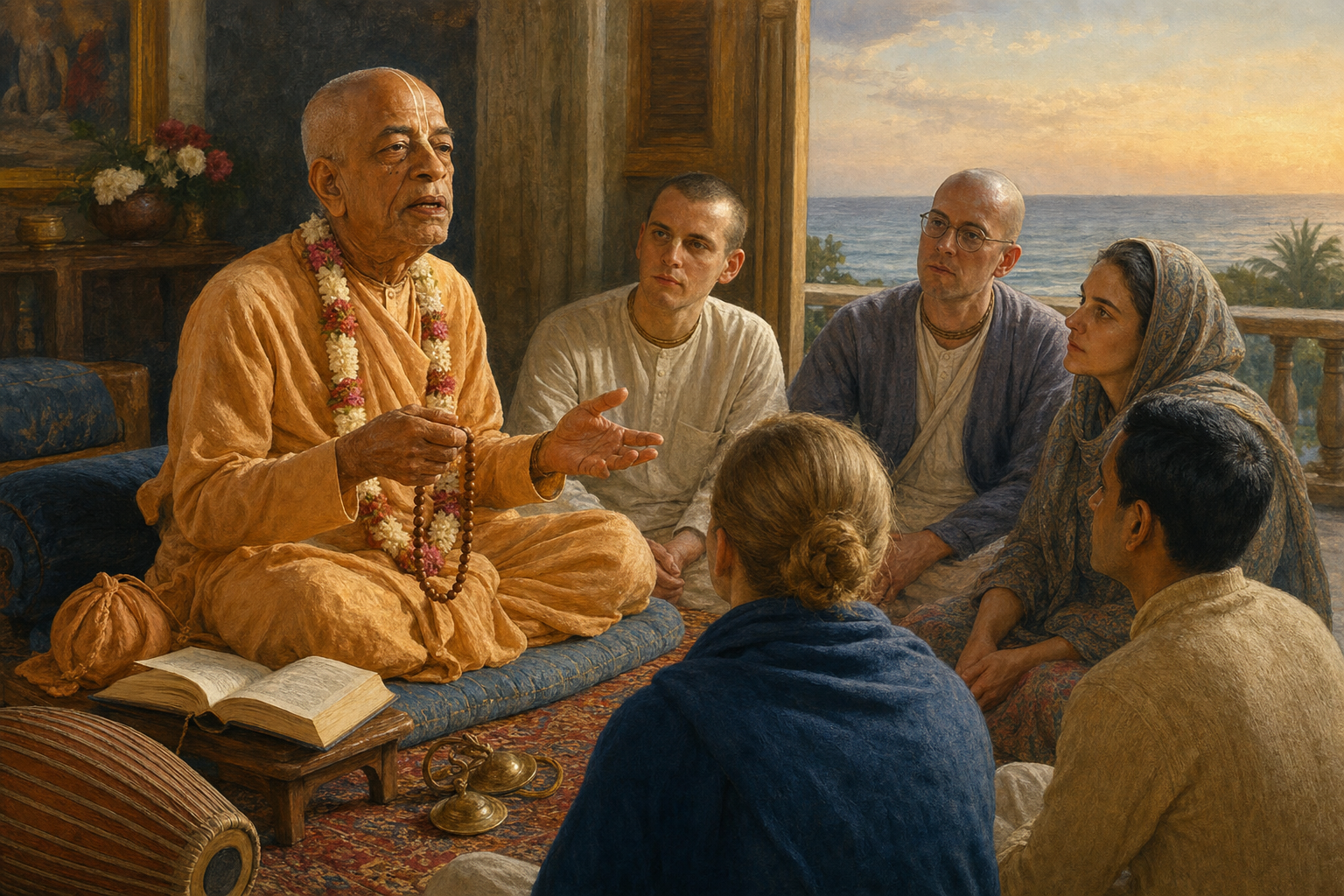
If Srila Prabhupada reached you through a few famous episodes, a shelf of books, or stories told in a temple room, you may be wondering how to hold it all together. How do you revere an acharya without turning his life into unexamined legend? How do you examine a memory without draining it of devotional meaning?
You do not have to choose between devotion and historical care. Evidence protects memory from distortion; sacred memory helps you notice the character, purpose, and devotional mood that a bare chronology cannot carry. Used together, they show you how one Gaudiya Vaishnava life became a global mission – and what part of that legacy you can responsibly carry forward.
Key takeaways
- Read Srila Prabhupada’s famous milestones as one sequence: formation, fidelity to guru, sustained preparation, courageous action, and institution-building.
- Treat personal recollections as valuable testimony, but label the difference between a documented event, a direct memory, a later retelling, and a devotional interpretation.
- Test every proposed adaptation by two standards: what Gaudiya principle it protects and what real obstacle to service it removes.
- Look for legacy not only in books and institutions but in the quality of chanting, teaching, hospitality, accountability, and care they make possible.
- Turn admiration into a durable rhythm of japa, scriptural study, aptitude-aligned seva, reflective writing, and satsang.
See one life, not a collection of heroic episodes
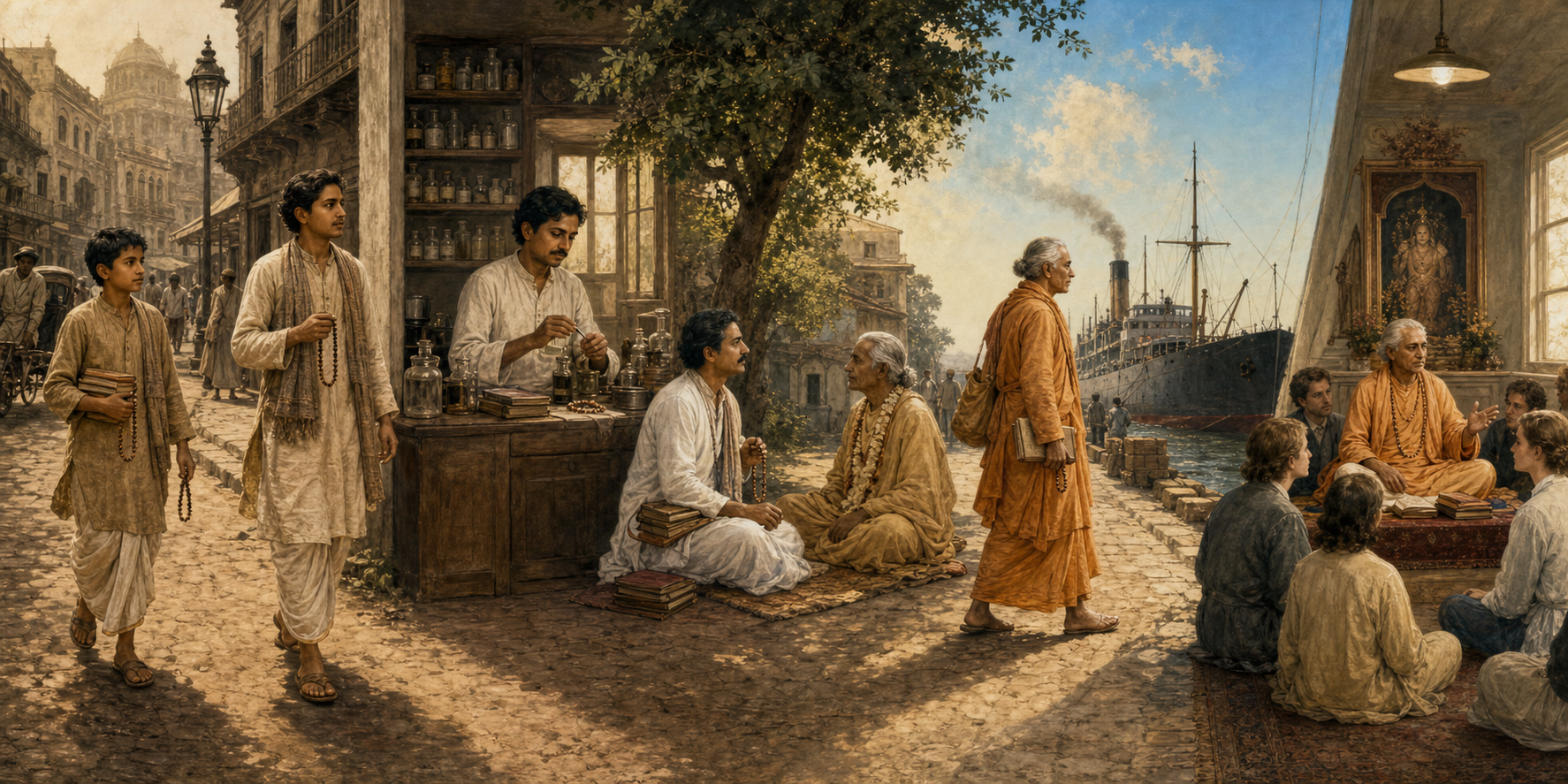
The voyage aboard the Jaladuta and the opening of the storefront at 26 Second Avenue are often remembered as dramatic beginnings. They make more sense, however, when you see the preparation behind them. Srila Prabhupada’s devotional upbringing, sustained response to his guru’s instruction, textual labor, transoceanic journey, and New York mission belong to a continuous line of service.
This changes the practical lesson. If you isolate the dramatic event, you may conclude that spiritual leadership means taking a spectacular risk. If you follow the whole sequence, the pattern is more demanding and more reproducible: receive an instruction carefully, form your character through sadhana, prepare for a long time without public recognition, act when service requires it, and build a structure that can outlast your own effort.
A devotional reading may recognize divine grace in the decisive moments. Historical attention can recognize planning, austerity, correspondence, translation, cooperation, and circumstance. Grace does not make preparation irrelevant, and preparation does not make grace unnecessary. Keeping both in view prevents two common errors: treating success as a miracle that no one can learn from, or treating a sacred mission as an ordinary exercise in organizational expansion.
Srila Prabhupada did not carry a vague spirituality from Bharat and repackage it for foreign consumption. He carried a lineage-specific Krishna bhakti grounded in guru-shishya parampara, nama-sankirtana, Bhagavad-Gita, Srimad Bhagavatam, disciplined practice, and service. His adaptability concerned how that inheritance could be communicated and supported in unfamiliar settings. The inherited center was not discarded to make the presentation easier.
When you encounter a memorable episode, ask three questions before drawing a lesson from it:
- What came before it? Look for the instruction, discipline, study, relationship, or preparation that made the action possible.
- What principle governed it? Identify the connection to shastra, guru, chanting, service, compassion, or protection of the mission.
- What came after it? Notice whether the act created a repeatable practice, trained other people, clarified teaching, or established an institution.
This method keeps you from imitating the surface of an acharya’s austerity while neglecting its purpose. You may never reproduce the Jaladuta voyage, nor should external hardship become a test of devotion. You can reproduce the inner sequence: fidelity, preparation, proportionate courage, and service made sustainable for others.
Let living memory answer to evidence without losing its warmth
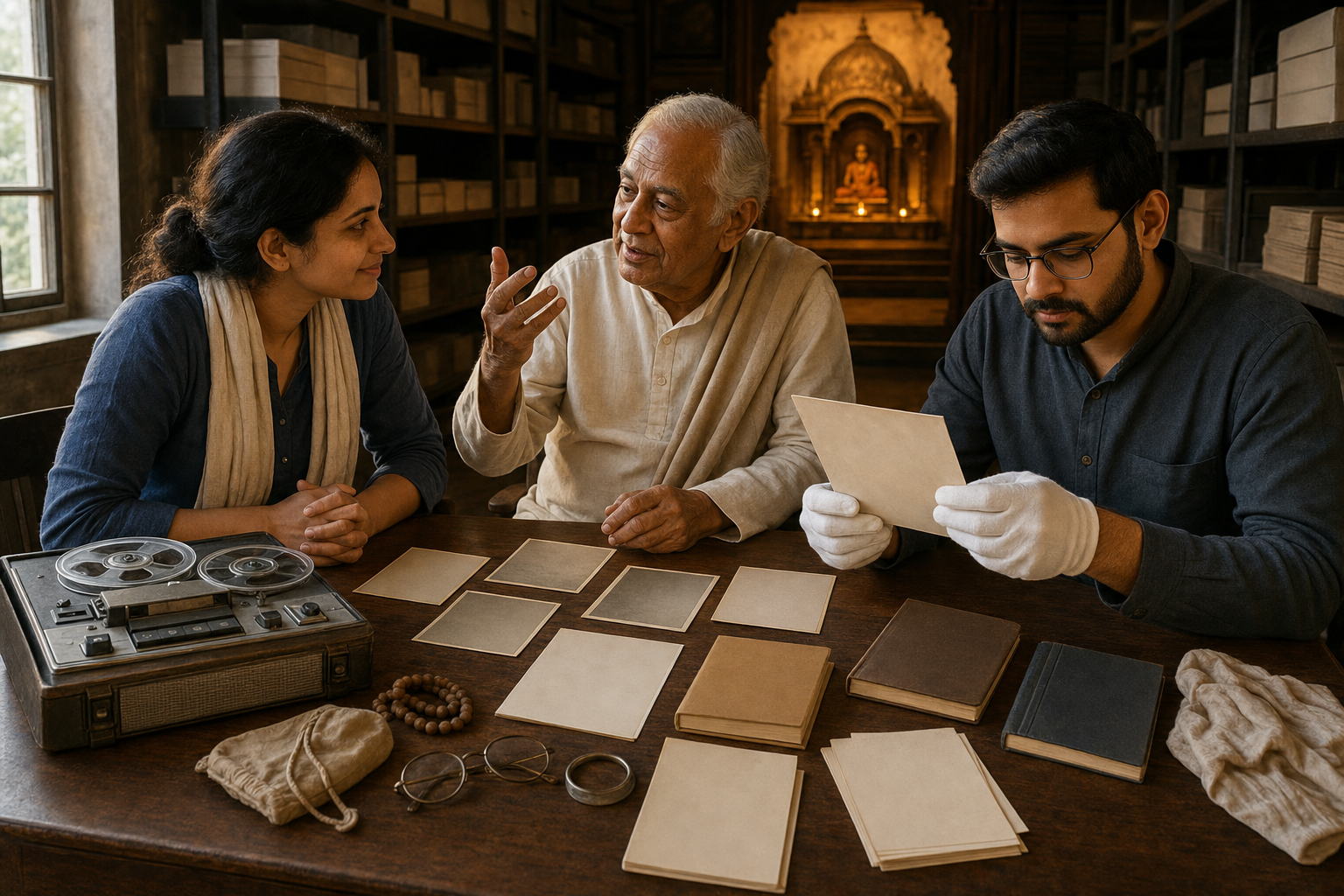
Within Gaudiya devotional culture, remembering an acharya’s conduct is not merely nostalgic. Smarana can turn philosophy into a visible choice: how a teacher corrected someone, protected a principle, encouraged service, or adjusted a presentation to meet an actual person. A remembered gesture may communicate devotional mood more effectively than an abstract rule.
Memory also has limits. A vivid recollection is not automatically an exact quotation. A private instruction may have addressed a particular person and circumstance rather than establishing a universal policy. A story repeated for decades may preserve its moral center while losing details. Respect for the speaker does not require you to erase these distinctions.
Satsvarupa dasa Goswami compiled the multi-volume Srila Prabhupada Lilamrita in the 1980s by drawing on letters, diaries, interviews, eyewitness testimony, and early institutional records. That combination offers a sound model for your own study: receive testimony with empathy, then compare it with material created close to the event.
Give every claim an evidence label
Keep four labels in your notes. They are not rankings of spiritual worth; they tell you what kind of conclusion the material can support.
- Documented event or instruction: a letter, diary entry, contemporaneous record, recording, or other dated material establishes the central fact.
- Direct recollection: the person telling the story identifies himself or herself as a participant or eyewitness. Record when the memory was preserved and whether the words are presented as exact or approximate.
- Corroborated recollection: independent witnesses or documentary records agree on the essential event, even if secondary details vary.
- Devotional interpretation: a teacher or community draws spiritual meaning from an event. Preserve that meaning as interpretation rather than quietly converting it into an additional historical fact.
For each anecdote, write down who witnessed the event, who first recorded it, where it occurred, and what can be dated. Separate the smallest factual core from the lesson being drawn. If an exact quotation matters, look for a recording, transcript, letter, or diary. If none is available, paraphrase honestly instead of placing polished words inside quotation marks.
Keep unresolved memories unresolved
When two sincere memories conflict, you do not have to select a winner immediately. Preserve the common core, record the disagreement, and look for contemporaneous evidence. Lack of corroboration does not prove that a recollection is false, but it does limit how confidently you can use it.
This restraint matters most when someone wants to turn an anecdote into a rule for other devotees. Ask whether the recollection agrees with Srila Prabhupada’s repeated public teaching, written instructions, and established Gaudiya principles. A disputed memory should not carry more authority than a clear and consistent body of instruction.
Historical care is therefore a form of seva. It protects the acharya from words casually placed in his mouth, protects the community from policy built on uncertain recollection, and protects future generations from inheriting confidence where the record warrants humility.
Use a Gaudiya test for continuity and change
Every global tradition faces the same practical pressure: new languages, technologies, social expectations, and institutional needs demand adaptation. The wrong response is to freeze every historical form as though it were doctrine. The opposite error is to call every novelty an adaptation while quietly abandoning the purpose of the lineage.
Srila Prabhupada’s example joins fidelity to parampara with pragmatic flexibility. A storefront, a publishing operation, a public feast, clear English exposition, and organized book distribution were means of carrying Krishna bhakti into new settings. Their legitimacy came from the service they performed, not merely from being new.
Apply the continuity test
Before defending a program, teaching method, media format, or organizational change as part of Prabhupada’s legacy, ask:
- Does it keep Sri Krishna and nama-sankirtana at the center, or does it make bhakti incidental?
- Can its central teaching be grounded in Bhagavad-Gita, Srimad Bhagavatam, and the Gaudiya parampara?
- Does it deepen hearing, chanting, remembrance, service, surrender, and Vaishnava character?
- Does it translate a principle for a new audience, or replace that principle with something easier to market?
- Does it help people approach sadhana freely and intelligently, or make an institution’s expansion the final measure of success?
- Can responsible teachers explain the change openly, including what remains non-negotiable?
A useful proposal should fit into two plain sentences: This change protects this Gaudiya principle. It removes this specific obstacle to hearing, chanting, learning, or serving. If the first sentence is vague, the change may be drifting from the lineage. If the second is vague, it may be novelty without a pastoral need.
This test also clarifies what fidelity is not. Fidelity is not copying every external circumstance of 1960s or 1970s outreach. Language, venue, teaching sequence, communication medium, and volunteer workflow may change. Nor is fidelity a license for harshness. Clarity joined to compassion is more faithful to a teaching mission than doctrinal vocabulary used without care for the person hearing it.
Find Dharmic unity without manufacturing sameness
Srila Prabhupada’s Gaudiya identity should be stated positively and precisely. That precision need not isolate Vaishnavas from the wider Dharmic family. Ahimsa in Jain traditions, naam-simran and langar in Sikh tradition, and contemplative discipline and compassion in Buddhist traditions offer recognizable points of ethical and practical resonance with chanting, prasadam distribution, self-restraint, and seva.
Resonance is not identity. Do not claim that distinct understandings of the self, the Divine, liberation, grace, or spiritual authority are interchangeable. Begin inter-tradition friendship with practices that can be understood honestly – non-harm, sacred remembrance, hospitality, disciplined conduct, and service – then name theological differences without hostility. Unity built on truth is stronger than unity built on blurred definitions.
Recognize institution-building as part of the spiritual legacy
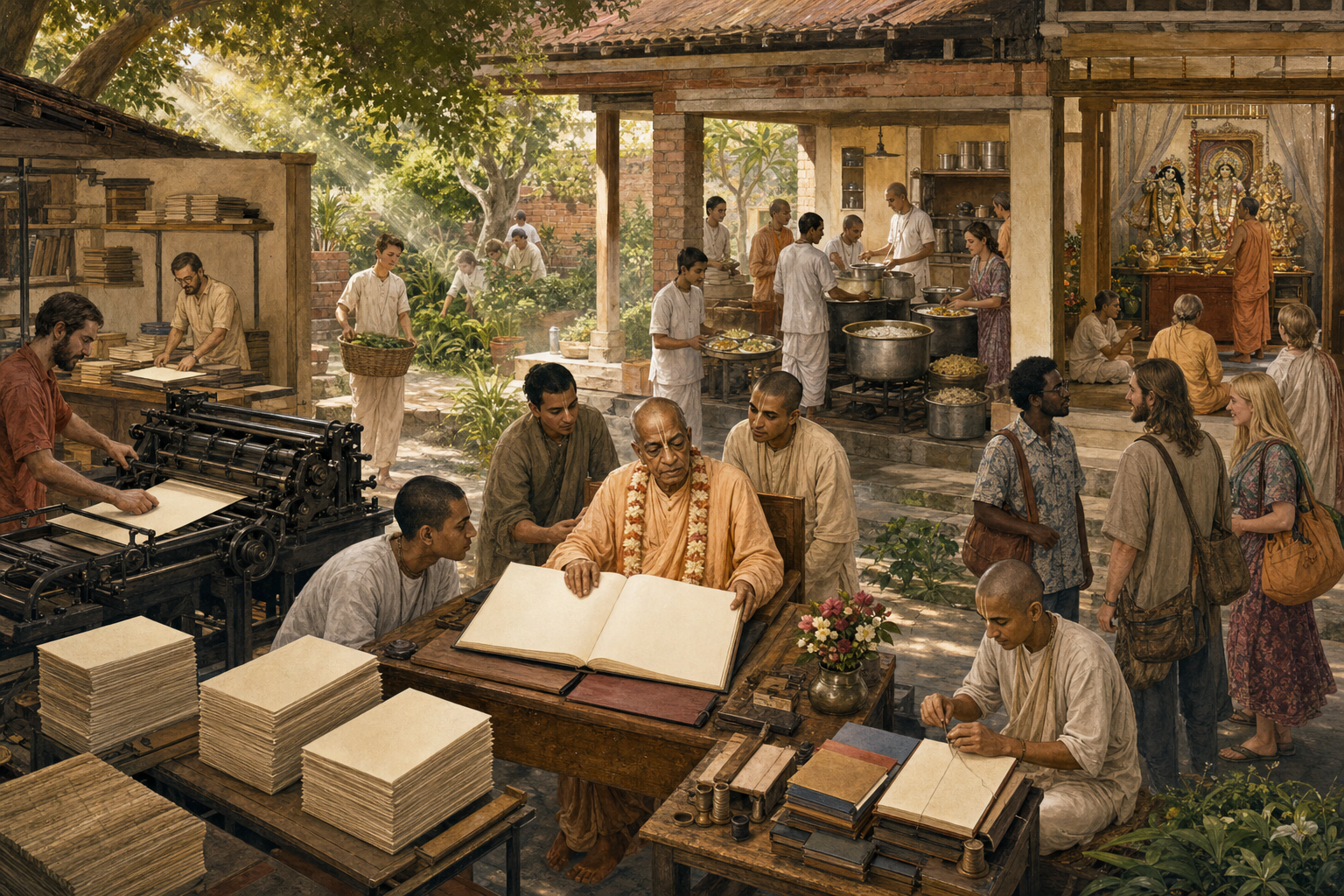
A movement cannot transmit memory by inspiration alone. It needs reliable ways to preserve teaching, train people, gather communities, distribute texts, correct mistakes, and care for newcomers. Srila Prabhupada’s founding of ISKCON, the development of institutional oversight in the early 1970s, and the establishment of the Bhaktivedanta Book Trust show how scriptural transmission was given durable organizational forms.
This does not make every institutional decision sacred or every structure permanent. It gives you a better criterion: an institution serves the legacy when it helps people hear, chant, study, remember, serve, and develop responsible relationships. When maintaining the machinery becomes more important than those purposes, the structure has begun to displace the service for which it was created.
Publishing makes the distinction visible. Book distribution is not simply the movement of inventory. Its spiritual purpose is to place carefully translated and explained teachings in a reader’s hands while protecting textual integrity. Production targets may help stewardship, but they cannot replace the questions that matter: Was the book represented honestly? Can the recipient understand what was offered? Is there a path to further study and association?
Audit the Sunday Feast as a living form of transmission
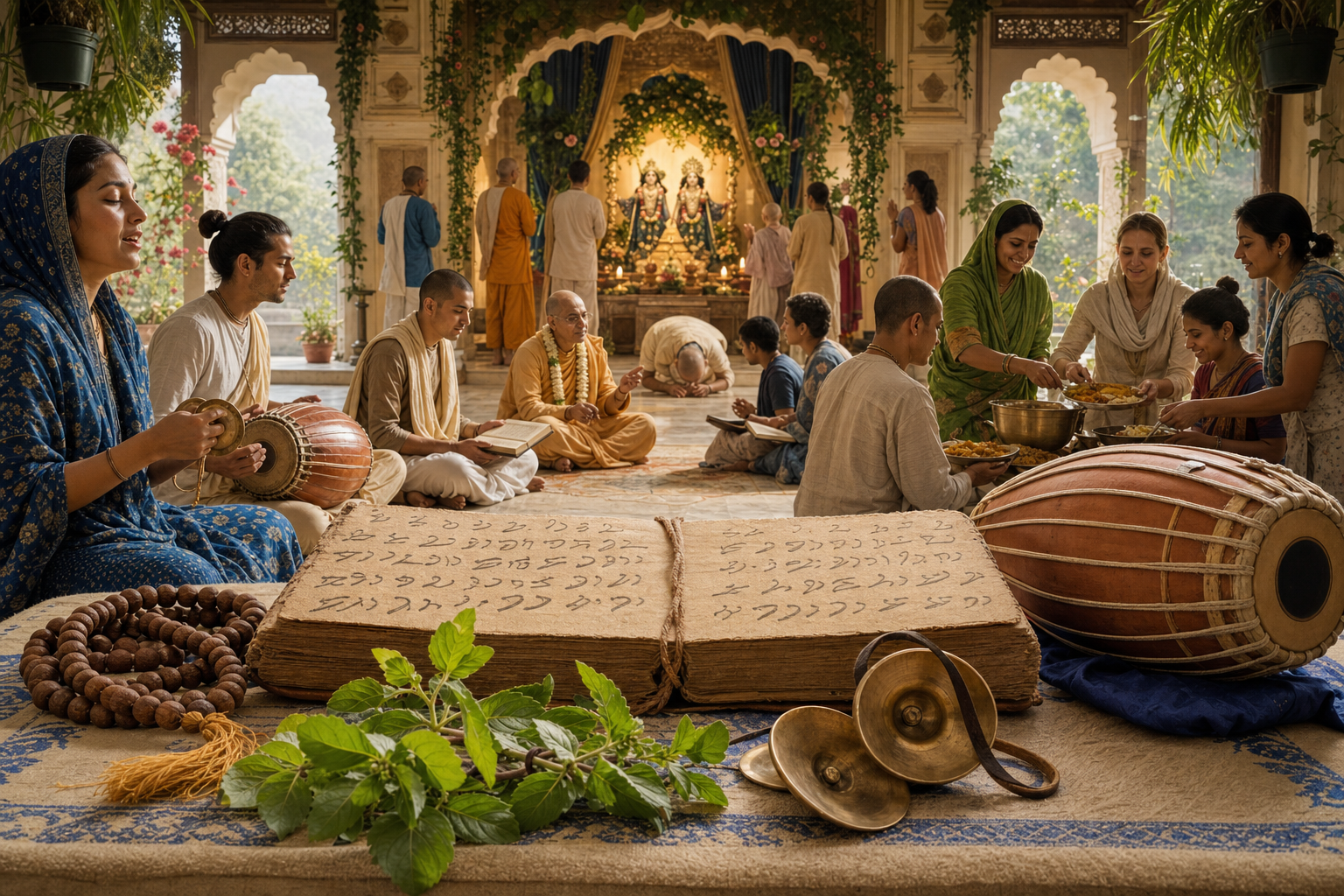
The ISKCON Sunday Feast, historically known as the Sunday Love Feast, gathers kirtan, philosophical discussion, prasadam, and service into a repeatable public encounter. It works because a newcomer does not merely hear information about bhakti. The person can sing, listen, ask, eat sanctified food, meet practitioners, and discover a next step. In that sense, the Feast is a practical pedagogy of devotion and sacred hospitality.
If you help organize one, walk through it from the position of someone arriving for the first time:
- Arrival: Is it clear where to go, what will happen, and whom to ask? Assign hospitality rather than assuming that someone will notice an unfamiliar face.
- Kirtan: Can a newcomer participate without already knowing the melodies or etiquette? Keep the congregational purpose visible; kirtan is not a performance with an audience of spectators.
- Discourse: Anchor the central point in Bhagavad-Gita or Srimad Bhagavatam, define necessary Sanskrit terms, and make the practical consequence explicit. Simple language should clarify the philosophy, not thin it out.
- Inquiry: Leave room for sincere questions. A person should be able to ask for clarification without being treated as hostile or spiritually deficient.
- Prasadam: Present it as food offered to Krishna and shared in a spirit of dignity, non-harm, and welcome. If it becomes indistinguishable from generic catering, an important part of its meaning has been lost.
- Next step: Offer a clear route into study, kirtan, japa guidance, or suitable seva. Warmth at the door matters, but continuity usually depends on what happens after the first visit.
Organizers can watch repeat attendance, participation in kirtan and questions, movement into study or seva, and reported experiences of connection or purpose. These are stewardship signals, not measurements of anyone’s bhakti. Use them to find practical failures – confusing language, poor follow-up, an unwelcoming flow – rather than to manufacture a spiritual scorecard.
The same care should shape leadership. Clear instruction without relational warmth can produce compliance without trust. Warmth without standards can leave newcomers confused about what the tradition teaches. Srila Prabhupada’s legacy asks communities to hold principle and care together so that institutions serve people while people learn to serve Krishna.
Turn remembrance into a practice you can sustain
Reading about an acharya can produce intense inspiration that disappears when ordinary responsibilities return. The answer is not to demand a dramatic life change from yourself. Convert one insight into a stable devotional action, then let repetition deepen it.
Use this study-and-practice cycle whenever you read a passage from Srila Prabhupada Lilamrita or hear a recollection:
- Receive: Read or hear without rushing to extract a slogan. Notice the situation, people, instruction, and devotional concern.
- Verify: When a factual detail matters, check letters, diaries, recordings, audiovisual archives, or other contemporaneous material where available. Mark what remains uncertain.
- Distinguish: Write under two headings: What happened? and What spiritual meaning am I drawing from it?
- Connect: Identify the relevant Gaudiya principle – guru-seva, nama-sankirtana, surrender, compassion, scriptural fidelity, perseverance, sacred hospitality, or responsible leadership.
- Practice: Choose one expression suited to your present duties: steadier japa, more attentive scriptural reading, service matched to your abilities, help with prasadam, or thoughtful welcome at a Sunday Feast.
- Discuss: Bring your understanding into satsang. Invite correction, especially if you intend to teach the episode or use it to guide other people.
- Examine the fruit: Ask whether the remembrance is making you more steady, truthful, teachable, compassionate, and ready to serve – or merely more certain of your opinions.
A durable personal rhythm can remain simple: regular japa, thoughtful engagement with Bhagavad-Gita and Srimad Bhagavatam, seva aligned with your actual capacity, reflective notes, and dependable association. Consistency matters more than copying the visible workload or austerity of a saint. The transferable principle is disciplined fidelity; the external form must fit your duties and stage of practice.
This is where living memory fulfills its purpose. You are not being asked to reenact another person’s circumstances. You are being asked to recognize how guru, shastra, sadhana, courage, cooperation, and grace came together – and then to let the same categories expose what is missing from your own practice.
Before your next temple visit or study circle, choose one episode from Srila Prabhupada’s life. Write one sentence stating its verified historical core, one stating its devotional meaning, and one naming the action it asks of you. Carry out that action until you return to sangha. That is how inherited memory stops being a monument and becomes Gaudiya service in the present.
References
- Dandavats – HG Daivi Shakti Mataji on Srila Prabhupada Lilamrita: Unveiling a Transformative Gaudiya Legacy
- Dandavats – Srila Prabhupada in Living Memory: HG Pancharatna Das on Bhakti and ISKCON Sunday Feast (03 May 2026)