
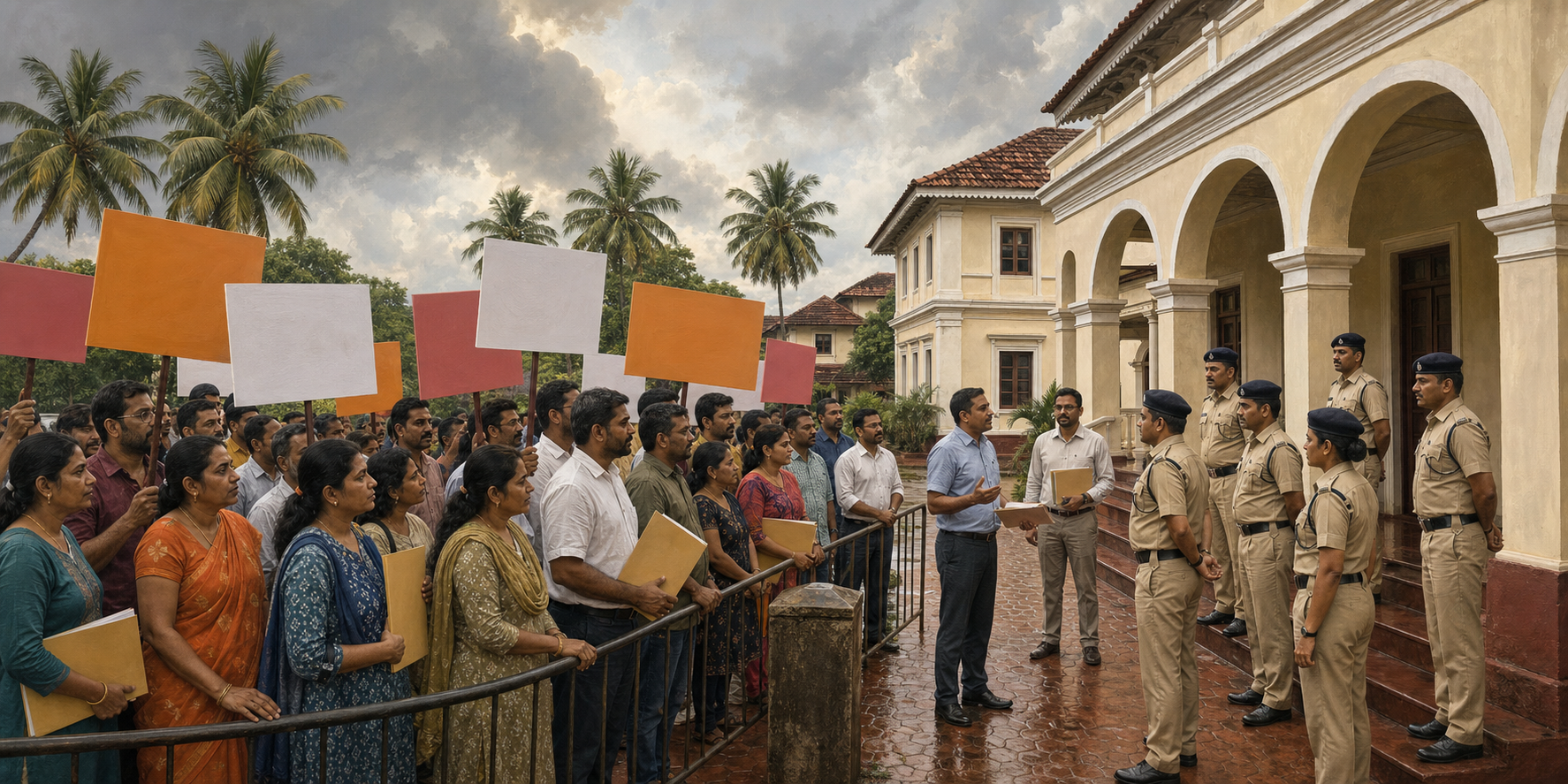
If you saw the gathering outside the Panaji Police Headquarters and wondered whether Hindu protesters were demanding the arrest of anyone who causes religious offence, that framing is too crude. The strongest case emerging from Goa is narrower and more defensible: the identity of the insulted community should not determine how seriously a complaint is received, investigated or resolved.
That distinction matters if you care about both Hindu dignity and freedom of expression. Automatic arrests can chill lawful criticism, while selective responsiveness can teach Hindus that legal protection exists more reliably for other communities. The practical task is to demand one evidentiary threshold, one fair process and reasons that the public can evaluate.
The Panaji demand is parity, not preferential protection
Hundreds of citizens, largely Hindus, assembled outside the Panaji Police Headquarters over what they perceived as unequal enforcement against derogatory religious speech. They contrasted the swift arrest of Gautam Khattar for remarks concerning St. Francis Xavier with what they regarded as slower or weaker action when Hindu deities and practices were denigrated.
The comparison carries genuine civic force, but it must be stated carefully. A public protest establishes that distrust exists; it does not, by itself, prove that two case files contained the same evidence, intent, reach or public-order risk. If Hindus want equality before the law, our argument becomes stronger when we ask authorities to disclose comparable procedures rather than assume that every offensive statement is legally identical.
Goa makes the issue especially sensitive. St. Francis Xavier is revered among many Goan Catholics, while Hindu sacred life encompasses numerous deities, temples, household observances and local traditions. An administration that appears highly responsive to one community and indifferent to another can damage trust even before a court determines whether an offence occurred. Perceived partiality is therefore an institutional problem, not merely an emotional disagreement between believers.
Key takeaways
- Equal protection means applying the same legal ingredients, evidence standards and arrest safeguards regardless of the religion involved.
- Equal treatment does not require identical outcomes when the facts, intent or public-order risks differ.
- A quick police response need not mean an immediate arrest; evidence preservation, a notice, witness contact and a reasoned decision are also meaningful actions.
- A strong complaint preserves the original material, its context and an accurate translation instead of circulating an edited clip.
- Hindu advocacy gains credibility when it rejects retaliatory abuse, collective blame and pressure for punishment unsupported by evidence.
Equal enforcement means the same test, not the same arrest

Religious-speech disputes sit between constitutional commitments that must be read together. Article 19(1)(a) protects freedom of speech. Article 19(2) permits reasonable restrictions on grounds that include public order and decency. Article 25 protects freedom of conscience and the right to profess, practise and propagate religion. None of these principles is served by a rule under which criticism is automatically criminal, or by an unofficial hierarchy in which some sacred identities receive more protection than others.
The IPC provisions invoked in this controversy illustrate why hurt feelings alone are not the whole test. Section 295A addressed deliberate and malicious acts intended to outrage religious feelings. Section 153A addressed the promotion of enmity between groups, while Section 505(2) addressed statements capable of producing communal public mischief. The important words are not simply “offensive” or “insulting.” Investigators must examine intention, the nature of the statement, its context, its audience and its plausible connection to communal disorder.
The constitutional and judicial guardrails associated with these disputes point in the same direction. Ramji Lal Modi v. State of U.P. upheld Section 295A in 1957, but Amish Devgan v. Union of India in 2020 reiterated that every insult or wounded sentiment does not become a criminal offence. Deliberate malice and a real tendency to disturb public order matter. Shreya Singhal v. Union of India struck down Section 66A of the Information Technology Act in 2015 for vagueness and overbreadth. S. Rangarajan v. P. Jagjivan Ram likewise stands for the principle that robust expression is the norm and restriction requires a sufficiently clear legal basis.
Arrest is a separate decision from receiving a complaint or opening an investigation. Arnesh Kumar v. State of Bihar directed police in 2014 to avoid routine arrests for offences punishable by up to seven years and to use a procedural notice where appropriate. The provisions central to this controversy have commonly fallen within that safeguard. A police force can therefore act promptly while still asking whether custody is necessary.
Statutory labels and procedures can depend on when and where the conduct occurred. If you are making a current complaint, describe the conduct and preserve the evidence instead of copying section numbers from a viral graphic. A qualified advocate or the investigating authority should identify the provisions currently applicable to your facts.
| Stage | Equal treatment requires | Equal treatment does not require |
|---|---|---|
| Complaint intake | The same access, acknowledgement and initial scrutiny for every community | Accepting every allegation as a proved offence |
| Evidence review | The same attention to complete context, intent, translation and public-order risk | Treating two edited clips as comparable merely because both caused anger |
| Investigation | Timely preservation of digital material and proportionate investigative steps | Using visible police activity as a substitute for evidence |
| Arrest decision | A recorded assessment of legal power, necessity and the facts of the case | Arresting equal numbers of people from different religions |
| Closure or prosecution | Reasons tied to evidence and legal ingredients | Forcing the same outcome in factually different cases |
This distinction protects Hindus from two bad outcomes at once. It challenges selective inaction without endorsing indiscriminate criminalization. The proper demand is not “arrest everyone” but “show that everyone passed through the same gate.”
Fair policing must be visible enough to measure

An allegation of institutional bias cannot be answered indefinitely with “trust us.” Nor can citizens prove bias merely by pointing to one highly visible arrest. Comparable process data is the missing middle.
Goa Police could publish anonymized aggregates for religious-denigration complaints without exposing complainants, accused persons or sensitive evidence. The most useful measures would include time from complaint to an FIR decision, time to the first investigative action and time to closure. A fuller dashboard could also distinguish whether police sought preservation of online material, requested additional evidence, obtained a translation, issued a notice or recorded why coercive action was considered necessary.
Raw speed is not enough. A difficult translation, an unavailable original recording, an anonymous account or a platform hosted outside the jurisdiction may make one investigation slower than another. Fair comparison therefore requires grouping cases by relevant features: the apparent completeness of evidence, the reach of the communication, the need for forensic work, the presence of an identifiable speaker and the alleged public-order risk. Religion should be visible for parity auditing, but it should not be the only variable.
A credible enforcement system would combine five practical safeguards:
- A neutral intake procedure: the same basic information should be requested whether the complaint concerns a Hindu deity, a Christian saint, a Sikh Guru, a Jain Tirthankara, a Buddhist figure or any other sacred tradition.
- Context-sensitive evidence handling: investigators should preserve the original digital material, examine the surrounding conversation and distinguish satire, criticism, theological disagreement, crude abuse and incitement.
- Reliable language assessment: regional idiom and religious vocabulary can change the meaning of a statement. Certified translation may be necessary when disputed wording is central to intent.
- A separate arrest assessment: officers should record why detention is necessary rather than treating arrest as the automatic proof that a complaint was taken seriously.
- Independent review: periodic audits should look for differences in intake, investigation time, coercive action and closure across comparable complaints from different communities.
Transparent timelines, trained investigators and district-level interfaith forums can address different parts of the problem. Data exposes patterns. Training improves legal and digital judgment. A forum can seek clarification, correction or apology before hostility grows. Such a forum should never decide criminal liability or suppress evidence, and dialogue should not delay urgent police action where a credible threat or incitement is present.
Transparency also disciplines public advocacy. If comparable records show similar treatment, a claim of religious bias should be reconsidered. If the records show that complaints involving Hindu targets repeatedly wait longer or receive less investigative attention, citizens will have evidence for oversight, litigation or policy reform. Either result is healthier than a politics built entirely on suspicion.
If you report anti-Hindu denigration, build a usable record

A police complaint is not a social-media caption. Investigators need material they can authenticate, understand and connect to a legal threshold. Public escalation can also expose you and others to safety or legal consequences. If your own liability, identity or security may be at risk, obtain advice from a qualified advocate rather than treating general civic guidance as advice for your individual case.
Before filing, decide what problem you are trying to solve. Are you asking a platform to preserve material, seeking removal of a threat, requesting an investigation, inviting a clarification, or documenting unequal treatment? You may need more than one remedy, but naming the objective prevents anger from becoming an unfocused demand for arrest.
- Preserve the primary material. Save the original URL, account name, visible date or time, complete image or video and any accompanying caption. Keep an unedited copy. A cropped version can be useful for explanation, but it should not replace the original.
- Capture the surrounding context. Preserve the full thread, the preceding and following remarks, and enough of a longer recording to show what prompted the disputed words. Context may strengthen the complaint, or it may reveal that an inflammatory clip changed the meaning.
- Separate quotation from interpretation. Write the exact words first. Then explain what you believe they mean and why. Do not silently correct, embellish or combine statements from different moments.
- Handle translation carefully. Include the original language and a faithful translation. If one expression has several plausible meanings, say so. Where the meaning is disputed and legally important, ask whether a certified translation is required.
- Explain the possible legal relevance. Identify any facts that may bear on deliberate malice, targeted hostility, promotion of enmity or public-order risk. Your anger demonstrates impact, but it does not by itself prove the speaker’s intent.
- Request proportionate action. You can ask for evidence preservation, an initial legal assessment, contact with the speaker, a platform request or an investigation. Leave the arrest decision to the applicable law, evidence and necessity assessment.
- Obtain and retain acknowledgement. Where the receiving mechanism provides a diary number, receipt, email confirmation or other reference, keep it. Record later requests for evidence and status updates in chronological order.
- Avoid creating a second offence or a larger danger. Do not threaten the speaker, publish private information, blame an entire religious community or repeatedly amplify the disputed material beyond what documentation requires. If the content contains a specific and imminent threat, contact law enforcement promptly instead of relying on a public pressure campaign.
A compact complaint structure
You can organize the factual part of a complaint under six short headings:
- What occurred: the exact statement or conduct, without rhetorical additions.
- Where and when: the platform or location and the available timing information.
- Who published it: the account or person as shown in the preserved material, without guessing at an anonymous identity.
- Original evidence and context: links, files, full conversation and translation.
- Why assessment is warranted: the facts bearing on intent, group hostility, reach or public-order risk.
- Action requested: preservation, acknowledgement, investigation and a reasoned response under the applicable procedure.
If you later allege unequal treatment, maintain a second record containing the date of submission, acknowledgement, first police contact, requests for additional evidence, investigative steps communicated to you and the eventual outcome. Compare those stages, not rumours about who received special treatment. A chronology is far harder to dismiss than a generalized accusation.
A dharmic response protects dignity without copying the insult

Derision aimed at a deity or a household tradition can feel like social humiliation, not just disagreement over doctrine. That harm deserves to be understood. Yet the method used to answer it determines whether Hindu advocacy restores dignity or merely extends the cycle of contempt.
The shared dharmic commitments to ahimsa, satya and compassion offer a practical discipline rather than a reason for passivity. Satya requires exact quotation, full context and honest acknowledgement of uncertainty. Ahimsa rules out threats, doxxing and mob harassment. Compassion prevents criticism of an individual statement from becoming hostility toward every member of another faith. Firmness still has a place: credible evidence of deliberate malice and communal danger warrants a lawful, timely investigation.
This discipline is especially important in Goa. Defending Hindu deities by insulting St. Francis Xavier or Catholics collectively would reproduce the very norm the protest asks society to reject. Equal dignity means that Hindus can insist on protection for our sacred traditions without denying the sacred attachments of our neighbours.
Proportionality helps you choose the next step. A genuine misunderstanding may call for clarification. A reckless insult may warrant correction, retraction and platform action. Repeated or apparently malicious conduct with a credible communal dimension may warrant police investigation. A specific threat or incitement may require urgent intervention. This is not a rigid ladder: serious danger can justify skipping directly to law enforcement, while criminal process should not be used merely to win a theological argument.
The most constructive civic demands are now concrete. Ask Goa Police for one written standard operating procedure covering all religious communities. Ask for multilingual complaint guidance, trained handling of digital evidence, anonymized enforcement timelines and periodic independent audits. Ask that interfaith engagement be available for de-escalation without becoming a substitute for legal action where the statutory threshold is met.
The next time a provocative clip reaches your phone, pause before forwarding it. Preserve the original, verify the context and choose the least coercive remedy that matches the actual risk. If you encounter a pattern of unequal process, document each stage and demand an audit. That is how the Panaji call for parity can become durable accountability rather than another brief cycle of outrage.