
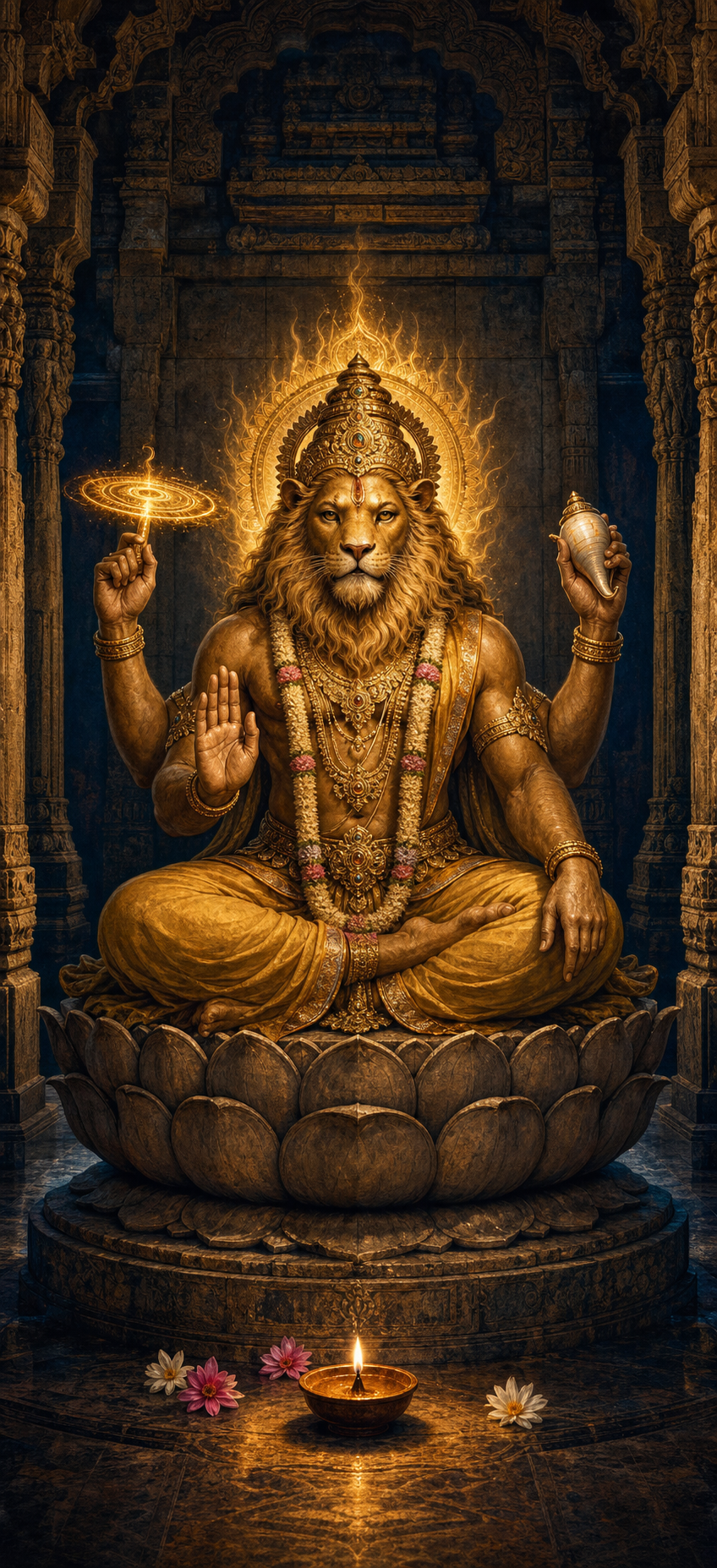
You may have come to the Nrisimha mantra because you want protection, courage, or a steadier mind during conflict. The central question is practical: which mantra should you use, what should you contemplate, and how do you avoid turning a profound Upanishadic practice into a hurried appeal for supernatural rescue?
Begin with the complete Nrisimha Mantraraja. Learn what its names mean, recite it at a sustainable pace, and let the repetition settle into silence. The seed syllable kṣrauṁ and the technical practice of nyasa can be added when you have reliable lineage guidance; they do not need to be improvised for a simple, serious meditation.
Start with the complete Nrisimha Mantraraja
Mantra:
ugraṁ vīraṁ mahāviṣṇuṁ jvalantaṁ sarvato-mukham
nṛsiṁhaṁ bhīṣaṇaṁ bhadraṁ mṛtyor mṛtyuṁ namāmy aham
A direct working translation is: “I bow to the fierce and heroic Great Vishnu, blazing and facing in every direction; to Nrisimha, awe-inspiring and auspicious, the death of death.” No single English rendering exhausts the Sanskrit, but this translation gives you enough meaning to keep the recitation contemplative rather than mechanical.
The formula is called the Mantraraja, the king of mantras. Its sequence matters. It does not present fierceness as an isolated virtue. Ugram and bhīṣaṇam stand beside bhadram, the auspicious and beneficent. Nrisimha is terrible to adharma and protective toward the vulnerable. If you contemplate only the terrible aspect, you can mistake agitation for spiritual strength. If you retain only gentleness, you lose the mantra’s demand for courage and moral boundaries.
This is the governing image for your meditation: not anger made sacred, but power governed by dharma. Prahlada represents the vulnerable devotee held in protection; the force directed against oppression is never directed indiscriminately.
Turn every name into an object of meditation

Recitation becomes meditation when each epithet changes what you attend to. You do not need to stop after every word during japa. Read through the meanings before you begin, then allow one or two of them to remain quietly present during the round.
| Sanskrit expression | Working meaning | What to notice in meditation |
|---|---|---|
| ugram | Fierce and purifying | What fear, confusion, or compromise must be faced rather than avoided? |
| vīram | Heroic | Courage is readiness to act rightly, not the performance of aggression. |
| mahāviṣṇum | Great, all-pervading Vishnu | Protection is not confined to a small imagined form in front of you. |
| jvalantam | Blazing or radiant | Picture a luminosity that exposes confusion without becoming hatred. |
| sarvato-mukham | Facing in every direction | Let awareness include the whole field rather than fixating on one threat. |
| nṛsiṁham | Nrisimha, the human-lion form | Hold together qualities the ordinary mind separates: strength and tenderness, awe and refuge. |
| bhīṣaṇam | Awe-inspiring or formidable | Recognize the aspect before which adharma cannot pretend to be harmless. |
| bhadram | Auspicious and gracious | Let power remain ordered toward protection, welfare, and clarity. |
| mṛtyor mṛtyum | The death of death | Look beneath immediate fear toward the awareness that is not reduced to a passing condition. |
| namāmy aham | I bow | Release the demand to control the practice or manufacture a dramatic experience. |
The movement from ugram to namāmy aham is especially important. The mantra begins with immense force and ends in surrender. Your task is not to appropriate Nrisimha’s fierceness for the ego. You bow to a power whose fierceness is inseparable from wisdom and auspiciousness.
Jvalantam and sarvato-mukham also open the contemplative meaning beyond an external protective figure. Radiance facing everywhere points toward consciousness itself as the field in which fear, the one who fears, and the object of fear appear. This is where bhakti, mantra, and jñana meet: you invoke Nrisimha with devotion, stabilize attention through sound, and then rest in the fearless presence to which the names point.
A simple Nrisimha meditation you can practise consistently
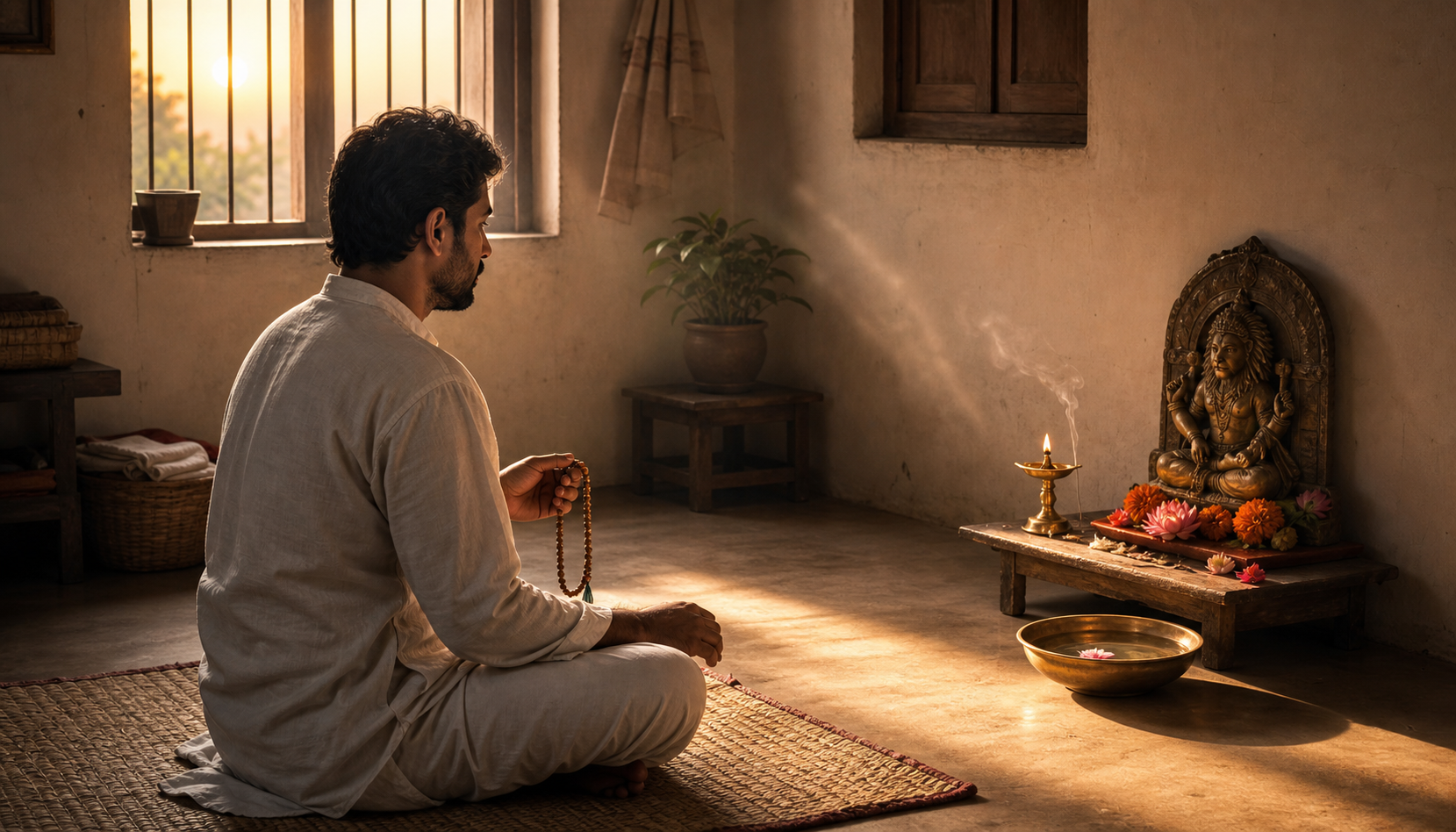
This sequence keeps the practice complete without pretending that a general explanation can replace a lineage-specific ritual manual.
- State a brief sankalpa. Name the quality you intend to cultivate. “May this practice establish courage without hatred and protection without cruelty” is more useful than asking vaguely for power.
- Settle the body and breath. Sit in a stable position you can maintain without strain. Allow the breath to become even and unforced. The purpose is collected attention, not an elaborate breath exercise.
- Visualize fierce compassion. Contemplate Nrisimha as radiant and present in every direction. His adamantine claws and fangs signify irresistible protection; the gestures of refuge and blessing show that this strength remains benevolent toward Prahlada and the devotee.
- Recite one planned round. A cycle of 28 repetitions is a manageable beginning. Longer traditional cycles include 54 and 108. Choose the count before starting and maintain a pace at which the syllables remain attentive rather than rushed.
- Let meaning accompany sound. Do not attempt to hold every definition simultaneously. You might keep bhīṣaṇam-bhadram in awareness during one sitting and jvalantam sarvato-mukham during another.
- Remain quiet after the final repetition. Do not immediately reach for another mantra or activity. Let the sound subside and notice the awareness in which it subsides. This quiet abidance is part of the practice, not empty time after it.
- Close in peace and translate the practice into conduct. Offer a peace invocation if one belongs to your tradition. Then identify the next situation in which courage, restraint, or protection of another person must become an action.
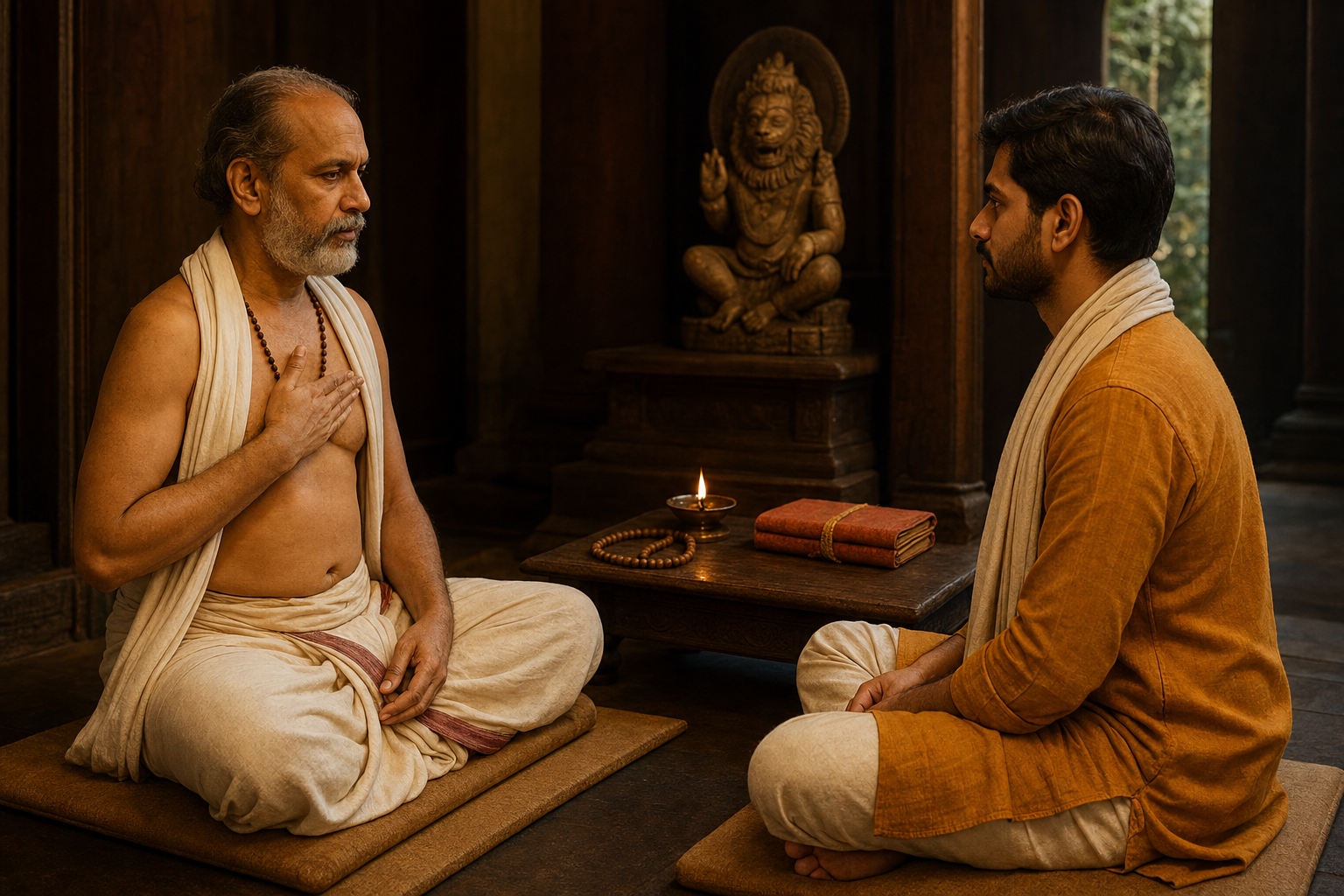
If Sanskrit pronunciation is unfamiliar, learn the mantra orally from a competent teacher or a trusted reciter when possible. Until then, work slowly from the transliteration rather than racing to complete a large count. A smaller attentive round is more coherent than 108 repetitions whose sounds and meanings have disappeared into haste.
Do not assess the sitting by heat, visions, emotional intensity, or an immediate change in external circumstances. A more dependable test appears afterward: are you less reactive, more truthful, clearer about the boundary that dharma requires, and less inclined to answer fear with indiscriminate hostility?
The mantra’s protective dimension should never become an excuse to neglect ordinary safety. If you face an actual threat, seek practical protection and appropriate help. Japa can support steadiness and ethical resolve; it does not make sensible action unnecessary.
When to add kṣrauṁ, nyasa, or the Nrisimha Gayatri
Kṣrauṁ is revered as the concentrated seed syllable of Nrisimha. Traditional mantra-shastra associates kṣ with protective radiance and the tension between what perishes and what is imperishable, r with transformative movement, au with expansion, and the final bindu with integration and stillness. These are contemplative associations within a sacred sonic system, not ordinary dictionary definitions assembled into a literal translation.
The bija is not merely a shorter replacement for the Mantraraja. Its concentrated use belongs especially to japa, visualization, and nyasa. If a teacher has given you a method, follow that sequence rather than mixing it with another recension.
Nyasa installs mantra in the embodied field of practice. Kara-nyasa assigns sacred sound to the hands and fingers. Aṅga-nyasa extends the installation through such ritual stations as the heart, head, crown, protective armor, eyes, and astra. The point is not to despise the body while seeking a disembodied spirituality. The body itself becomes a disciplined field of attention and protection.
Exact syllable assignments and formulas can differ across transmitted versions. That variation is a reason for precision, not anxiety. If you do not have a complete paddhati or qualified instruction, omit the technical nyasa and use the full Mantraraja with visualization and silent abidance. An honest, bounded practice is preferable to constructing a ritual from disconnected fragments.
Many lineages also use the Nrisimha Gayatri:
oṁ nṛsiṁhāya vidmahe vajranakhāya dhīmahi
tanno siṁhaḥ pracodayāt
Its movement is from knowing, to contemplation, to the prayer that divine intelligence impel understanding: vidmahe, dhīmahi, pracodayāt. Use it as a prelude or conclusion if that is how your tradition teaches it. There is no need to stack the Mantraraja, bija, Gayatri, nyasa, and every available protective formula into one sitting merely to make the practice seem stronger. Coherence and steadiness matter more than accumulation.
Key takeaways for your practice
- Use the complete Mantraraja as the foundation when you want a clear practice without an elaborate ritual procedure.
- Hold bhīṣaṇam and bhadram together: Nrisimha is formidable toward adharma and auspicious toward those needing refuge.
- Begin with a sustainable cycle such as 28 repetitions; use 54 or 108 when the longer count supports attention rather than haste.
- Let japa end in quiet awareness. The silence after the mantra is part of its Upanishadic movement from sound toward realization.
- Treat kṣrauṁ and nyasa as precise practices. Use the method of a reliable lineage instead of inventing syllable assignments.
- Judge the fruit by conduct: clearer boundaries, less reactive fear, greater restraint, and courageous protection of what dharma asks you to protect.
At your next sitting, keep the method modest: establish a dharmic intention, recite 28 attentive repetitions, remain still when the sound ends, and carry that steadiness into the next difficult choice before you. That movement from sacred sound to courageous conduct is where Nrisimha meditation becomes lived sadhana.