

You finish a seva, someone praises you, and the mind quietly begins arranging a second reward: being remembered as the person who served well. That is the moment Madhavendra Puri becomes more than a revered name from the Gaudiya Vaishnava lineage.
If you worry that humility means denying your abilities, refusing appreciation, or making yourself small, his conduct at Remuna offers a stricter and healthier standard. Keep your desire aligned with Krishna’s service, receive mercy without entitlement, and do not convert grace into reputation. You can practise all three without becoming passive, evasive, or falsely modest.
Service begins in the motive, not the visible act
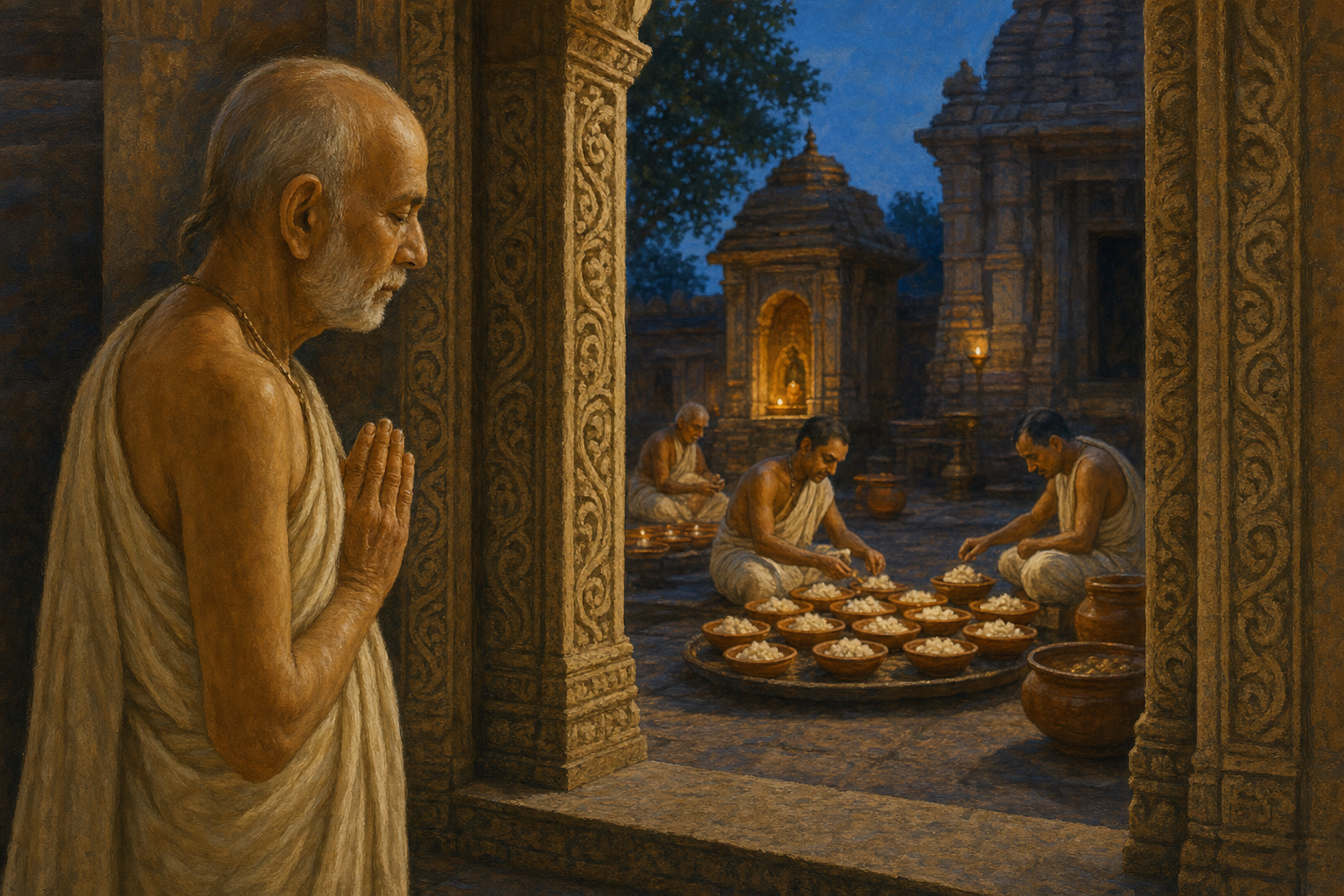
At Remuna, Madhavendra Puri encountered the renowned sweet-rice offering of Gopinatha. He quietly wanted to understand the preparation so that he could make something similar for the Deity he served. His desire was not simply to enjoy a celebrated dish. It arose within seva: he wanted to learn what could be offered for the Lord’s pleasure.
He did not demand a portion or use his spiritual standing to obtain one. Gopinatha then set aside a pot of the offering and instructed the temple priest through a dream to deliver it to him. This intimate exchange, remembered in CC Madhya 4.112–123, gave the Deity the name Kshirachora Gopinatha, the Lord who stole sweet rice for His devotee.
The distinction between appetite and service can look very small from the outside. Two people may want the same object, skill, position, or opportunity. One wants it to increase an offering; the other wants the pleasure, identity, or influence attached to possessing it. The external desire does not tell you which is which. The direction of the desire does.
You can examine that direction with four uncomfortable questions:
- Would I still want to do this if nobody learned that I had done it?
- If a more capable devotee took over, would I feel relieved that the service was secure or resentful that I was no longer central?
- If Krishna and the community benefited but my name disappeared, would the result still satisfy me?
- If I did not receive the opportunity or object I wanted, would my willingness to serve continue?
These questions do not magically purify a mixed motive. They reveal it. That is already useful. A motive you can see may be redirected; a motive protected by devotional language usually continues unchecked.
Within Gaudiya theology, the exchange at Remuna is personal rather than merely symbolic. The archa-vigraha is understood as non-different from Sri Krishna, capable of accepting an offering and reciprocating with a devotee’s inner disposition. Bhoga becomes prasada through divine acceptance, and prasada returns to the devotee as grace. The crucial element is therefore not the expense or fame of the offering but the seva-bhava carried within it.
The direction of giving is even reversed. Madhavendra Puri wished to prepare something for the Lord, but the Lord first arranged to feed him. Devotional humility can receive that reversal without concluding, “I must be important.” It receives mercy as mercy: undeserved, personal, and an invitation to deeper service.
Madhavendra Puri’s place in the lineage makes this disposition especially significant. He was the guru of Isvara Puri and therefore the param-guru, or guru’s guru, of Sri Caitanya Mahaprabhu. His selfless longing was not a decorative virtue at the edge of Gaudiya Vaishnavism. It helped shape the devotional current transmitted through the lineage.
Leaving Remuna reveals the danger of spiritual prestige

After receiving the prasada, Madhavendra Puri left Remuna at night. He understood that news of Gopinatha’s extraordinary provision would bring attention, praise, and crowds. Rather than settle into the identity of the famous devotee for whom Krishna had performed a miracle, he removed himself from the acclaim.
This is the sharp edge of his humility. He did not merely avoid boasting. He recognised pratiṣṭhā, the hunger for prestige, as a threat to devotion and acted before it could become comfortable.
Praise becomes spiritually dangerous when it functions as a hidden wage. Once being seen as devoted becomes part of the payment, your choices begin to shift. Visible service feels more attractive than necessary service. Speaking feels more rewarding than cleaning. A dramatic contribution wins over a dependable one. Eventually, the image of being a servant competes with the work of serving.
You do not need to fear every kind word. Fear of praise can become another form of self-absorption, because you remain preoccupied with how others see you. Use a simpler response:
- Receive appreciation briefly: “Thank you. I am grateful I could serve.”
- Credit other contributors accurately, without inventing false modesty or denying work you actually performed.
- Do not fish for a second round of praise by describing how humble, difficult, or sacrificial your service was.
- Return attention to the responsibility in front of you instead of preserving the moment as a new spiritual identity.
Madhavendra Puri’s departure should not be copied mechanically. Walking away from praise is not permission to abandon a duty, leave other people with an unfinished task, or avoid accountability. Your family, temple, workplace, or community may need a handover, a financial record, a safeguarding report, or a clear explanation of what was done. Complete those obligations. The principle is to refuse prestige, not responsibility.
The same distinction applies when sharing devotional experiences. Testimony can strengthen another person’s faith, but it can also make the speaker the centre of the event. Before repeating an experience, ask what the listener needs from it. If the main effect will be to establish your special status, silence may protect the experience better than publicity.
Build humility into your daily sadhana

Humility is unreliable when it depends on a devotional mood appearing at the right moment. It becomes steadier when your routine makes self-display less rewarding and sincere service easier. The familiar disciplines of śravaṇam, kīrtanam, and arcana or seva can each train that orientation.
- Before serving, name the actual offering. Complete the sentence, “This is for Krishna’s pleasure, expressed by…” and identify the concrete benefit: a clean altar, an attentive reading, food properly prepared, a visitor welcomed, or a responsibility completed. A clear purpose gives you something to return to when thoughts of recognition appear.
- During śravaṇam, extract an instruction rather than merely collecting information. After hearing or reading a passage, write down the one choice it asks you to change. In the Remuna account, that choice may be to stop advertising a service, to honour prasada more carefully, or to notice resentment when another person receives recognition.
- During kīrtanam, bring your speech under the purpose of glorification. Do not use participation as a ranking system for voices, visibility, or spiritual importance. If you lead, facilitate the congregation’s remembrance. If you follow, support the same purpose without treating a less visible role as a lesser offering.
- During arcana or seva, finish the needed task, including its ordinary closing work. Preparation, cleaning, documentation, and handover are also service. Humility often becomes measurable after the inspiring portion is over.
- When prasada is received, pause before treating it as ordinary consumption. Remember that it began as an offering, was accepted as mercy, and is now to be honoured and, where possible, shared. A prasada-centred community asks who has not yet been served before deciding who deserves preference.
- After the service, examine your reaction rather than your public image. Notice whether being overlooked produces anger, whether praise creates fantasies of importance, or whether correction makes you defensive. Treat the reaction as a diagnosis of attachment, then choose the next service without staging a display of repentance.
Non-ostentatious service does not have to be literally secret. A temple coordinator may need to know who completed a task. A community needs transparent accounts and reliable communication. Quiet service means that visibility is governed by the work rather than by your need to be admired. Necessary reporting remains; self-promotion falls away.
Small, regular acts are especially revealing. It is easy to feel humble during an exceptional ceremony. It is harder to remain steady when the task is repetitive, unnoticed, and unlikely to produce a story worth telling. That is precisely why ordinary seva can train the heart so effectively.
Healthy humility is not self-erasure

Madhavendra Puri did not deny what happened at Remuna. He did not claim that the prasada was worthless or that Krishna’s reciprocation was unreal. His humility concerned ownership and prestige: he would not turn mercy into a claim of personal greatness.
That gives you a practical way to distinguish humility from its imitations:
- Humility acknowledges a skill and offers it. False modesty denies the skill so that others must provide reassurance.
- Humility accepts correction and changes course. Shame declares the self hopeless and avoids the work of repair.
- Humility can say no when a request would violate dharma, safety, or an existing responsibility. Servility agrees to everything in order to preserve approval.
- Humility tells the truth about an error. Image management hides the error to protect a reputation for holiness.
- Humility shares credit accurately. Performative self-denial pretends that human effort played no part and may erase the contributions of other servants.
“I am useless” can remain intensely centred on the self. “I handled this poorly; here is how I will correct it” is often the humbler sentence because it places truth and service ahead of emotional theatre. Devotional humility does not ask you to become vague about reality. It asks you to stop using reality as material for self-exaltation.
Nor does humility require concealing misconduct, tolerating harm, or surrendering sound judgement to a charismatic person. Reverence for guru, sadhu, scripture, and temple discipline must not be confused with protecting adharma. Accountability can wound pride, but it protects service.
The wider Dharmic family offers related disciplines without erasing the differences among its traditions. Hindu bhakti places loving seva at the centre; Buddhism cultivates dāna and forbearance; Jainism gives particular force to aparigraha, or non-possessiveness; Sikh tradition embodies seva and equal welcome through langar. The doctrines are not interchangeable, but the ethical convergence is useful: spiritual practice should loosen possessiveness, widen generosity, and reduce the craving for rank.
That convergence also clarifies the social meaning of prasada. If food is received as the Lord’s mercy rather than as a badge of status, sharing cannot be organised around spiritual vanity. Gratitude softens hierarchy. Service moves toward the person who needs care, not merely toward the person whose recognition benefits the server.
Key takeaways for your next act of seva
- Judge a desire by its direction: is it moving resources and attention toward Krishna’s pleasure, or toward your enjoyment and identity?
- Do not confuse being unnoticed with being unvalued. In bhakti, the intended recipient of service is not the audience around you.
- Receive praise without either feeding on it or demanding that others deny your contribution. Gratitude and accuracy are enough.
- Keep quiet service accountable. Complete handovers, records, safety duties, and corrections even when they make your work visible.
- Honour prasada as received mercy, then let that gratitude become generous and inclusive sharing.
- When disappointment exposes a mixed motive, do not dramatise it. Redirect the motive and perform the next needed service.
Before your next seva, write one sentence naming whom the work is meant to please and what benefit it should produce. When the work is finished, ask whether you would make the same offering without recognition. If the answer is not yet yes, you have not failed. You have found the precise attachment your practice must address next.