

When you see Baba Deep Singh Ji depicted continuing to fight after a mortal neck wound, awe comes easily. The harder and more useful question is this: what made his last stand an act of Sikh shaheedi rather than an episode of battlefield ferocity?
If you want to carry the sant-sipahi ideal into family, community or civic life, do not begin with the weapon. Begin with the order of Baba Deep Singh Ji’s life: study that disciplined his mind, seva that fixed his purpose on others, preparedness that gave duty practical force, and courage governed by restraint. The sequence is the lesson.
Begin with the manuscript, not the battlefield

Baba Deep Singh Ji lived from 1682 to 1757, but the scene from his final year can obscure the decades that formed him. Sikh tradition places his birth in the Amritsar district and his early formation at Anandpur Sahib, where he became associated with Guru Gobind Singh’s discipline. His education joined languages and scriptural interpretation to shastar-vidya, the disciplined study of arms.
That combination was not a collection of unrelated accomplishments. The same person had to understand what was sacred, serve the community sustained by it, and be capable of protecting it when ordinary safeguards failed. Knowledge identified the good. Seva made that good public rather than private. Martial discipline supplied capacity without deciding the purpose for which it should be used.
At Damdama Sahib, also known as Talwandi Sabo, Baba Deep Singh Ji is remembered for scribal work, scriptural teaching and the formation of scholars associated with the later Damdami Taksal. Copying sacred text demanded more than elegant handwriting. It required attention, memorisation, interpretive discipline and the character to transmit the Gurus’ word without subordinating it to personal vanity.
This is the first correction to a shallow idea of the warrior-saint. Baba Deep Singh Ji guarded textual continuity before he became the enduring image of physical resistance. If you celebrate his khanda but ignore his labour with scripture, you reverse his priorities. The sipahi did not manufacture a cause and then recruit spirituality to bless it. The sant learned to recognise duty before the sipahi acted.
His setting made this integration practical. Eighteenth-century Punjab faced political fragmentation, weakening Mughal authority and repeated Afghan incursions. The Khalsa therefore operated not only as an armed body but as an organised community that protected pilgrimage routes, assisted traders and farmers, taught scripture and sustained sacred institutions. Service around gurdwaras, including the wider orbit of Tarn Taran Sahib, joined langar, kirtan and instruction. Spiritual literacy had visible consequences: people were fed, taught and protected.
Three disciplines emerge from that life, and each corrects a failure in the others:
- Study gives judgment. Without it, courage can become impulse dressed in religious language.
- Seva gives public purpose. Without it, learning can become status and martial display can become theatre.
- Preparedness gives duty practical capacity. Without it, sincere concern can remain helpless when protection is actually required.
When you evaluate a modern claim to sant-sipahi leadership, look for all three. Loud courage without patient study and recurring service is not an abbreviated version of the ideal. It is a different thing.
Why the sant must govern the sipahi
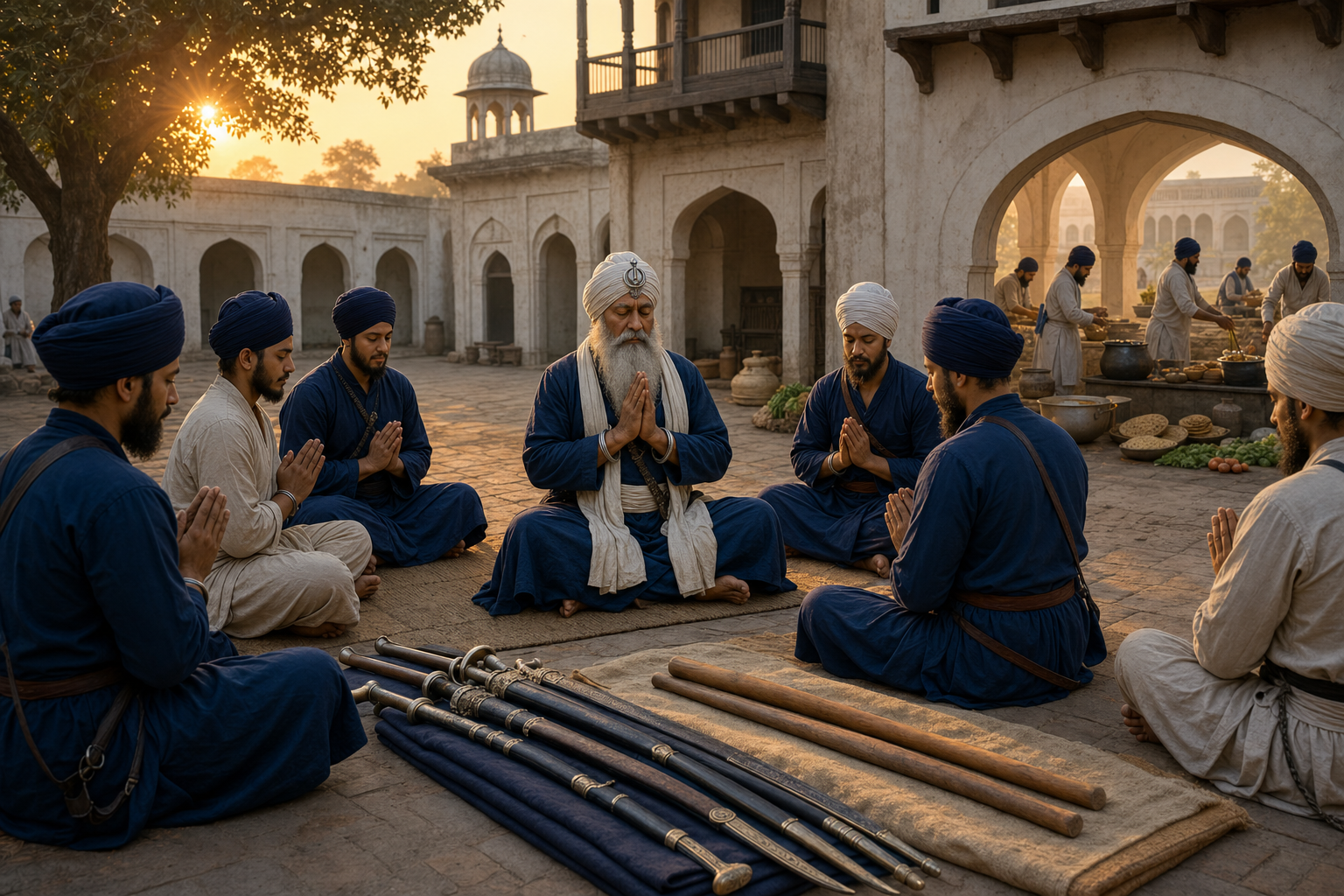
Sant-sipahi is often translated as saint-soldier, but the English pairing can sound like two personalities taking turns. Sikh thought demands a deeper integration. The sant is not a retreat from worldly responsibility, and the sipahi is not permission for aggression. Spiritual discipline establishes the purpose and limits of action; temporal responsibility refuses to leave justice as a beautiful but ineffective intention.
This relationship belongs with miri-piri, the joining of temporal and spiritual responsibility. Piri without miri can decay into quietism: prayer remains untouched while vulnerable people bear preventable harm. Miri without piri can decay into domination: power begins to justify itself. The sant-sipahi carries both, but not as equal impulses competing for control. The sant supplies moral command.
| Discipline | The question it asks | The distortion it prevents |
|---|---|---|
| Sant | Are ego, anger and fear answerable to truth, compassion and the Gurus’ teaching? | Rage renamed as righteousness |
| Seva | Who is concretely fed, taught, sheltered or protected by this action? | Religious performance centred on the actor |
| Sipahi | Are you disciplined and capable enough to protect rather than merely speak? | Good intentions without usable capacity |
| Miri-piri | Are conscience and public responsibility directing one another? | Withdrawal on one side and domination on the other |
Seva is the hinge. It trains you to notice real needs instead of imagined insults. A person who regularly cooks, cleans, teaches, carries responsibility and listens to the vulnerable develops a different understanding of protection from someone whose only contact with dharma is symbolic combat. Service reveals what could be lost and who would bear the loss.
The same discipline sets boundaries around force. Within the ideal represented by Baba Deep Singh Ji, force is a last resort in defence of life, dignity and sacred institutions. Its purpose is guardianship, not conquest. It distinguishes aggressors from noncombatants, rejects cruelty and remains ordered toward restoration. Readiness matters, but so do right intention, necessity and a stopping point.
Sarbat da bhala, the welfare of all, widens the circle further. It does not require indifference to an attack on your own community. It requires that defence remain answerable to a good larger than revenge. If the action depends on hatred of an entire people, delights in humiliation or continues after protection has been achieved, the sant is no longer governing the sipahi.
Read the 1757 martyrdom at its proper depth
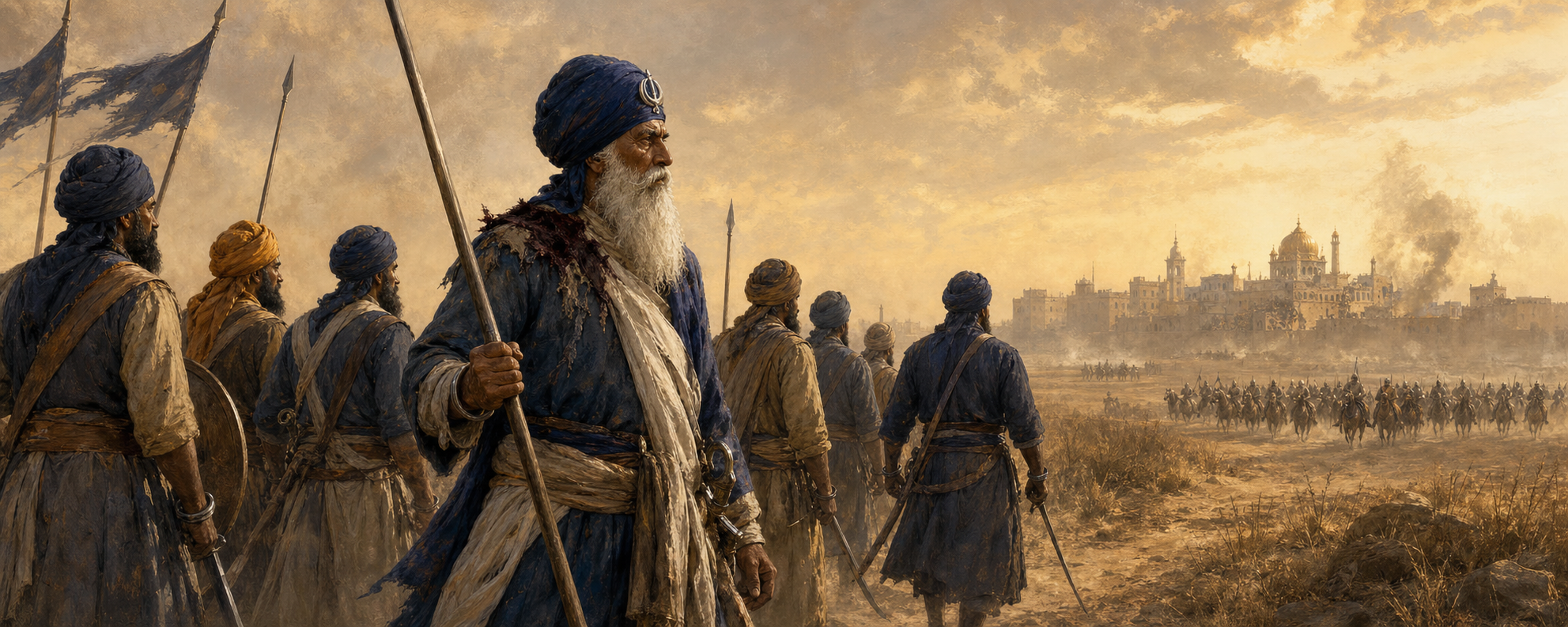
The decisive crisis came in 1757, during an incursion by Ahmad Shah Durrani. Afghan forces assaulted Amritsar and desecrated the precincts of Harmandir Sahib. Baba Deep Singh Ji was already an elder known for learning and service when he resolved to go from Damdama Sahib toward Amritsar with an initial company of a few hundred. More volunteers joined as the jatha advanced.
The objective explains the ethics of the action. The aim was to recover access to Harmandir Sahib, restore the sarovar and re-establish the ordinary life of prayer, langar, seva and teaching. Retaliation may keep an enemy at the centre of the story. Restoration puts the threatened community and its sacred rhythm back at the centre.
Fighting took place on the approaches to Amritsar. Sikh remembrance preserves the image of Baba Deep Singh Ji continuing after a devastating wound to his neck, driven by his resolve to reach the parkarma of the shrine. The image communicates fidelity that does not retreat when duty becomes personally costly.
You do not have to choose between uncritical literalism and contempt for sacred memory. A devotional reading receives the account as testimony to extraordinary resolve. Critical historical reading distinguishes the securely remembered martyrdom from the hagiographic form through which later generations carried its meaning. These readings ask different questions. One asks what happened in recoverable sequence; the other asks what a community understood the sacrifice to reveal.
A careful reader can therefore hold three layers apart without tearing them away from one another:
- The historical core: an elderly Sikh scholar and leader marched to defend desecrated Harmandir Sahib and died in that struggle.
- The sacred image: even a mortal wound could not sever his commitment from the duty he had accepted.
- The ethical meaning: a cause becomes worthy of sacrifice through the life, dignity and sacred order it protects, not through the spectacle of violence surrounding it.
This approach neither empties the tradition nor asks it to function as a medical report. It also prevents the miraculous element from swallowing the rest of Baba Deep Singh Ji’s life. His shaheedi carries authority because the man at the battlefield was already the scholar at Damdama Sahib and the sevadar formed by community responsibility.
The aftermath reinforces that point. The community moved to restore worship and security around Harmandir Sahib. The meaningful outcome was not an enduring condition of battle. It was the return of devotees, prayer, learning and service. Shaheedi protected the possibility of ordinary sacred life.
Practice guardianship without turning it into aggression
You are unlikely to face Baba Deep Singh Ji’s historical circumstances, and you should not pretend that every dispute is their equivalent. Criticism is not desecration. An insult is not an invasion. A political disagreement is not automatically dharma-yuddha. Inflating ordinary conflict into civilisational emergency bypasses the very judgment that the sant is supposed to provide.
Before describing an action as sant-sipahi, apply five tests:
- Name the good at risk. Identify the person, dignity, access, institution or practice facing concrete harm. Vague claims about wounded pride are not enough.
- Choose the least coercive adequate response. Dialogue, documentation, lawful complaint, community organisation and protective presence ordinarily come before force. An immediate danger may shorten that sequence, but anger does not.
- Keep the aim restorative. State what safe and just condition you are trying to recover. If your only answer is that an opponent must suffer, the aim has already become punitive.
- Set limits before acting. Decide who must be protected from spillover, what conduct remains forbidden and what condition ends the intervention. Restraint invented after escalation is usually too late.
- Remain accountable. Accept correction from disciplined community authority. A private appetite for confrontation does not become dharmic merely because it borrows sacred vocabulary.
This ideal does not authorise vigilantism. In a present physical emergency, use lawful emergency services and trained responders, help people reach safety, and follow competent safeguarding procedures. Historical martial memory is not a substitute for training, legal responsibility or control of the scene.
Most opportunities to practise sant-sipahi are less dramatic and more revealing. You can build the required habits before a crisis:
- Study before sharing slogans. Read Sikh teaching with sound commentary, learn the historical setting and verify a dramatic claim before making it part of communal memory.
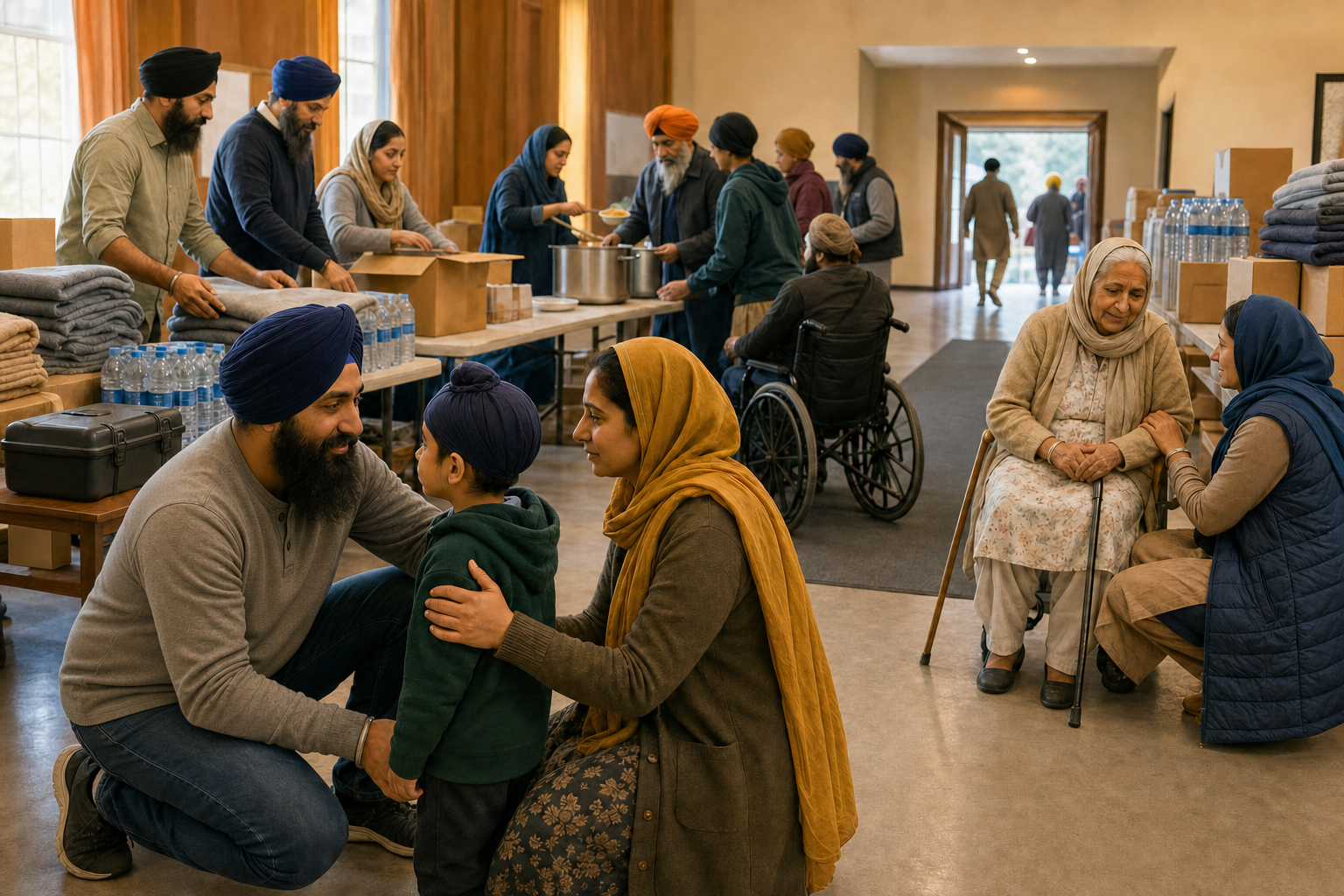
- Take recurring seva. Help with langar, instruction, maintenance or care for vulnerable people. Choose work whose benefit does not depend on your visibility.
- Develop useful preparedness. First-aid knowledge, de-escalation, physical fitness and clear emergency procedures turn concern into capacity. If you learn gatka or another martial discipline, learn through qualified instruction, safety rules and an ethical code.
- Protect access and continuity. Sacred institutions need maintained buildings, accurate texts, trained teachers, safe congregations and dependable volunteers. Guardianship includes all of them.
- Watch what anger does to your categories. The moment a particular wrong becomes contempt for an entire religious, ethnic or political population, return to Sarbat da bhala and correct the course.
The wider dharmic comparison should be made carefully. Sant-sipahi belongs to Sikh history and theology; it should not be dissolved into a generic Indian warrior archetype. Yet it has a family resemblance to kshatra-dharma and dharma-yuddha where struggle is justified by duty, treated as a last resort and bounded by ethical limits. Hindu, Buddhist, Jain and Sikh traditions do not give identical accounts of force, authority or renunciation, so solidarity should preserve real distinctions rather than conceal them.
The shared civic task is easier to name. A gurdwara, mandir, vihara or pathshala is more than property. It is a place where memory is transmitted, generosity becomes habitual and the next generation learns how to live. Protecting another community’s ability to pray, teach and serve does not weaken fidelity to your own tradition. It demonstrates that guardianship is ordered toward a plural sacred civilisation rather than sectarian domination.
Key takeaways
- Baba Deep Singh Ji’s final battle should be read through the scholarship, scriptural labour and seva that preceded it.
- In sant-sipahi, the sant sets the purpose and limits of the sipahi; martial capacity does not define its own cause.
- Seva is the practical test of guardianship because it reveals whom an action actually helps, teaches or protects.
- The tradition of his mortal neck wound can be read devotionally and historically without discarding either its ethical meaning or the need for factual care.
- The purpose of the 1757 struggle was restoration of Harmandir Sahib’s sacred life, not violence for its own sake.
- A present-day sant-sipahi practice joins serious study, recurring service, useful preparedness, lawful protection and restraint toward opponents and noncombatants.
Before your next community conflict, write down four questions: What is true? Who is served? What response is necessary? Where does it stop? Answer them before anger answers for you. That small discipline moves remembrance of Baba Deep Singh Ji from the wall into your conduct.