
If you are coordinating family observances, temple visits, work and school, a list of festival names is not enough. You need to know which dates can be reserved now, which details still require a local panchanga, and why relatives in different regions may use different lunar-month names for the same festival.
This focused August-September 2026 planner covers Garuda Panchami, Sri Krishna Janmashtami and Hartalika Teej, along with the transition into Ganesh Chaturthi. Use it to build your household calendar without mistaking a regional naming difference for a disagreement about the observance itself.
Dates to place on your 2026 calendar
| Observance | 2026 planning date | Lunar marker | What to confirm |
|---|---|---|---|
| Garuda Panchami | August 17 | Panchami during Shravan | Whether your family observes it specifically as Garuda Panchami, within Nag Panchami customs, or both |
| Sri Krishna Janmashtami | Confirm through your local panchanga or temple | Krishna Paksha Ashtami, called Shravan or Bhadrapad according to the regional calendar | The civil date and worship period for your location |
| Hartalika Teej | September 14 | Shukla Paksha Tritiya in Bhadrapad | Your household’s vrata and puja practice |
| Ganesh Chaturthi | September 15 as the planning date implied by this sequence | The day following Hartalika Teej | The local tithi and temple or home-puja schedule before treating the planning date as final |
Write these dates as “17 August” and “14 September,” rather than using an all-numeric format that relatives abroad may read differently. Keep the civil date and lunar marker in separate calendar fields. The first helps with leave, travel and guests; the second preserves the basis of the observance.
For Janmashtami, do not guess the civil date from the lunar-month name alone. Its governing marker is Krishna Paksha Ashtami, but a location-specific panchanga is still needed for the date and worship period. Confirm it before booking travel or circulating a family invitation.
Why Janmashtami may be called a Shravan or Bhadrapad festival
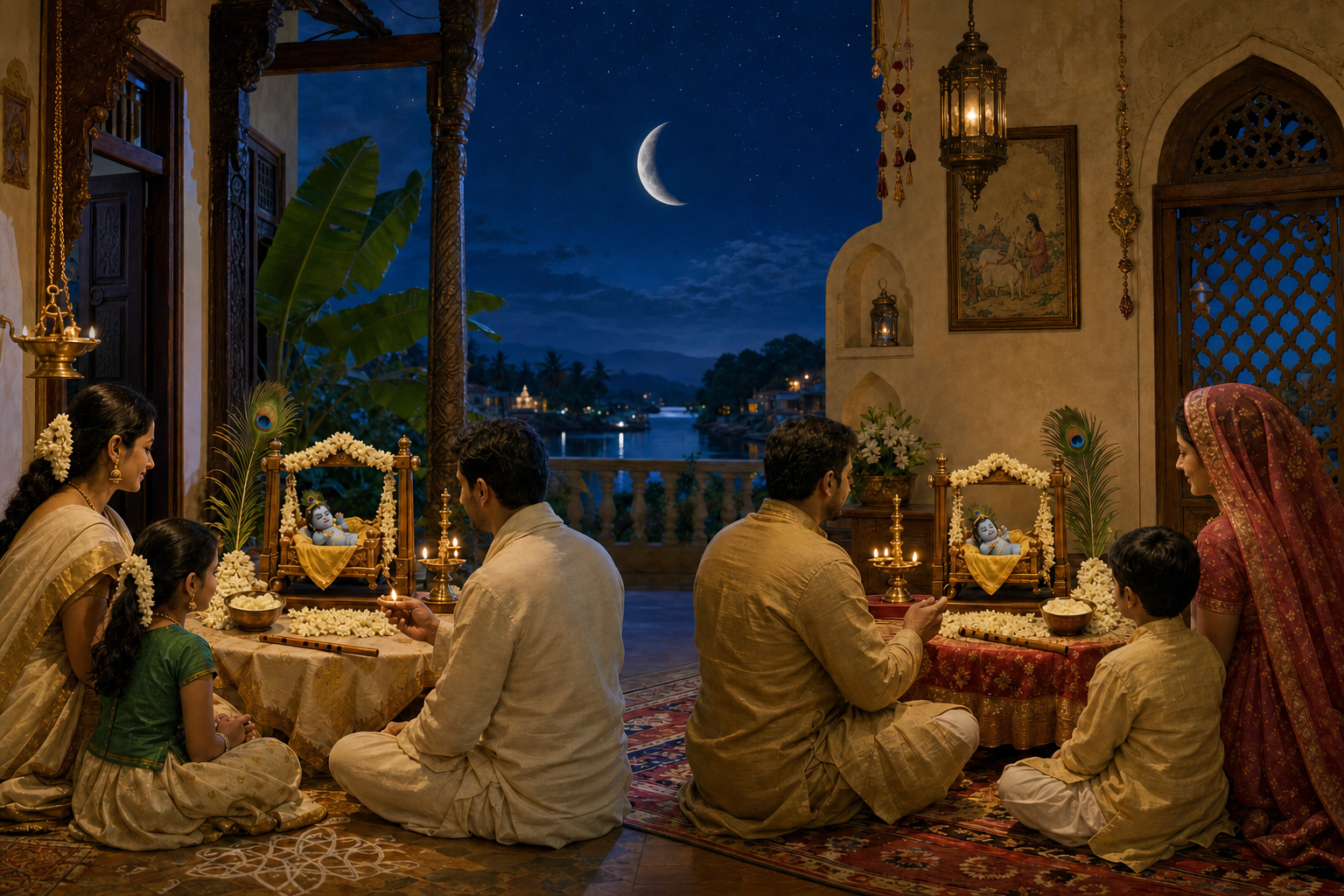
The apparent month mismatch around Janmashtami is usually a calendar convention, not evidence that one side has chosen a different Krishna Jayanti. The festival falls on Krishna Paksha Ashtami. Calendars followed in Maharashtra, Gujarat, Andhra Pradesh, Telangana and Karnataka place it in Shravan, while North Indian Hindi calendars followed in Uttar Pradesh, Himachal Pradesh, Haryana, Punjab and Madhya Pradesh place it in Bhadrapad.
This distinction matters when you compare printed calendars, family messages and temple announcements. If one relative says “Shravan Krishnashtami” and another says “Bhadrapad Janmashtami,” compare the tithi and local civil date before assuming that either calendar is wrong.
Use the name familiar to your community on invitations, but add one alternate name when guests come from several regions. “Sri Krishna Janmashtami (Gokulashtami),” for example, makes the event recognizable without turning a devotional invitation into a debate over terminology. Sri Krishna Jayanti, Krishnashtami and Gokulashtami all identify the celebration of Sri Krishna’s birth.
Keep the spiritual focus of each observance distinct
Garuda Panchami: devotion and the mother-son bond
Garuda Panchami is dedicated to Garuda, the vahana of Bhagavan Vishnu. Its observance also gives attention to the love, affection and devotion binding a mother and son. That makes August 17 more than another entry on a crowded Shravan calendar: it offers a clear theme for family reflection.
Garuda Panchami is also closely associated with Nag Panchami observance. If your home knows the day primarily by the Nag Panchami name, ask an elder or family priest whether Garuda is remembered separately within your tradition. Do not merge two sets of customs merely because they share a calendar context; preserve the practice actually handed down in your household.
Janmashtami: centre the celebration on Krishna’s birth
The many names of Janmashtami can make planning look more complicated than it is. Begin with the one point they share: the birth of Bhagavan Sri Krishna on Krishna Paksha Ashtami. Once the local date is confirmed, let your family tradition determine the form of worship instead of assembling unrelated practices from several regional calendars.
If you are hosting people from different traditions, state which schedule you are following. A short note such as “home observance according to our local temple calendar” prevents confusion without implying that other regional practices are invalid.
Hartalika Teej: prepare for two consecutive festival days
Hartalika Teej is a vrata and puja dedicated to Goddess Gauri, or Parvati. It falls on September 14 in 2026, on Shukla Paksha Tritiya in Bhadrapad. Because it comes one day before Ganesh Chaturthi, treat September 14 and 15 as a connected planning block even though each day retains its own deity, meaning and observance.
The practical pressure point is the overnight transition. Do not wait until Hartalika Teej is complete to think about the following day. Separate the materials, household duties and invitations for each observance in advance. This protects the devotional focus of Hartalika Teej while preventing Ganesh Chaturthi preparations from becoming a last-minute scramble.
Build a household calendar that can survive regional differences
A reliable festival entry should answer more than “what day is it?” Record the civil date, lunar marker, regional convention and next practical action. That makes the calendar usable by elders concerned with tithi as well as younger family members arranging leave or transport.
- Identify the calendar tradition your household normally follows. Do this before comparing dates from different states or countries.
- Check a panchanga calculated for your location. A festival’s lunar marker is fixed by tradition, but its appearance on a civil calendar must be confirmed locally.
- Ask whether the family is keeping a vrata, conducting puja, attending a temple programme or combining these. The festival name alone does not settle the household schedule.
- Put consecutive observances into one preparation window. For 2026, reserve September 14 for Hartalika Teej and September 15 as the Ganesh Chaturthi planning date, subject to local confirmation.
- Give every entry a concrete next action: contact the temple, consult an elder, confirm the worship period, arrange leave or assign preparations.
A useful entry could read: “14 September 2026 — Hartalika Teej — Shukla Paksha Tritiya, Bhadrapad — Goddess Gauri/Parvati — confirm our household’s puja and vrata practice.” This format tells everyone what is established and what still needs an answer.
Keep temple events and home observances as separate calendar entries, even when they concern the same festival. A community programme may be scheduled for convenience, while your home follows the relevant tithi. One entry should not silently replace the other.
Key takeaways
- Reserve August 17, 2026, for Garuda Panchami, an observance dedicated to Garuda and associated with the bond between mother and son.
- Anchor Janmashtami to Krishna Paksha Ashtami and verify its civil date locally; Shravan and Bhadrapad labels can both be correct under different regional calendars.
- Reserve September 14 for Hartalika Teej, dedicated to Goddess Gauri or Parvati.
- Because Hartalika Teej precedes Ganesh Chaturthi by one day, use September 15 as the next planning date and confirm it through your local panchanga.
- Store the civil date, tithi, regional convention and household action together so that a naming difference does not become a scheduling mistake.
Open your calendar now and create the August 17 entry, a locally verified Janmashtami entry, and a two-day September 14-15 preparation block. Then resolve each unfinished detail with the panchanga, temple or family authority your household already trusts.
References
- Hindu Pad — Janmashtami 2026 | Krishnashtami | Gokulashtami | Sri Krishna Janmashtami
- Hindu Pad — Hartalika Teej 2026 | Hartalika Teej Vrat & Puja
- Hindu Pad — Garuda Panchami 2026 | Garuda Panchami Vrata