

An administrative order, a proposed endowment law, an access restriction, or a dispute over a sacred site can force a Dharmic institution into public advocacy before its trustees feel ready. The first statement may define the issue for officials, devotees, tenants, journalists, and the wider public. If it overstates the law or the evidence, correcting the record later will be difficult.
If you are a trustee, office-bearer, community convenor, or volunteer, your task is to convert a legitimate concern into a disciplined constitutional case. That means identifying the precise state action, proving its practical effect, asking for a lawful remedy, and keeping mobilisation peaceful enough that the conduct of the campaign strengthens rather than weakens its claim.
This is an institutional decision framework, not legal advice on a particular dispute. A qualified Indian lawyer should review the applicable statute, current procedural posture, limitation periods, and proposed public claims before your institution files a representation or begins litigation.
Key takeaways
- Name the exact government action, its current legal status, the responsible authority, and every response deadline before describing it publicly.
- Separate religious affairs from secular administration, property, heritage conservation, and public-order questions. Different constitutional and statutory rules may govern each one.
- Build a claim ledger linking every factual assertion to a document, witness, account, expert finding, or clearly labelled inference.
- Ask for a narrow remedy tied to the proven harm, then offer workable alternatives such as audits, registries, consultation, temporary oversight, or protected revenue substitution.
- Use non-coercion, verified communication, listening, and seva as operating rules. Dharmic values become persuasive in public life when they control institutional conduct.
Classify the state action before framing the grievance
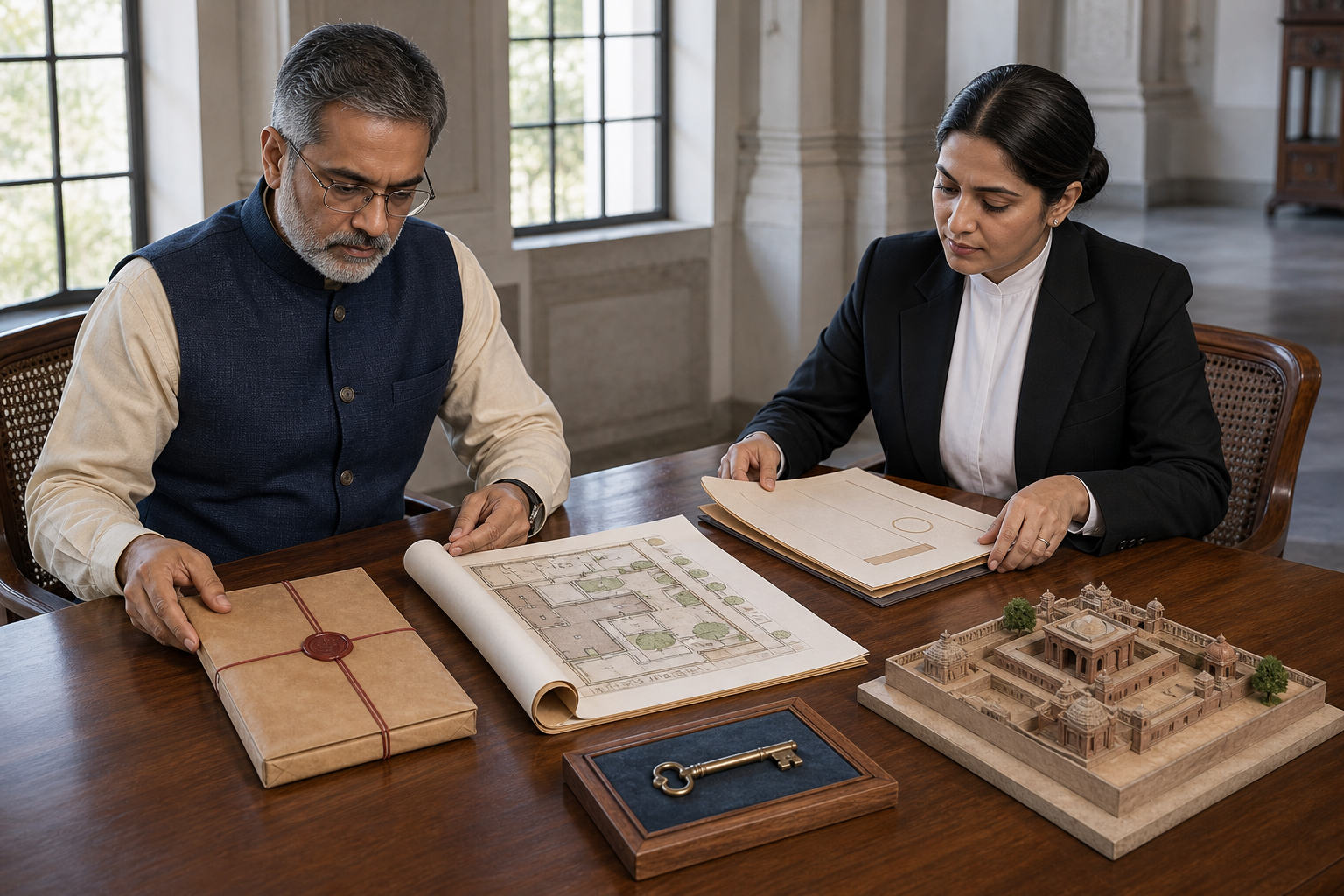
Constitutional protection is not activated by calling every dispute an attack on Dharma. Begin with classification. Is the institution responding to a draft policy, an introduced bill, an enacted statute, a rule, an audit direction, a takeover order, a land notice, a conservation restriction, or an oral instruction from an official? Each has a different authority, forum, evidentiary need, and route of challenge.
Articles 25 and 26 are the central constitutional reference points, but they do different work. Article 25 protects freedom of conscience and the profession, practice, and propagation of religion, subject to public order, morality, health, and other constitutional limits. Article 26 protects qualifying religious denominations in managing religious affairs, owning and acquiring property, and administering property in accordance with law. The religious-affairs and secular-administration distinction is therefore the hinge of many institutional disputes.
Neither side of that distinction should be exaggerated. A governance concern does not automatically justify extinguishing an institution’s property or depriving it of the means needed for worship. At the same time, religious ownership does not place every account, lease, employment decision, or property transaction beyond lawful regulation. Ask counsel whether Article 26 applies to the particular institution; registration as a trust does not, by itself, answer every denomination-specific constitutional question.
Complete a legal triage sheet
- Identify the act: record the exact title, issuing authority, date, version, annexures, and method of service. Preserve earlier versions if the language changed.
- Confirm the status: distinguish a proposal open to consultation from binding law, and a preliminary notice from a final order. Do not campaign against powers that the text does not actually contain.
- Establish standing: record who owns, manages, worships at, works for, leases from, or receives services from the institution. Obtain the trustee resolution authorising representation and litigation.
- Name the impaired function: specify whether the measure affects ritual continuity, appointment of religious functionaries, property administration, recurring income, charitable service, access, conservation, or public safety.
- Map the legal fields: identify the constitutional, trust, land, tenancy, heritage, municipal, and public-order rules that may apply in that state.
- Calendar the procedure: record consultation dates, reply periods, appeal routes, hearing dates, and court deadlines. A persuasive constitutional theory cannot repair a missed limitation period.
- Define the remedy: state what the competent authority can lawfully do now, rather than asking an official for relief that only a legislature or court can grant.
The major temple-autonomy cases should be used with similar precision. The Shirur Mutt, Ratilal, Seshammal, and Subramanian Swamy line of authority distinguishes protected religious affairs from regulable secular administration, considers whether regulation leaves an institution capable of sustaining religious practice, and treats corrective state intervention as something that must remain justified and proportionate. Those principles guide analysis; they do not produce the same answer for every trust, property, or statute.
Do not make one heritage claim do four legal jobs
A sacred-site dispute can contain several questions that must be proved separately: the site’s historical character, the nature of present worship, legal title or management authority, and the conservation or access regime. An inscription may illuminate historical character without proving present title. Continuous worship may matter greatly without resolving how a protected monument must be conserved.
These matters may also engage the Ancient Monuments and Archaeological Sites and Remains framework, the Places of Worship (Special Provisions) Act, 1991, Articles 25 and 26, and public-order powers. Their application depends on the site’s legal status, procedural history, evidence, and relief sought. Treat any public claim about their effect as a legal conclusion requiring case-specific review.
Build a record that can survive scrutiny

Good advocacy has at least two demanding audiences: an administrator who needs a workable decision and a court that may later examine the record. Build for both from the beginning. A folder full of devotional material is not a substitute for title records, audited accounts, official notices, or qualified heritage evidence. Equally, a property file that never explains the religious and charitable functions at risk leaves the constitutional harm abstract.
Create an evidence index organised around the propositions you need to prove:
- Operative materials: the complete bill, order, notice, circular, map, schedule, annexure, amendment, official translation, and proof of service.
- Institutional standing: trust deeds, endowment grants, governing instruments, succession or appointment records, trustee resolutions, property cards, title records, leases, and pending case details.
- Governance condition: audited accounts, statutory filings, conflict disclosures, internal controls, encroachment records, related-party transactions, and corrective steps already taken.
- Functional impact: the connection between each affected asset or revenue stream and daily worship, festivals, staff or archaka support, kitchens, pathshalas, scholarships, goshalas, pilgrim facilities, health outreach, maintenance, and conservation.
- Affected people: verified information about tenants, cultivators, employees, devotees, service-holders, neighbouring residents, and beneficiaries. Record disagreements instead of erasing them.
- Expert material: reports whose authors, methods, qualifications, source materials, and degrees of certainty can be examined independently.
For an endowment dispute, do not stop at saying that the land was historically dedicated to a temple. Show what the land produces, which obligations depend on that recurring income, what costs are fixed, and what would happen under the proposed conversion, compensation, or annuity. Separate audited figures from estimates and estimates from worst-case scenarios. If compensation is proposed, test whether it preserves a continuing capacity to meet continuing obligations rather than merely replacing a perpetual asset with a nominal one-time payment.
Do not cast cultivators or tenants as obstacles to Dharma. Security of tenure, protection from arbitrary eviction, and predictable obligations are legitimate interests. A credible institutional position explains how those interests can coexist with a sustainable rent, revenue-share, or other lawful arrangement that preserves the endowed purpose.
For a contested sacred site, assemble evidence by discipline. Relevant material may include epigraphy, architectural typology, iconography, archival and gazetteer records, ASI material, expert testimony, and evidence of worship or use. Record provenance and preserve originals. Mark a hypothesis as a hypothesis. Do not present a stylistic resemblance as a settled date or an inscriptional fragment as proof of a proposition it does not state.
Never excavate, alter, occupy, enter, clean, repaint, or remove material from a disputed or protected site without lawful authority and professional supervision. Apart from the legal exposure and public-order risk, physical intervention can destroy the very evidence on which a heritage claim depends.
Turn the evidence into a focused memorandum
A memorandum should let a decision-maker understand the issue without first adopting your civilizational vocabulary. Use a clear sequence:
- Relief sought: state the immediate request at the top.
- Authority and status: identify the measure, decision-maker, procedural stage, and institution’s standing.
- Material facts: give a restrained chronology with an annexure reference for every important claim.
- Constitutional and statutory frame: explain which protected function or property interest is affected and which lawful regulatory objective the state is pursuing.
- Demonstrated impact: connect the measure to actual worship, service, financial, tenancy, access, or conservation consequences.
- Proportionality: ask whether the measure addresses a proved problem, whether a less intrusive method can do so, and whether safeguards reduce the burden.
- Primary and alternative remedies: offer an implementable path instead of relying on an all-or-nothing demand.
- Annexure index and contact: make verification easy and identify the person authorised to answer questions.
A useful remedy paragraph can follow this form: Our institution supports the legitimate objective of transparent and accountable administration. We seek reconsideration of the identified measure because the attached records show that it would impair the specified religious or charitable function. We request consultation and adoption of the less restrictive alternative described below, with interim protection against irreversible consequences while the review is completed.
Match the alternative to the alleged problem. Suspected encroachment may call for a digital asset registry and geospatial verification. Weak accounts may call for independent audits, standard disclosures, trustee training, and conflict-of-interest controls. Proven maladministration may justify targeted, time-bound supervision with review and a clear return mechanism. A proposed conversion of endowed property may require recurring, inflation-responsive compensation, a ring-fence against diversion, and independent review of whether religious and charitable obligations remain funded.
Where legislation is still being designed, useful requests may include an asset and service-impact white paper, district-level consultation, a clause-by-clause constitutional justification, publication of compensation assumptions, and representation for religious institutions, tenants, cultivators, heritage specialists, accountants, and legal scholars. The Maharashtra endowment debate illustrates why revenue continuity, governance reform, and tenant protection must be designed together.
Make public advocacy enlarge the record

Public mobilisation should help officials understand the issue, help affected people participate, and help the institution discover weaknesses in its own position. It should not turn a precise legal dispute into a broad accusation against a community, profession, or every level of government.
Run the campaign through distinct but coordinated workstreams:
- Legal and evidence work: counsel, trustees, accountants, historians, conservation professionals, and authorised record custodians maintain the verified case file.
- Public communication: a designated team publishes the operative text, institutional position, remedy sought, hearing information, and corrections. It should never improvise legal conclusions.
- Dialogue and participation: local convenors hear devotees, tenants, staff, women, youth, neighbouring communities, and service beneficiaries before large public events harden positions.
- Seva and continuity: the institution keeps worship, charitable service, maintenance, and assistance to affected people functioning as far as lawfully possible.
Listening is not a ceremonial preface to a predetermined resolution. Small-group consultations can surface local facts that a central committee misses. Larger assemblies can then test areas of agreement. Neutral ground rules, accurate notes, named responsibility for follow-up, and an open correction process make the consultation usable. Stakeholder mapping, listening circles, guided samvad, local-language communication, and feedback loops offer a practical model for regional outreach.
Your standard public statement should answer the questions a careful reader will have:
- What exactly has happened, and is it a proposal, notice, final order, or court development?
- Which verified religious, charitable, property, livelihood, access, or heritage interest is affected?
- What evidence supports that claim, and what remains uncertain or disputed?
- Which authority has power to act, and what precise remedy is being requested?
- What lawful action can a supporter take, such as filing a representation, attending a consultation, supplying a record, or correcting misinformation?
- What conduct is prohibited within the campaign, including coercion, threats, communal denigration, unauthorised site activity, and publication of private information?
A concise message can read: Our institution seeks review of the identified measure because the attached evidence connects it to a specific impairment of worship, service, heritage, or livelihood. We support transparent administration and propose a less restrictive solution. Participation must remain lawful, non-coercive, fact-based, and respectful toward every affected person.
Dharmic language should govern the campaign rather than decorate it. Ahimsa rules out intimidation and reckless escalation. Anekantavada requires you to examine what another stakeholder can see that your committee cannot. Karuna keeps employees, tenants, and vulnerable beneficiaries visible. Seva turns institutional solidarity into practical assistance. Sarbat da Bhala asks whether the remedy protects the wider good as well as the institution. These principles are fully compatible with firm advocacy.
Non-partisan advocacy does not mean silence about policy. It means that the institution’s evidence, remedy, and conduct do not change with the party in office. Keep elected-party slogans, candidate endorsements, and electoral rivalry away from a constitutional campaign unless the institution has obtained specific legal and governance advice about its authority to engage in them.
Use a visible verification process
Maintain a claim ledger with fields for the claim, evidence, confidence level, responsible reviewer, publication status, and required correction. Route public claims through a designated verification channel. Mark unconfirmed reports as unconfirmed, and do not publish them merely to deny them. If an error has already circulated, correct it through the same channel and preserve the correction.
Check local permission requirements before assemblies, processions, sound amplification, or use of public space. Coordinate through recorded, respectful communication with the competent authority. Public order is an express constitutional limitation; creating an avoidable safety problem can overshadow the substantive rights the institution is trying to protect.
Protect the campaign from avoidable legal and civic damage

A campaign can have a strong underlying case and still fail through a missed deadline, unauthorised claim, governance defect, or inflammatory message. Conduct a risk review before every filing, public meeting, fundraising appeal, and major update.
- Procedural risk: confirm who must reply, who may sign, which forum has jurisdiction, and whether a filing or appeal deadline is running.
- Accuracy risk: distinguish a historical inference from a judicial finding, a proposed clause from enacted law, and an allegation from a proved event.
- Litigation risk: if proceedings are pending, let counsel review descriptions of what the court has held, the relief presently sought, and material that may affect contempt, confidentiality, or trial fairness.
- Defamation and safety risk: do not name private people as encroachers, corrupt actors, or offenders without a legally reviewed evidentiary basis. Never publish home addresses, identity records, or sensitive personal data as mobilisation material.
- Governance risk: document trustee authority, spending approval, donation restrictions, conflicts of interest, and custody of records. Correct internal defects rather than concealing them.
- Partisan-capture risk: apply the same speaking rules to every guest, keep the requested remedy visible, and prevent an institutional platform from becoming an electoral rally.
- Escalation risk: establish a non-coercion code, a process for removing disruptive participants, and a channel through which affected people can raise complaints without confronting a crowd.
- Heritage risk: prohibit unauthorised physical action at the site and refer conservation questions to the competent authority and qualified professionals.
Seek immediate professional advice when possession, title, acquisition, demolition, sealed premises, criminal allegations, imminent limitation periods, court orders, or irreversible changes to a protected site are involved. A public memorandum cannot substitute for an application, appeal, injunction request, or statutory response that must be filed in the proper forum.
Measure whether advocacy is producing institutional capacity
Attendance and online reach are outputs, not proof that the institution is safer or the policy is better. Maintain a decision log that tracks official acknowledgements, substantive replies, consultation opportunities, verified evidence added, misinformation corrected, governance improvements completed, service interruptions prevented, stakeholder commitments, and unresolved grievances.
Use a baseline and follow-up snapshot of what participants know, believe, and can actually do. Participation breadth, community-led follow-ups, knowledge-attitude-practice snapshots, and continuing consultation can reveal whether trust and civic competence are growing beyond a single event. Record who owns each commitment and when it will be reviewed.
A constitutional campaign has succeeded in part when the institution can produce better accounts, a cleaner title file, a verified heritage record, a workable tenant arrangement, a proportionate policy alternative, or a durable consultation channel. Litigation may still be necessary, but institutional competence makes both advocacy and litigation more credible.
Before your next public statement, require the exact operative instrument, an indexed evidence file, a written remedy, and an enforceable code of conduct. If any of them is missing, pause the claim that depends on it, assign responsibility, and obtain the legal or technical review needed to complete the record.
References
- DharmaRenaissance Blog – Sadguru Dr Charudatta Pingale’s Madhya Pradesh Abhiyan Sparks Dharmic Unity and Dialogue
- DharmaRenaissance Blog – MP High Court Recognizes Dhar’s Bhojshala as a Hindu Temple: Evidence, Law, and Legacy
- DharmaRenaissance Blog – Mandir Mahasangh’s Statewide Drive Challenges Maharashtra Devasthan Inam Abolition Draft 2026