
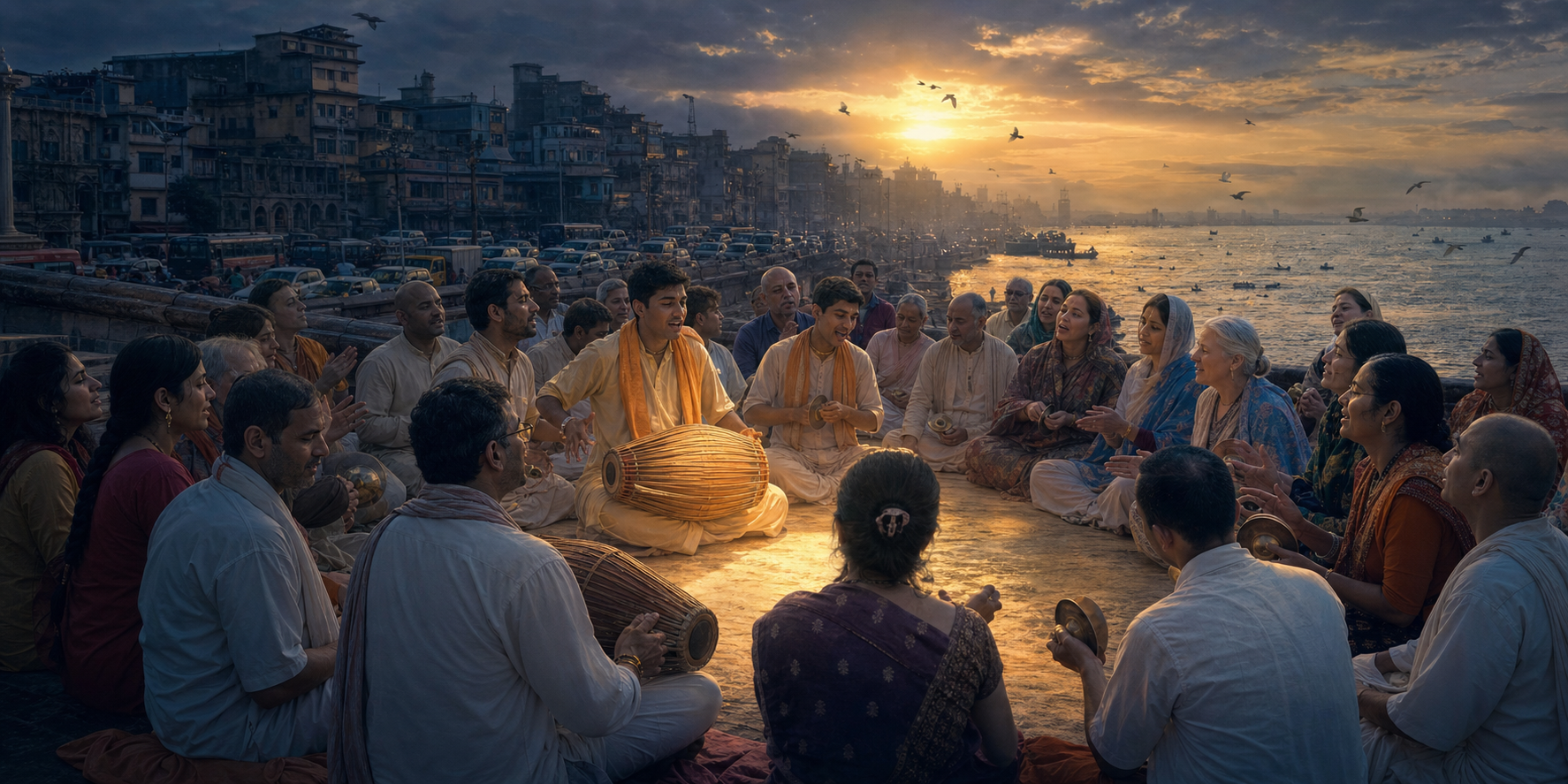
You may understand why chanting matters and still hesitate when Krishna consciousness is called the movement for Kali-yuga. Does that mean a modern organisation is divine? Does taking shelter of Krishna’s name guarantee that nothing painful will happen? And what should the claim change in your life tomorrow morning?
The answer begins with a distinction that protects both faith and judgement. In this Vaishnava understanding, the incarnation is Krishna present through His holy name. Institutions, leaders and public campaigns can serve that descent, but they must never replace it.
The claim rests on Krishna’s name, not an institution
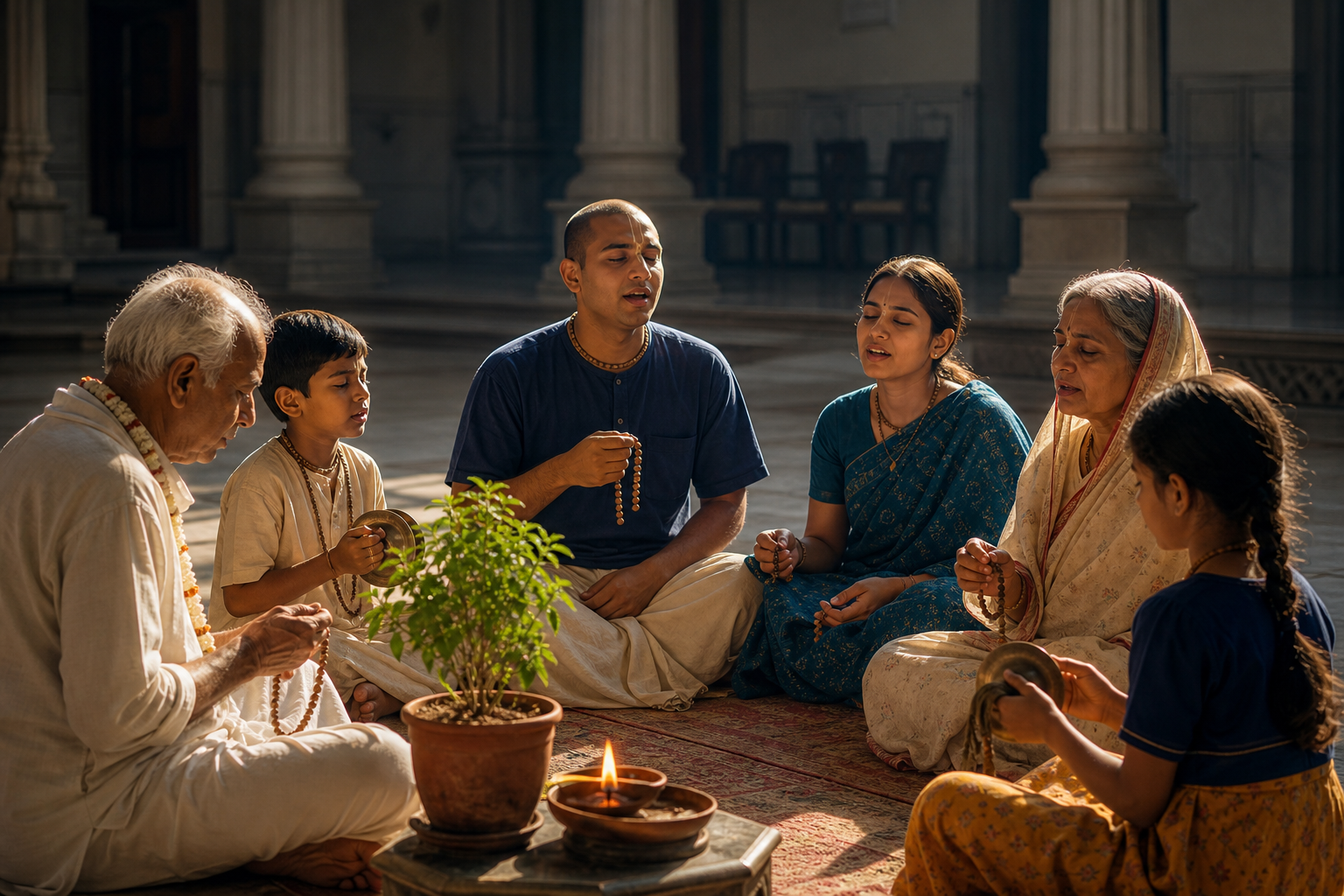
Within the Vaishnava teaching articulated by A.C. Bhaktivedanta Swami Prabhupada, Krishna need not appear only in a visible bodily form. He can descend in sound: nama-rupe avatara, an incarnation in the form of the name. The theological basis is that Krishna’s name is nondifferent from Krishna. The holy name is therefore understood as complete, pure and spiritually potent, not as a verbal reminder of an absent deity.
Ordinary names point towards things. Saying the name of water does not place water in your hands. This teaching makes a particular claim about divine omnipotence: Krishna is capable of being present through His own name. Chanting is consequently an encounter and an act of shelter, not merely a technique for producing a peaceful mood.
This also tells you what the word movement means here. A society can arrange temples, publications, festivals and teaching. Those activities matter when they carry the holy name and help people enter devotional service. They do not make an administration infallible. Buildings can be closed, programmes can be interrupted and office-holders can fail; none of those events can reduce the spiritual completeness attributed to Krishna’s name.
When evaluating any Krishna-conscious community, ask whether it is directing attention towards Krishna or making the institution, leader, status system or controversy the centre. The movement remains true to its stated identity only while it serves the descent of the name.
The same test applies to you. A Vaishnava does not claim to become God through chanting. The devotee understands himself or herself as an eternal and subordinate servant of God. If spiritual practice increases entitlement, self-deification or hunger for control, something has moved away from Krishna consciousness even if the vocabulary remains devotional.
Why sankirtana addresses Kali-yuga’s actual disorder
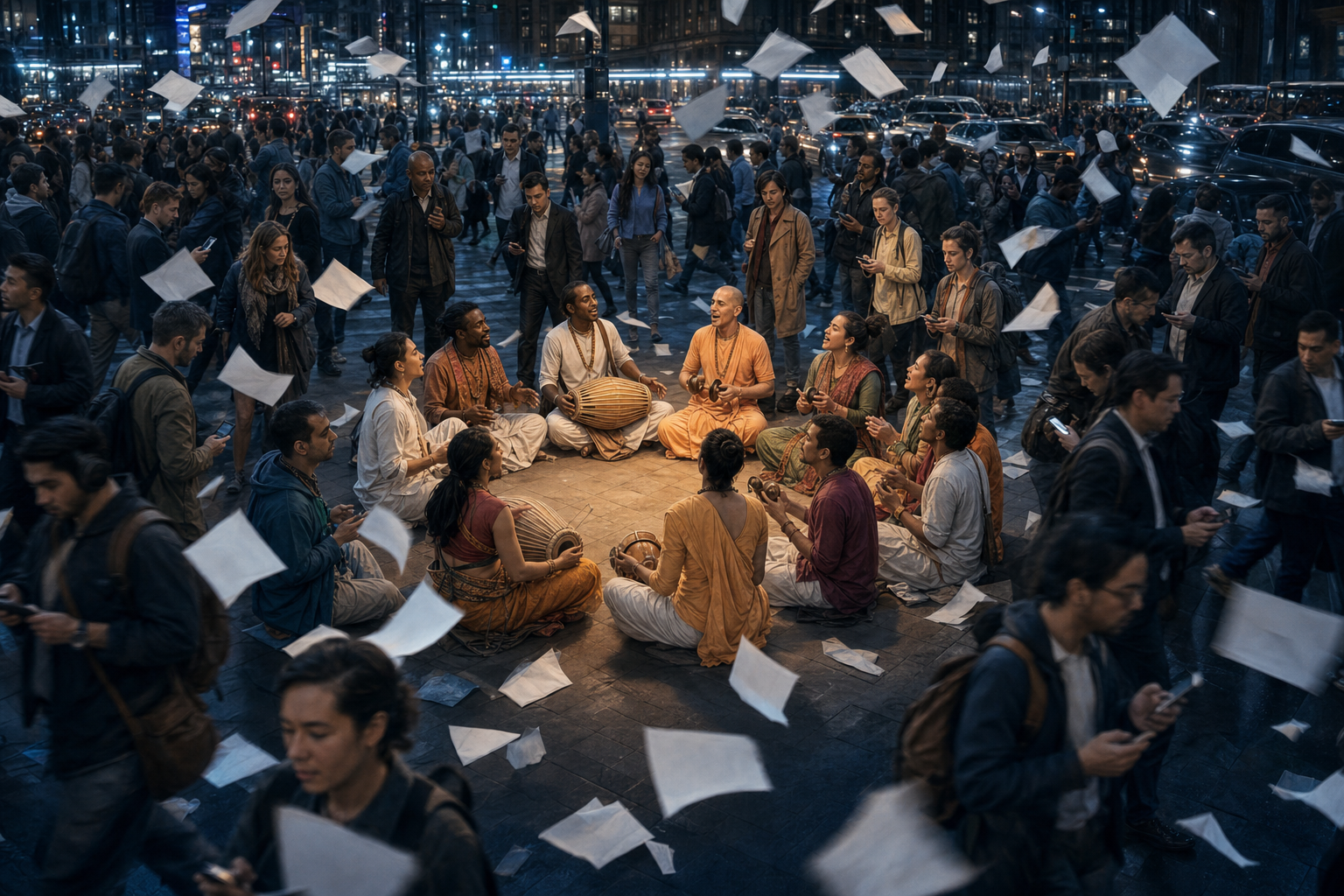
Kali-yuga is not diagnosed merely as an age with unpleasant politics or declining manners. Its deeper disorder is estrangement from God, disruption of dharma and the elevation of personal gratification over devotional duty. Opposition to devotees is one outward symptom. The inward symptom is the same impulse working within the individual: whatever obstructs my desire must be dismissed or attacked.
Sankirtana answers that disorder by repeatedly placing Krishna, rather than the isolated ego, at the centre. Personal chanting trains you to hear the name instead of following every demand of the mind. Congregational chanting makes remembrance shared and audible. Service then carries that orientation into conduct. These are not three competing programmes. They are three dimensions of one movement.
This gives you a practical way to test your priorities. If discussion of Kali-yuga leaves you agitated about enemies but rarely brings you to Krishna’s name, the diagnosis has displaced the remedy. Defending space for Dharmic life can be necessary, but political reaction cannot become the engine of Krishna consciousness. The engine is sankirtana, supported by service and the servant’s disposition.
You also do not need to search for opponents in order to prove that the movement is authentic. Harassment should be recognised when it occurs, but mere disagreement does not establish demonic intent. Being criticised is not proof of spiritual purity. Examine conduct precisely, respond without fear and refuse to let resentment occupy the place meant for remembrance of Krishna.
The first battlefield of Kali-yuga is therefore close at hand. Notice the moment when convenience asks you to abandon a devotional commitment, when pride wants credit for service or when anger makes another person’s hostility more absorbing than Krishna’s name. That is where the movement becomes a present discipline rather than a theory about the age.
Protection means fidelity, not insulation from hardship
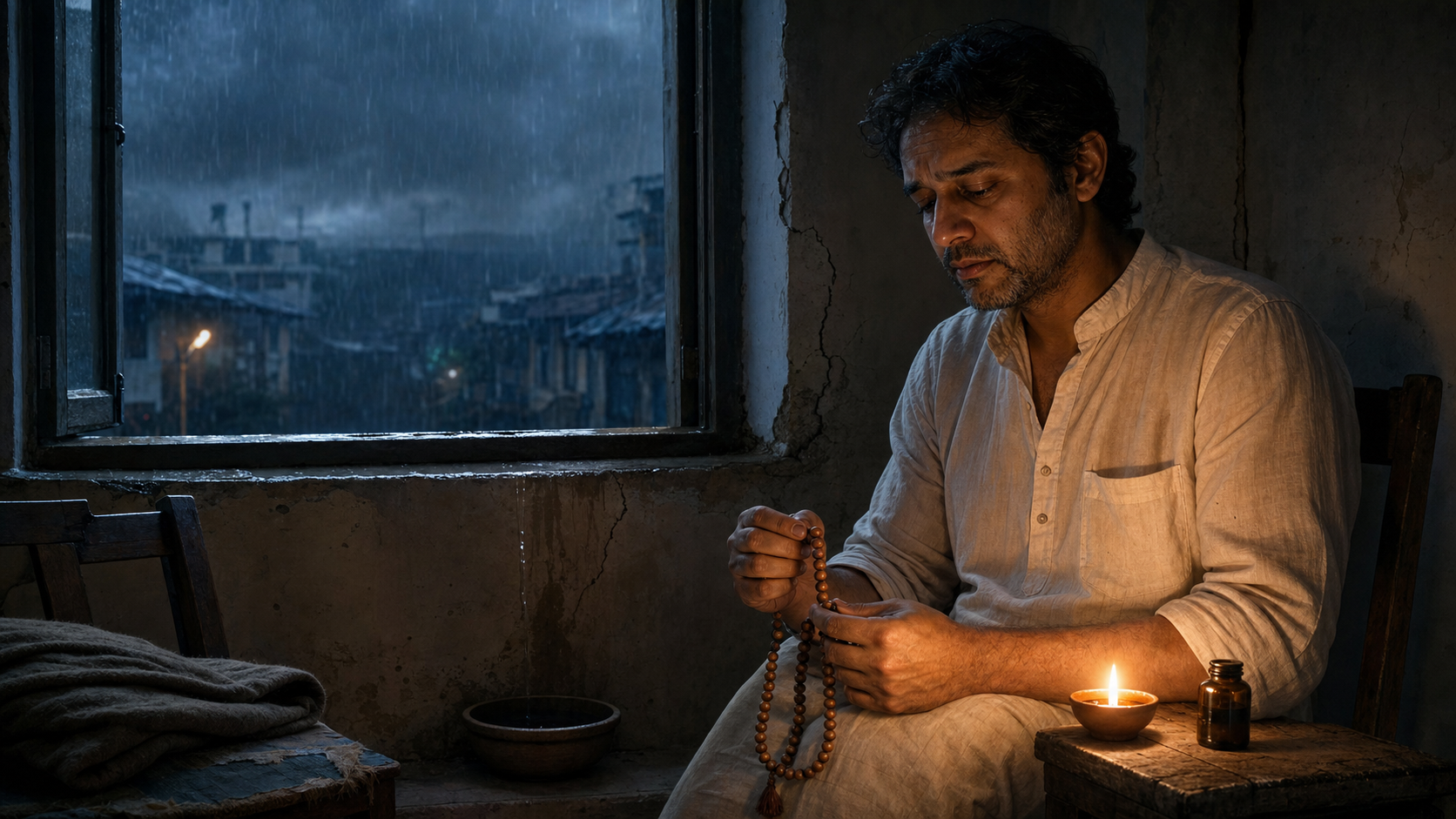
Surrender, or saranagati, includes confidence that Krishna will protect His devotee. Bhagavad-gita 9.31 expresses the assurance in the words na me bhaktah pranasyati: Krishna’s devotee will not be lost or annihilated. This promise is meant to produce courage in devotional service.
It is not a guarantee of uninterrupted comfort. Prahlada was tormented by his own father before Narasimha protected him. Devaki and Vasudeva suffered under Kamsa before his power was ended. These examples place danger, waiting and distress inside the narrative of protection rather than pretending they never occur.
For you, the distinction matters most when fear starts dictating conduct. Protection means that hostility cannot make Krishna’s shelter spiritually ineffective and should not force you to abandon devotional service. It does not give you a timetable for relief, immunity from consequences or permission to take needless risks.
When pressure rises, use four questions to keep surrender concrete:
- Which devotional duty am I being tempted to abandon?
- What safe and lawful action will preserve my ability to continue that duty?
- Am I protecting service to Krishna, or merely defending my pride and public image?
- What act of chanting, remembrance or service can I continue under the present conditions?
Do not confuse faith with remaining inside avoidable danger. Seeking safety, reporting violence, accepting medical help or asking trustworthy people for assistance does not negate surrender. The teaching gives you a reason not to abandon Krishna; it does not require you to abandon prudent action.
Nor does special protection mean partiality based on divine insecurity. Krishna is described as equal towards all beings while giving particular care to those who approach Him in loving service. The practical response is not superiority over non-devotees. It is deeper responsibility: if you claim shelter, your choices should increasingly display the humility and steadiness of someone who trusts that shelter.
A daily practice that keeps the movement centred on Krishna

A large historical claim can remain emotionally attractive while changing very little. To receive Krishna consciousness as the Kali-yuga movement, give the holy name a stable place in your day and let it govern what follows. If you already follow a practice given by your guru, remain faithful to that commitment. Otherwise, the following sequence offers a sustainable starting structure without pretending to replace formal guidance.
- Choose a dependable daily anchor. Attach chanting to a duty that already happens consistently, such as your morning preparation or the close of your evening responsibilities. A stable cue is more useful than waiting to feel spiritually inclined.
- Hear the name you pronounce. Chant clearly enough for your own attention to receive the sound. When the mind moves elsewhere, return to hearing without turning distraction into a second drama.
- Begin from the servant’s position. Before chanting, state the intention plainly: this time is for remembering and serving Krishna, not for displaying attainment or demanding a particular experience.
- Join sankirtana when you can. Congregational chanting corrects the tendency to make spiritual life entirely private. Choose association that keeps Krishna’s name central rather than organising itself around status, personalities or hostility towards outsiders.
- Carry remembrance into a definite service. After chanting, complete a duty with greater honesty, patience or care. The purpose is not to purchase Krishna’s favour but to stop separating sacred sound from daily character.
- Review your motive under pressure. When criticised or obstructed, ask whether your response protects devotional service or personal gratification. Continue the service, adjust the method if necessary and do not manufacture a confrontation merely to feel courageous.
There is an important moral boundary here. Prahlada witnessing Narasimha’s action and Arjuna fighting after Krishna’s instruction are particular scriptural circumstances. They do not give an ordinary person a blank cheque to sanctify preference, vengeance or an institutional command by saying it is for Krishna. Strong emotion is not proof of divine authorisation.
The safer application is demanding but clear: do not abandon a genuine dharmic duty merely because it is costly, frightening or uncomfortable. At the same time, keep that duty subject to truthful discernment. An instruction requiring deceit, abuse or private retaliation should not escape scrutiny because it carries devotional language. Service reduces self-interest; it does not give self-interest a sacred disguise.
You can measure progress without chasing dramatic experiences. Notice whether you return to the name more readily, keep commitments more steadily, need less recognition for service and recover from provocation without making the opponent the centre of your consciousness. Those changes show the movement operating where Kali-yuga actually reaches you.
Key takeaways
- Krishna consciousness is called the Kali-yuga movement because Krishna is understood to descend through His holy name.
- The claim belongs to the principle of nama-avatara, not to the infallibility of a particular administration or personality.
- Sankirtana counters forgetfulness of God by making remembrance audible, shared and connected to service.
- Krishna’s protection gives courage to remain faithful; it does not promise comfort, instant rescue or freedom from prudent safety measures.
- A devotee’s governing identity is servant, not God, victim, hero or owner of the movement.
- Claims of acting for Krishna must not become shortcuts around dharma, honest discernment or moral responsibility.
Begin with the next repeatable opportunity, not a grand declaration. Set your daily anchor, chant with attention and follow it with a real act of service. When opposition comes, protect the service without feeding the ego. That is how the Kali-yuga movement moves from a theological claim into your consciousness.