
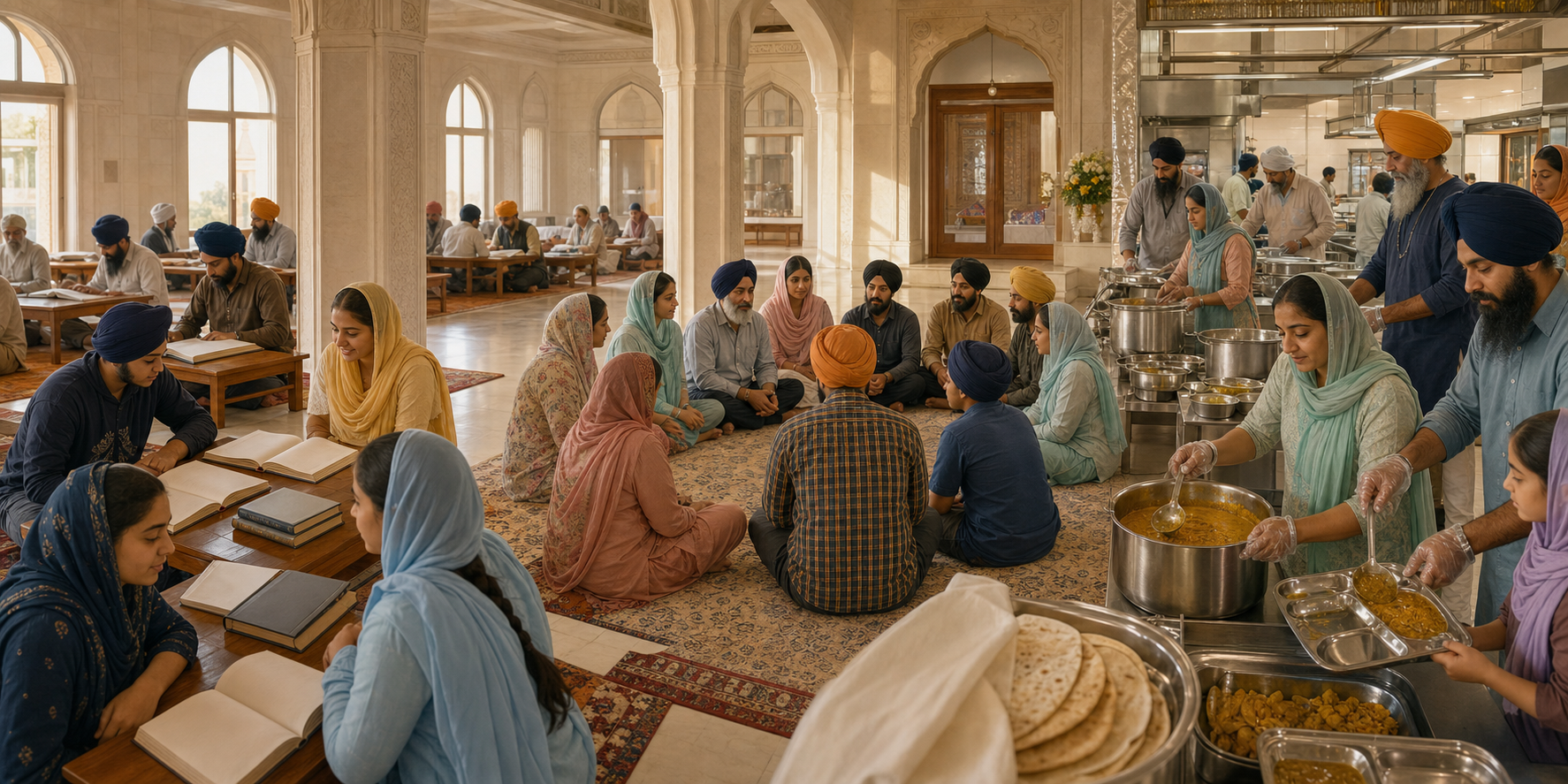
You may be reading Gurbani seriously, helping with langar, teaching younger Sikhs, or taking responsibility in a gurdwara. The tension appears quickly: study can remain in the head, while seva can become a rota of tasks with little reflection. You want both to deepen Sikhi rather than compete for your time.
Treat teaching, scholarship, and service as a single feedback loop. Sikh teaching gives seva its purpose. Seva tests whether your interpretation produces dignity rather than ego. Scholarship helps the sangat examine the result honestly and correct its course.
Trace the path from Oneness to responsibility
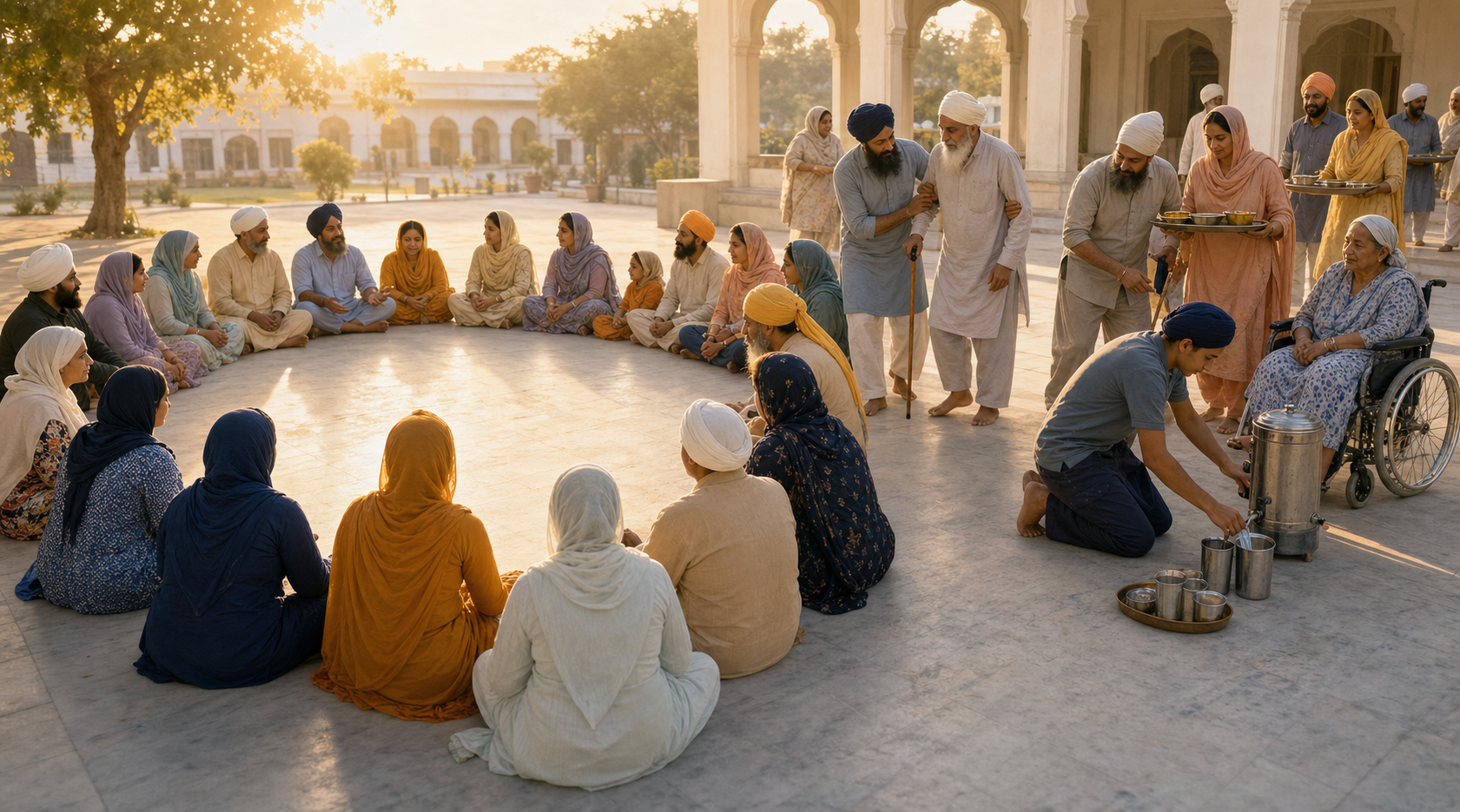
Sikh principles are often presented as a collection of admirable words. Their practical force appears when you follow the connection between them. Ik Onkar, Naam, Shabad, Hukam, Kirat Karni, Vand Chakna, Seva, and Sarbat da bhala form a connected moral architecture, not a menu from which you select the easiest virtue.
Ik Onkar supplies the metaphysical ground: reality is grounded in Oneness. That is not a shortcut for claiming that every person, belief, or action is identical. It means that another person’s dignity cannot be dismissed as spiritually irrelevant. Naam, divine remembrance, and Shabad, the sacred Word, train attention so this conviction can govern conduct rather than remain an abstraction.
Hukam then places the individual within an order larger than personal preference. Haumai pulls in the other direction. It makes status, possession, recognition, and control appear more important than truthful action. The Gurmukh-Manmukh distinction therefore has an immediate use: it asks whether you are becoming receptive to the Guru or merely arranging religious language around the demands of ego.
Kirat Karni carries this discipline into livelihood through honest work. Vand Chakna carries it into the use of what you earn by making sharing a spiritual obligation. Seva gives the ethic a communal form, while Sarbat da bhala prevents service from shrinking into concern for an approved in-group. The movement is from Oneness, through disciplined attention, into work, sharing, and the welfare of all.
When you face a decision in a family, workplace, study circle, or institution, examine the whole chain:
- Oneness: whose dignity is easiest for us to overlook?
- Naam and Shabad: are we responding from disciplined attention, or from anxiety, anger, and the desire to be seen?
- Hukam and Haumai: does this choice accept responsibility, or protect someone’s status?
- Kirat and Vand: were the resources obtained honestly, handled transparently, and shared fairly?
- Seva and Sarbat da bhala: does the action produce real benefit beyond our immediate circle, without turning the people served into props?
These questions will sometimes produce uncomfortable answers. Do not resolve the discomfort with a slogan. Name the competing duties, establish the relevant facts, notice who will bear the cost, and return to the teaching. That process is already part of Sikh discipline.
Study a Sikh term before turning it into a slogan

Scholarship is not confined to a university. In a Sikh setting, it is an accountable way of knowing: careful with language, honest about evidence, open to correction, and answerable to the sangat. Definitional clarity, transparent reasoning, charitable treatment of disagreement, and intellectual humility are forms of nimrata, not merely academic etiquette.
Use the following method when preparing a talk, class, social-media explanation, or community proposal:
- Keep the Sikh term visible. Give a plain-language gloss, but do not replace Naam with concentration, Hukam with fate, or Seva with volunteering. Each English word captures only part of the meaning.
- Identify the kind of claim you are making. Distinguish Gurbani from historical narrative, Rehat Maryada from local custom, and a scholar’s interpretation from an uncontested definition.
- Read concepts in relationship. Hukam becomes clearer beside Haumai; Kirat Karni belongs beside Vand Chakna; Seva is shaped by Sangat, equality, and Sarbat da bhala.
- Ask what conduct the term requires. If an explanation of Seva changes nothing about access, dignity, money, labor, or responsibility, it is probably incomplete.
- State uncertainty plainly. If Sikhs interpret a question differently, describe the strongest version of each view before giving your judgment. Do not disguise a contested interpretation as settled doctrine.
Seva shows why this precision matters. Translating it only as volunteering can reduce a sacred discipline to donated labor. Calling it selfless service is closer, but still leaves practical questions unanswered. Who decides what help is needed? Can the recipient refuse? Are volunteers seeking recognition? Are funds accounted for? Does the arrangement weaken hierarchy, or quietly reproduce it?
The canon itself teaches disciplined openness. The Guru Granth Sahib serves as the community’s living guide and includes the bani of Sikh Gurus alongside Bhagats such as Kabir, Namdev, Ravidas, and Sheikh Farid. That inclusiveness does not declare all doctrines interchangeable. It demonstrates that spiritual authority can encounter voices across social and religious boundaries without abandoning discernment.
Apply the same discernment online. Verify a quotation before placing it in quotation marks. Never present your paraphrase as Gurbani. Preserve enough context to show what problem a line addresses. If you cannot establish the wording or origin, share the underlying idea in your own words and label it as interpretation. Restraint is more truthful than a memorable misquotation.
Build seva so equality survives contact with logistics
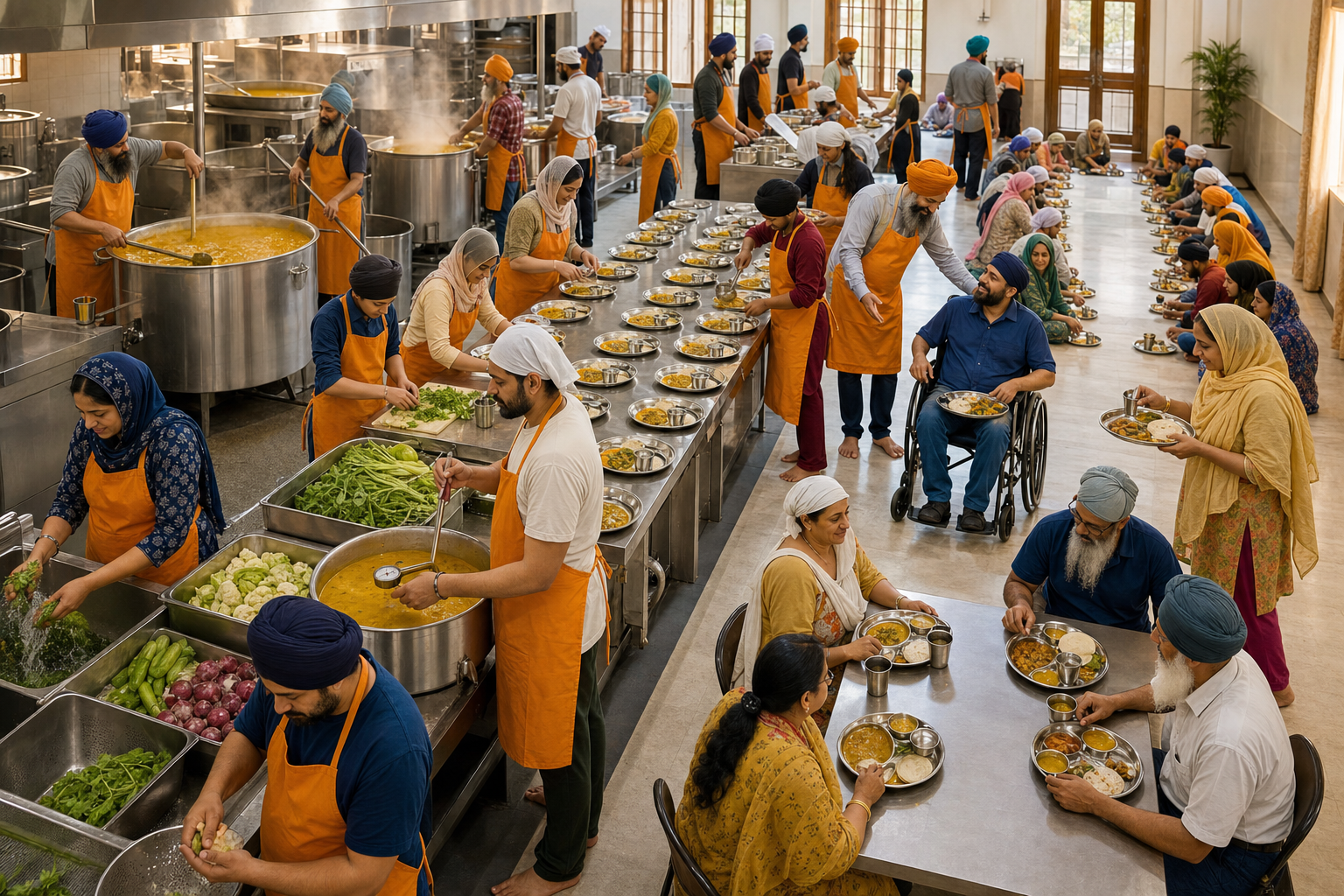
Good intention is not enough. A service effort can feed people while humiliating them, raise money while concealing decisions, or attract volunteers while exhausting the same dependable families. Sikh seva becomes credible when its structure embodies the equality it proclaims.
Use langar as an operating test
Langar is applied theology. The shared meal challenges caste, class, gender, and status through an arrangement in which nourishment and dignity belong together. Its lesson extends beyond a gurdwara kitchen: equality must be designed into the way service is requested, funded, prepared, delivered, and reviewed.
Before calling a project seva, test its design:
- Need: was the need defined with the people affected, or merely assumed by those eager to help?
- Dignity: can someone receive assistance without public exposure, forced gratitude, or a lower-status process?
- Access: have language, mobility, schedule, and unfamiliarity with the institution become hidden barriers?
- Accountability: can the sangat see how money, supplies, authority, and complaints are handled?
- Continuity: is the work repeatable, with clear handoffs, or dependent on an exhausted volunteer who holds everything in memory?
- Learning: will feedback from recipients and volunteers alter the next round of decisions?
This test also protects volunteers from spiritual performance. Before the work begins, name the teaching the activity is meant to embody. Afterward, discuss where impatience, hierarchy, waste, or the desire for recognition entered the process. Then change the process. Reflection without correction is commentary; correction is where reflection becomes seva.
Join livelihood, sharing, and governance
Kirat Karni and Vand Chakna prevent charitable activity from being separated from economic conduct. A donation does not make dishonest earning ethical. Honest earning that never opens into sharing also falls short of the complete discipline. The question is not only how much a community gives, but how its resources were earned, governed, and distributed.
The same standard belongs in gurdwara committees, charities, and cultural organizations. Transparent finances, responsive leadership, clear succession, youth formation, and institutional accountability are moral practices because structures teach. A community cannot convincingly proclaim equality while concentrating information and authority in an unanswerable circle.
Miri-Piri offers a useful governance discipline. Piri keeps spiritual purpose, humility, and conscience in command. Miri accepts temporal responsibility: budgets, policies, leadership, public action, and protection of the vulnerable. Piri without Miri can retreat into pious speech. Miri without Piri can turn service into a contest for influence.
This balance also clarifies the Sant-Sipahi ideal. Courage is not aggression, and restraint is not passivity. Protective strength must remain governed by conscience, proportion, and compassion. In an institution, that means confronting abuse or injustice directly while refusing humiliation, factional revenge, or coercion as methods.
When young people participate, do not confine them to ceremonial visibility or leftover tasks. Give them work that reveals how a Sikh institution makes decisions, handles disagreement, serves strangers, and accounts for resources. Pair responsibility with study and mentorship. Seva then becomes a curriculum in belonging rather than a requirement to accumulate volunteer hours.
Compare Dharmic traditions without dissolving difference

Readers across the Dharmic family will recognize important convergences. Ik Onkar can enter a serious conversation with Advaita’s non-duality. Sarbat da bhala resonates with Buddhist karuna. Sikh seva can cooperate with Hindu traditions of dana and lokasangraha. Jain Ahimsa sharpens attention to harm, while Anekantavada encourages humility about the limits of any single viewpoint.
Convergence is not equivalence. Sikh thought retains its own grammar of Guru, Shabad, Naam, Hukam, grace, Sangat, and Khalsa discipline. If those elements disappear, the comparison may sound inclusive while teaching very little about Sikhi.
Use a disciplined sequence in a class or interfaith discussion:
- Define the Sikh concept from within Sikh vocabulary and practice.
- Identify the ethical or philosophical question it shares with another tradition.
- Name the real overlap, then name what remains distinct in doctrine, authority, method, or communal form.
- Translate the overlap into a suitable field of cooperation without demanding theological merger.
For example, do not settle for saying that every Dharma tradition teaches the same kindness. Say instead that Sikh langar, Hindu dana, Buddhist karuna, and Jain Ahimsa can support cooperation against hunger and social exclusion, while their metaphysical foundations and disciplines remain distinct. That statement gives people a reason to work together and a reason to keep learning from one another.
If disagreement becomes tense, ask each participant to state the other position in terms its own adherents would recognize before offering criticism. This slows the rush toward caricature. It also puts the Sikh commitments to sat and nimrata into the method of dialogue itself.
Dharmic unity should therefore be judged by its fruit: honest understanding, mutual defense of religious freedom, shared work for the common good, and the capacity to disagree without contempt. Unity that requires blurred identities is fragile. Cooperation grounded in clarity can endure.
Key takeaways for study and seva
- Follow the whole ethical chain: Oneness, remembrance, alignment with Hukam, honest work, sharing, service, and the welfare of all.
- Preserve Sikh vocabulary and distinguish Gurbani, history, communal discipline, commentary, and local custom.
- Pair study with a change in conduct, and pair every seva effort with honest reflection on its results.
- Judge service by dignity, access, accountability, continuity, and responsiveness rather than visibility.
- Use Miri-Piri to keep spiritual purpose and practical governance answerable to each other.
- Build Dharmic cooperation through precise comparisons, not claims that every tradition is the same.
At your next study circle or seva meeting, begin with a live decision rather than a new slogan. Write down the Sikh teaching at stake, whose dignity might be missed, what evidence is needed, and which process must change. Assign the change, then let the sangat revisit the result. That is where teaching becomes scholarship, scholarship becomes accountability, and seva becomes a durable form of collective spiritual life.
References
- DharmaRenaissance Blog – ‘Gems of Sikhism’ Review: Timeless Teachings, Khalsa Ethos, and Dharmic Unity Today
- DharmaRenaissance Blog – Honoring Dr. I. J. Singh: Enduring Legacy of Sikh Scholarship, Dharmic Unity, and Seva