
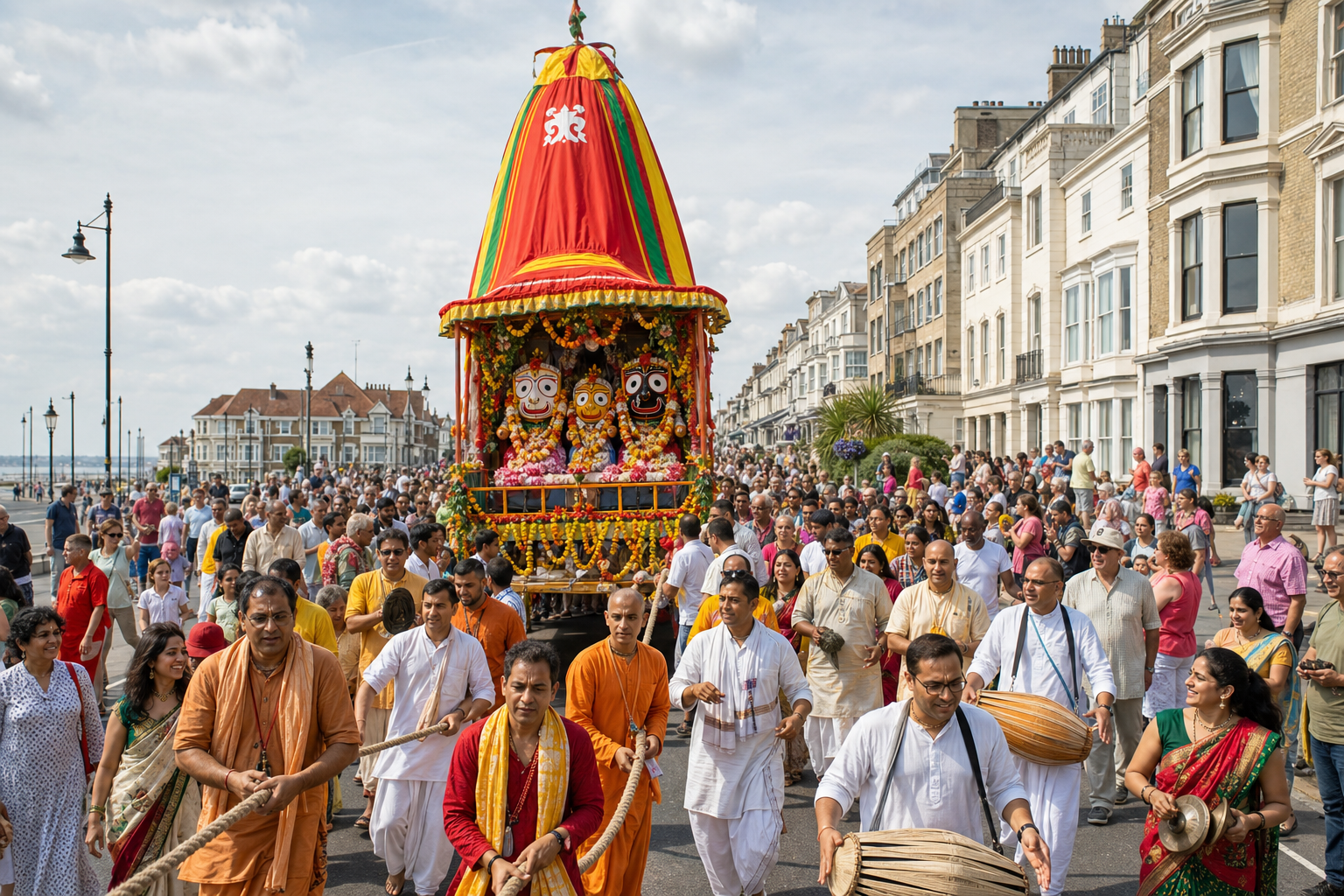
If you saw a chariot, chanting devotees and dancing crowds moving through Southend-on-Sea on 12 July 2026, you were not simply watching a cultural parade. Ratha-yatra brings Lord Jagannatha – the Lord of the Universe – into public view so that worship, kirtan and prasadam are available beyond the walls of a temple.
For a Hindu family in Essex, a curious local resident or a volunteer thinking about the next community celebration, Southend’s third Jagannath Ratha-yatra offered a clear model: begin with sacred worship, carry that worship through the town and then give people several practical ways to participate.
The route formed a five-hour journey into bhakti
The public programme had two distinct parts. The chariot left Victoria Circus at 12:00 pm and reached Royal Square at about 2:00 pm. Activities then continued near Southend’s beach until 5:00 pm.
- Before the chariot moved, invited guests broke coconuts, offered arati to Lord Jagannatha and ceremonially swept the road.
- From 12:00 pm to about 2:00 pm, devotees accompanied the chariot with dancing and the congregational singing of the Hare Krishna maha-mantra.
- After the procession reached Royal Square, visitors could stay for kirtan, meditation, learning activities, children’s attractions and prasadam until 5:00 pm.
That sequence matters if you want to understand a Ratha-yatra rather than merely photograph it. The worship before departure establishes whom the procession is for. The walk makes devotion public. The programme at the destination allows a passer-by to move from observing to participating at a comfortable pace.
If another Southend festival is announced, do not plan to arrive only when the chariot reaches Royal Square. Arriving before departure lets you see the transition from arati and service to public kirtan. Staying after the procession reveals how the organisers turn a moving celebration into sustained community contact.
The preliminary rituals explain the meaning of the procession
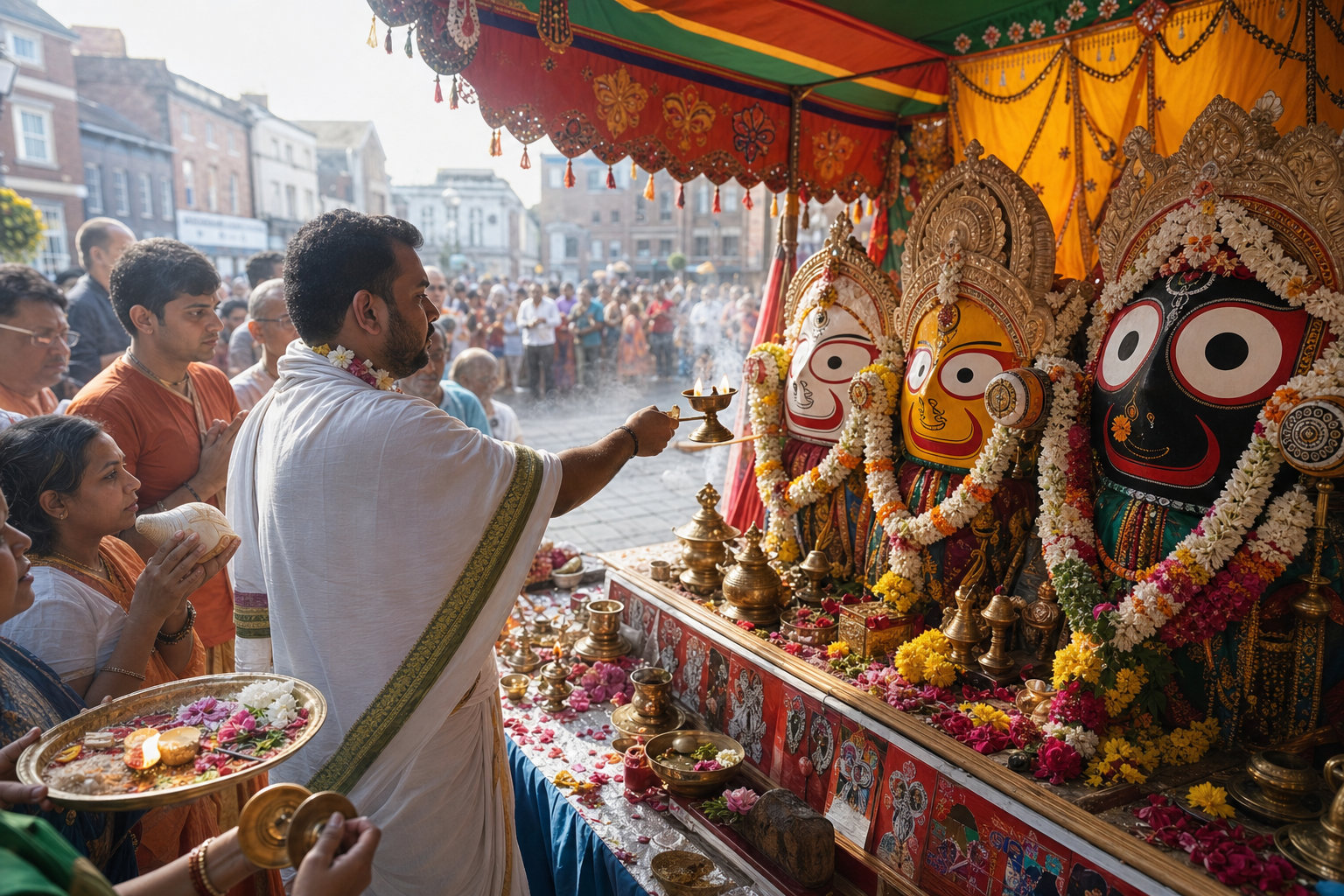
Within the bhakti tradition, Jagannatha is not a decorative emblem placed on a festival vehicle. He is worshipped as the Lord of the Universe. Ratha-yatra therefore reverses the direction people may expect from temple worship: instead of waiting for everyone to enter a sacred building, the Lord travels among the public.
The rituals before departure made that devotional understanding visible. Arati was direct worship. Breaking coconuts marked an auspicious beginning. Ceremonial sweeping placed service and humility before status, even though the people taking part included civic and religious guests.
The 2026 guests included Member of Parliament David Burton-Sampson, ISKCON London Temple President Dayal Mora Dasa, Parasuram Dasa, Tribhangananda Dasa and other monks. Their presence joined civic recognition to a festival that remained openly and specifically Vaishnava.
For you as an attendee, the practical lesson is simple: treat the moments before the wheels begin to turn as part of the festival, not as waiting time. Watch the arati, notice the acts of service and then follow the chariot. That order gives the chanting and dancing their proper centre.
Visitors could enter the festival at several depths
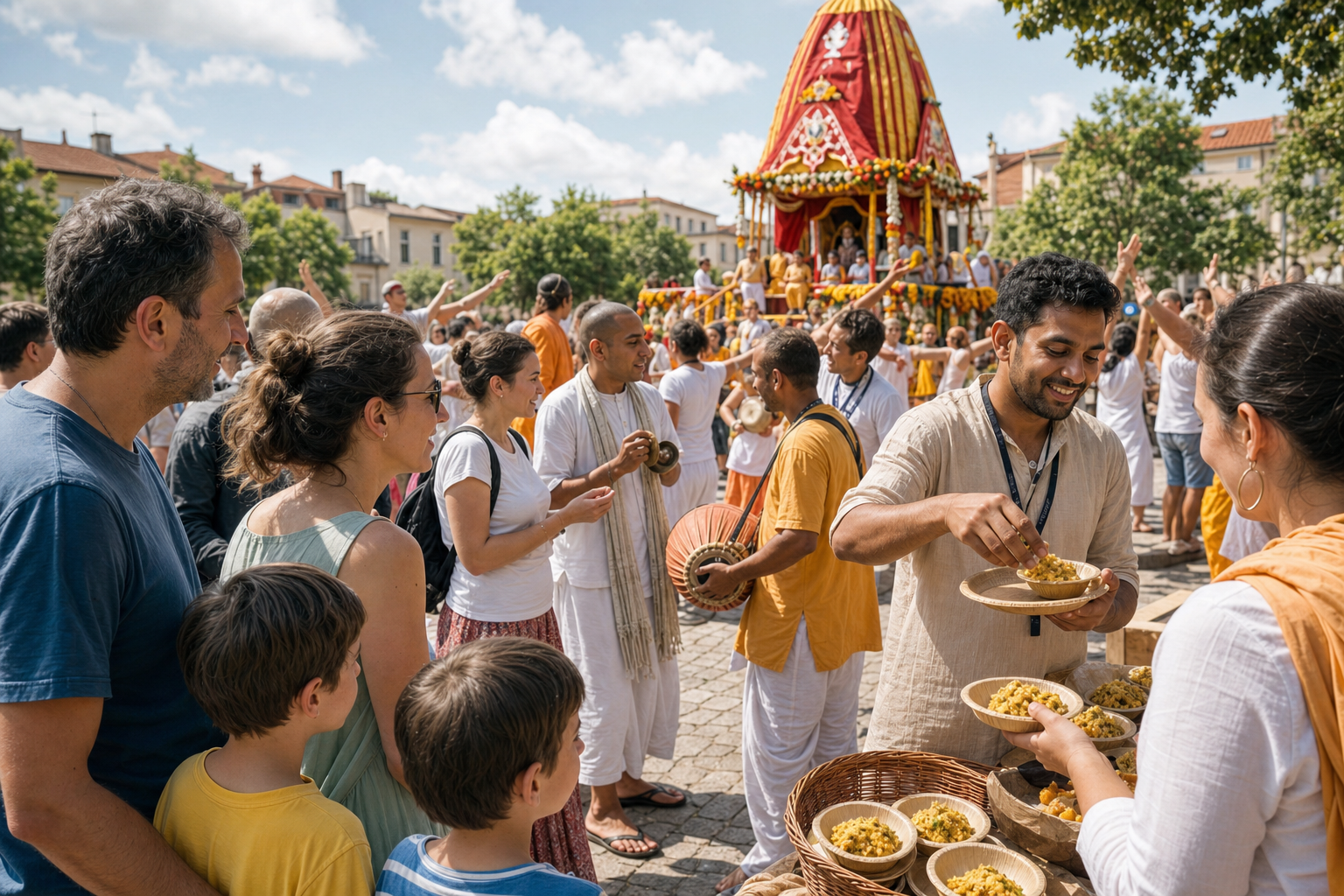
A public Dharmic celebration has to welcome someone who knows the mantras, someone encountering Hindu worship for the first time and a family whose children need something they can engage with immediately. Royal Square addressed those different needs without reducing the day to a generic street fair.
- For direct devotional participation: kirtan allowed people to listen, chant and dance together rather than remain a silent audience.
- For a first spiritual practice: the Kirtan Yoga and Meditation tent introduced mantra meditation, Bhakti-yoga and spiritual teachings in an accessible setting.
- For structured learning: visitors could explore Gita in 18 Days and browse books presenting ancient wisdom.
- For families: a children’s corner, henna art and face painting gave younger visitors approachable ways to remain involved.
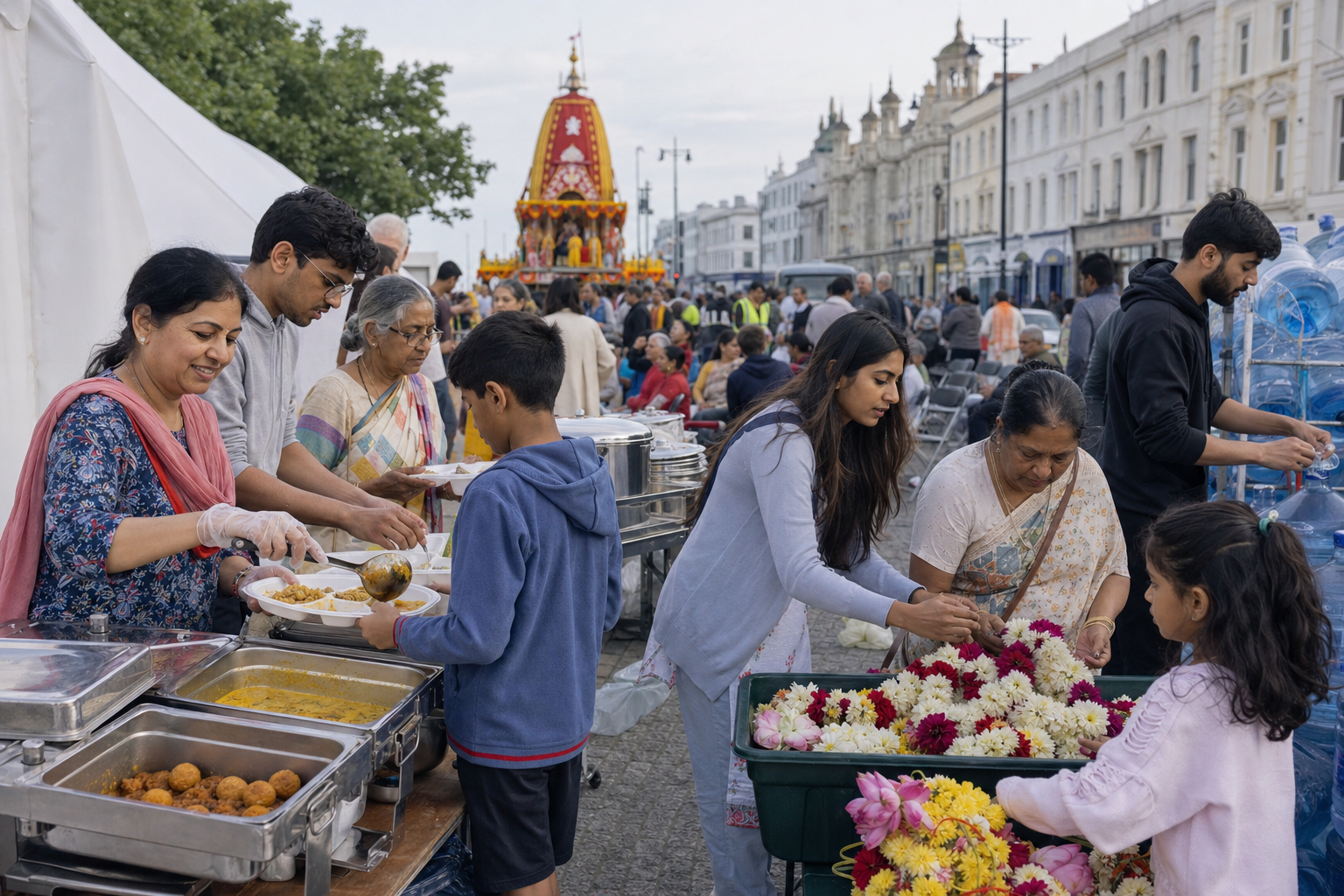
- For hospitality: snack facilities and a shared vegetarian prasadam feast made food part of the welcome.
- For cultural enjoyment: Parasuram Dasa presented magic performances before leading an energetic kirtan with his team.
Prasadam deserves a distinction that can be lost in the phrase “free vegetarian food.” It is food prepared and offered in devotion before being shared. Receiving it is therefore participation in sacred hospitality, not merely taking refreshments from an event caterer.
The scale of that hospitality was substantial. More than 1,200 people participated, and approximately 1,200 plates of prasadam were served. The close relationship between attendance and meals shows why food service belongs near the centre of Ratha-yatra planning: the welcome becomes tangible when nearly everyone can receive something sanctified.
Southend offers a practical model for diaspora Dharma
Southend’s celebration was the community’s third annual Ratha-yatra. That continuity matters. A single procession may attract attention, but a recurring festival can become part of a town’s cultural memory while giving the Hindu community a regular occasion for collective seva.
The organisers combined an uncompromised devotional centre – Jagannatha, arati, the maha-mantra and prasadam – with low-pressure points of entry for the wider public. Someone did not need prior knowledge of Sanskrit, temple etiquette or Vaishnava philosophy to listen to kirtan, visit a meditation tent, ask about the Gita or receive food.
Civic cooperation also had a visible place. Southend Council supported the festival, and a local MP joined the ceremonial opening. Public recognition did not require the community to disguise the event’s religious identity. That is an important lesson for Dharmic communities in Britain: hospitality and theological clarity can reinforce one another.
The 2026 team put more than three weeks of planning and coordinated work into the day. Organisers elsewhere should not treat that period as a universal planning minimum. A different route, council process, crowd size or programme may require a longer lead time. What can be copied is the structure: confirm the public journey, preserve the sacred sequence, prepare distinct activities for different visitors and plan prasadam capacity alongside expected attendance.
Key takeaways for your next Ratha-yatra
- Arrive before the advertised departure if you want to witness the arati, coconut breaking and ceremonial sweeping.
- Follow the chariot rather than waiting only at the destination; the public chanting and shared movement are central to the experience.
- Join kirtan at the level you can manage. Listening attentively is a valid beginning, while singing and dancing let you participate more directly.
- Leave time for the destination programme. In Southend, the three hours after the procession held the meditation, learning, family and prasadam activities.
- Receive prasadam as sanctified hospitality, not simply as a complimentary meal.
- Check a fresh announcement before planning a future visit. The date and timings here belong specifically to the 12 July 2026 festival and do not establish a schedule for a later year.
If Southend announces another Ratha-yatra, use one simple plan: arrive for the opening worship, walk with Lord Jagannatha’s chariot and keep enough time for the gathering at Royal Square. You will then encounter the festival as it is meant to unfold – from reverence, through public sankirtan, into learning and shared service.