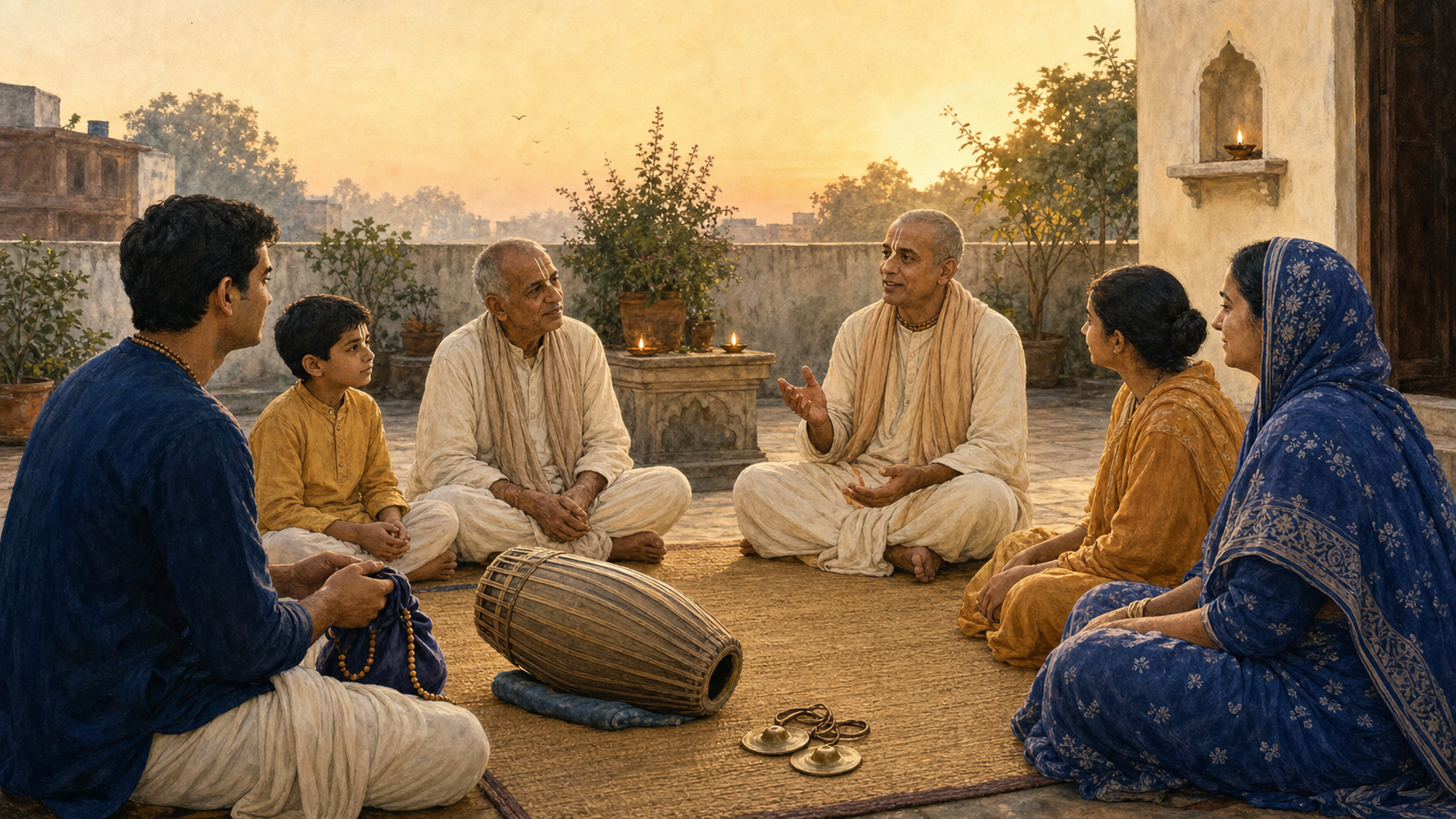
You can leave a powerful kirtan with a full heart and still have no clear idea what to do the next morning. If the effect depends entirely on the next gathering, you experienced a devotional event; you have not yet built sādhu-saṅga into your sādhana.
Your task is not to recreate an emotional peak. It is to choose spiritual company wisely, learn how to hear and chant with attention, accept useful guidance, and carry that association into ordinary conduct. That is where a gathering begins to become a devotional life.
Choose association by what it asks you to become

In Gaudiya Vaishnava practice, sādhu-saṅga means purposeful association with spiritually minded people. It is not merely social time with devotees, proximity to a respected teacher, or attendance at a large festival. Its purpose is to awaken and direct bhakti through hearing, chanting, guidance, service, and the example of disciplined conduct.
Caitanya-caritāmṛta, Madhya 22.54, condenses the principle in the phrase sādhu-saṅga, sādhu-saṅga—sarva-siddhi haya. Association is treated as spiritually decisive because human beings absorb more than formal instruction from one another. We learn what deserves attention, how to respond to difficulty, what service looks like when nobody applauds, and whether sacred teachings remain visible after the singing ends.
This gives you a practical way to assess a community. Do not ask only whether the music is moving or the speaker is learned. Ask what kind of person the association is training you to become.
- The Divine remains at the center. Conversation, music, teaching, and service repeatedly return attention to sacred remembrance rather than to personalities, gossip, or factional rivalry.
- Senior practitioners model service. Their authority is visible in patience, reliability, cooperation, and care for others, not only in eloquence or status.
- Practice is made understandable. A newcomer can learn when to listen, how to respond in kirtan, where to sit for japa, and whom to approach with a sincere question.
- Humility works in every direction. Juniors show respect, while experienced members do not use seniority as permission to humiliate or dismiss others.
- Instruction leads to something you can practise. You leave knowing what to hear, chant, study, correct, or serve—not merely feeling impressed.
The familiar Gaudiya instruction for continual chanting joins it to humility, patience, and giving respect without demanding recognition. That is not decorative poetry. It is an operating standard for conversations, queues, shared spaces, musical leadership, disagreement, and service. A group may be intense, charismatic, and emotionally charged while failing that standard. Do not confuse intensity with holiness.
Respect for guru-śiṣya paramparā also need not become passive admiration. Sound guidance turns your attention toward the Divine, the teachings, your vows, and service. If all attention continually returns to the social standing of the teacher or follower, the relationship has stopped doing some of its essential devotional work.
Link intention, japa, kirtan, and sevā
Sādhu-saṅga becomes repeatable when its main elements support one another. Sankalpa gives direction. Japa develops personal steadiness. Kirtan places that remembrance within a community. Sevā prevents devotion from ending as a private feeling.
- Set a sankalpa before beginning. Use a plain intention such as May I hear the Divine Names carefully and become more willing to serve. A useful sankalpa directs attention and conduct; it does not promise an emotional result.
- Practise japa with clarity. Sit in a stable posture, use the japa-mālā to support the commitment you have actually made, pronounce the mantra distinctly, and listen to what you are saying. When attention wanders, return to the next Name without turning distraction into a personal drama.
- Enter kirtan as a listener and responder. Hear the complete lead phrase before answering. Let your voice join the congregation rather than compete with it. If the melody is unfamiliar, listen until you can respond without guessing.
- Complete the practice through sevā. Help with the need that is present: welcoming someone who is unsure, preparing or distributing prasāda, keeping a shared area orderly, supporting the musicians, or staying for cleanup. Choose useful work rather than visible work.
Hear the mahā-mantra as an address
The Hare Krishna mahā-mantra is: Hare Krishna Hare Krishna Krishna Krishna Hare Hare / Hare Rama Hare Rama Rama Rama Hare Hare. Its grammar is vocative: the chanter is addressing the Divine rather than merely repeating a conceptual statement.
Within Gaudiya interpretation, Krishna is the all-attractive Lord and Rama carries the sense of divine joy or plenitude. Hare is explained within the lineage as an appeal to the compassionate divine energy, Harā, and is also associated with Hari. These explanations are related devotional readings, not a reason to become distracted by word analysis during every repetition. Learn the meaning, then let the meaning help you address rather than merely recite.
Gaudiya theology goes further: the Divine Name is understood to be non-different from the Named. This is why attentive hearing is not treated as a warm-up for a supposedly deeper practice. Bhagavad-gītā 9.14 places continual glorification within sustained devotion, while Śrīmad-Bhāgavatam 12.3.51 presents the chanting of Krishna’s Name as a distinctive spiritual means amid the difficulties of Kali-yuga. The practical implication is direct: do not wait for ideal concentration before chanting. Chant, hear, notice the departure of attention, and return.
Troubleshoot attention without chasing a mood
- If you are rushing, reduce speed enough to hear the complete mantra. Counting supports a vow, but it should not erase pronunciation and listening.
- If the mind wanders, return at the next Name. Rehearsing irritation about the previous distraction only creates another distraction.
- If chanting feels mechanical, renew the sankalpa, make the posture attentive, and hear the mantra as an address. Do not manufacture emotion or conclude that an unremarkable session has no value.
- If you compare yourself with another chanter, return to your own act of hearing. Volume, musical skill, visible emotion, and speed are unreliable measures of devotion.
- If a large kirtan becomes overwhelming, use a designated quiet area when the gathering provides one, or step aside and continue attentive remembrance at a quieter pace. Protecting attention is not a rejection of congregational devotion.
The musical structure of kirtan should make this easier. The lead voice and harmonium establish a melodic center; mṛdaṅga and karatālas support a shared pulse; call and response allow the congregation to participate without mastering a complex composition. The ensemble is serving its purpose when it helps people hear and answer together. Complexity that makes the congregation into spectators has lost sight of that function.
Carry the gathering into the next ordinary day

A quieter mind, softened interpersonal tension, or a strong sense of belonging can arise during japa and congregational singing. Receive those experiences with gratitude, but do not use them as the sole test of progress. A devotional atmosphere can change your state for an evening. Sādhana asks whether remembrance and conduct begin to change when the atmosphere is no longer carrying you.
Before you leave a gathering or retreat, build a bridge back to daily life:
- Record the instruction you intend to practise. Do not collect a page of inspiring lines. Write the teaching that will affect your next decision or practice session.
- Attach japa to a stable cue. Practise after an established part of your morning or evening routine, before messages and interruptions take control of your attention.
- Know where your next association will come from. Identify a recurring kirtan, class, temple community, or trustworthy relationship with a senior practitioner. Good intentions fade when the next point of contact remains vague.
- Carry home a service, not only a memory. Continue an existing responsibility more faithfully or accept a manageable need from the community.
- Take a concrete question to someone qualified. Ask about the obstacle actually affecting your practice: pronunciation, attention, a commitment, a scriptural point, or how to serve without overcommitting.
Do not try to reproduce the full intensity of a retreat in an ordinary week. Build the smallest honest form that can survive work, family duties, tiredness, and an uninspiring day. A prescribed number of japa rounds belongs to the commitments of a practitioner and the guidance of the lineage. Borrowing someone else’s target for appearance can turn the mālā into a scoreboard. Choose fidelity over display.
Use conduct as the longer test
The deeper test of sādhu-saṅga appears in speech and responsibility. Notice whether you listen before reacting, keep the service you accepted, become less hungry for recognition, and remain capable of respecting someone with whom you disagree. If chanting becomes more visible while contempt also grows, sacred sound has not yet matured into the conduct it is meant to nourish.
- Does your practice continue when nobody in the community can see it?
- Can you receive correction without collapsing into defensiveness or resentment?
- Are you becoming more dependable in small acts of service?
- Does association help you remember the Divine, or mainly tell you who belongs to your social camp?
- Can you honour another person without demanding that the person confirm your importance?
Use these questions for course correction, not self-punishment. Bring a recurring difficulty into honest conversation with a trusted senior devotee. Purposeful association includes allowing another person to see the gap between your aspiration and your habits without turning that gap into either shame or theatre.
Recognize dharmic kinship without erasing distinctions

Sacred association is not unique to one dharmic tradition, though each tradition gives it a distinct doctrinal and practical form. Buddhist Saṅgha preserves and embodies the Dharma through a community of practice. Sikh Sangat gathers in remembrance, with kirtan occupying a central place in communal devotion. Jain Saṅgha joins renunciant and lay communities around disciplined conduct, nonviolence, and truth. Gaudiya Vaishnava sādhu-saṅga centers devotional association expressed through hearing, chanting, remembrance, guidance, and sevā.
The family resemblance is meaningful: a practitioner does not mature through solitary preference alone. Community transmits discipline, ethical expectations, sacred sound, and living examples. That common pattern can deepen mutual respect across Hindu, Buddhist, Jain, and Sikh communities.
Respect becomes weaker, however, when it is built on the claim that all practices mean the same thing. The Gaudiya teaching that the Divine Name is non-different from the Named belongs to a particular theology of bhakti. Buddhist chanting need not assume that theology. Sikh kirtan belongs within the authority and discipline of the Sikh path, while Jain stotras arise within Jain understandings of liberation and ethical purification. Shared reverence does not require interchangeable metaphysics.
- Name the tradition whose practice you are entering. Do not replace its own vocabulary with the vocabulary most familiar to you.
- Learn the host community’s protocol. Watch, listen, and ask how to participate rather than assuming that customs transfer unchanged from another setting.
- Receive similarities as bridges. Communal recitation, disciplined fellowship, service, compassion, and ethical restraint provide real points of recognition.
- Do not turn similarity into ownership. Honour the history, authority, texts, and aims that give each practice its distinctive meaning.
- Bring the encounter back to conduct. Dharmic unity is credible when it produces informed respect and cooperation, not merely a photograph of different communities sharing a stage.
This approach protects both unity and truthfulness. You can recognise a civilizational kinship among dharmic traditions while allowing each path to speak in its own voice. That is stronger than flattening difference for the sake of a temporary appearance of harmony.
Key takeaways
- Sādhu-saṅga is purposeful spiritual association, not mere attendance, proximity, or devotional socialising.
- Choose company by its fruits: remembrance, humility, clear practice, reliable service, respectful guidance, and ethical conduct.
- Connect sankalpa, attentive japa, congregational kirtan, and sevā so that each practice strengthens the others.
- During japa, prioritize clear hearing over speed, comparison, or the attempt to manufacture a devotional mood.
- After a gathering, anchor the inspiration to a stable practice cue, a continuing relationship, and a concrete service.
- Honour Buddhist Saṅgha, Sikh Sangat, Jain Saṅgha, and Vaishnava sādhu-saṅga as related dharmic patterns without claiming that their doctrines are identical.
Before your next kirtan, set a sankalpa that joins attentive hearing to service. When the kirtan ends, decide exactly where that intention will enter your next ordinary day. That small bridge—from sacred company to repeated conduct—is where sādhu-saṅga starts becoming a steady devotional practice.