
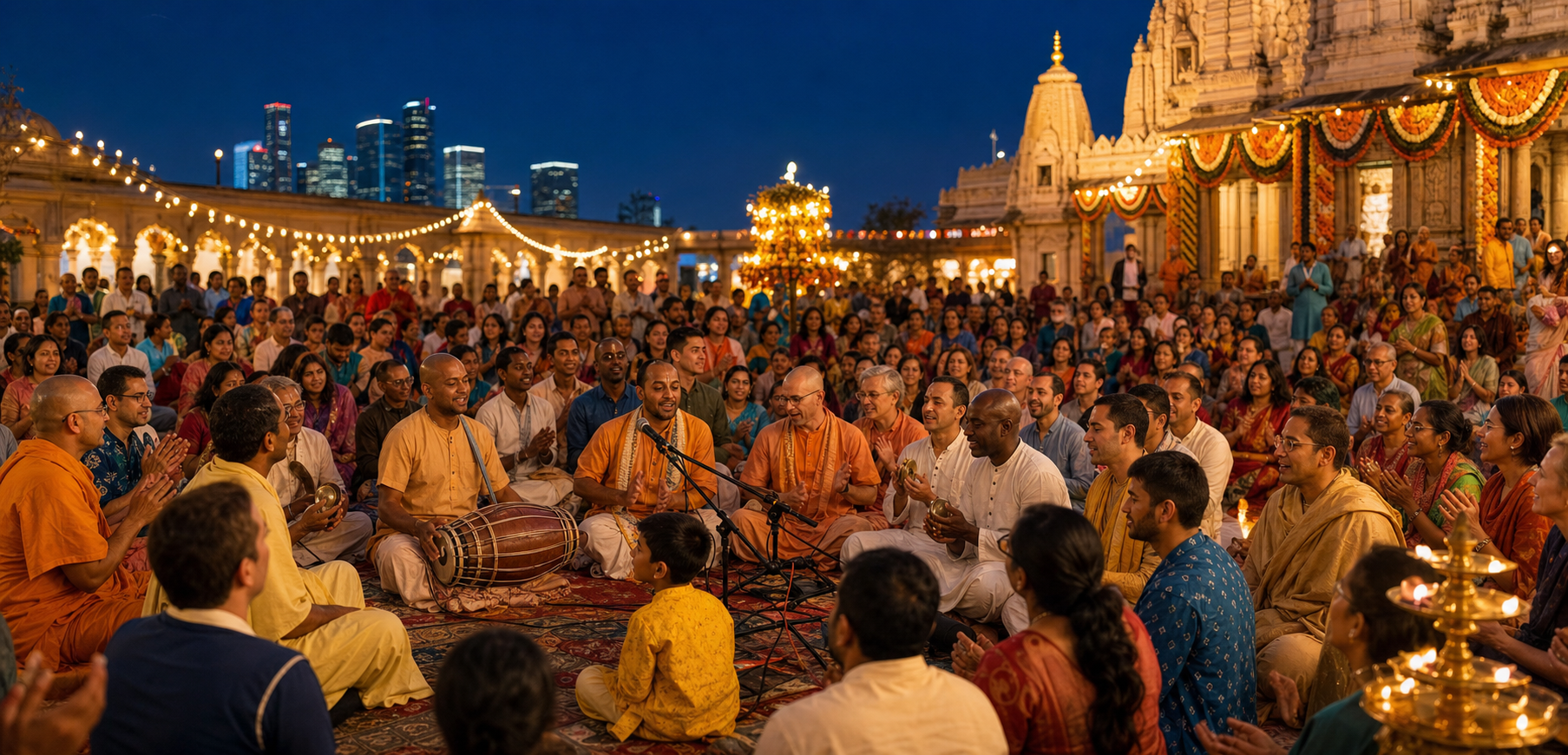
If you are wondering what was actually being marked in Houston, start with one important distinction: this was ISKCON’s six-decade global milestone, observed by its Houston community. It was not presented as the Houston temple’s own sixtieth birthday.
On Saturday, June 13, 2026, more than 275 people gathered at the Houston temple complex, including Consul General of India D. C. Manjunath, Giriraj Swami, Hanumat Presaka Swami, devotees, and regional community leaders. The useful question is not whether the gala looked impressive. It is what the evening showed you about carrying bhakti, Dharmic culture, and community responsibility into the next generation.
Sixty years measures transmission, not merely survival
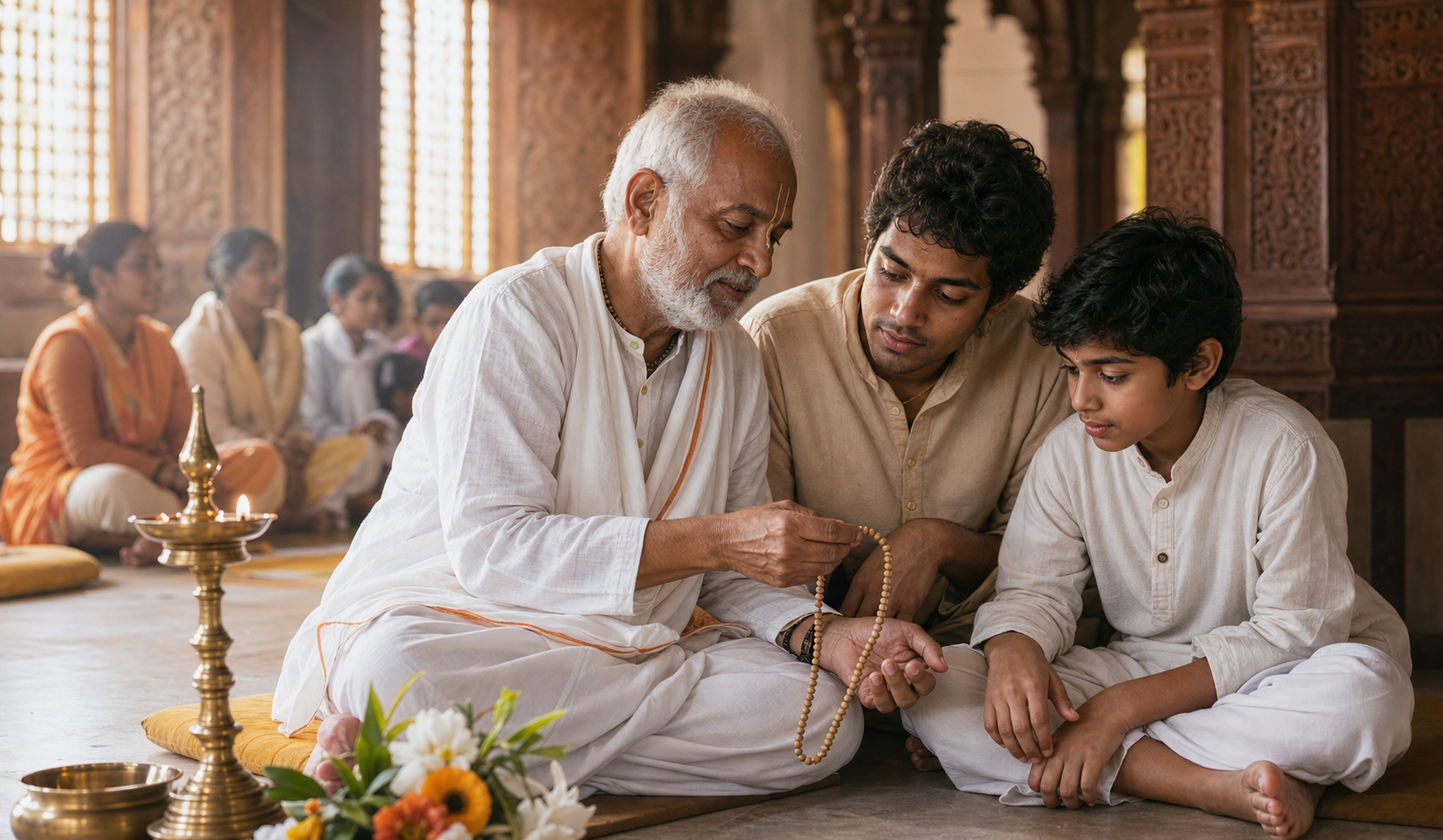
A. C. Bhaktivedanta Swami Prabhupada founded ISKCON in New York City in 1966. What began in a small storefront developed into an international movement with hundreds of temples and cultural centers. Along the way, ISKCON made public kirtan, Vaishnava literature, bhakti-yoga, and Krishna prasadam recognizable far beyond the Indian diaspora.
Longevity alone does not prove spiritual depth or institutional health. The stronger test is transmission: can a person enter the community, encounter a coherent practice, learn why it matters, accept responsibility, and eventually help someone else do the same?
That gives you four useful verbs for evaluating any anniversary celebration: practice, learn, serve, and transmit. A temple can fill a hall for one evening without strengthening any of them. Houston’s program mattered because worship, instruction, music, hospitality, and volunteer service were presented as parts of one spiritual life.
Use that test the next time you visit a temple or support a Dharmic organization. Can a newcomer participate without already knowing every custom? Can a child move from watching a performance to understanding the tradition behind it? Can a willing volunteer find a concrete responsibility? Does scriptural learning lead to disciplined practice and service? Those questions tell you more about the future of an institution than the size of its anniversary banner.
The devotional order of the evening carried its message
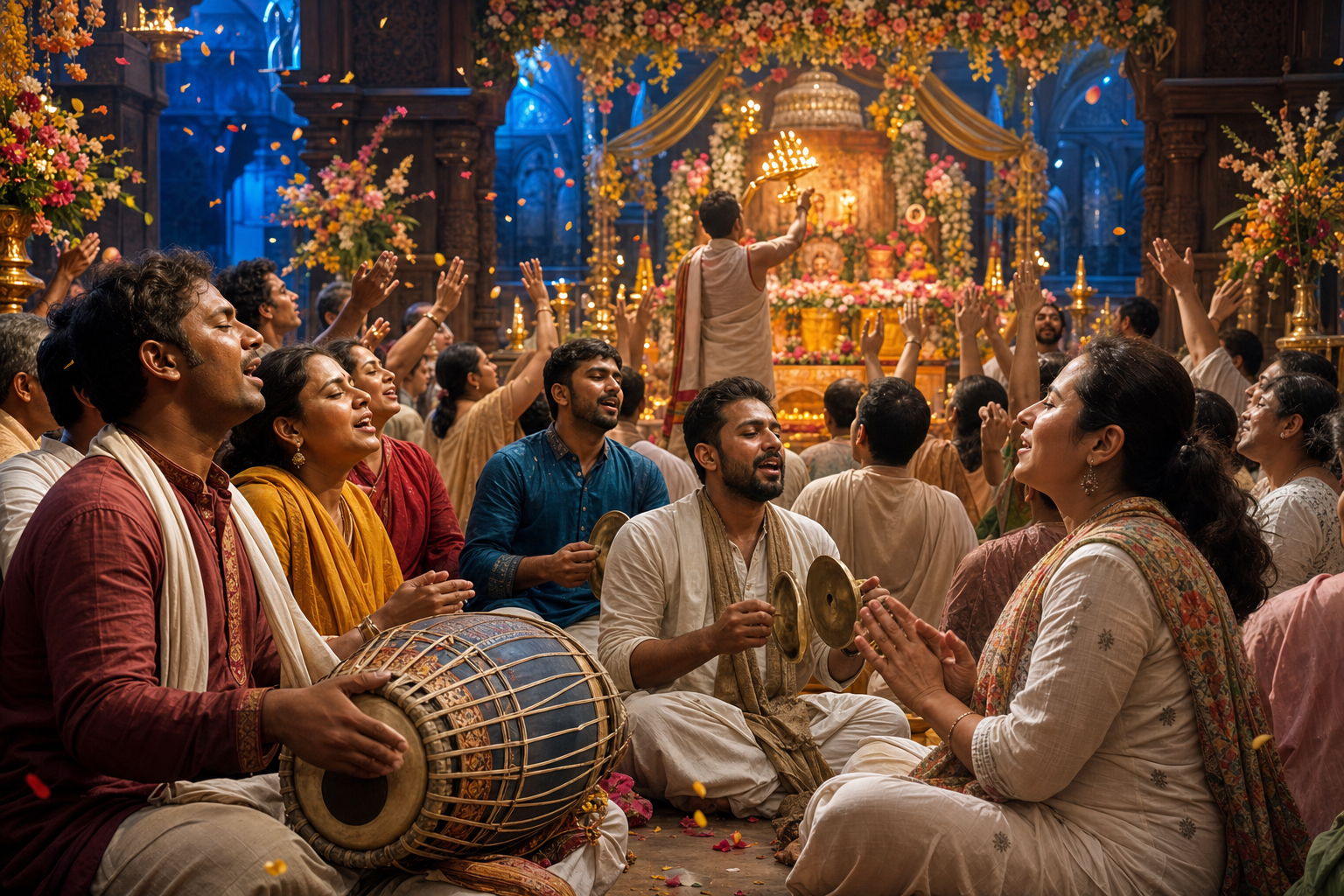
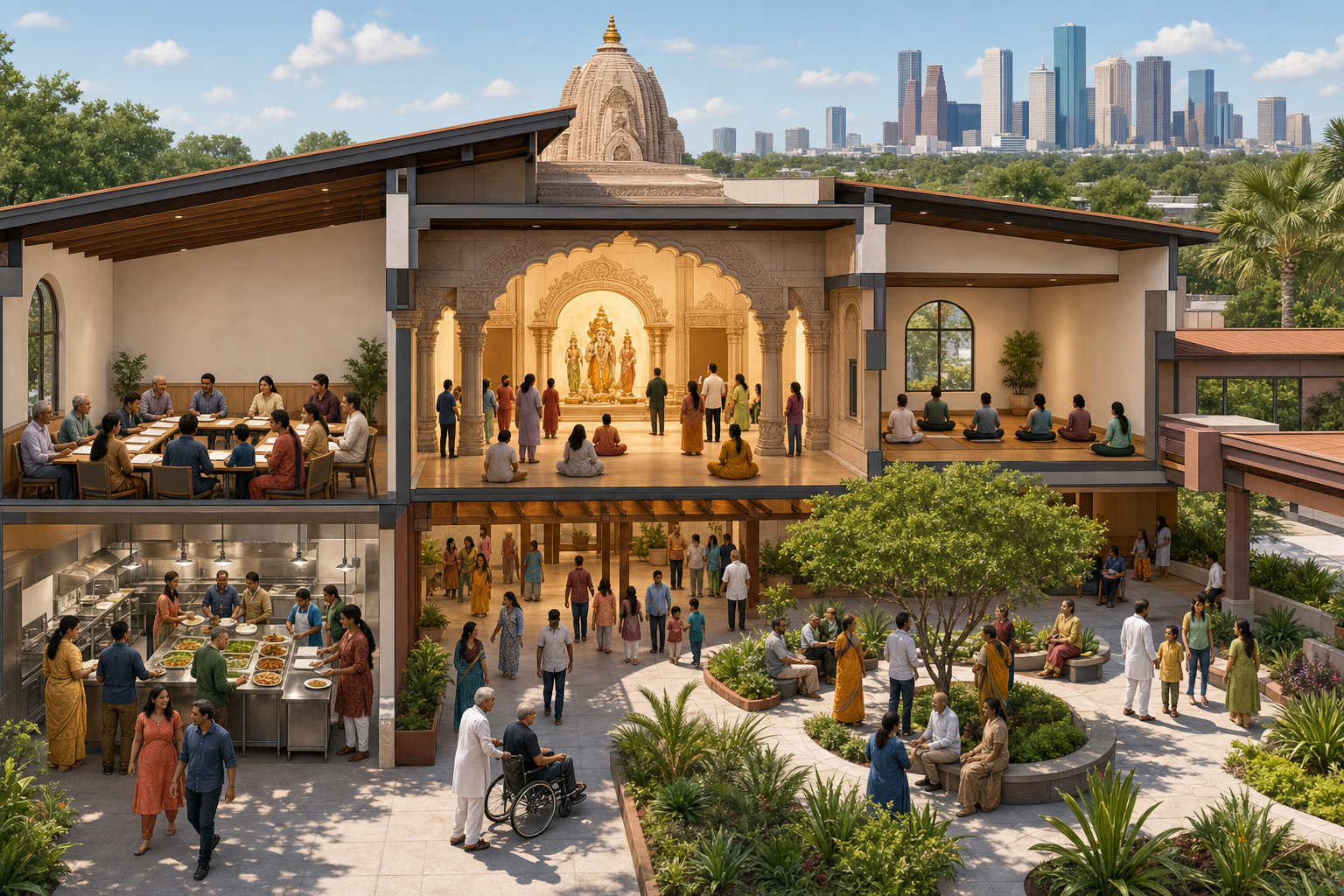
The Houston complex did not function merely as an event venue. The sanctum of Radha-Krishna and Gaura-Nitai, the bell at arati, and the fragrance of incense kept the gathering oriented toward worship. That distinction matters. A cultural celebration held at a temple can easily become a stage program with sacred decoration around the edges. Here, devotion supplied the structure.
The sequence joined Vedic invocations, ceremonial lamp-lighting, reflections on ISKCON’s legacy, kirtan, cultural presentations, and prasadam. Each element performed a different task. Invocation established sacred intention. Discourse supplied memory and meaning. Music made participation immediate. Cultural performance gave artistic form to inherited ideas. Prasadam turned hospitality into devotional fellowship.
Kirtan was especially important because it reduced the distance between the platform and the congregation. The call-and-response chanting of the Hare Krishna maha-mantra did not require a newcomer to master a long text before joining. A first-time guest and a lifelong practitioner could respond to the same sacred names, even though their depth of understanding differed. Participation came first; further learning could follow.
The addresses then gave direction to that participation. Giriraj Swami connected devotional service with resilient families and institutions, while Hanumat Presaka Swami emphasized disciplined study, cultural literacy, and structured mentorship. Those are complementary needs. Emotion without formation can fade after the festival. Study without shared worship can become detached from lived bhakti. A durable community needs both.
Prasadam completed the movement from worship to relationship. Sanctified vegetarian food is not simply an event meal with a religious label. It places nourishment within gratitude, nonviolence, and service. It also creates an unusually practical setting for intergenerational conversation: children, elders, students, visitors, and established devotees can sit within the same culture rather than encounter it only from an audience seat.
If you organize a Dharmic celebration, examine its order. Do not treat arati as an obstacle to the entertainment or prasadam as a logistical afterthought. Begin with the sacred purpose, then ask how teaching, art, food, and fellowship can carry that purpose to people with different levels of familiarity.
Seva is the anniversary test that photographs rarely capture
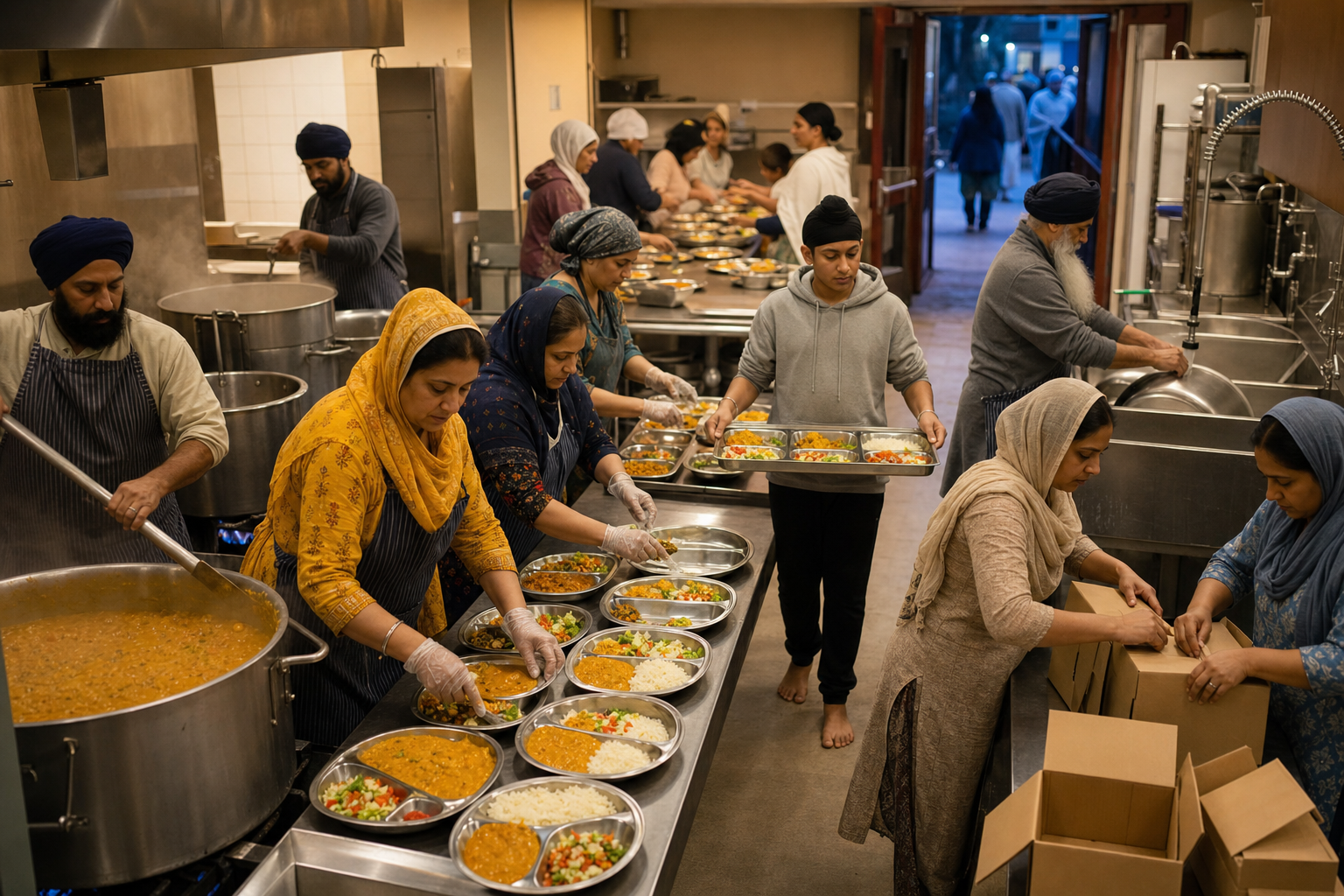
The gala depended on hundreds of collective volunteer hours. Hospitality, parking, altar care, sound engineering, and meal preparation were not peripheral chores. They were the infrastructure through which devotion became a shared public event.
This is where an anniversary reveals the actual culture of an institution. If service is concentrated in a small exhausted circle while everyone else consumes the program, the community has a succession problem. If newcomers can enter manageable roles, receive guidance, and grow into responsibility, the event becomes a training ground for future stewardship.
Your own contribution does not have to begin with a prominent position. A recurring responsibility in the kitchen, guest reception, music team, classroom, parking area, or technical crew may strengthen the community more than an occasional visible appearance. The key word is recurring. Repetition builds skill, trust, and relationships across generations.
Organizers and donors should also distinguish spiritual purpose from resistance to accountability. Attendance across age groups, volunteer hours, meals served, and funds or pledges directed toward education or relief are practical measures of community work. They cannot quantify bhakti, and they should never pretend to. They can show whether stated priorities were matched by people, time, food, and resources.
A useful question after any large celebration is therefore simple: what continues next week? Ask which educational program gained support, which service team gained volunteers, which younger member received mentorship, or which relief effort became more capable. That is how commemoration becomes capacity.
A diaspora temple must be sacred, teachable, and publicly useful
The presence of Consul General D. C. Manjunath signaled that the gathering had significance beyond the internal life of one congregation. Diplomatic recognition does not confer spiritual legitimacy; a Vaishnava community does not need consular approval to practice its tradition. It does, however, show that a temple can become a visible point of connection between Bharat’s civilizational heritage and the civic life of an American city.
Cultural continuity must be teachable
Diaspora identity cannot be preserved by occasional spectacle alone. Children and young adults need repeated opportunities to learn vocabulary, texts, music, ethical reasoning, and modes of service. Houston’s Sunday schools, scriptural study, music instruction, and language education show the kind of recurring structure through which cultural confidence can develop.
If you are a parent, do not ask only whether your child enjoyed the program. Ask what the child can now explain, practice, or help teach. If you are a student or young professional, look for a study path and a mentor rather than relying entirely on inspirational events. Hanumat Presaka Swami’s emphasis on disciplined study speaks directly to that need, while Giriraj Swami’s focus on families and institutions reminds elders that young people require both knowledge and a community in which to use it.
Public usefulness matters as well. ISKCON’s Food for Life network and local partnerships connect the ethic of prasadam with food relief, while values-based education and mentorship connect scripture with civic need. The temple becomes a credible community partner when spiritual commitments produce reliable service, not when service is added merely for public relations.
Dharmic solidarity needs accuracy as well as goodwill
The Houston gathering also affirmed common ground among Hindu, Buddhist, Jain, and Sikh communities through ahimsa, seva, fellowship, and sacred music. That is a worthwhile basis for cooperation, but it should not be confused with doctrinal sameness. Dharmic unity becomes stronger when each tradition is allowed to speak in its own vocabulary.
For example, ISKCON kirtan and Sikh kirtan both give sacred music a congregational role, but they arise from distinct theological and scriptural settings. Prasadam and langar both make food a sacred form of hospitality, yet their ritual meanings and community contexts are not interchangeable. You do not need to flatten those differences to recognize a shared refusal to separate spiritual life from service.
An effective inter-Dharmic program should therefore begin with a real activity: food service, youth education, sacred music, cultural literacy, or compassionate civic work. Let each participating community explain its own practice accurately. Shared action builds trust; careful language preserves integrity.
That approach fits the priorities articulated in Houston: expanded cultural education, inter-Dharmic dialogue, more sustainable events and kitchens, and leadership platforms for students and young professionals. Each priority answers the same question from a different direction: how can an inherited tradition remain spiritually serious while serving a changing urban community?
Key takeaways for carrying the milestone forward
- Name the milestone accurately. Houston hosted an observance of ISKCON’s global sixtieth anniversary, marking the movement founded in 1966.
- Judge continuity by repeatable practices. Worship, kirtan, study, prasadam, and seva matter most when people can return to them after the gala ends.
- Choose one recurring service. A modest responsibility performed consistently develops more institutional strength than occasional enthusiasm without ownership.
- Ask what younger participants can learn and lead. Cultural performances attract attention; curricula, mentorship, and real responsibility produce transmission.
- Measure work without pretending to measure devotion. Track participation across generations, volunteer time, meals, and resources committed to education or relief.
- Build Dharmic cooperation around shared action. Honor common values while naming the theological and ritual differences among Hindu, Buddhist, Jain, and Sikh traditions accurately.
Your next step should match your place in the community. Attend a service with the intention to join rather than merely observe. Ask for one responsibility, one course of study, or one mentor. If you lead or fund programs, identify the recurring work that the celebration will strengthen. An anniversary becomes an inheritance only when admiration turns into a practice someone is prepared to carry.