
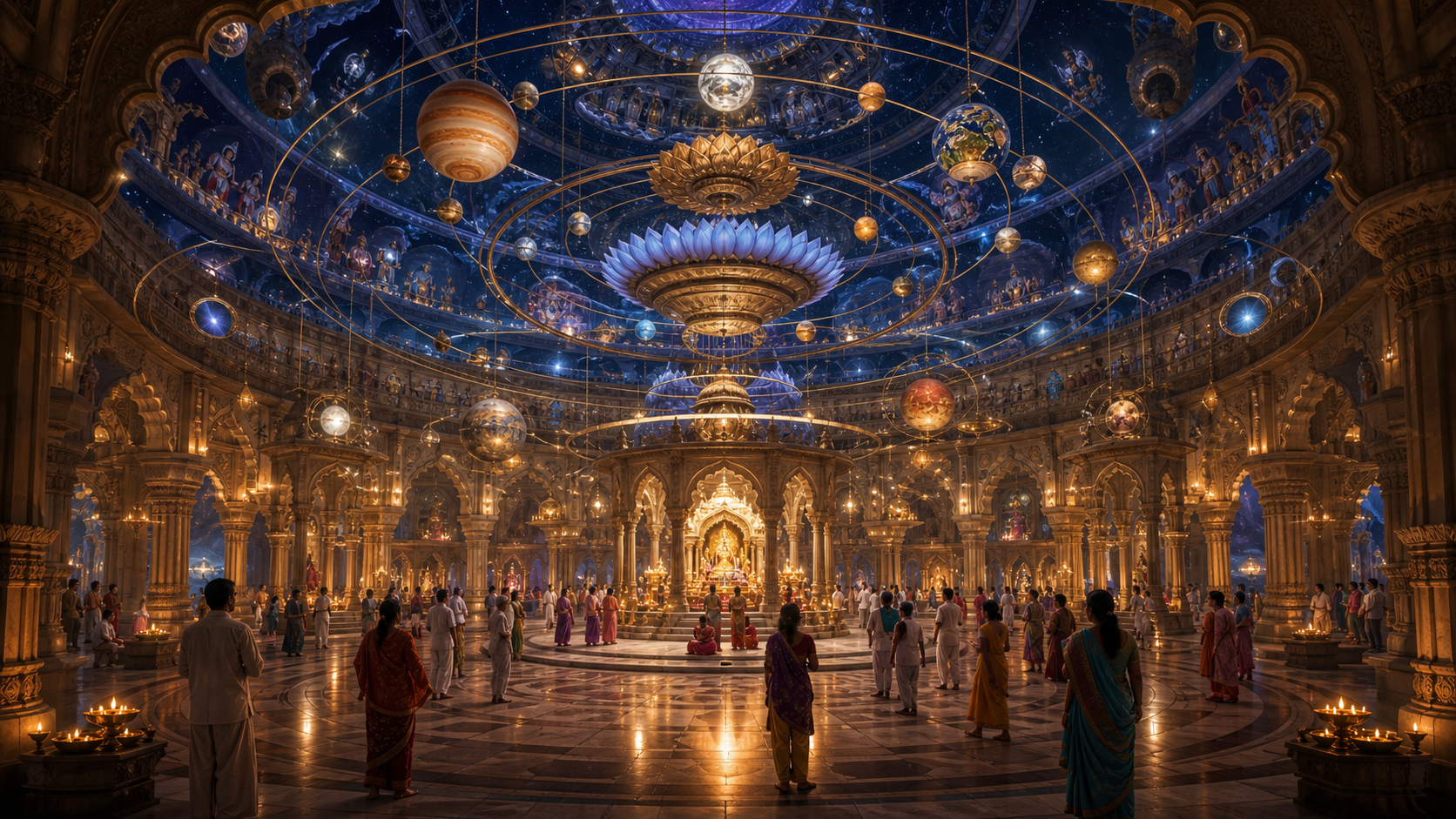
You may be drawn to Mayapur and still wonder what you are supposed to do with a vision of the universe that does not resemble a modern astronomy textbook. The easiest mistake is to choose between two extremes: treating every image as a conventional star chart or admiring the entire display as devotional spectacle. Both approaches flatten what the Temple of the Vedic Planetarium is meant to accomplish.
A more fruitful approach is to read the planetarium as sacred cosmography made walkable. Its models, levels, sightlines, texts, and devotional setting work together. If you learn to distinguish measurement from metaphysics, representation from revelation, and information from spiritual application, the apparent strangeness becomes an invitation to serious inquiry.
Begin with the right category: sacred cosmography
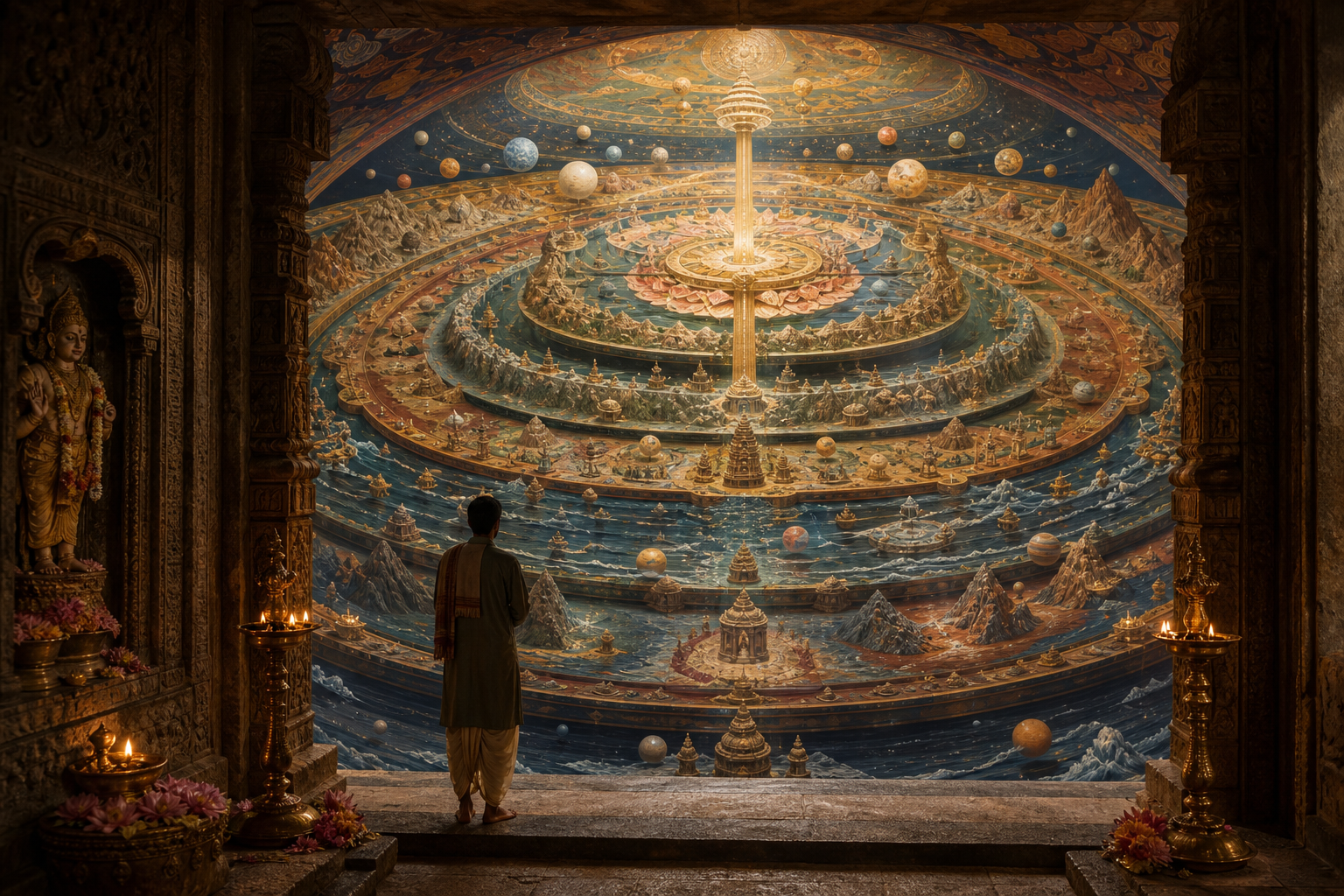
Modern astrophysics and Bhagavata cosmography do not always ask the same kind of question. Astrophysics measures observable physical phenomena and develops models that can be tested against new observations. The cosmography of the Srimad Bhagavatam also concerns the structure of the universe, but it places that structure within an account of consciousness, karma, dharma, and gradations of existence.
The two vocabularies may share words such as world, planet, distance, and universe without assigning them identical meanings. This is why a quick attempt to match every loka to an astronomical object usually produces more heat than understanding. It assumes the equivalence that first needs to be demonstrated.
Mayapur’s founding vision places the Fifth Canto cosmography within the Gaudiya Vaishnava commentarial tradition. It includes the planar schema of Bhu-mandala, a vertical ordering of lokas, and an orientation toward the spiritual realm. The arrangement is therefore more than a physical inventory. It is an ordered account of reality in which location, mode of being, consciousness, and spiritual purpose belong together.
You can avoid three common interpretive failures:
- Do not force every cosmological feature into a one-to-one match with a planet, orbit, or distance used in contemporary astronomy.
- Do not dismiss a model merely because its visual grammar is unfamiliar. First determine what kind of relationship the model is expressing.
- Do not call every curatorial reconstruction a direct scriptural statement. A text, an acharya’s explanation, and a museum visualization may carry different levels of interpretive authority.
At each major feature, ask four questions: What exactly is being represented? Which part comes from the primary text? Which part comes through commentary or curatorial interpretation? Is the relationship physical, ontological, symbolic, pedagogical, or some combination of these?
This method is neither defensive nor dismissive. If a panel makes a measurable physical claim, you can examine it as a measurable claim. If it presents an ontological hierarchy, you should first understand its philosophical terms. Respect for Vedic knowledge does not require mixing categories that the presentation itself may be trying to distinguish.
Let the architecture teach you how to see the cosmos
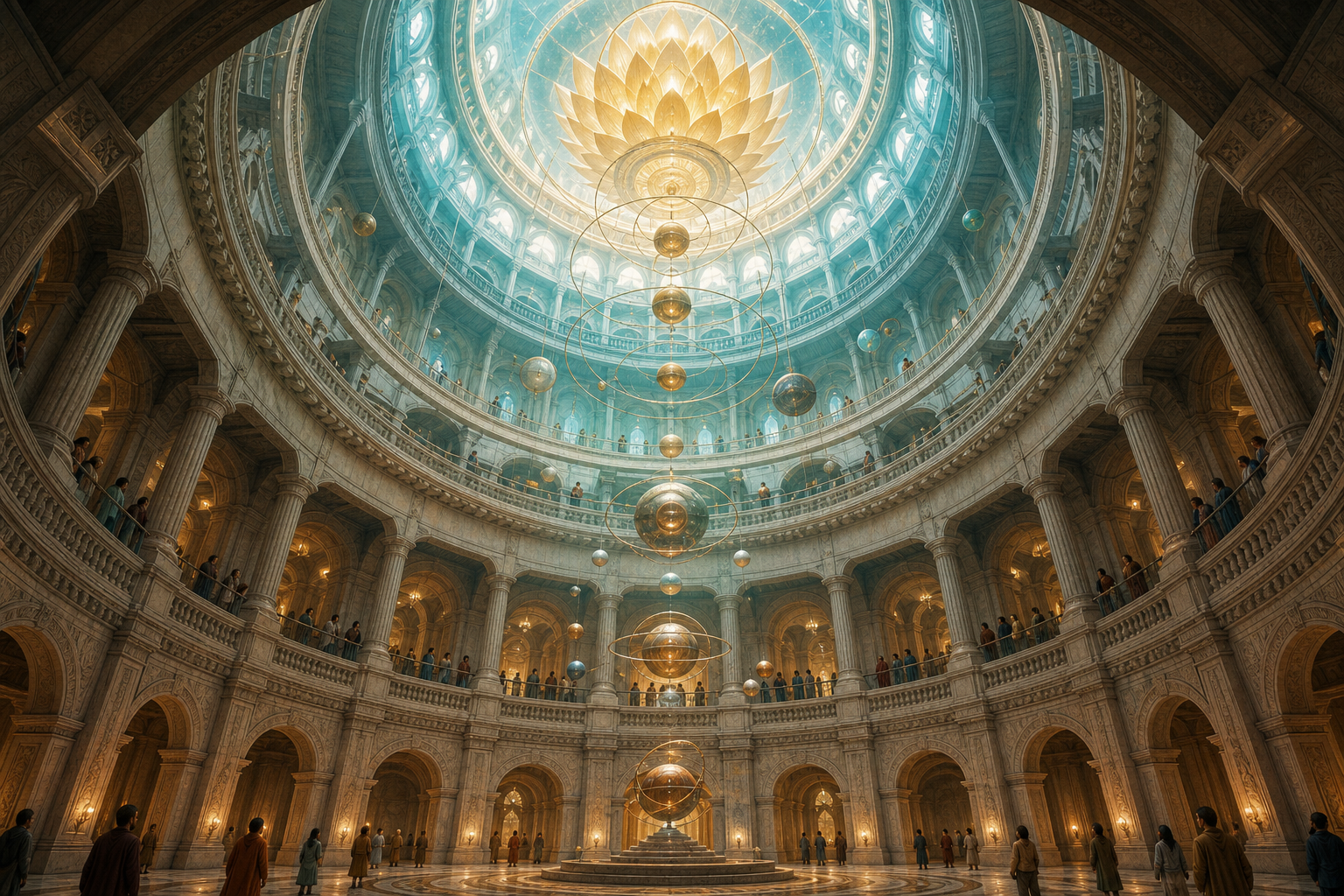
Srila Prabhupada did not envision a conventional temple with a small cosmology room attached to it. The founding design called for a large, detailed universe model that visitors could study from successive levels, with escalators guiding movement and open verandahs supporting charts, dioramas, films, and explanatory material.
To show spiritual world, material world, and so on succession of the planetary systems, everything.
Srila Prabhupada, July 1976
The movement through the building is part of the lesson. A changing viewpoint allows you to see the same model first as a whole and then as a set of relationships. Each level can correct an impression formed at the previous one. The intended ascent also gives physical form to the idea of ontological gradation: you do not merely read about an ordered cosmos; you move through an interpretation of it.
The exterior had a public task as well. In July 1976, Srila Prabhupada asked for detailed photographs of the United States Capitol while explaining the Mayapur planetarium concept. The point was not to import the Capitol’s political meaning into a Vaishnava temple. Its monumental and legible civic form offered an architectural language for a place intended to receive, orient, and educate a large public.
When you study the planetarium, use the building in the sequence for which it was conceived:
- Begin with the largest available view. Identify the overall form before trying to decode an isolated detail.
- Follow the intended route once without jumping between levels. Sequence is carrying part of the argument.
- At each overlook, locate where you have been, where you are, and what the next level adds.
- Use the available media in layers: introductory label first, diagram or diorama second, and detailed textual material after you understand the basic relationship.
- Return at the end to the feature you found most difficult. It will often read differently once you have seen the complete hierarchy.
Mayapur’s setting on the Ganga and within the heartland of Gaudiya Vaishnavism also changes the experience. This is not a cosmology exhibit placed in a culturally neutral box. Temple worship, kirtan, seva, pilgrimage, and scriptural study surround the act of looking. The larger township concept reinforces that intention: the planetarium was conceived as part of an enduring devotional and educational environment rather than as a single display to be visited once.
A founding plan is not an opening notice. If you are arranging travel, verify current access, schedules, and which exhibition spaces are available before committing to an itinerary.
Read the seven lokas as a hierarchy, not a travel list
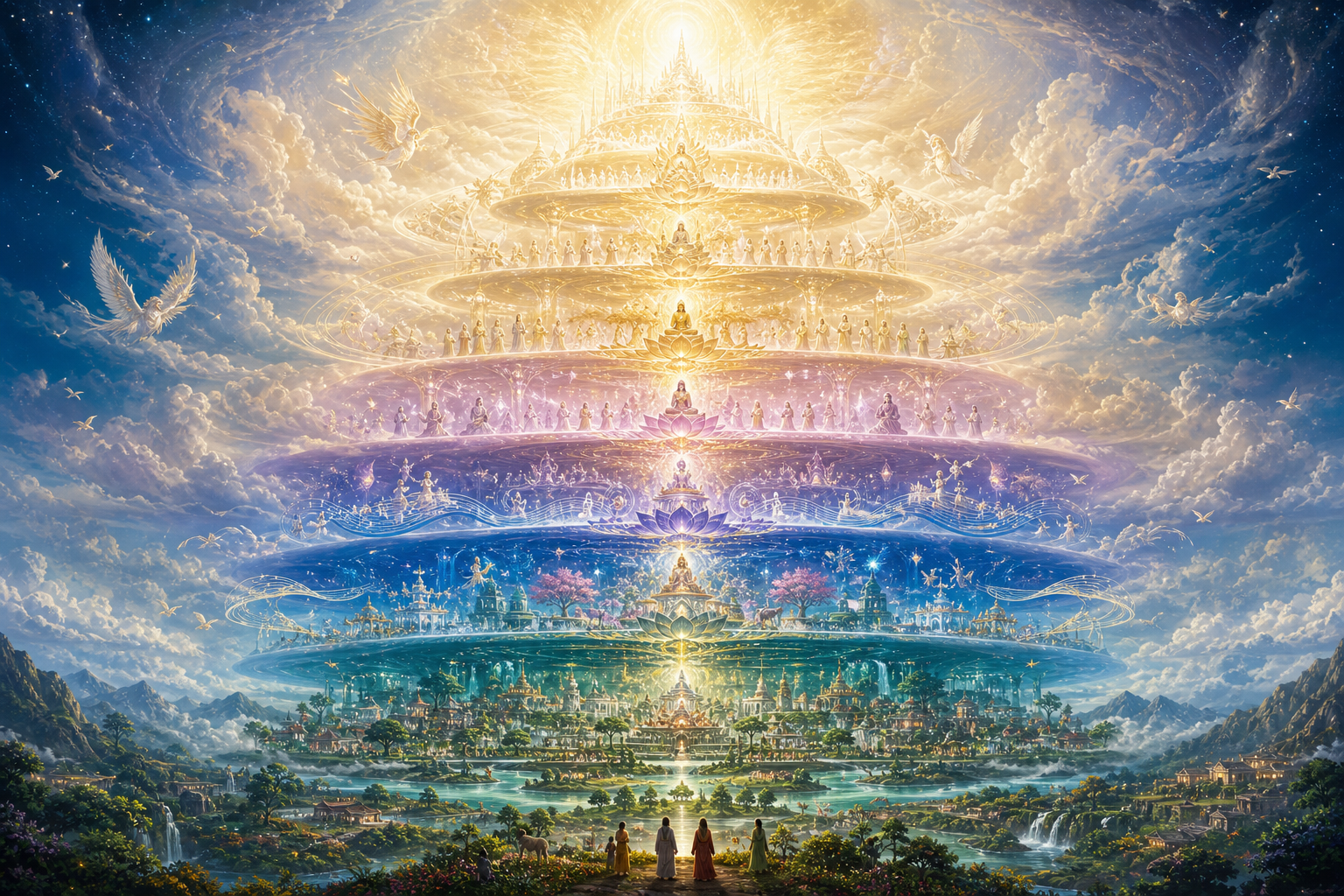
The vertical presentation moves through Bhurloka, Bhuvarloka, Svargaloka, Maharloka, Janaloka, Tapoloka, and Satyaloka before conceptually orienting the visitor toward the spiritual sky. Memorizing those names is useful, but it is not yet understanding.
A list can make the lokas sound like seven pieces of cosmic real estate. The more important question is what changes across the sequence. The planetarium’s layered method is meant to connect spatial relations with ontological gradation, allowing introductory explanations, visual models, and more advanced textual references to serve different levels of inquiry.
Keep a simple four-part record as you move through the model:
- Name and position: What is the realm called, and how is it situated in relation to the others?
- Mode of existence: What distinction in life, consciousness, or cosmic order does the presentation associate with it?
- Basis of the claim: Does the explanation identify a Bhagavatam passage, a Vaishnava commentary, or a curatorial reconstruction?
- Spiritual consequence: What assumption about human centrality, desire, time, responsibility, or liberation does this level challenge?
If the display does not answer one of these questions, write down “not yet clear” rather than filling the gap from imagination. That small discipline keeps curiosity from turning into either credulity or premature rejection. It also gives you a precise question to take to a teacher, docent, or study circle.
Pay particular attention to how the spiritual realm is presented. A vertical exhibit needs a visible culmination, but you should not automatically assume that transcendence means only a greater physical altitude. The presentation is directing attention beyond the sequence of material lokas. Ask how the transition is explained, what changes in the category of existence, and whether the visual model clearly marks that change.
You can also judge the interpretive quality of an exhibit by four practical standards. Terms should be defined before they are used. Important claims should be traceable to texts or commentaries. Visualizations should indicate when they are explanatory reconstructions. And the route should help you understand relationships, not merely overwhelm you with scale. Those standards serve devotion and scholarship alike.
Make the cosmology living through practice and dialogue
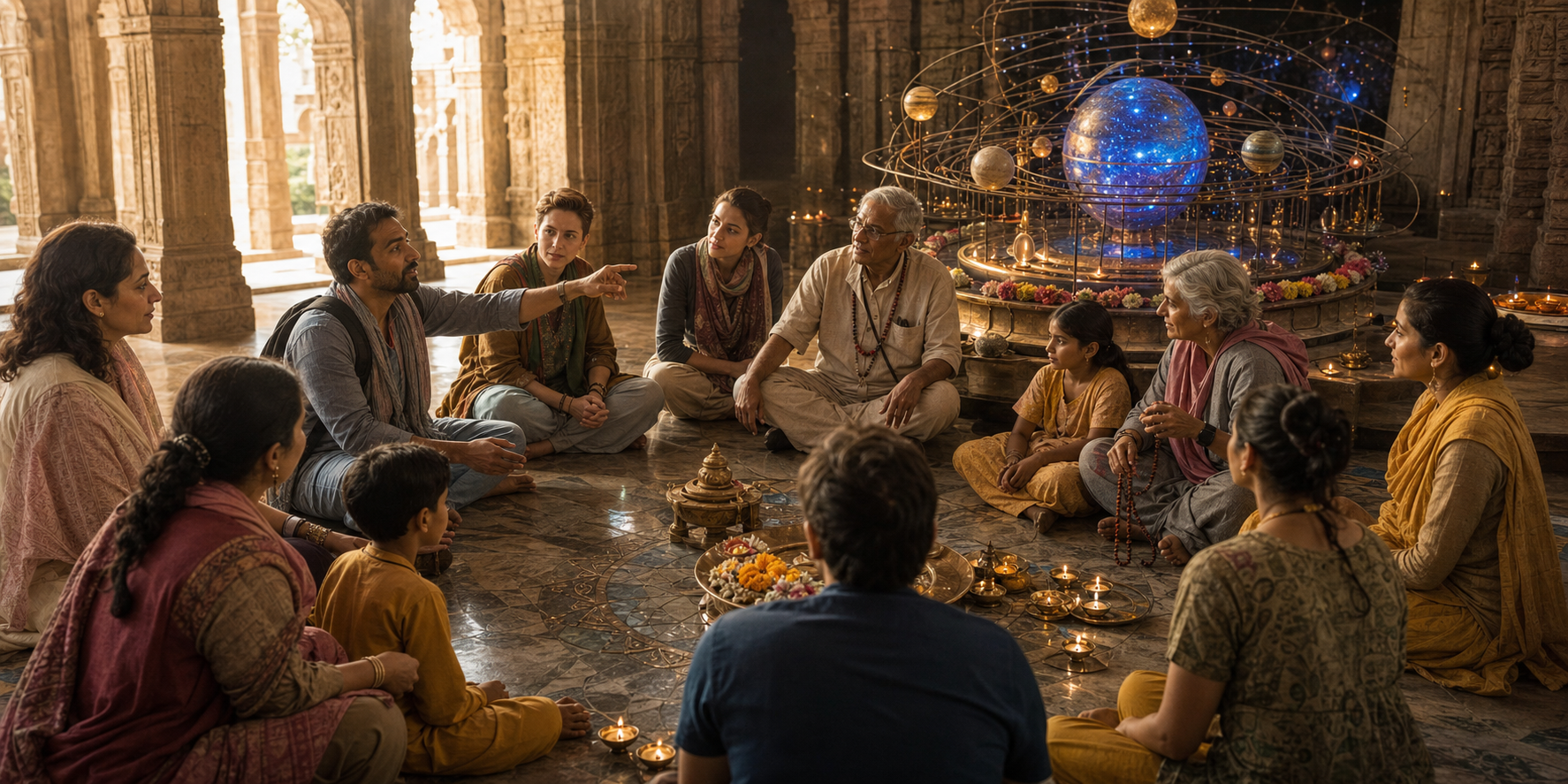
A cosmology becomes living when it changes the scale at which you understand your life. If the model remains only an impressive object, you may remember its size while forgetting its purpose. Mayapur’s integration of temple and planetarium asks you to connect cosmic order with sadhana, conduct, and the search for higher knowledge.
Carry one question from the model into sadhana
Before a visit or group study, read a manageable overview of the relevant Fifth Canto cosmography in a translation and commentary you trust. Your aim is not to master every measurement. Learn enough vocabulary to recognize Bhu-mandala, the ascending lokas, the material hierarchy, and the conceptual turn toward the spiritual realm.
During the encounter, choose one relationship you can explain and one you cannot. If your time in Mayapur also includes kirtan, worship, seva, or scriptural discussion, notice whether those practices change how you read the model. The same cosmological hierarchy can look very different when approached as a diagram of remote places and when approached as a challenge to bodily identification and worldly self-importance.
Afterward, give the cosmology one concrete consequence. You might identify a desire that has occupied more of your attention than it deserves, choose a regular act of seva, or study the textual basis of the feature that puzzled you. The action need not be dramatic. It needs to connect the scale of the cosmos with the scale of your next decision.
For a group visit, assign four roles: one person tracks scriptural references, one reads the diagrams, one records unresolved objections, and one connects the display to practice. Rotate the roles at each level. This keeps a confident speaker from deciding the meaning for everyone and gives both devotional and analytical questions a legitimate place.
Compare dharmic traditions without pretending they are identical
The planetarium is grounded in Vaishnava exegesis. That clarity makes comparison possible because you know which tradition is speaking. It should not be turned into a vague all-religions cosmology in which distinctive teachings disappear.
Its museum method nevertheless creates room for disciplined conversation with Buddhist Abhidharma cosmology, Jain accounts of loka, and the contemplative cosmic imagery of Sikh Gurbani. The most productive comparison concerns recurring dharmic questions: How are consciousness and cosmic order related? What gives a realm its spiritual significance? How do conduct, knowledge, devotion, or discipline transform one’s condition? What lies within conditioned existence, and what counts as liberation from it?
Use four rules to keep that conversation honest:
- Name the tradition and framework behind each claim. “Dharmic cosmology says” is usually too broad.
- Compare the function of an idea before comparing the shape of a diagram. Similar-looking structures may perform different philosophical work.
- Separate ethical convergence from doctrinal agreement. Traditions can share disciplines or moral concerns without teaching the same metaphysics.
- Allow genuine disagreement to remain visible. Unity in diversity becomes meaningful only when diversity has not been edited away.
This approach turns the planetarium into a meeting place without displacing its Vaishnava center. A tradition does not become hospitable by becoming indistinct. It becomes hospitable when it can present its own account clearly, listen to a serious question, and answer without caricaturing another path.
Key takeaways
- Approach the planetarium as sacred cosmography: an account of physical order joined to consciousness, dharma, and spiritual purpose.
- Follow the intended sequence before isolating a controversial image. Movement, sightlines, and changing viewpoints are part of the explanation.
- Distinguish scriptural statements, acharya commentary, and curatorial visualization instead of assigning them the same authority.
- Track what changes across the lokas rather than treating them as a list of destinations.
- Carry one unresolved question into textual study and one spiritual implication into practice.
- Compare Vaishnava, Buddhist, Jain, and Sikh perspectives through shared questions while preserving their real differences.
If you plan a visit or study session, divide one page into four columns: “What I saw,” “Text or commentary,” “What remains open,” and “What it asks of me.” Add one entry at each major stage. That simple record prevents argument by first impression and turns visual wonder into disciplined study.
Begin with one manageable commitment: follow the complete sequence once before debating any single image. Then take one unanswered question back to the Srimad Bhagavatam, a qualified teacher, or your study circle. That is how a monumental building becomes a continuing practice of cosmological reflection.