
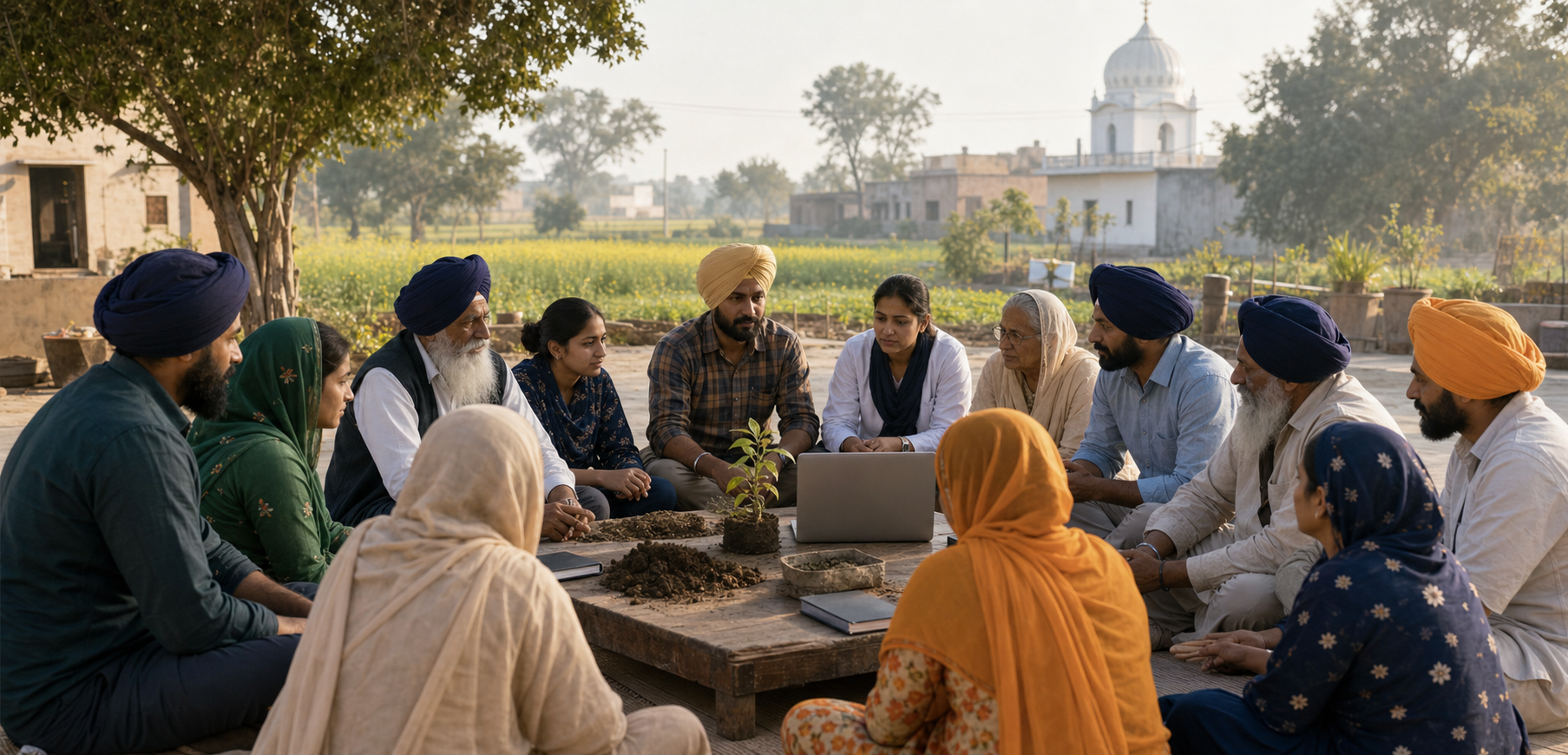
You may be seeing the pressure in your own circle: a young person preparing to leave Punjab, a family confronting addiction, a Khalsa school struggling to move learners from Romanized lines to Gurmukhi, or a gurdwara meeting consumed by factional argument. The mistake is to treat each problem as an isolated emergency – or as proof that Sikhi itself is weakening.
The more useful question is: what responsibility belongs to you? If you are a parent, educator, committee member, donor, health professional, farmer, student or granthi, you do not need a slogan covering the whole Panth. You need one credible action, a responsible owner and a way for the sangat to see whether the action worked.
Key takeaways
- Treat Punjab’s ecological stress, insecure livelihoods and migration as one connected problem. Crop advice without markets, risk-sharing and non-farm employment will not be enough.
- Respond to substance-use disorders through qualified clinical care, counseling and dignified peer support. Seva can support recovery, but it is not a substitute for treatment.
- Use Romanization as a bridge into Gurmukhi, not as the permanent destination. Measure comprehension and application rather than attendance or memorization alone.
- Make gurdwara accountability routine by publishing finances, tender information, conflicts of interest, governance dates and program results before controversy forces disclosure.
- Reject the false choice between Sikh distinctiveness and Dharmic cooperation. Shared seva with Hindu, Buddhist and Jain communities can protect social trust without erasing theological differences.
- When polarization rises, slow the information chain: distinguish verified facts from allegations, protect due process and correct false claims as visibly as they were circulated.
Repair Punjab’s livelihood and ecological foundations together
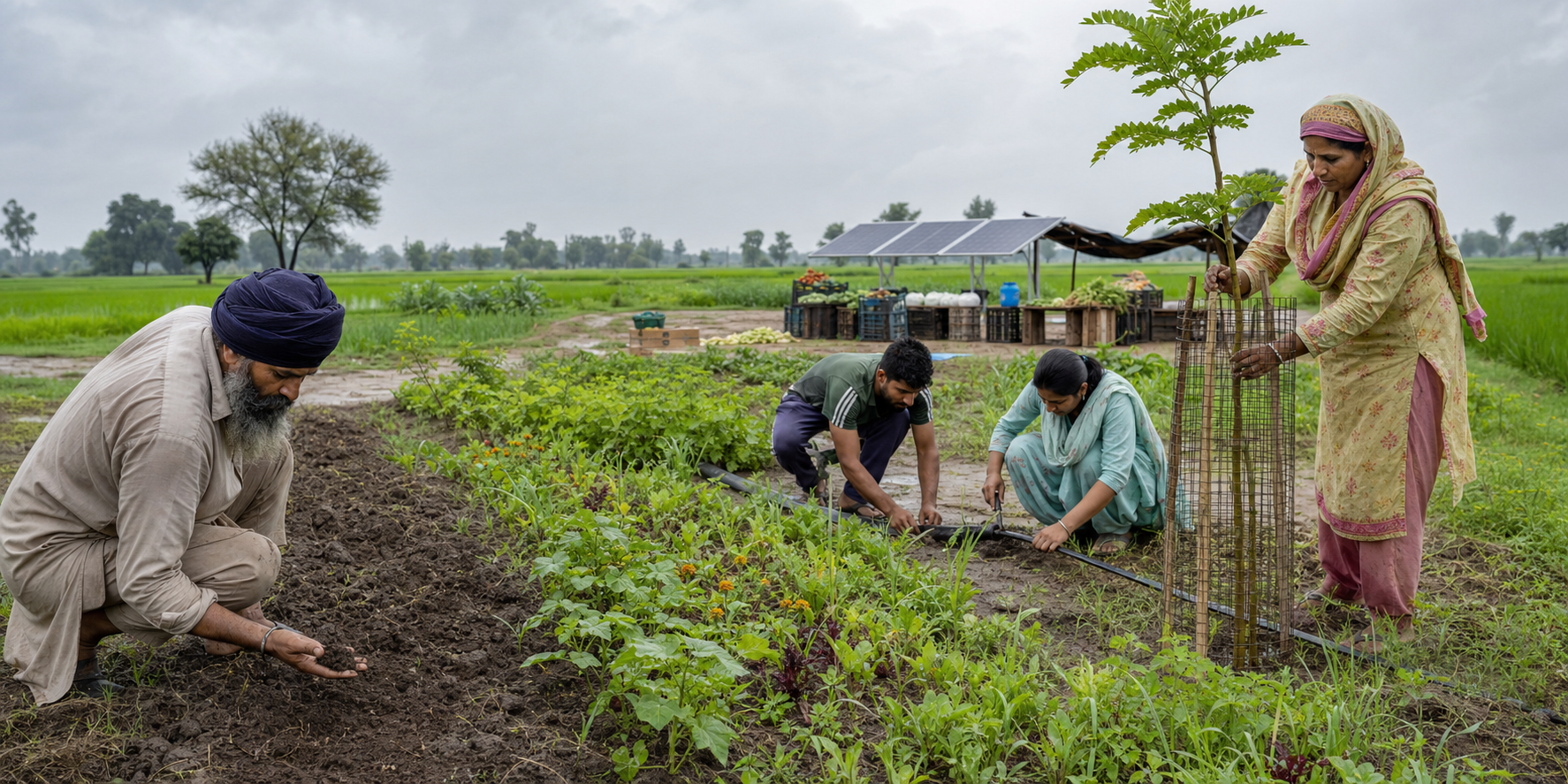
Punjab’s high-input paddy-wheat system delivered food security while contributing to groundwater over-extraction, soil fatigue and exposure to climate variability. Mechanization has also reduced the amount of labor agriculture can absorb, while manufacturing and service-sector opportunities have developed unevenly. These are not separate files for an agriculture office, an employment office and a migration seminar. They meet inside the same household.
A farmer cannot diversify because a committee passes a resolution praising millets or pulses. A viable shift needs a buyer, suitable storage or processing, transport, agronomic support and a way to share the transition risk. Without that chain, the individual farmer carries the downside while everyone else enjoys the language of reform.
Build a local plan around decisions farmers can actually make
- Establish the baseline. Record the groundwater trend for the relevant block, the local cropping mix and the instability of net farm income. A state-level average is too distant to guide a village-level decision.
- Select diversification paths that match real demand. Pulses, oilseeds, millets and horticulture become practical only when procurement, cold-chain capacity, processing or cooperative marketing exists alongside production.
- Evaluate water-saving practices under local conditions. Micro-irrigation, direct-seeded rice and soil-restoration methods deserve serious use, but no single technique should be promised as an identical solution for every field.
- Connect colleges, small and medium-sized enterprises and gurdwaras through apprenticeship and skills pathways. Track actual placement, the sectors entered and the participation of young women, not merely enrollment in training.
- Publish the results in a simple community dashboard. Groundwater direction, crop diversification, income volatility and employment outcomes tell the sangat far more than photographs from a launch event.
If you are part of a diaspora association or charitable trust, fund the enabling link that is missing. That might be processing capacity, a cooperative system, practical training or a transparent risk-sharing mechanism. Asking farmers to display environmental virtue while leaving them alone with uncertain income is neither fair nor likely to work.
Migration also needs a more mature response. Education abroad can open a future for a young person while weakening village demographics, separating generations and making families dependent on remittances. Do not treat departure as betrayal, but do not let it become severance. Build a repeatable rhythm of Punjabi use, Gurmukhi reading, family decision-making and participation in a real Punjab-based community project. Identity survives distance when it remains a practice rather than a memory.
Give young people care, competence and a lived Sikh identity
The 2019 Ministry of Social Justice and Empowerment-AIIMS report Magnitude of Substance Use in India identified Punjab among the states with high opioid-misuse prevalence. Substance-use disorders intersect with unemployment, mental distress, stigma and family instability. Calling the problem a lack of character or faith makes concealment more likely and care harder to reach.
Keep the gurdwara inside the care network, not in place of it
Qualified care may include medication-assisted treatment, counseling and peer-led recovery. Clinical decisions belong with trained health professionals. If someone may be in immediate danger, seek local emergency or qualified clinical help; prayer, family supervision and a community program are not emergency medical treatment.
A gurdwara can still become a powerful recovery-friendly space. Its role should be concrete:
- Maintain an up-to-date referral path to qualified treatment, counseling and family-support services.
- Designate trained contacts who can listen without public exposure, moral interrogation or promises they are not qualified to make.
- Offer families education about treatment and recovery so that shame does not drive the problem underground.
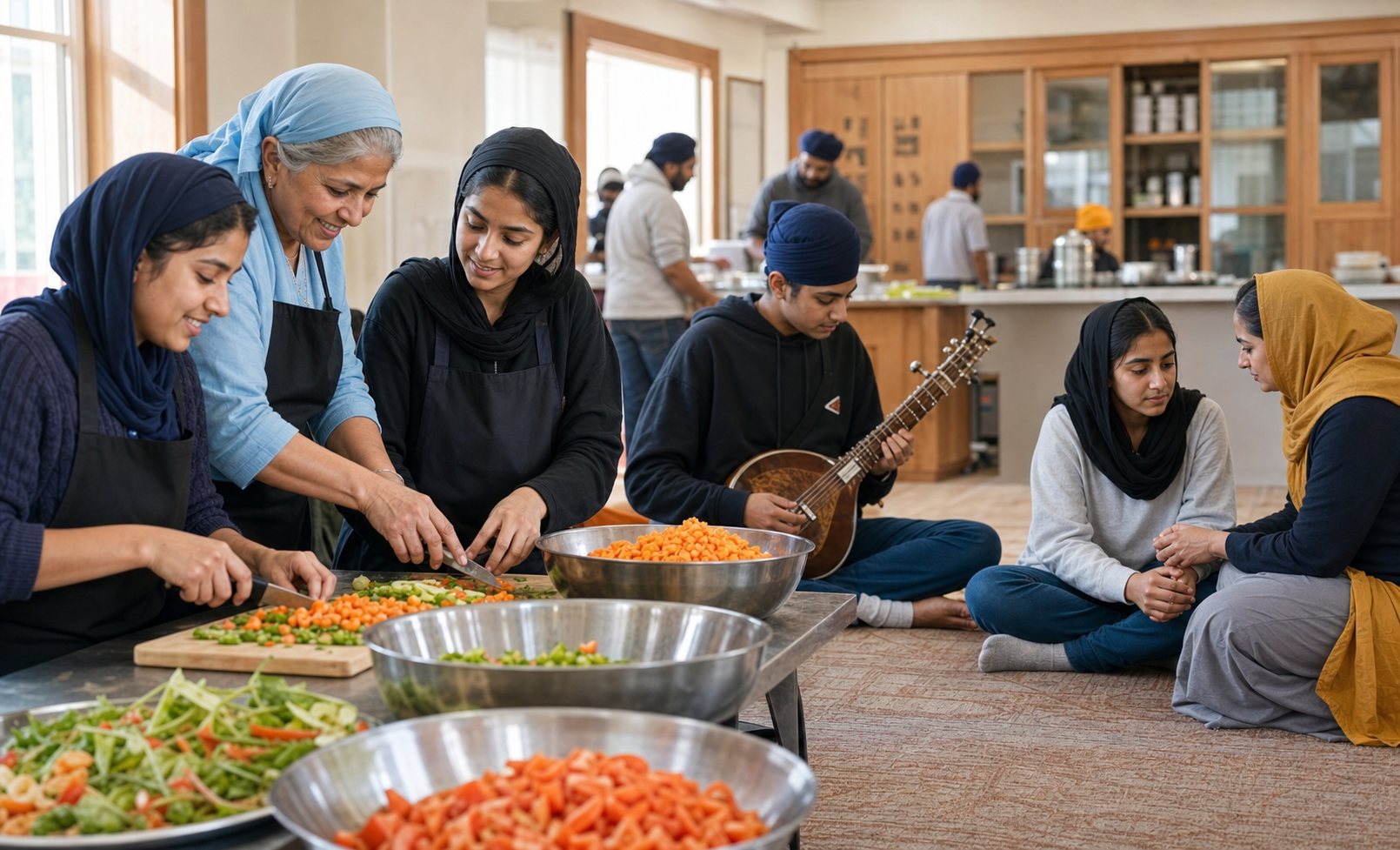
- Create voluntary peer support and a path from recovery into appropriate seva. Service can restore routine, dignity and belonging, but it should never be imposed as proof that a person deserves care.
- Support protective routines for adolescents through sports, arts, kirtan and dependable sangat rather than relying on one-off warnings about drugs.
A Recovery-to-Seva approach works only when the sequence is right: care and stabilization first, voluntary responsibility as the person is ready, and sustained community inclusion afterward. Seva should not become unpaid punishment, public labeling or an amateur detoxification program.
Treat digital well-being as safeguarding
Digital overexposure, cyberbullying, disrupted sleep, anxiety and fragmented attention are not solved by telling young people that phones are bad. Schools and gurdwaras can agree on a shared approach: parent training, clear reporting routes for cyberbullying, device expectations around study and sleep, and safe peer-support groups. When harm occurs, handle it as a safeguarding matter rather than humiliating the young person in front of family or sangat.
Parents can replace recurring arguments about screen time with a few stable household practices. Decide when devices are set aside, which adult a child can approach after an online incident and what the family will do before forwarding an inflammatory clip. The aim is not to make technology disappear. It is to keep technology subordinate to sleep, learning, relationships and discernment.
Move from inherited labels to religious literacy
Romanized Gurbani can help a beginner participate, but it cannot carry the full work of Gurmukhi literacy. A durable learning path moves from hearing and recitation to recognizing the script, reading it, explaining the meaning and applying the teaching. A learner who can reproduce a line but cannot discuss its meaning has memorized something valuable, yet has not completed the task.
Weekend Khalsa schools, university sabhas and online learning platforms should collaborate on open-licensed resources, teacher development and credible assessments. Evaluate whether a learner can read Gurmukhi, understand Gurbani at an age-appropriate level, discuss Sikh Rehat Maryada and connect Gurmat with conduct, environmental responsibility, civic ethics and digital citizenship. Attendance certificates should not conceal gaps in understanding.
At home, set a repeatable time for conversational Punjabi and shared Gurmukhi reading. Keep the passage manageable, let the learner explain it in the language they command best and correct without embarrassment. Build an age-appropriate path toward Nitnem instead of demanding an outward performance that the child does not yet understand.
Handle constitutional identity questions with the same precision. Article 25 of India’s Constitution, including its explanatory clause, remains part of Sikh conversations about recognition and rights. A school can affirm the distinct Sikh identity without turning a complicated legal question into a loyalty test. When an issue affects someone’s actual legal rights, use the constitutional text and qualified legal advice rather than a viral summary.
Make gurdwara governance worthy of the sangat’s trust
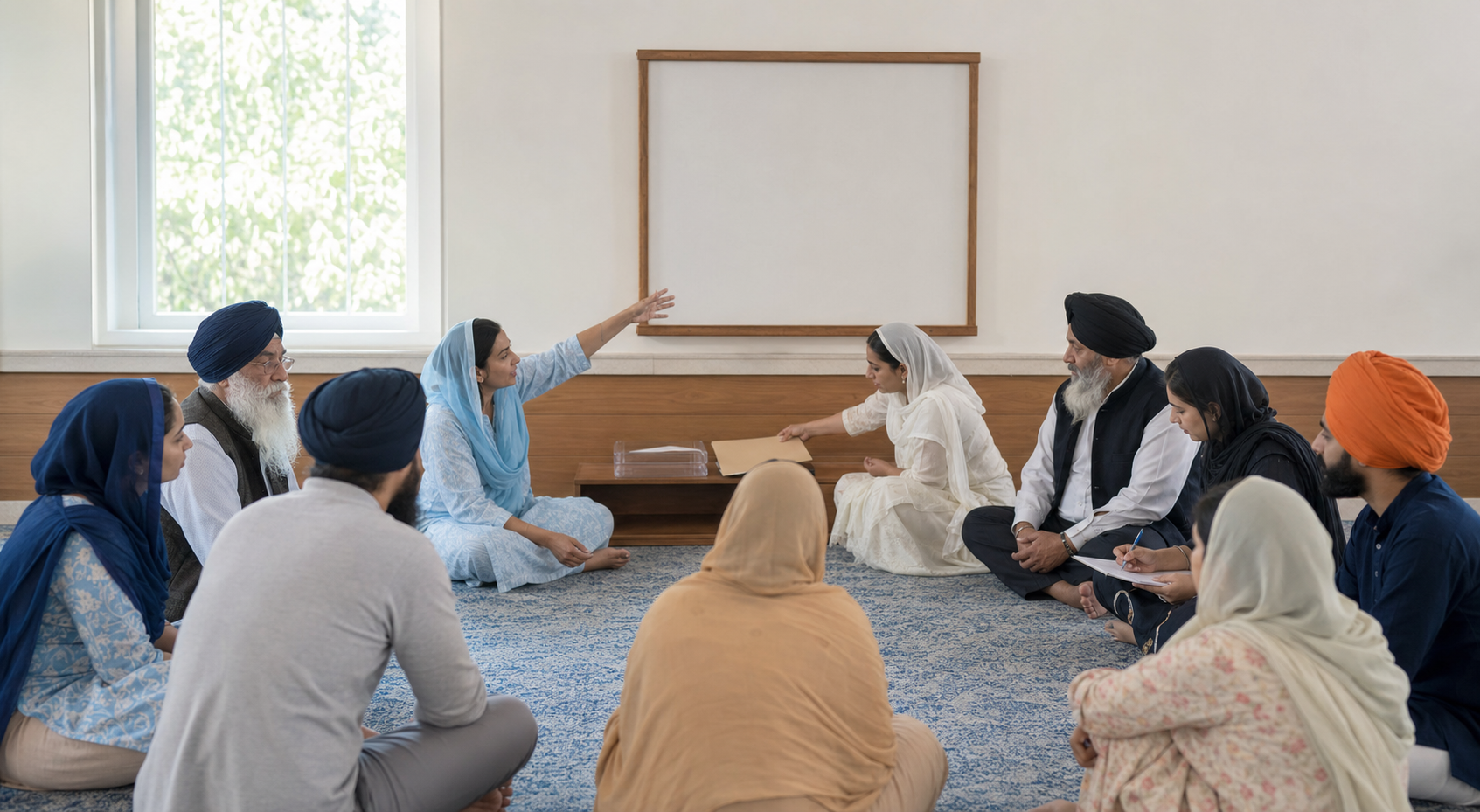
The SGPC, the DSGMC and local gurdwara bodies carry responsibilities extending far beyond building maintenance. They oversee sacred spaces, educational work, charitable funds and public service. When factional politics, litigation or opaque decisions dominate attention, the cost is not merely reputational. Money, volunteer energy and spiritual confidence are diverted from the institution’s mission.
The sangat should not have to choose between reverence and accountability. Transparent finances, independent audits, conflict-of-interest rules, open tender details and visible program outcomes are forms of stewardship. They do not diminish the sanctity of the gurdwara.
Publish a governance pack before anyone has to demand it
- The approved budget, with income and expenditure separated by program rather than buried in broad headings.
- Tender notices, selection information and the identities of decision-makers involved in material procurement.
- Independently audited financial statements and a clear response to any control weakness identified.
- A conflict-of-interest policy, declarations from office-holders and a record of recusals where relevant.
- A governance calendar showing meetings, elections, consultations and reporting dates.
- Outcome reporting for education, health, elderly care and other seva programs. Money spent is an input; people reached and needs met are outcomes.
Participatory budgeting should begin before the spending plan is finalized. Ask the sangat to rank service needs, publish the available resources and explain which requests were accepted, deferred or declined. Consultation without a visible response becomes theatre; a documented decision creates accountability even when everyone does not get the answer they wanted.
Capacity matters as much as disclosure. Granthis, ragis, educators and administrators need continuing development suited to their responsibilities, including Sikh Rehat Maryada, ethics, child protection and financial control. Women and young adults also need meaningful representation in governance, with access to information and votes, not ceremonial invitations after decisions have been made.
When a dispute arises, classify it before arguing about it. A doctrinal question needs informed panthic deliberation. A legal question needs qualified counsel and due process. An operational failure needs records, controls and a responsible manager. A personal conflict may need mediation. Treating every disagreement as a battle for the soul of the Panth turns correctable administrative problems into permanent factions.
Professional administration does not require centralizing every local decision. The aim is coherence of purpose: devotion, education and seva supported by controls that work in every institution. A trusted gurdwara is not one that never faces disagreement. It is one whose members can see how decisions are made, how money is used and how errors are corrected.
Lower polarization without trading away Sikh dignity
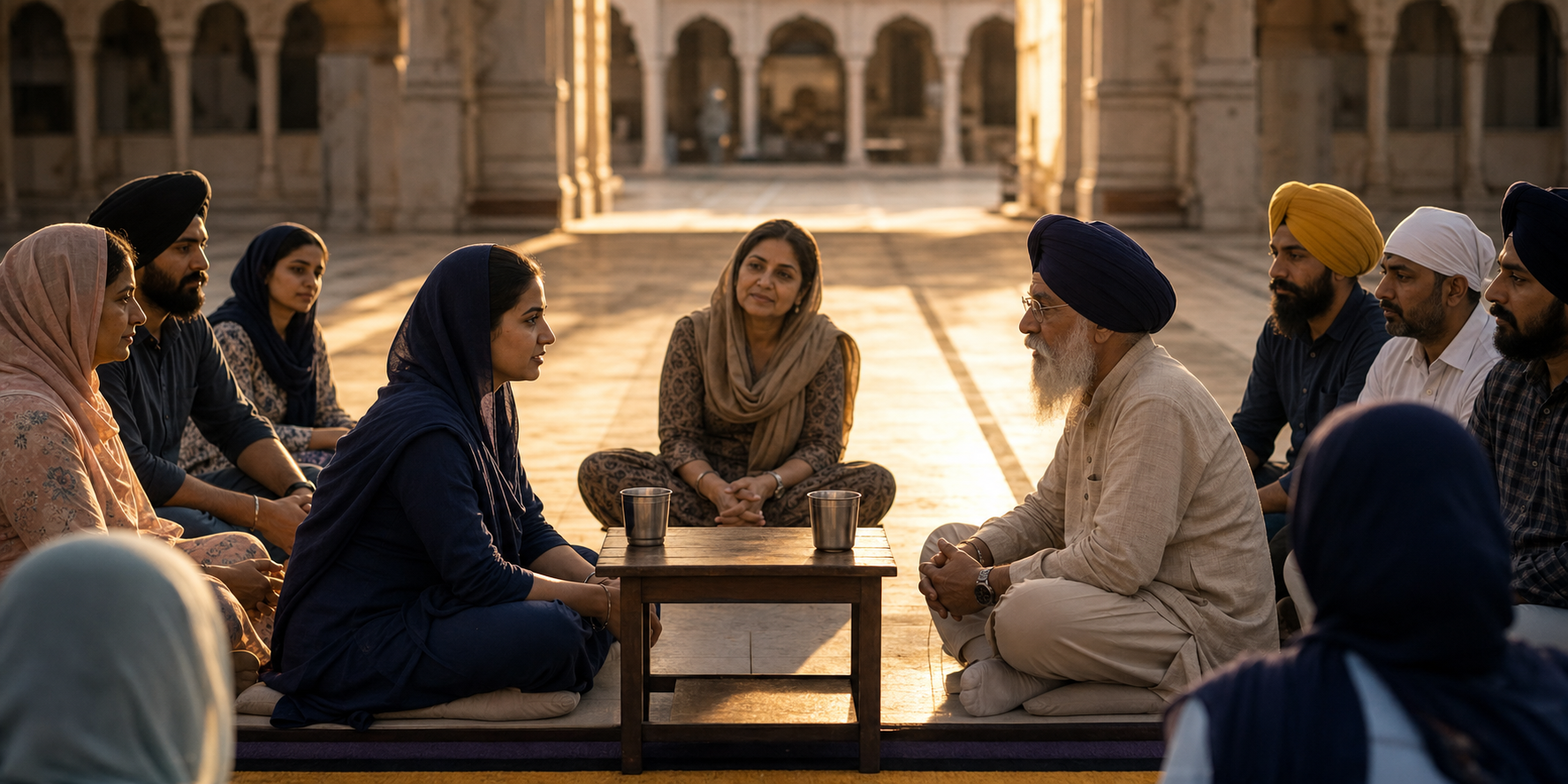
Sikh public life is often represented through its most heated online dispute, even though ordinary community life remains centered on family, kirtan, work and seva. Sacrilege incidents, diaspora arguments, security concerns and geopolitical tensions can rapidly harden an echo chamber. Once anger becomes the test of authenticity, unverified claims travel faster than corrections and moderate voices are treated as suspect.
Discussion of the Khalistan movement requires a disciplined position: reject violence, protect civil liberties, insist on due process and refuse to assign collective guilt. Security and dignity are not rivals. Proportionate law enforcement and transparent communication protect trust; indiscriminate rhetoric and opaque action weaken it. Community leaders should be equally clear that political grievance cannot excuse threats or violence.
Use a verification rule before sharing charged claims
- Can you identify the original evidence, or are you forwarding a screenshot of someone else’s assertion?
- Does the message distinguish an allegation, a verified fact and a legal finding?
- Could publication expose a private person to harassment before the facts are established?
- Is the wording designed to inform, or mainly to make your group angrier?
- If the claim proves false, will you correct it in the same groups and with the same visibility?
For a fast-moving local incident, create an early-warning and response process before it is needed. Identify responsible contacts, record what is verified and unverified, protect sensitive identities, issue time-marked updates and bring trained mediators in before rumor becomes mobilization. Rapid myth-busting is useful only when it is accurate; speed without verification merely adds another rumor.
Practice Dharmic kinship without erasing difference
Sikh distinctiveness can be affirmed alongside civilizational kinship with Hindu, Buddhist and Jain traditions. Shared commitments such as satya, ahimsa or karuna, and seva offer grounds for cooperation. They do not make the traditions interchangeable, and interfaith harmony should never require a Sikh to minimize the Guru tradition, the Khalsa discipline or a distinct communal identity.
Begin cooperation with a task that produces a visible public good: a blood-donation effort, disaster relief, food-security work or an environmental clean-up. Shared work gives people a reason to trust one another before they enter difficult historical or political discussions. It also places sarbat da bhala in public view as conduct rather than branding.
A serious dialogue can then ask each community to explain its own terms, name a shared civic concern, acknowledge a real disagreement without caricature and choose a joint action. Gurdwaras, temples, universities and youth groups are suitable settings when facilitators protect dignity and prevent the event from becoming a contest over whose history is allowed to exist.
At your next family, school or gurdwara meeting, resist adopting a declaration that promises to solve all five challenges. Choose one pressure within your reach. Name the responsible person, the next observable action, the measure the sangat will see and the date on which the result will be reviewed. Gurmat supplies the direction through Naam, Kirat Karni, Vand Chhakna, seva, chardi kala and sarbat da bhala. Your task is to turn that direction into competent, transparent practice.