
You may be deciding whether Sunday is suitable for a puja, a new undertaking, or an important family ceremony. The answer for June 28, 2026 depends on what you intend to do and where you live: the tithi is clear for India, but the day’s clock-based windows must be calculated for your city.
In Indian Standard Time, Shukla Trayodashi ends at 12:35 AM on June 28. Shukla Chaturdashi then prevails for nearly all of Sunday. This near-Purnima day favors japa, dana, quiet worship, and preparation for the full moon more readily than major samskaras.
Key takeaways
- Shukla Trayodashi ends at 12:35 AM IST; Shukla Chaturdashi governs the remainder of June 28.
- Pradosh belongs to the evening of June 27 because Trayodashi was present during the dusk observance period.
- The Moon is expected largely in Dhanu Rashi under Purva Ashadha, moving toward Uttara Ashadha and possibly Makara Rashi as the night advances, subject to location.
- For Sunday, Yamaganda occupies the fifth daylight segment, Gulika the seventh, and Rahu Kaal the eighth.
- Use the day for spiritual practice and seva. Verify a city-specific muhurta before marriage, upanayana, griha-pravesha, or another consequential beginning.
Read the tithi before choosing an observance
June 28 falls in Ashadha during the waxing fortnight in the commonly followed Amanta and Purnimanta reckonings described for this date. Because Trayodashi finishes shortly after midnight in India, Chaturdashi is the operative tithi at sunrise and through the ordinary daytime.
This distinction settles a common practical question: Shukla Pradosh should not be shifted to Sunday evening merely because Chaturdashi fills most of June 28. Pradosh is tied to Trayodashi at dusk, so the relevant observance was on Saturday evening, June 27.
Chaturdashi immediately before Purnima carries a contemplative character. You can treat it as a day for finishing, cleansing, and steadying the mind rather than forcing a ceremonial beginning. A short ishta-mantra practice, temple seva, annadana, or deepa-dana fits that purpose without requiring an elaborate household program.
The lunar background adds another layer. For much of the date, the Moon is best understood as moving through Dhanu Rashi with Purva Ashadha predominating, then trending toward Uttara Ashadha and possibly Makara Rashi late in the cycle. Purva Ashadha is associated with Apas, the Waters, and themes of renewal and perseverance. Uttara Ashadha brings an emphasis on durable resolve, truth, and responsibility. Use those themes for reflection, but do not infer an exact nakshatra changeover without a local calculation.
Calculate Sunday’s caution periods for your city
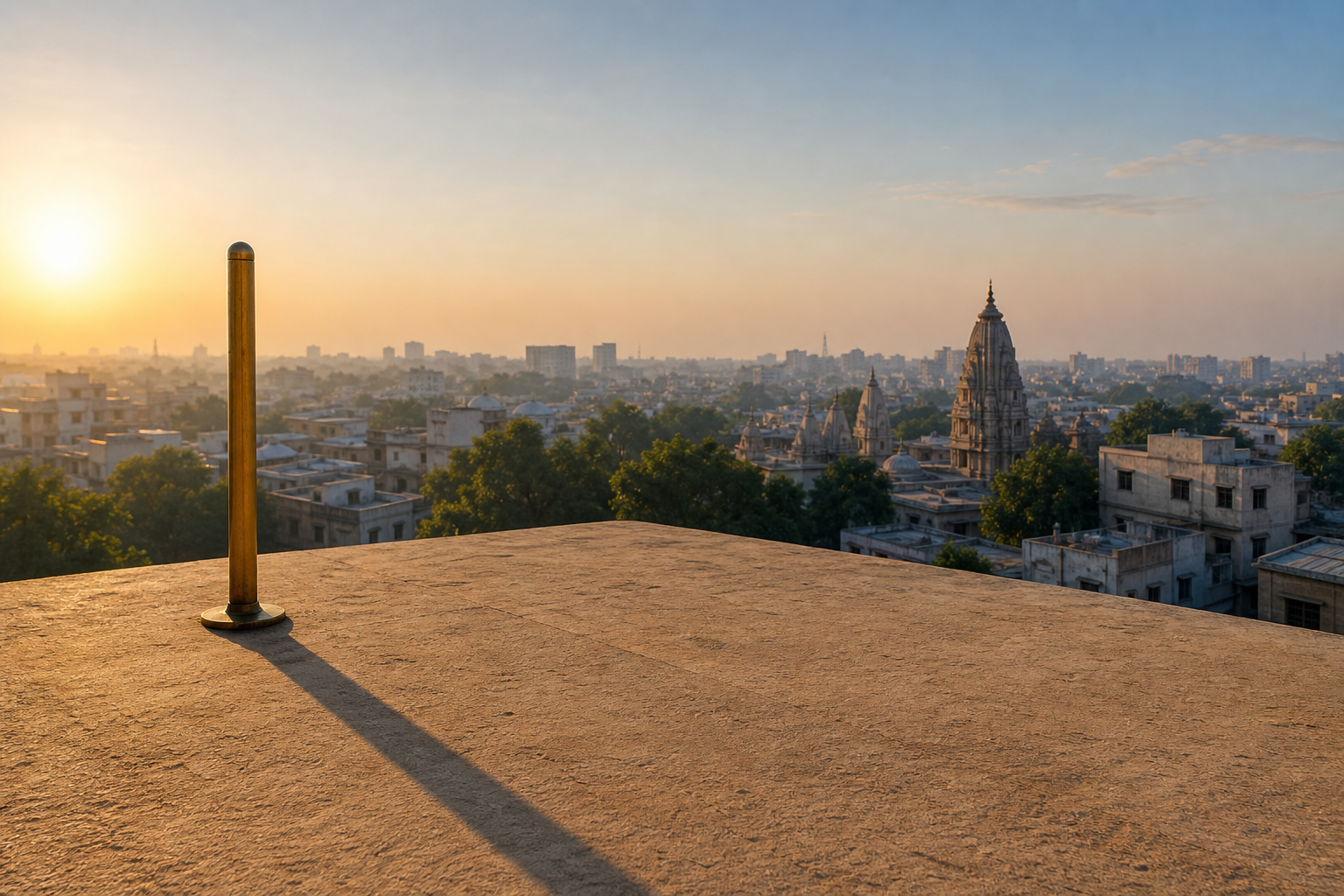
Rahu Kaal, Yamaganda, and Gulika are not fixed clock appointments. They are portions of the local sunrise-to-sunset interval. Record your city’s sunrise and sunset, find the total daylight duration, divide it into eight equal segments, and then apply Sunday’s sequence: Yamaganda is the fifth segment, Gulika the seventh, and Rahu Kaal the eighth.
Illustration only: If sunrise is 5:30 AM and sunset is 6:50 PM, daylight lasts 13 hours 20 minutes. Each of the eight segments is therefore 1 hour 40 minutes.
| Period | Sunday segment | Illustrative time | Planning decision |
|---|---|---|---|
| Yamaganda | Fifth | 12:10 PM-1:50 PM | Avoid beginning an important undertaking |
| Gulika | Seventh | 3:30 PM-5:10 PM | Keep consequential launches outside this interval |
| Rahu Kaal | Eighth | 5:10 PM-6:50 PM | Do not schedule a new or high-stakes start here |
Do not reuse those sample times unless your sunrise and sunset match them. Outside India, configure the exact city, time zone, and daylight-saving setting. The 12:35 AM tithi endpoint is stated in IST and should not be copied directly onto a local clock elsewhere.
Abhijit Muhurta is centered on local solar noon and often falls roughly between noon and 12:50 PM in many Indian cities in late June. That range is only a starting point. Calculate it locally and reject any portion that overlaps Yamaganda, Rahu Kaal, or another avoidance period. An auspicious label does not cancel an unfavorable overlap.
Before fixing a sensitive start, check Karana and Nitya Yoga as well. The Trayodashi-Chaturdashi sequence can involve Vanija and Vishti, or Bhadra, Karanas. Vishti is generally avoided for auspicious launches, but its presence and endpoint cannot be assigned confidently without a city-specific Panchang.
Match the activity to the character of Chaturdashi
Practices that fit the day
Begin after sunrise with arghya to Surya if that belongs to your practice. Set a manageable japa count rather than leaving the intention vague. You might then choose one concrete act of dana, arrange annadana, help with temple work, or light a diya at dusk with the household. These are devotional continuities, not attempts to manufacture a grand muhurta.
The sidereal Sun in Mithuna and Moon in Dhanu lend themselves symbolically to study joined with principle. If you have postponed scripture reading, svadhyaya, or a conversation about family dharma, give it a defined place in the day. Choose one text, one teaching, or one decision that you can complete rather than beginning several things at once.
Beginnings that deserve another date or a precise muhurta
Shukla Chaturdashi is generally treated conservatively for vivaha, upanayana, and griha-pravesha. If one of these must occur on June 28, a broad statement such as “Abhijit is auspicious” is not enough. Ask for an event-specific calculation using the exact venue, local sunrise, nakshatra endpoint, Karana, Yoga, and the relevant family or lineage requirements.
The same caution is sensible for a consequential contract, institutional launch, or other beginning that is difficult to reverse. Routine duties can continue; the point of Panchang is to guide deliberate starts, not to turn an ordinary Sunday into a source of anxiety.
Use Sunday to prepare for the approaching Purnima
Preparation is one of the most useful ways to honor a near-full-moon day. If your household plans Satyanarayana puja or Vishnu Sahasranama recitation on Purnima, gather the required items, agree on a time, and assign responsibilities on Sunday. This removes avoidable haste from the observance itself.
The lunar rhythm also has meaning beyond one sampradaya. Buddhist communities may prepare for full-moon Uposatha practice, while Sikh families may orient themselves toward Puranmashi through Paath or Shabad kirtan. Jain and other Dharmic practitioners can emphasize self-restraint, compassion, dana, and seva according to their own lineage. Shared timing need not erase distinct teachings or ritual forms.
Before Sunday arrives, save a Panchang configured for your actual city and write down only the intervals that affect your plans. If the occasion is a major samskara, use June 28 for devotion and preparation, then select a more suitable tithi-nakshatra combination with local guidance.