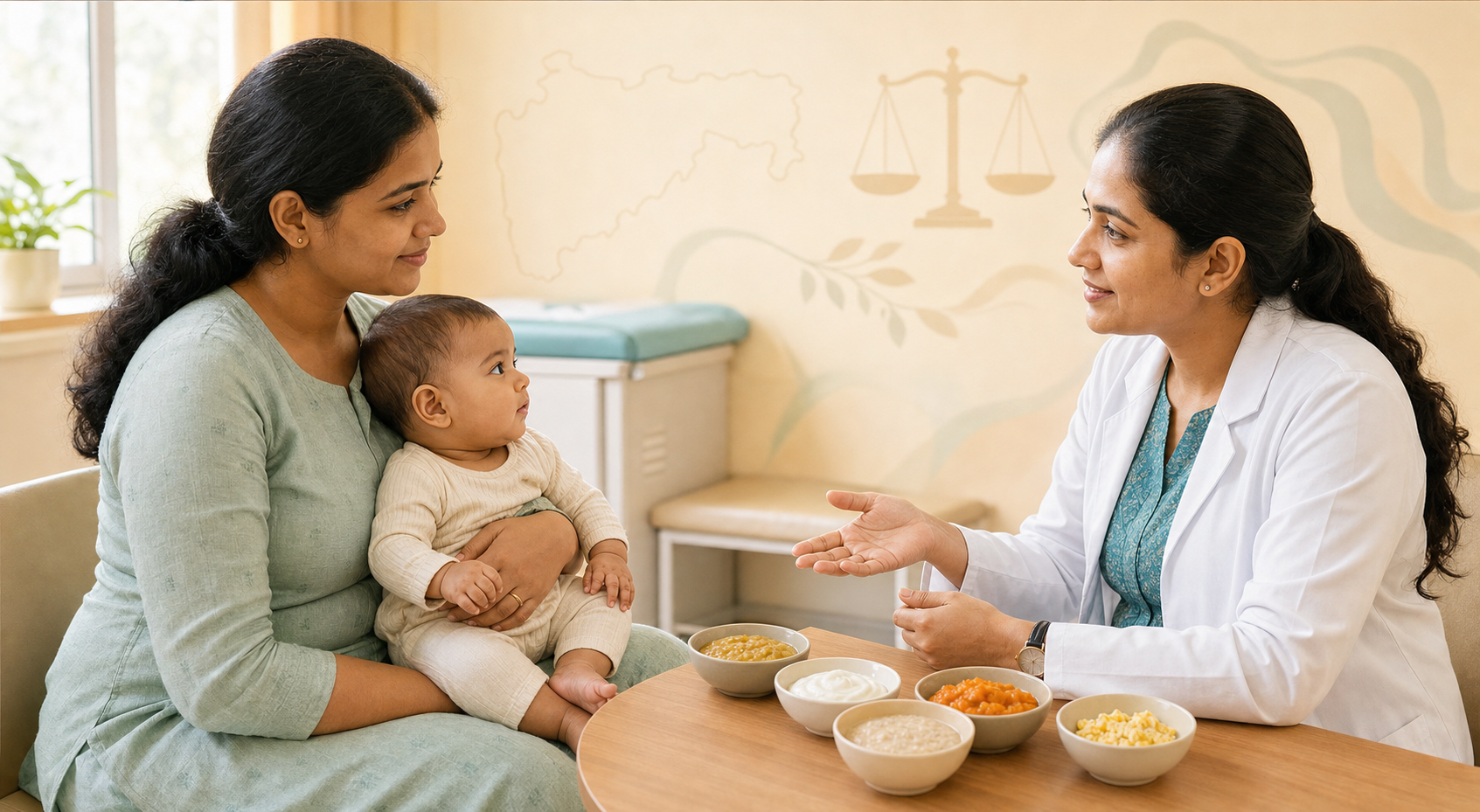
A disputed infant-feeding pamphlet in Navi Mumbai has brought together questions that are often treated as one: what Maharashtra law prohibits, what young children nutritionally require, who approved the material, and how public hospitals should respect religious and dietary choice.
The most useful response is not to set nutrition science against cultural conviction. It is to separate the legal, clinical, ethical, and administrative issues, then require public advice to satisfy all four.
Establish the facts before assigning responsibility
According to the supplied DharmaRenaissance Blog account, a child-feeding pamphlet displayed at a Navi Mumbai municipal hospital recommended beef for infants. The article reports that the Hindu Janajagruti Samiti sought legal action against the Indian Academy of Pediatrics and responsible officials, alleging that the advice contravened Maharashtra law and offended Hindu religious sentiments.
Those are reported allegations rather than independently established findings. Before responsibility can fairly be assigned, an inquiry would need to identify the exact document, its wording, its author, who authorized its display, and whether a professional body’s name or branding was used with approval. A pamphlet found inside a hospital does not by itself establish that the hospital administration, a local professional unit, and a national medical organization all endorsed it.
Provenance also determines the appropriate remedy. An outdated template, an unauthorized local adaptation, and an officially approved state-facing publication would represent materially different governance failures.
Key takeaways
- The supplied report describes a disputed pamphlet and a demand for action; it does not establish authorship or legal liability.
- The report summarizes Indian infant-feeding guidance as exclusive breastfeeding for the first six months, followed by adequate, safe complementary feeding.
- Iron, zinc, protein, and dietary diversity can be addressed through several food pathways; no single controversial food needs to be presented as indispensable.
- Legal compliance, clinical accuracy, cultural respect, and practical availability should be reviewed together before public nutrition material is displayed.
What Maharashtra law does – and does not – settle
The source reports that the Maharashtra Animal Preservation Act, 1976, as amended in 2015, prohibits the slaughter of cows, bulls, and bullocks and the sale of their meat within the state. It also notes that Bombay High Court rulings have introduced distinctions concerning possession and meat brought from outside Maharashtra, while leaving the central state prohibition on slaughter and sale in place.
That statutory setting makes a government-facility recommendation of beef appear poorly aligned with Maharashtra’s regulatory environment and readily foreseeable public sensitivities. It does not, however, answer every legal question. A restriction on slaughter or sale is not automatically identical to a restriction on mentioning or recommending a food. Whether displaying the pamphlet itself constitutes an offence would depend on the precise statutory provision, the document’s language and purpose, and the facts established through due process.
The same distinction applies to the allegation concerning religious sentiments. The intensity of public objection explains why the material requires scrutiny, but an allegation and a proven violation are not interchangeable. A careful inquiry should therefore avoid both premature exoneration and automatic criminalization.
Nutrition goals need not dictate one prescribed food
The source places the controversy within Infant and Young Child Feeding guidance associated with Indian public-health authorities and WHO and UNICEF principles. As summarized there, breastfeeding is prioritized exclusively during the first six months, after which complementary foods should be introduced while feeding remains adequate, safe, and appropriate to the child’s stage of development.
Animal-source foods can supply readily absorbed iron and zinc, but that nutritional observation does not make beef uniquely necessary. The report says standard guidance generally refers to categories such as meat, fish, and eggs and expects recommendations to be adapted to what is locally available, affordable, lawful, and culturally acceptable. Nutrient requirements are universal; the foods used to meet them need not be.
For families in Maharashtra seeking vegetarian routes, the article identifies combinations involving dal, moong, chana, sprouted pulses, curd or paneer where accepted, groundnut or sesame preparations, green leafy vegetables paired with vitamin-C-rich foods, and fortified infant cereals. Small quantities of ghee may contribute dietary energy but should not be confused with an iron or protein substitute. Where a household eats non-vegetarian food, the source points to eggs or fish as possible locally lawful choices after six months, prepared safely and in an age-appropriate texture.
These examples are best presented as options rather than a universal menu. Individual counseling remains important when a child has feeding difficulties, suspected deficiency, allergy concerns, impaired growth, or another clinical need. The core communication task is to explain the nutrient objective and offer several acceptable ways to pursue it.
Public-health advice must earn caregiver trust
A technically defensible statement can still fail as public communication if it ignores the setting in which families encounter it. Many Hindu, Buddhist, Jain, and Sikh households understand food through ethical commitments that may include ahimsa, restraint, or vegetarian practice. Other families make different dietary choices. A municipal hospital serves all of them and should not imply that one disputed food is the only medically responsible choice.
This is especially important in pediatric clinics, where caregivers may already be anxious about vaccination, growth, illness, or feeding. Material perceived as dismissive of conscience can weaken trust in the rest of the guidance, including messages that are both clinically sound and broadly accepted.
A stronger communication model begins with the function of food: iron for preventing deficiency, protein for growth, energy for development, and varied foods for overall adequacy. It then supplies parallel examples suitable for vegetarian and non-vegetarian households, while noting local law, affordability, safe preparation, and family preference. Such wording respects pluralism without diluting the nutritional objective.
Accountability should be evidence-led and proportionate
The episode points to a broader administrative weakness described in the source: health-education materials may circulate without an obvious approval chain. A credible hospital process would verify the origin of every document, obtain pediatric review, check state-specific legal implications, edit for plain language, examine translations for unintended connotations, and require documented approval before display. Professional organizations also need control over the use of their names and state-aware templates for local units.
The response should then match the established facts. The source proposes withdrawal, a correction, and staff retraining where the problem proves to be an inadvertent lapse. Deliberate disregard, unauthorized brand use, or repeated failures could justify stronger administrative or legal consequences under whatever provisions actually apply. This graduated approach protects both institutional fairness and public confidence.
Civil-society organizations, hospital administrators, pediatric bodies, legal reviewers, and representatives of affected communities can turn the dispute into a durable improvement by agreeing on vetted, state-appropriate feeding materials. The practical next step is a transparent review that produces lawful guidance with multiple nutritional routes, allowing child welfare, conscience, and public trust to reinforce rather than undermine one another.