
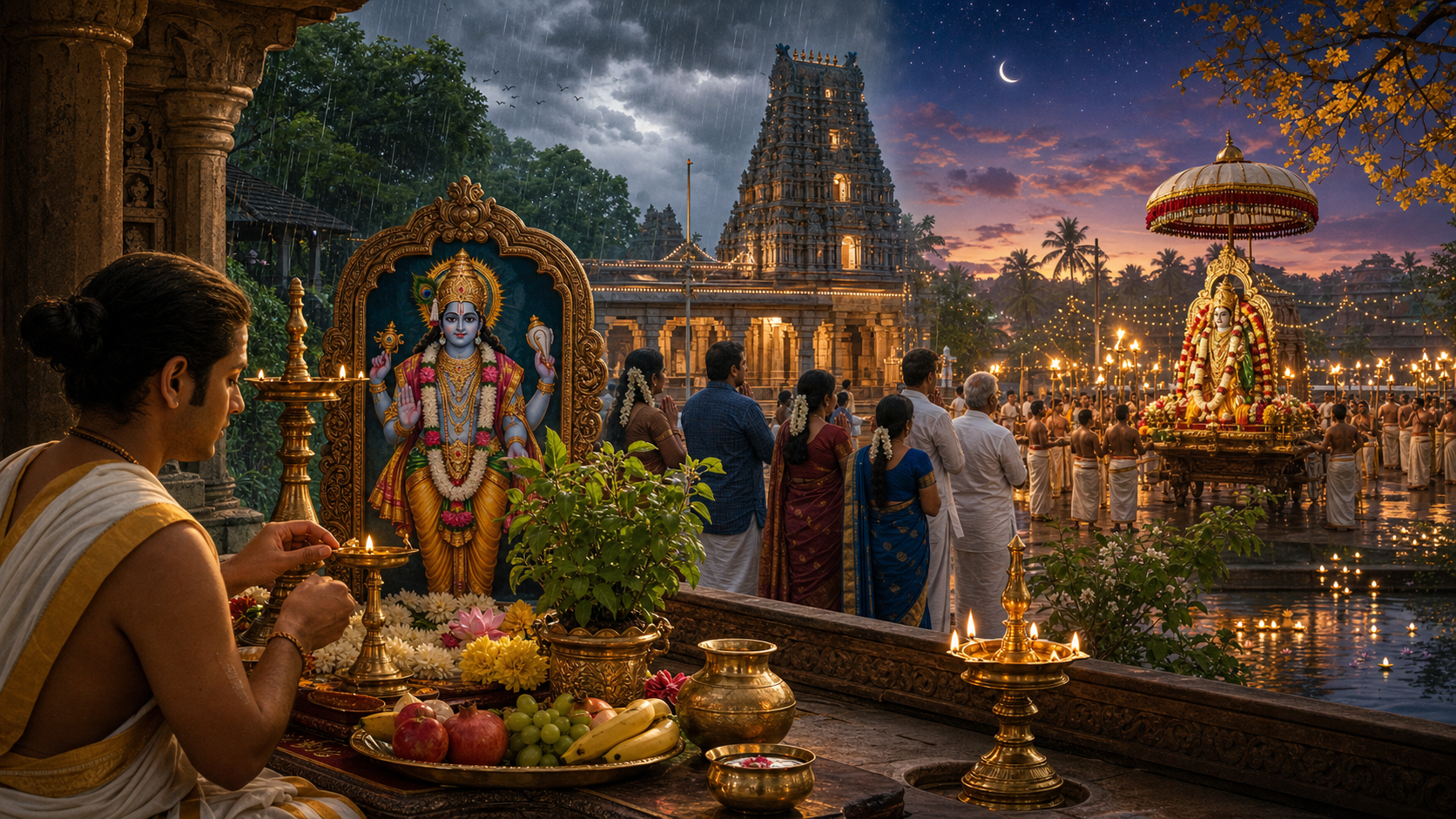
Vishnu observance in 2026 does not follow a single ritual pattern. The source reports bring together a four-month personal vow, two date-sensitive fasting traditions, an avatara commemoration, a nine-day temple festival and a recurring series of full-moon processions.
Viewed as one calendar, these observances show how Vaishnava sacred time moves between disciplined household practice, reflection on Vishnu’s forms and public darshan. This guide organizes the reported dates, explains the important distinctions and identifies where local panchang or temple confirmation remains necessary.
One devotional calendar, three scales of practice
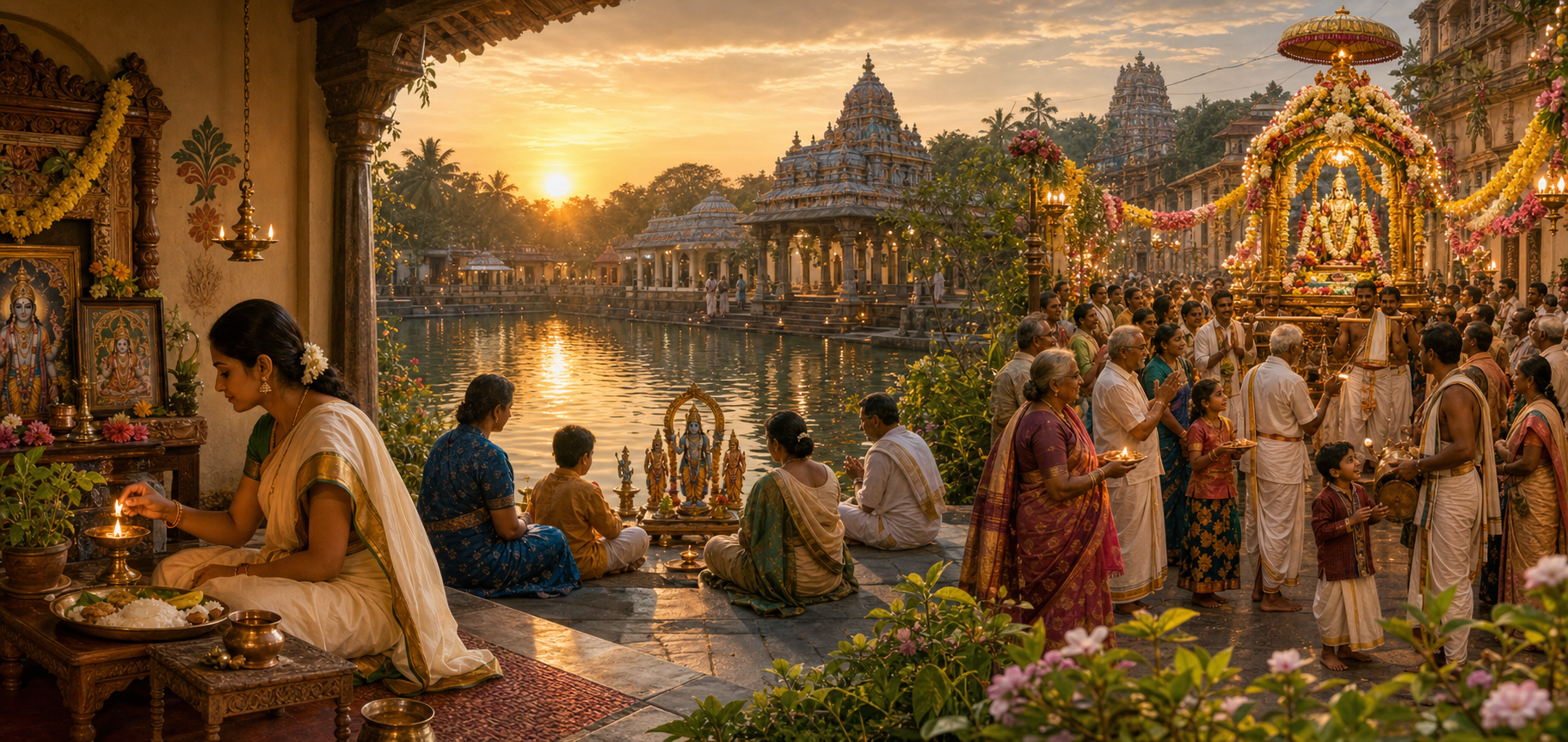
The observances fall into three broad scales. Dhwaja Vrata and Parama Ekadashi primarily organize the devotee’s conduct. Kurma Jayanti joins worship to remembrance of a particular avatara. Narayanavanam Brahmotsavam and Tirumala’s Pournami Garuda Sevas place devotion in a public, temple-directed setting. The distinctions matter because a personal fast, a lunar anniversary and an institutional procession do not require the same kind of preparation.
The Dhwaja Vrata article describes the most extended discipline in the group. Also called Chaturmurti Vrata, it proceeds from Chaitra through Ashadha and honors Vasudeva, Sankarshana, Pradyumna and Aniruddha in succession. Each month has its own flag emblem and color. The changing ritual focus turns four months into a progressive practice rather than four repetitions of one ceremony.
Parama Ekadashi is much more concentrated in time. Its source places the 2026 vrata on June 11, during Krishna Paksha of Adhik Jyeshta Maas. The extra lunar month, also treated in Vaishnava traditions as Purushottam Maas, gives this Ekadashi a distinctive context of intensified Vishnu remembrance. Its practical center is fasting according to capacity, puja, recitation, restraint in conduct, charity and Dwadashi parana.
Kurma Jayanti uses sacred time in another way: it commemorates Vishnu as the stabilizing tortoise beneath the churning of the cosmic ocean. The relevant source reports May 1, on Vaishakh Purnima, as the principal 2026 date, while also recording June 25, Nirjala Ekadashi, as an observance date in some regional traditions. That variation should be preserved rather than forced into artificial uniformity.
The temple festivals shift attention from individual regulation to collective darshan. The Narayanavanam report describes preparations, processions and Kalyanotsavam within the Vaikhanasa Agama tradition under Tirumala Tirupati Devasthanam administration. The separate Tirumala schedule lists seven planned Pournami Garuda Sevas and two full-moon dates on which that seva was reported as cancelled because other temple observances had priority.
The reported 2026 dates from May through December
The following calendar consolidates the dates as reported by the source articles; it is not an independently verified temple or panchang schedule. The overlap on May 1 is especially notable: one source assigns Kurma Jayanti to Vaishakh Purnima, while another lists a Pournami Garuda Seva at Tirumala on the same civil date.
| Date or period | Observance | What the source reports |
|---|---|---|
| Chaitra through Ashadha | Dhwaja Vrata | A four-lunar-month cycle honoring the Chaturvyuha forms of Vishnu; no corresponding civil-date range was supplied. |
| May 1 | Kurma Jayanti and Pournami Garuda Seva | Kurma Jayanti on Vaishakh Purnima; separately, the first listed 2026 full-moon Garuda procession at Tirumala. |
| May 24 | Koil Alwar Tirumanjanam | Temple cleansing and sanctification before the Narayanavanam Brahmotsavam. |
| May 27 | Ankurarpanam | The seed-sowing preparatory rite for the Narayanavanam festival. |
| May 28 to June 5 | Narayanavanam Brahmotsavam | The reported main festival period at Sri Kalyana Venkateswara Swamy Temple. |
| May 31 | Pournami Garuda Seva | The second date listed in the Tirumala full-moon procession schedule. |
| June 1 | Narayanavanam Garuda Seva | A highlighted vahana seva within the Brahmotsavam. |
| June 4 | Narayanavanam Kalyanotsavam | The divine-wedding observance associated with Venkateswara Swamy and Padmavati Devi. |
| June 11 | Parama Ekadashi | Krishna Paksha Ekadashi of Adhik Jyeshta Maas, according to the dedicated source. |
| June 25 | Regional Kurma Jayanti observance | A date followed by some traditions that associate Kurma Jayanti with Nirjala Ekadashi. |
| June 29, July 29, August 28, September 26 and October 26 | Pournami Garuda Sevas | The remaining five planned dates in the reported Tirumala schedule. |
| November 24 | Pournami Garuda Seva not scheduled | The source lists the seva as cancelled because of Karthika Deepotsavam. |
| December 24 | Pournami Garuda Seva not scheduled | The source lists the seva as cancelled because of Adhyayanotsavam. |
The calendar also reveals two different kinds of recurrence. Ekadashi and Purnima arise from lunar tithis, so their observance depends on calendrical rules and location. Brahmotsavam is an institutionally sequenced temple festival whose practical details depend on the administering temple. Dhwaja Vrata is longer still, using four lunar months as the architecture of a sustained vow.
What the vratas ask of a devotee
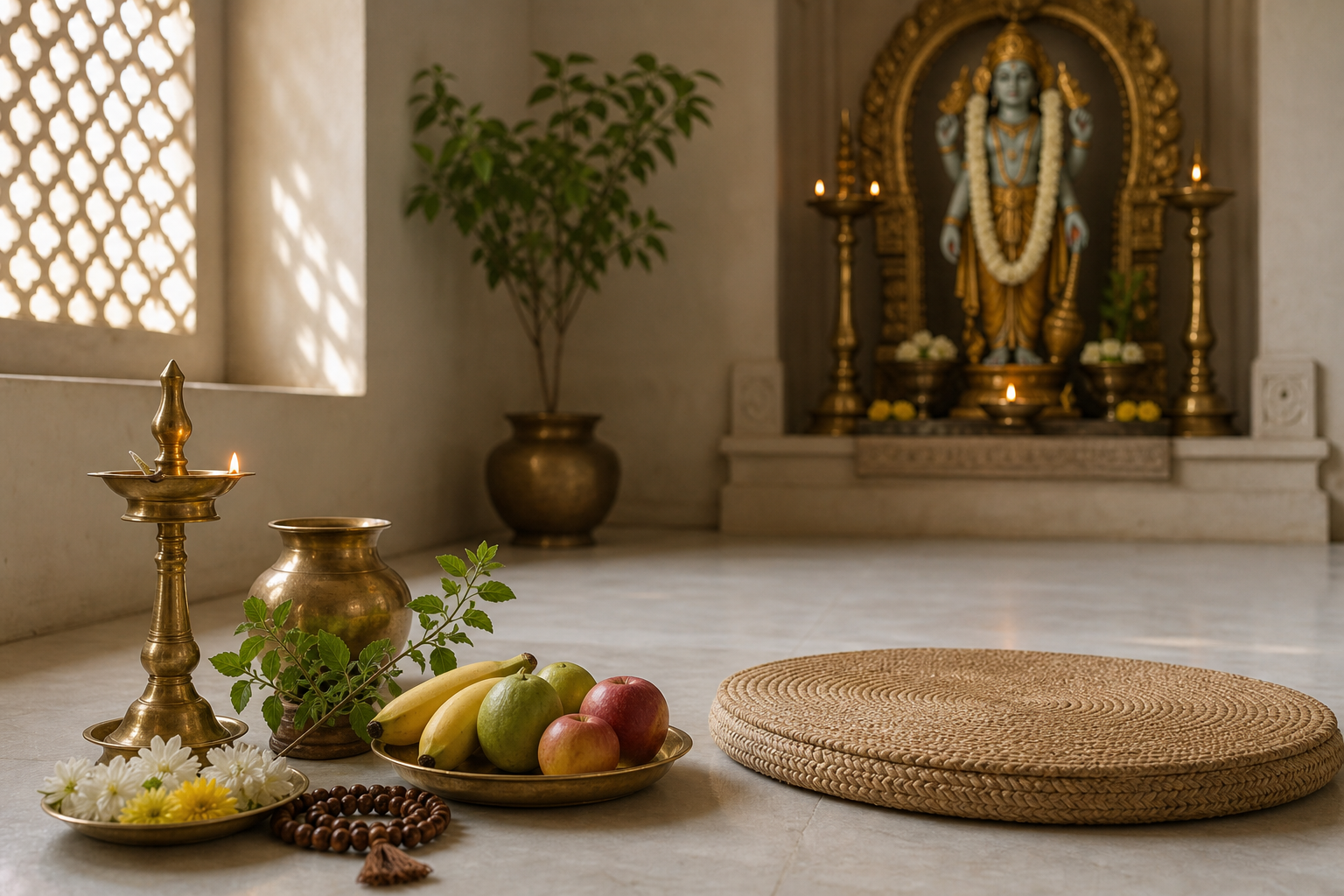
Dhwaja Vrata is the strictest discipline described in the sources. In Chaitra, Vasudeva is associated with a yellow Garuda flag; in Vaishakha, Sankarshana with a blue Tala or palm-tree flag; in Jyeshtha, Pradyumna with a white Makara flag; and in Ashadha, Aniruddha with a red Rishya, understood as a deer or antelope. The sequence integrates deity, image, color and season into one practice.
The classical regimen reported for this vow includes daily bathing, worship of the monthly emblem, honoring Agni, eating one oil-free meal at night, brahmacharya and sleeping on the floor. The final Ashadha observance culminates in feeding Brahmins and donating yellow, blue, white and red clothes. Its scriptural promise is correspondingly long-term: the article says that completing the annual cycle for twelve years leads to Sayujya with Vishnu. This is a devotional claim reported from the vrata tradition, not a measurable outcome.
Parama Ekadashi uses fasting within a shorter framework. Its source notes that devotees may undertake a full or partial fast according to health, age, family custom and personal capacity. It mentions the avoidance of grains, beans and heavy foods, while fruits, milk, nuts or other vrata foods may be used in less severe forms. Vishnu Sahasranamam, other Vishnu stotras, divine-name japa, charity and disciplined speech give the vrata a purpose beyond food restriction.
Kurma Jayanti places less emphasis on one uniform fasting formula. The reported practices include Vishnu puja, remembrance of Kurma Avatara, stotra recitation, vrata, charity and a temple visit where possible. Its theological center is the Samudra Manthan: Vishnu assumes the tortoise form to support Mandara mountain while the devas and asuras churn the ocean with Vasuki. The source interprets that support as a model of patience, restraint and the stable foundation required for transformation.
Key takeaways
- A civil date is only the starting point for a tithi-based vrata; local sunrise, tithi boundaries and parana windows can affect practice.
- Dhwaja Vrata is a four-month rule of life, whereas Parama Ekadashi is a concentrated fast and Kurma Jayanti is an avatara commemoration with regional calendrical variation.
- Temple processions follow institutional schedules, so pilgrimage planning requires confirmation from the relevant temple authority.
- Shared Vishnu devotion does not make every observance interchangeable; each retains its own symbol, discipline and ritual purpose.
Garuda and Kurma express complementary forms of support

Garuda supplies the clearest connection across the source material. In Dhwaja Vrata, Garuda is the yellow emblem associated with Vasudeva during Chaitra. At Narayanavanam, Garuda Seva is a major event within Brahmotsavam. At Tirumala, Garuda becomes the vehicle for a recurring public full-moon darshan of Malayappa Swamy. Three articles therefore present the same Vaishnava figure at different scales: a meditative flag, a festival highlight and a repeated temple procession.
The sources associate Garuda with alertness, protection, strength, Vedic knowledge, surrender and the capacity to rise above harmful tendencies. The meaning changes in emphasis without losing its core. A household emblem focuses the practitioner’s attention; a vahana procession makes the relationship between Vishnu and Garuda visible to a gathered community.
Kurma offers a productive contrast. Garuda rises and carries; Kurma remains beneath and steadies. The Kurma Jayanti source presents the tortoise as the hidden support without which the cosmic churning cannot continue. Read alongside the vrata and festival reports, this produces a coherent devotional insight: aspiration needs lift, but sustained practice also needs a foundation.
Narayanavanam adds a social dimension through Kalyanotsavam. Because the temple tradition connects the site with the marriage of Venkateswara Swamy and Padmavati Devi, the divine wedding is interpreted through household harmony, responsibility and family dharma. Vishnu worship in these sources consequently spans solitary restraint, symbolic contemplation, marital ideals and collective pilgrimage.
Planning without flattening regional and temple differences
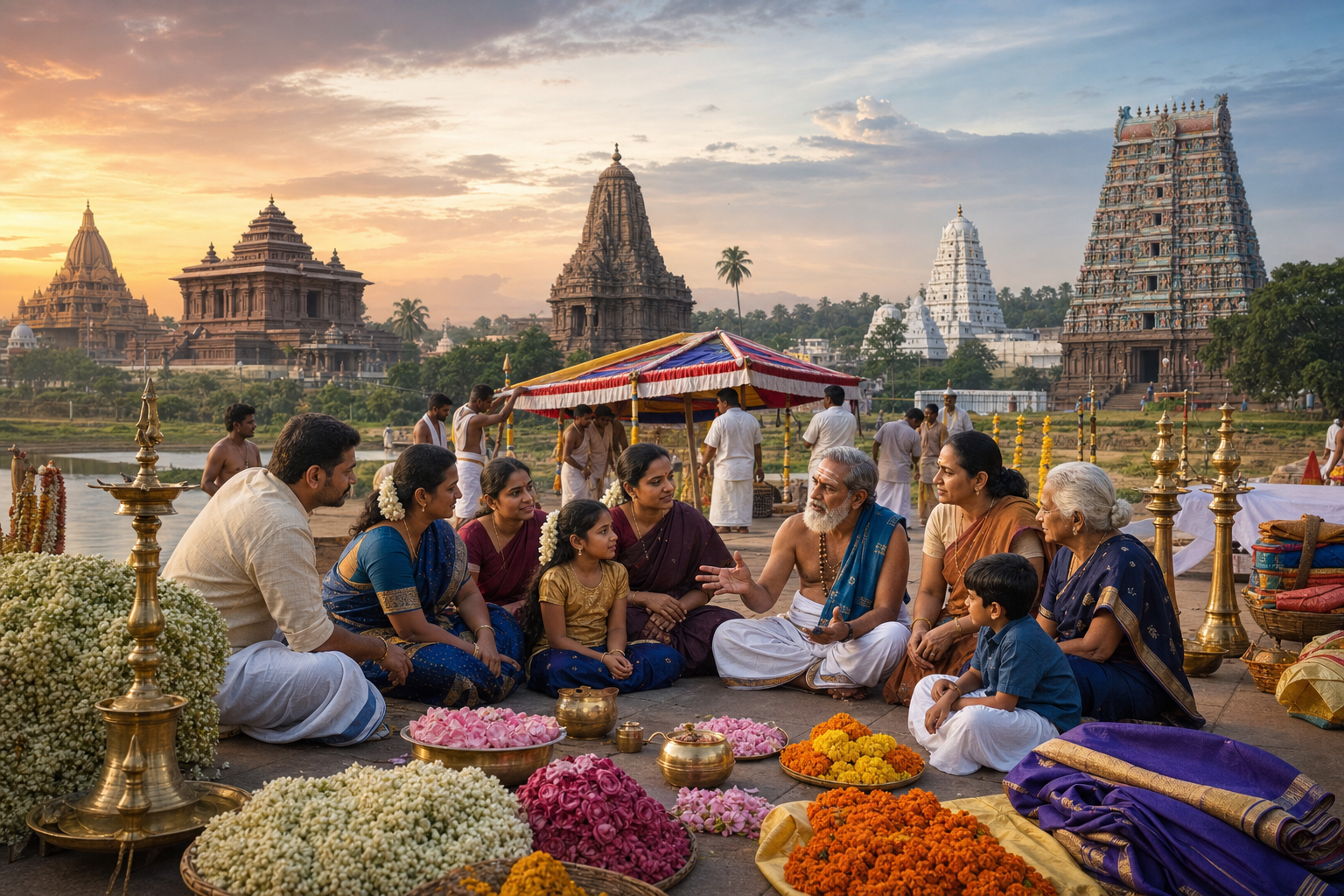
For a date-sensitive home vrata, the appropriate authority is a reliable local panchang together with family or sampradaya practice. The Parama Ekadashi article explicitly warns that local sunrise, tithi start and end times, and the Dwadashi parana window can vary by location. The Kurma Jayanti source likewise advises following the inherited tradition, temple calendar or regional panchang when choosing between the May 1 and June 25 observances.
For a temple festival, the practical authority is the temple administration. The Narayanavanam report calls for checking official TTD communications closer to the festival for detailed seva times and crowd arrangements. The Pournami schedule’s November and December cancellations illustrate why a full-moon date alone does not guarantee that Garuda Vahana Seva will occur: established observances elsewhere in the temple calendar can take precedence.
Personal capacity also belongs in the planning process. The Parama Ekadashi source rejects competitive austerity and allows for different forms of fasting based on health and circumstance. Dhwaja Vrata, by contrast, is reported with a demanding classical discipline and should be understood on its own terms rather than reduced to a single symbolic offering.
A sound 2026 observance plan will therefore pair a trusted regional panchang with current temple guidance, while preserving the theological character of each practice. That approach leaves room for calendrical diversity without turning sacred time into guesswork or treating every Vishnu festival as the same event under a different name.
References
- DharmaRenaissance Blog – Dhwaja Vrata: A Powerful Four-Month Vishnu Vow of Discipline and Liberation
- DharmaRenaissance Blog – Parama Ekadashi 2026: Powerful Vrat Date, Vishnu Puja Vidhi and Sacred Meaning
- HinduPad – Narayanavanam Brahmotsavam 2026: Sacred Dates, Rituals and Devotional Meaning
- DharmaRenaissance Blog – Complete 2026 Srivari Pournami Garuda Seva Dates: A Devotee’s Essential Guide
- DharmaRenaissance Blog – Kurma Jayanti 2026: Powerful Meaning, Date, Rituals, and Samudra Manthan