
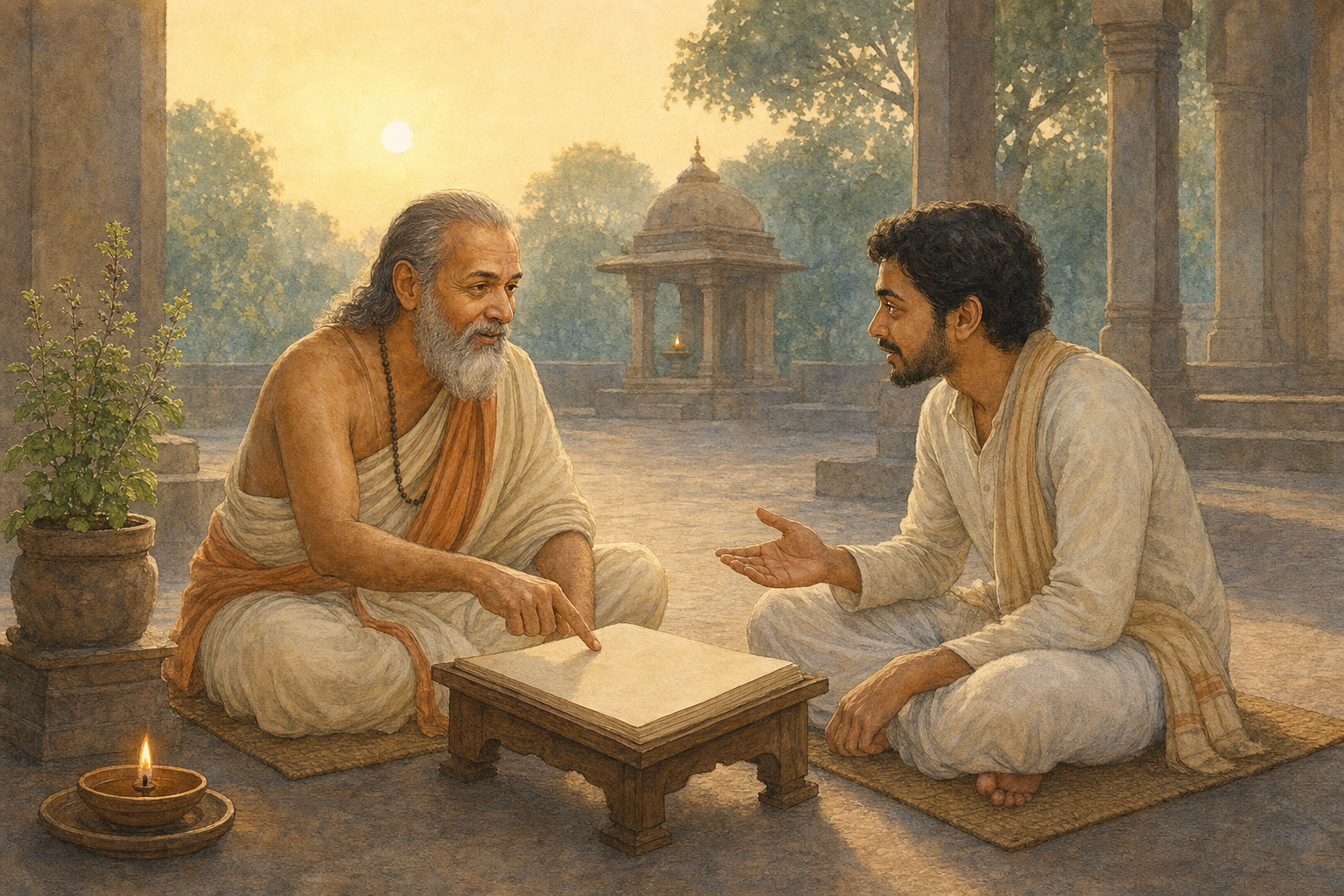
Bhāgavata learning asks more of a seeker than reverence and more of a teacher than fluency. Read together, the three source articles present a demanding educational ethic: the student approaches truth with humility and serious questions, while the guide answers from realized steadiness and remains accountable to Bhagavān, śāstra and lineage.
This synthesis helps distinguish teachability from passivity, inquiry from argument, and spiritual authority from personality-centered control. It also offers a practical standard for evaluating learning in classes, homes and devotional communities.
The shared grammar of sacred learning
The three accounts approach spiritual education through different scenes. The Hungary reflection on Śrīmad-Bhāgavatam 3.7.8 focuses on Vidura as a seeker of reality and Maitreya Muni as a composed respondent whose consciousness is centered on Bhagavān. The article honoring Śrīla Prabhupāda draws on Bhagavad-gītā 4.34 to identify humble approach, sincere inquiry and service as the mutually supporting elements of discipleship. The account of King Pṛthu and the four Kumāras shows those principles operating in public life as a powerful ruler receives renounced sages and asks about the highest welfare.
Taken together, these are not three endorsements of deference for its own sake. They describe an ordered relationship among the questioner, the guide, the teaching and the goal. The seeker does not invent truth privately, but neither is the seeker asked to abandon thought. The guide does not merely supply information or demand loyalty; the guide helps direct attention toward reality beyond both participants.
This relational structure explains why dialogue is so prominent in the reported passages. Vidura questions Maitreya, Kṛṣṇa instructs Arjuna, and Pṛthu addresses the Kumāras. Knowledge is preserved in words, but it becomes formative through listening, response, correction and application. The dialogue succeeds when both parties are oriented toward truth rather than social victory.
Humility has obligations for student and teacher
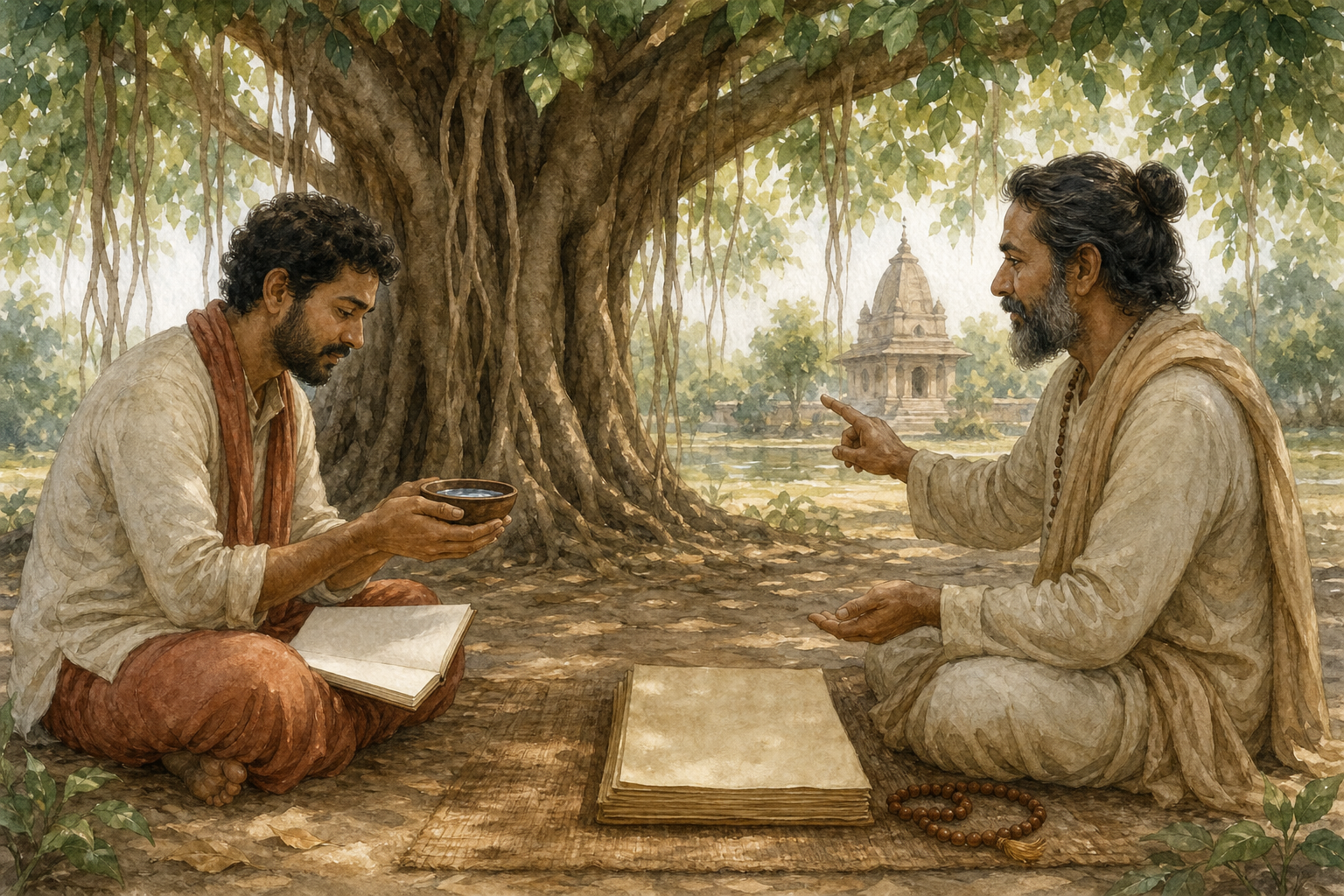
On the student’s side, humility creates teachability. The Hungary reflection highlights the expression tattva-jijñāsunā, describing an eagerness to inquire into the nature of reality. Such inquiry differs from casual curiosity or adversarial debate because the questioner is prepared to be changed by the answer. The Prabhupāda article reinforces this point through the Gītā’s combination of praṇipāta, paripraśna and sevā: respectful approach, sustained questioning and service belong together.
King Pṛthu supplies a social illustration of the same disposition. According to the third source, the Kumāras arrive after Pṛthu has been publicly praised, yet he does not treat royal acclaim as evidence that he has nothing left to learn. He rises to receive the sages, offers scripturally prescribed hospitality and turns the encounter toward questions of ultimate good. His humility is therefore not self-denigration. It is an accurate recognition that political position and spiritual realization are different kinds of authority.
The teacher carries a corresponding responsibility. The first source portrays Maitreya as outwardly struck by Vidura’s question but inwardly stable because his awareness is fixed on Bhagavān. This makes composure more important than the performance of effortless certainty. A mature guide can acknowledge the weight of a question without becoming defensive, dismissive or personally threatened by it.
The Prabhupāda article adds an institutional safeguard: the guru is honored as a representative of disciplic succession, not as an independent center of glory. The teacher’s authority is transparent when it directs the learner toward Kṛṣṇa, the previous ācāryas and scripture. The Kumāras provide a complementary image in the third source. Their authority is associated with realization, restraint and spiritual presence rather than wealth, office or publicity. Humility thus runs in both directions: the student relinquishes intellectual vanity, while the teacher relinquishes ownership of truth.
Living example makes scripture visible
The sources also show why Bhāgavata education cannot be reduced to private reading. The Hungary presentation places remembrance of experiences with Dhirasanta Goswami beside the exchange between Vidura and Maitreya. As that source frames it, contact with a senior practitioner does not replace śāstra; it can help a learner recognize how steadiness, devotion and thoughtful speech appear in lived circumstances.
The article on Śrīla Prabhupāda develops the same relationship between teaching and conduct through the classical idea of the ācārya. It reports that his instruction was accompanied by sustained practices of writing, chanting, teaching, traveling and service. The significance of such an example is pedagogical as well as devotional: discipline becomes observable, and abstract principles acquire a pattern that students can attempt to embody.
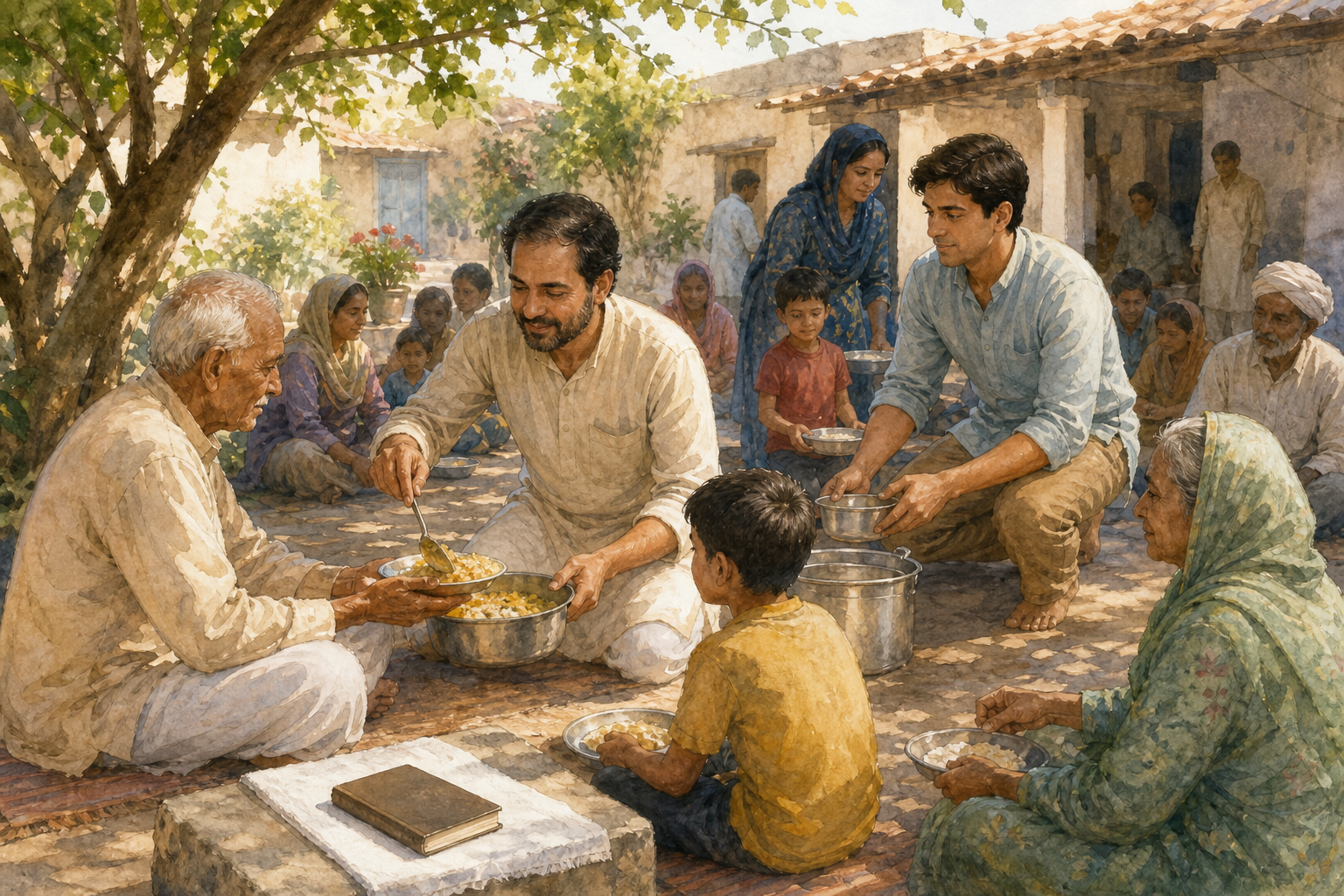
Pṛthu’s meeting with the Kumāras extends embodied learning into the palace and household. The third source interprets his bowing, reception and offerings as disciplined reverence rather than social ornament. It also reports the passage’s contrast between a simple home that welcomes saintly persons and a prosperous home closed to such association. The enduring principle is not that every contemporary setting must reproduce a royal reception. It is that spaces of ordinary responsibility become places of learning when they make room for wisdom, gratitude and serious questions.
These examples reveal a threefold relationship: scripture supplies the norm, realized conduct makes the norm visible, and the learner tests understanding through practice. Removing any one element weakens the process. Text without guidance can be flattened into isolated quotations; example without scriptural accountability can become personality worship; admiration without practice leaves the learner unchanged.
Safeguards against blind following and combative inquiry

The source on Bhagavad-gītā 4.34 explicitly presents submission, inquiry and service as protection against two failures: passive following and intellectual arrogance. The other accounts sharpen that balance. The Hungary reflection states that genuine spiritual authority does not silence a truth-seeking question, while the Pṛthu account contrasts realized significance with mere visibility and status.
A respectful manner alone therefore cannot establish that a learning relationship is healthy. The substance of the exchange matters. A sound question seeks clarification rather than humiliation of the respondent. A sound answer can be connected to scripture and the tradition’s stated goal rather than resting only on personal prestige. Service should turn knowledge into responsible conduct, not make scrutiny impossible. Reverence should deepen orientation toward Bhagavān, not isolate the student around a teacher’s personality.
The model also challenges communities to examine how they respond when questions become difficult. Maitreya’s reported steadiness suggests that defensiveness is not a sign of realization. Vidura’s persistence shows that humility need not mean silence. Pṛthu’s conduct shows that rank does not cancel the need to learn. A Bhāgavata community honors the guru most coherently when its culture supports disciplined inquiry, scriptural accountability and the practical cultivation of service.
Key takeaways for Bhāgavata learners
- Humility qualifies inquiry by making the seeker willing to receive correction and apply what is learned.
- Questioning is integral to discipleship when its object is truth rather than victory, novelty or self-display.
- A trustworthy guide directs attention beyond personal charisma toward Bhagavān, scripture and disciplic succession.
- Spiritual authority becomes credible through steadiness, conduct and service, not title or visibility alone.
- Homes, classrooms and institutions support sacred learning when reverence and honest examination remain together.
The continuing task is to build learning environments in which profound questions can be voiced without arrogance and received without fear. In that setting, guru, śāstra and sincere inquiry work together to form character rather than merely accumulate religious information.
References
- DharmaRenaissance Blog — A Powerful Hungary Reflection on Dhirasanta Goswami and Bhagavatam 3.7.8
- DharmaRenaissance Blog — Honoring Srila Prabhupada: A Powerful Guide to Guru, Devotion, and Spiritual Shelter
- DharmaRenaissance Blog — King Pṛthu’s Humility Reveals a Powerful Bhagavatam Path to Spiritual Wisdom