Guru Nanak’s ethics begin with the mind but do not end there. Inner transformation becomes credible only when remembrance changes how a person earns, shares, speaks, serves, and responds to social difference.
The supplied DharmaRenaissance Blog article develops this connection through several strands of Guru Nanak’s teaching. Read together, they present an integrated discipline: awareness restrains ego, honest work tests integrity, sharing redirects wealth, and service gives spiritual equality a social form.
Remembrance creates the conditions for ethical agency
The article presents Ik Onkar as an affirmation of one ultimate reality with direct ethical consequences. Oneness is not treated merely as a metaphysical proposition. It challenges the habit of assigning unequal human worth according to caste, gender, wealth, occupation, or religious identity.
This is where inner transformation begins. If reality is understood as one and human beings possess a shared spiritual dignity, the ego can no longer claim absolute importance for its inherited status or acquired power. Prejudice then appears not simply as a social mistake but as evidence that spiritual understanding has failed to enter conduct.
The source places Naam Japna, remembrance of the Divine Name, at the beginning of the familiar ethical triad of remembrance, honest labor, and sharing. It explicitly distinguishes remembrance from mechanical repetition. Its ethical function is to recollect dependence, the impermanence of status, and the moral claim that other people place upon one’s behavior.
Understood in this way, attention is a form of moral preparation. A scattered or self-absorbed mind reacts through anxiety, comparison, appetite, and pride. Remembrance creates the pause in which motives can be examined before they become decisions. It does not replace action; it makes responsible action more possible.
Honest livelihood is the first public test of inward change
The second principle discussed by the article, Kirat Karni, connects spiritual life to honest work. Rather than restricting religious discipline to withdrawal or ceremony, this principle places it within household responsibilities, professions, commerce, education, and ordinary social participation.
This move is ethically significant because livelihood reveals what contemplation alone cannot. A person may profess truth while benefiting from deception, manipulation, corruption, or exploitation. Honest work asks whether inward commitments survive contact with incentives, competition, authority, and the desire for advancement.
Truthful living is therefore broader than factual speech. In the source’s account, sacred language and visible piety cannot compensate for conduct governed by greed or prejudice. The relevant question is not only whether an individual tells the truth, but whether the arrangements through which that individual succeeds are themselves fair.
This makes work a field of spiritual accountability. The ethical measure of a livelihood includes the means used to obtain income, the treatment of people with less power, and the consistency between public devotion and private decisions. Inner reform becomes observable through choices that may carry a real material cost.
Sharing turns personal integrity into social nourishment
Vand Chakna, described in the article as sharing with others, prevents ethical livelihood from becoming a purely individual achievement. Honest earnings remain incomplete if prosperity closes in upon itself. Sharing directs the fruits of work toward relationships and communities, joining self-discipline to responsibility for human need.
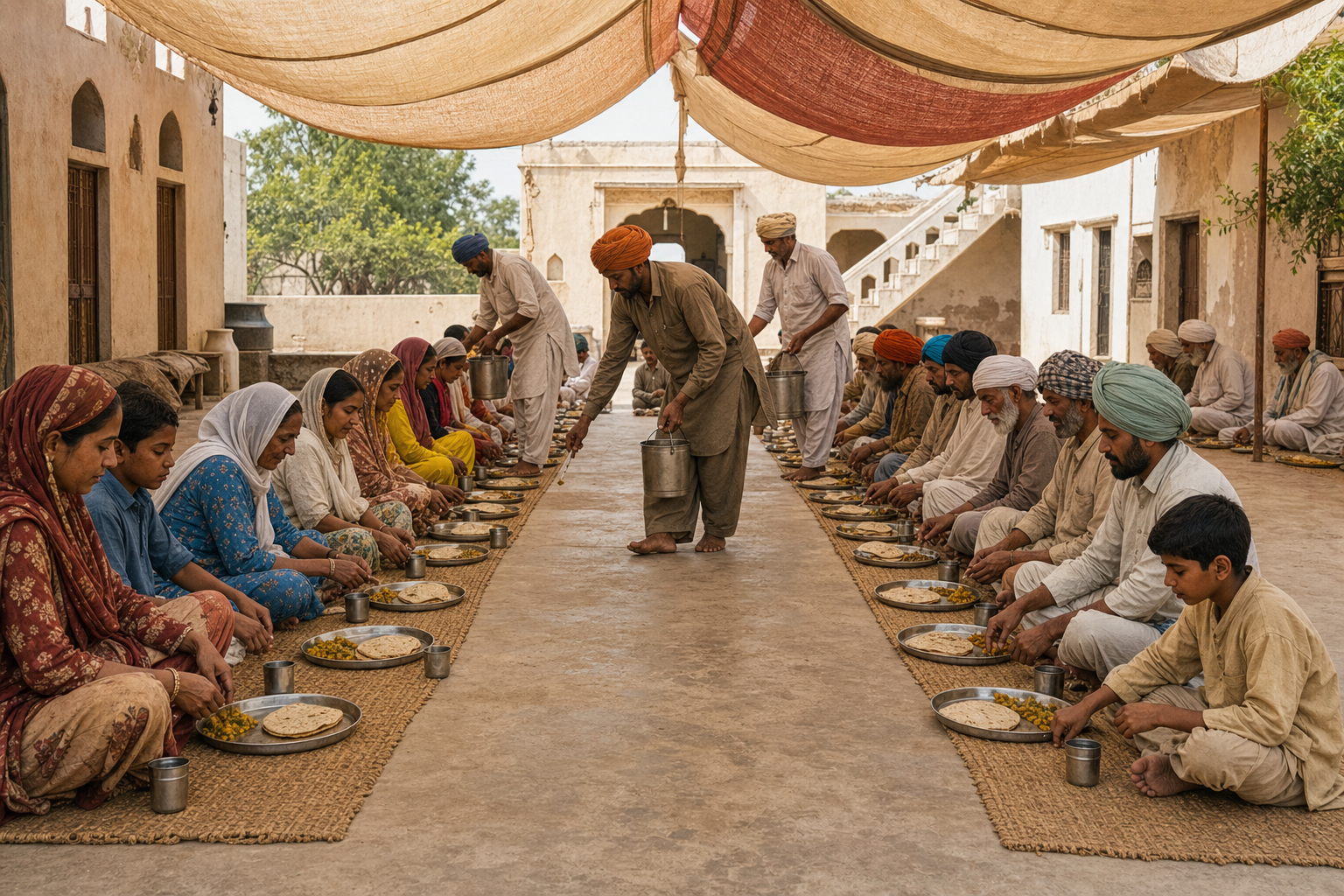
The source identifies langar, the community kitchen associated with gurdwaras, as a visible institutional expression of this principle. Its significance lies not only in distributing food. People sit and eat together without hunger being organized according to social rank. An inward belief in equality is thus translated into a repeated communal practice.
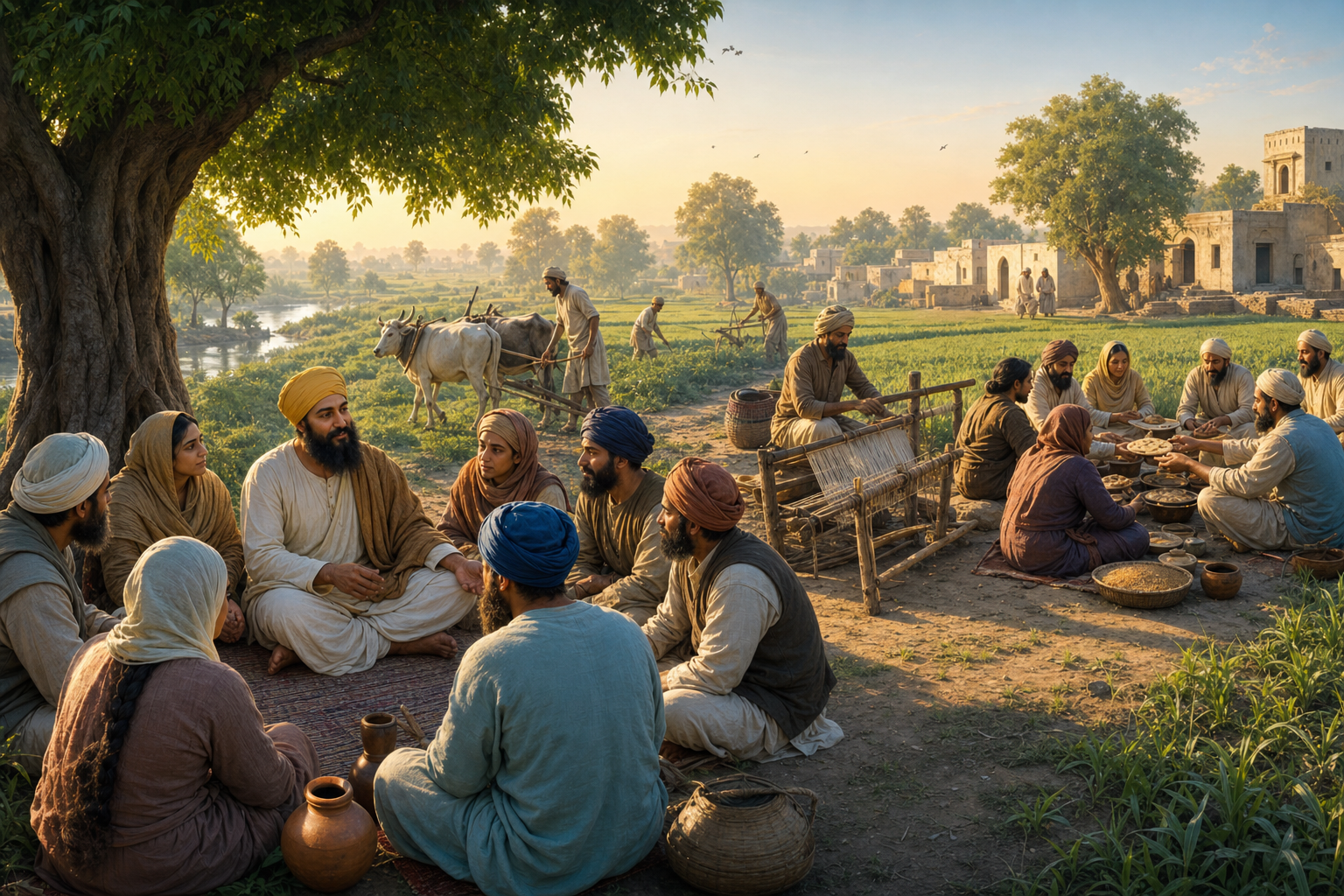
The connection among remembrance, labor, and sharing is stronger than a collection of three separate virtues. Remembrance disciplines desire; honest work disciplines the acquisition of resources; sharing disciplines their use. Each stage tests the others. Contemplation without integrity becomes escapism, earnings without generosity become self-enclosure, and generosity funded through exploitation cannot represent complete ethical reform.
This integrated reading also clarifies why social equality cannot remain an inspiring slogan. If inherited rank continues to determine who is respected, heard, fed, or humiliated, the claim of spiritual oneness has not yet shaped the community. Institutions provide a practical test of whether convictions proclaimed in worship govern collective life.
Humility and service reveal the direction of transformation
The article portrays Guru Nanak’s teaching as a challenge to ritual pride, religious exclusivism, social arrogance, and empty claims of superiority. The resulting ideal is not the abandonment of conviction. It is humility: the capacity to hold conviction without using religion as an instrument of vanity or domination.
Humility can be evaluated through behavior. It appears in listening before judging, restraining a need for recognition, admitting the limits of one’s perspective, and serving before asserting status. These habits matter in families and public institutions as much as in explicitly religious settings.
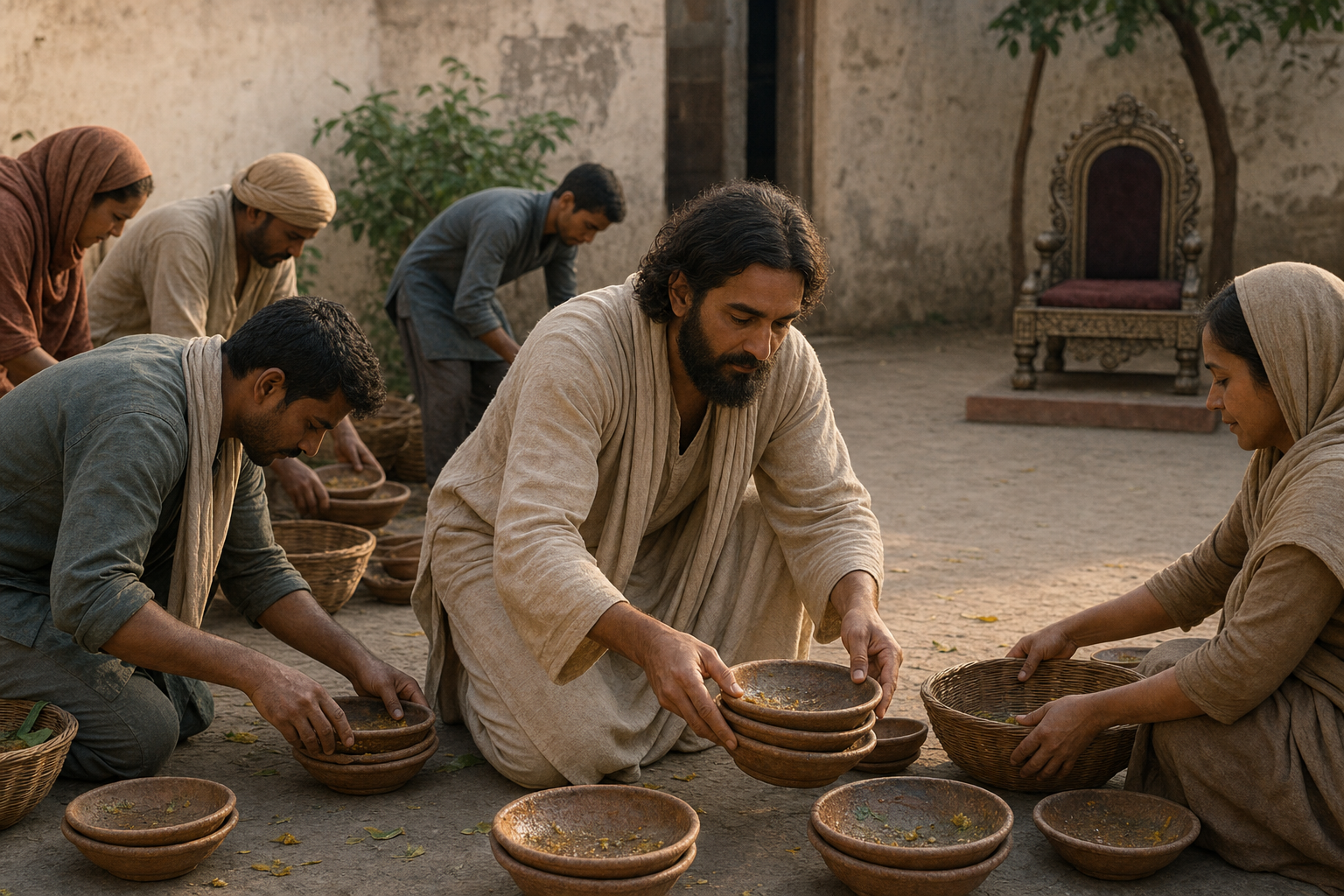
Seva, or selfless service, intensifies this test because a helpful act can still enlarge the helper’s ego. The source argues that the inner posture matters alongside the deed. Feeding, teaching, healing, cleaning, protecting, mentoring, and comforting can become forms of service when they address another person’s need without turning that person into a prop for reputation.
Inner and outer reform therefore operate as a feedback loop. A changed orientation produces more ethical conduct, while work and service expose motives that still require discipline. Transformation is not a private feeling certified by the individual. It is an ongoing process made visible in relationships, economic choices, and the treatment of people whom society places at the margins.
Questions that clarify the ethical standard
Is inner transformation mainly a private spiritual experience?
No. The source’s presentation of remembrance, honest labor, sharing, and service makes inward change accountable to outward conduct. The mind is the starting point, while livelihood and relationships show whether the change has become durable.
Why is ritual observance not sufficient by itself?
Ritual can support reflection and communal memory, but it cannot substitute for integrity. The article contrasts visible devotion with the harder disciplines of refusing dishonest gain, restraining harmful speech, sharing resources, and confronting social prejudice.
What distinguishes transformative service from performative generosity?
Transformative service attends to both consequence and motive. It meets a genuine need while reducing the servant’s attachment to status or praise. Its aim is the dignity and well-being of the person served, not the public image of the person serving.
This ethical framework gives commemoration a future-facing purpose. Celebrations associated with Guru Nanak can preserve memory, but their most consequential legacy will be communities in which attention becomes integrity, resources circulate through sharing, and spiritual equality is made credible through everyday practice.