
The central Panchang fact for Friday, July 10, 2026 is a pre-dawn change of tithi: the supplied DharmaRenaissance Blog source reports that Krishna Paksha Dashami continues until 3:39 AM, after which Krishna Paksha Ekadashi governs the date.
That transition establishes the day’s devotional emphasis, but it does not produce one universal schedule for every observer. The useful distinction is between the reported lunar timing, the practices associated with Ekadashi, and the city-specific calculations that still need verification.
Key takeaways
- The source reports Krishna Paksha Dashami ending at 3:39 AM on July 10, followed by Krishna Paksha Ekadashi.
- The source therefore characterises July 10 as an Ekadashi-oriented day for many observers.
- Suggested observances include devotion to Vishnu or Krishna, prayer, japa, scriptural reading, dietary restraint and charity.
- Nakshatra, Moon rashi, muhurat, Rahu Kaal and the Dwadashi parana window require a reliable Panchang calculated for the observer’s location.
Why the pre-dawn tithi change defines the date
A Panchang does not interpret time solely through the civil date running from midnight to midnight. It also considers the tithi present in relation to sunrise, together with such elements as vara, nakshatra, yoga and karana. The source consequently treats the change from Dashami to Ekadashi at 3:39 AM as more significant than the fact that Dashami occupies the first few hours after midnight.
In general calendrical terms, a tithi is determined by the changing angular relationship between the Sun and Moon, with each tithi representing a further 12 degrees of separation. Because this astronomical relationship does not conform to fixed civil-day boundaries, a tithi may begin or end during the day or night. July 10 illustrates the practical result: one date contains parts of two lunar days, although the source identifies Ekadashi as its predominant religious character.
Krishna Paksha denotes the waning half of the lunar cycle. The source places the date in the Ashadha period and notes that this Krishna Paksha observance is commonly associated with Yogini Ekadashi in many Vaishnava and regional Panchangs. It presents that identification cautiously because sunrise rules, regional calendar conventions and calculation locations can affect formal observance.
Observance centres on restraint, attention and devotion
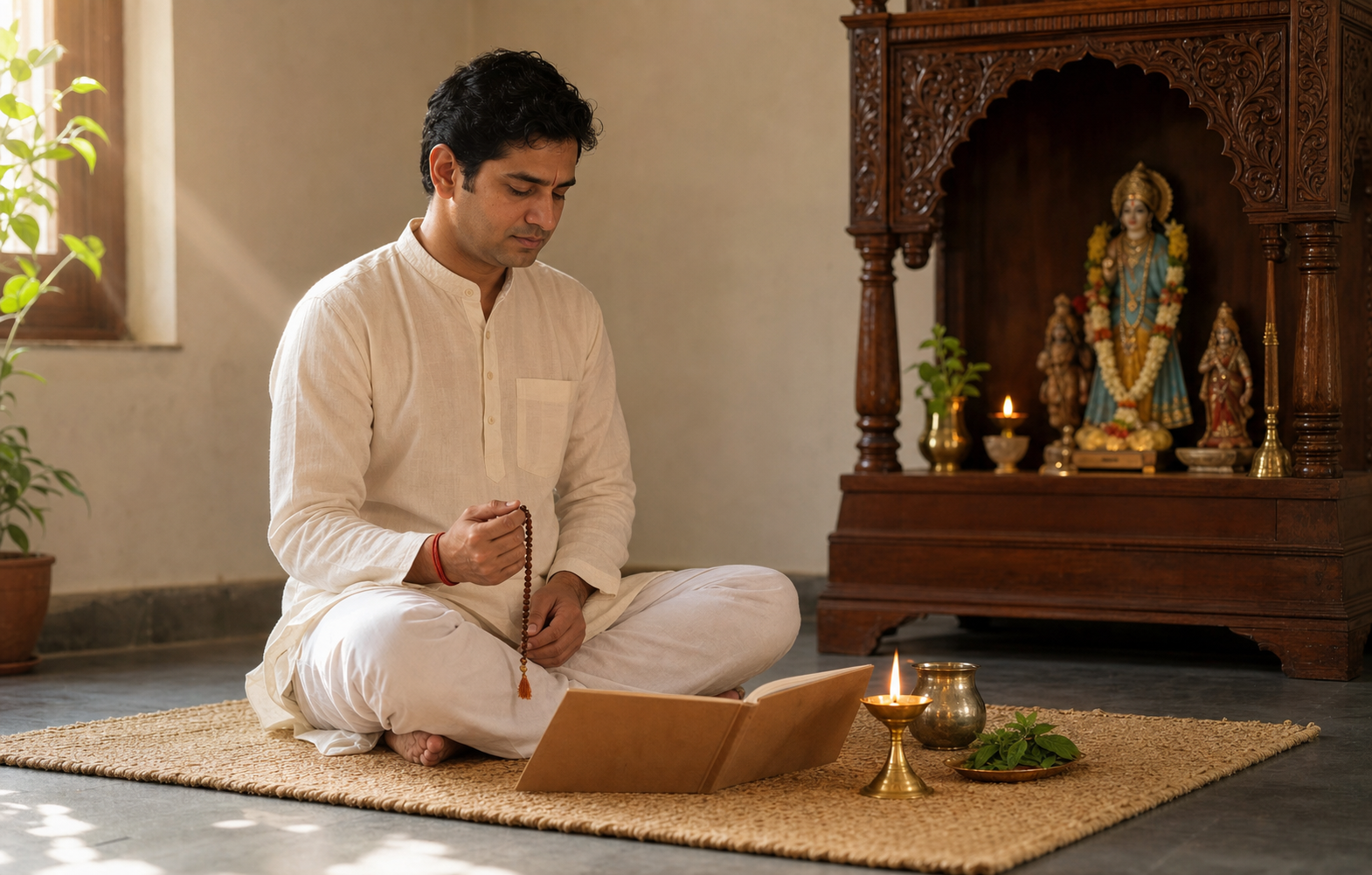
The source describes Ekadashi as especially important in Vaishnava practice, where it is connected with devotion to Lord Vishnu and Sri Krishna, purification of intention and discipline of the senses. Its practical suggestions include sattvic food choices, fasting according to capacity, mantra japa, prayer, temple worship, charity and reduced indulgence.
These activities form a coherent discipline rather than a collection of isolated rules. Simpler consumption creates room for attention; japa and scriptural reading direct that attention; charity prevents restraint from becoming merely self-focused. The source specifically mentions the Bhagavad Gita and Srimad Bhagavatam as suitable reading and presents Ekadashi as favourable for worship at a Vishnu or Krishna temple.
The household rhythm can begin before Ekadashi itself. According to the source, observers often simplify food and conduct on Dashami, maintain the vrata on Ekadashi, and break the fast on Dwadashi within the proper parana period. The article does not supply that Dwadashi window, so it should not be inferred from the reported 3:39 AM transition.
The same discipline can be understood without turning the Panchang into a source of fear. The source frames it as guidance for aligning conduct and intention, not as fatalistic control over ordinary life. It also places the observance within a wider dharmic appreciation of mindfulness, ethical restraint, compassion and remembrance of the Divine, while recognising that Hindu, Buddhist, Jain and Sikh traditions express those values through different forms.
Which timings cannot be generalised
The reported tithi transition is the usable date-level detail in the source, but the article does not provide a verified nakshatra or Moon rashi for a specified city. Those factors can change within a civil date and should be checked locally before they are used for a formal muhurat decision.
The same caution applies to clock-based periods such as Rahu Kaal, Yamaganda, Gulika, Abhijit Muhurat and Choghadiya. Their calculation depends on local astronomical or daylight information. For Friday Rahu Kaal, the source explains the general method as dividing the interval from sunrise to sunset into eight equal portions and selecting the weekday-associated segment. The method is stable, but its clock time changes with local sunrise and sunset.
Strict observers therefore need two separate checks: a city-specific determination of whether the vrata is assigned to July 10 under their tradition, and the correct Dwadashi parana interval for ending it. Anyone arranging another important undertaking should likewise consult a locally calculated muhurat rather than treating an online time from another city as transferable.
A practical reading of the day
For a general devotional observance, the source supports treating July 10 as a day for simplified habits, careful speech, worship, reading, service and inward attention. These practices remain meaningful even when a person is not following the most rigorous form of fasting.
For ritual precision, the next step is to consult a trusted Panchang prepared for the observer’s city and lineage. That local check should settle the formal vrata date, relevant lunar factors and the parana window before plans are finalised.