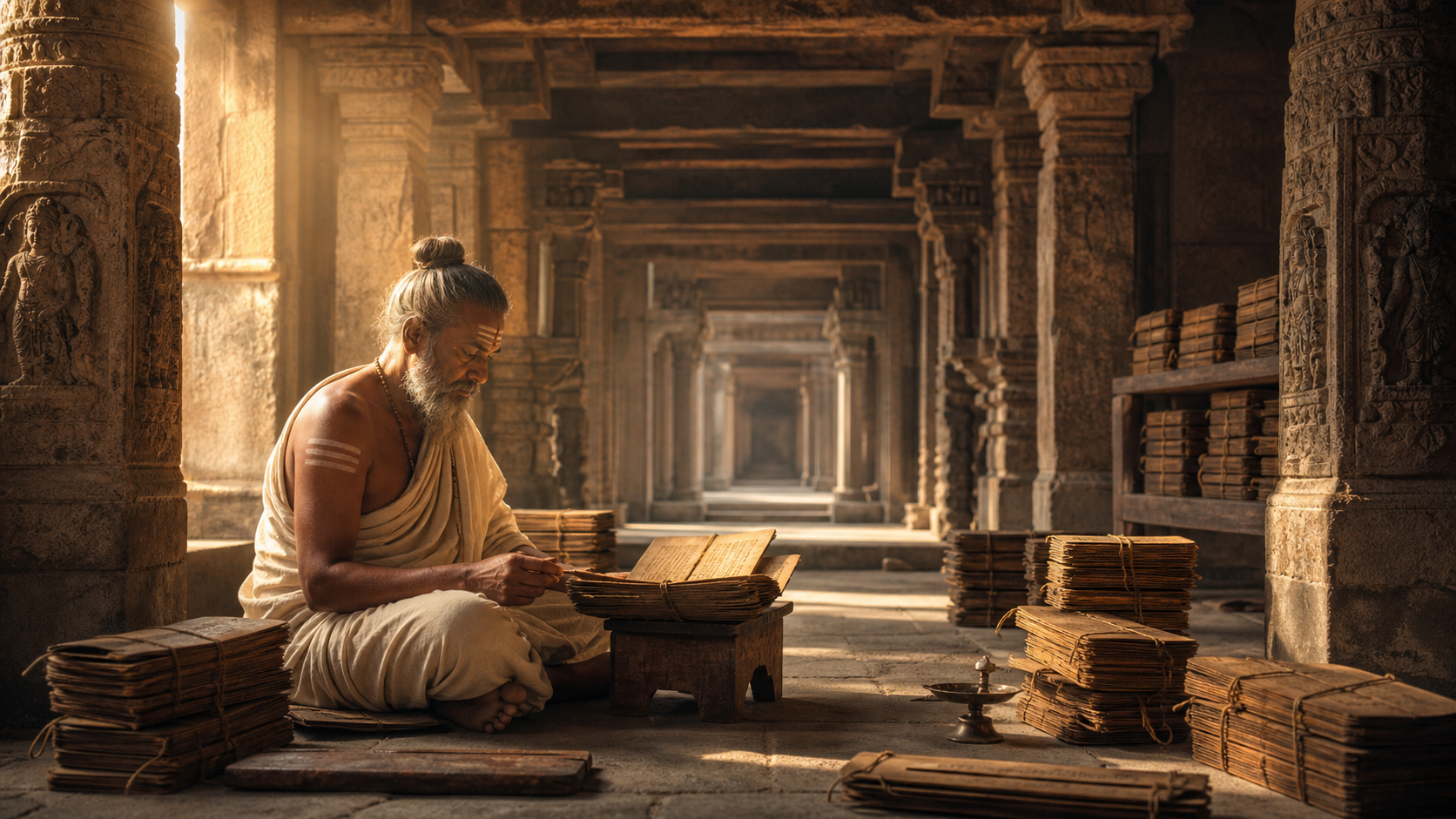
Nyayasudha becomes easier to understand when two questions are separated: what kind of reality does Dvaita Vedanta affirm, and why does that claim require such elaborate argument? The supplied DharmaRenaissance Blog article presents Jayatirtha’s work as the point at which Madhvacharya’s compact Vedantic formulations receive an extensive defense through logic, scriptural interpretation, and debate.
Read in this way, Nyayasudha is more than an explanation of an earlier text. It provides an intellectual architecture for Tattvavada, connecting its account of God, souls, and the world with its understanding of knowledge, devotion, and liberation.
How commentary becomes a philosophical system
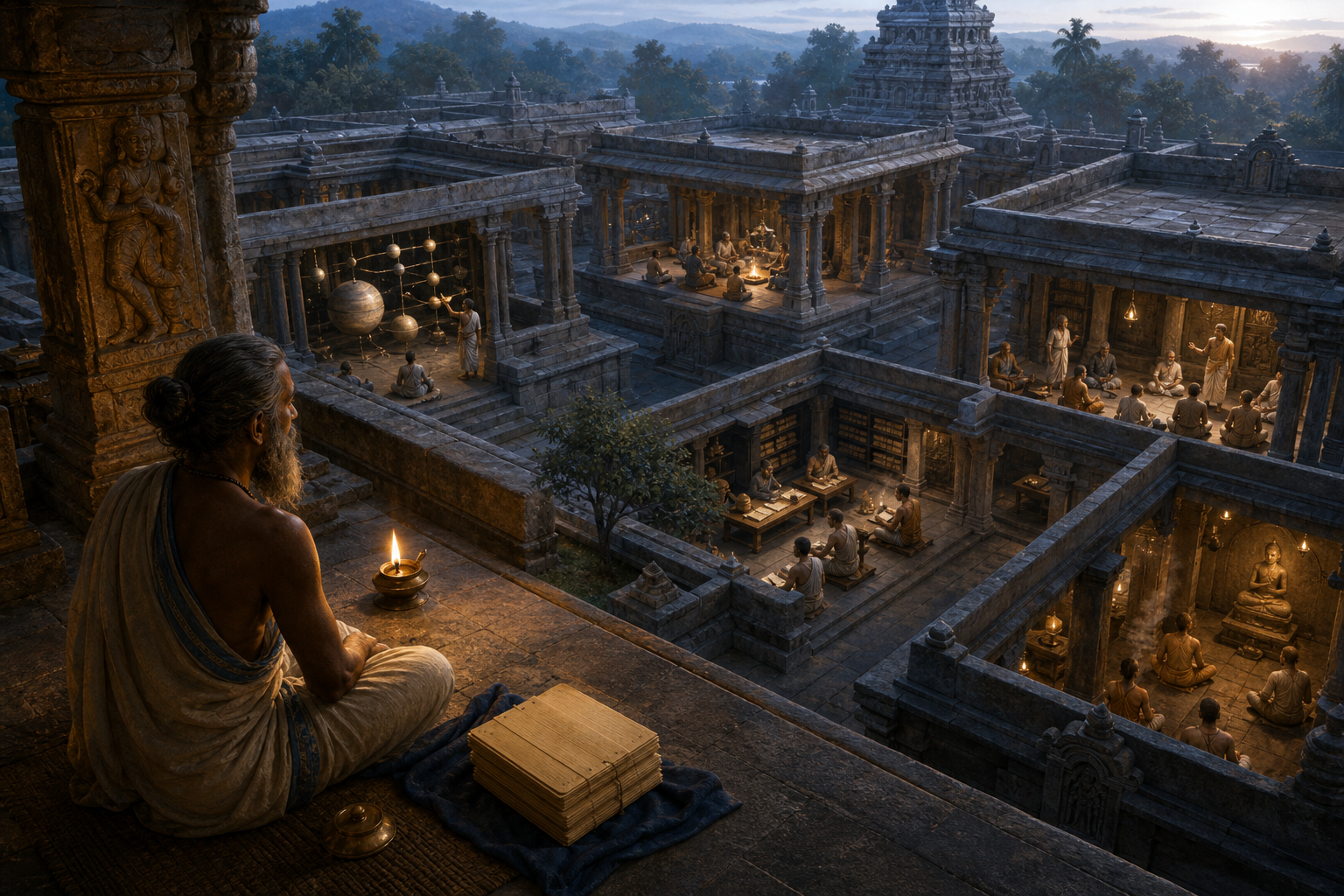
According to the source article, Jayatirtha composed Nyayasudha in the 14th century CE as a commentary on Madhva’s Anuvyakhyana, a metrical exposition of the Brahma Sutras. The relationship between these works explains Nyayasudha’s role: it unfolds condensed claims, states their implications, anticipates objections, and supplies a more explicit structure for defending them. The article accordingly identifies Jayatirtha as Tikacharya, the master commentator.
The source situates this project within the wider Vedantic interpretation of the Prasthanatrayi: the Upanishads, Bhagavad Gita, and Brahma Sutras. Advaita, Visishtadvaita, and Dvaita offer different accounts of how these foundational texts describe Brahman, the self, and the world. Nyayasudha’s significance therefore lies not simply in preserving Madhva’s conclusions, but in showing how a Dvaita reading can function as a coherent alternative within that shared field of interpretation.
Dependence, not unreality, orders existence
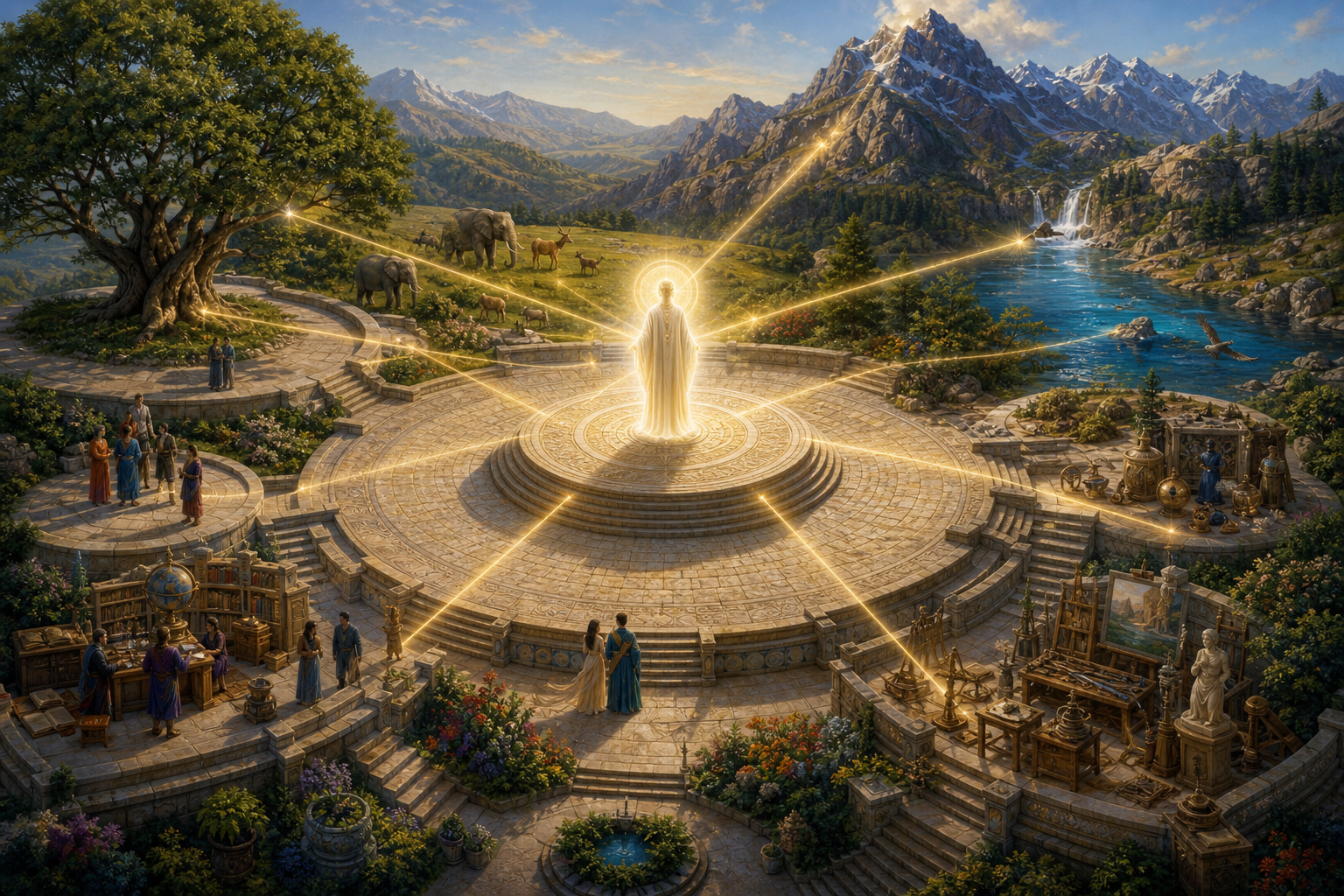
The source identifies the distinction between svatantra and paratantra as central to Nyayasudha. The Supreme Being alone is svatantra, or independent; individual souls and matter are paratantra, or dependent. On this account, Dvaita is not a theory of two equally self-sufficient realities. It is a realism ordered by radical dependence: created realities genuinely exist, yet neither their existence nor their significance is independent of the Supreme.
This distinction clarifies why plurality need not compete with divine supremacy. If dependence meant unreality, the soul’s devotion, moral agency, and pursuit of knowledge would lose their stable subjects. Nyayasudha instead treats dependence as an ontological relationship. God remains uniquely independent while finite beings and the material world retain reality within an unequal order.
The source presents pancabheda, the fivefold difference, as the more detailed expression of that order: difference between God and a soul, God and matter, one soul and another, soul and matter, and one material entity and another. These distinctions make plurality foundational rather than a temporary mistake awaiting cancellation. Dvaita realism thus preserves both the unity supplied by universal dependence on the Supreme and the diversity evident among dependent beings.
Why logic and scripture must work together
The article describes Nyayasudha as employing perception, inference, and scriptural testimony as valid means of knowledge. Sacred testimony is indispensable for realities beyond ordinary perception, but it is not presented as permission to disregard reasoning or experience. The method instead asks whether an interpretation preserves scriptural coherence without making the experienced world, knowledge, or meaningful action unintelligible.
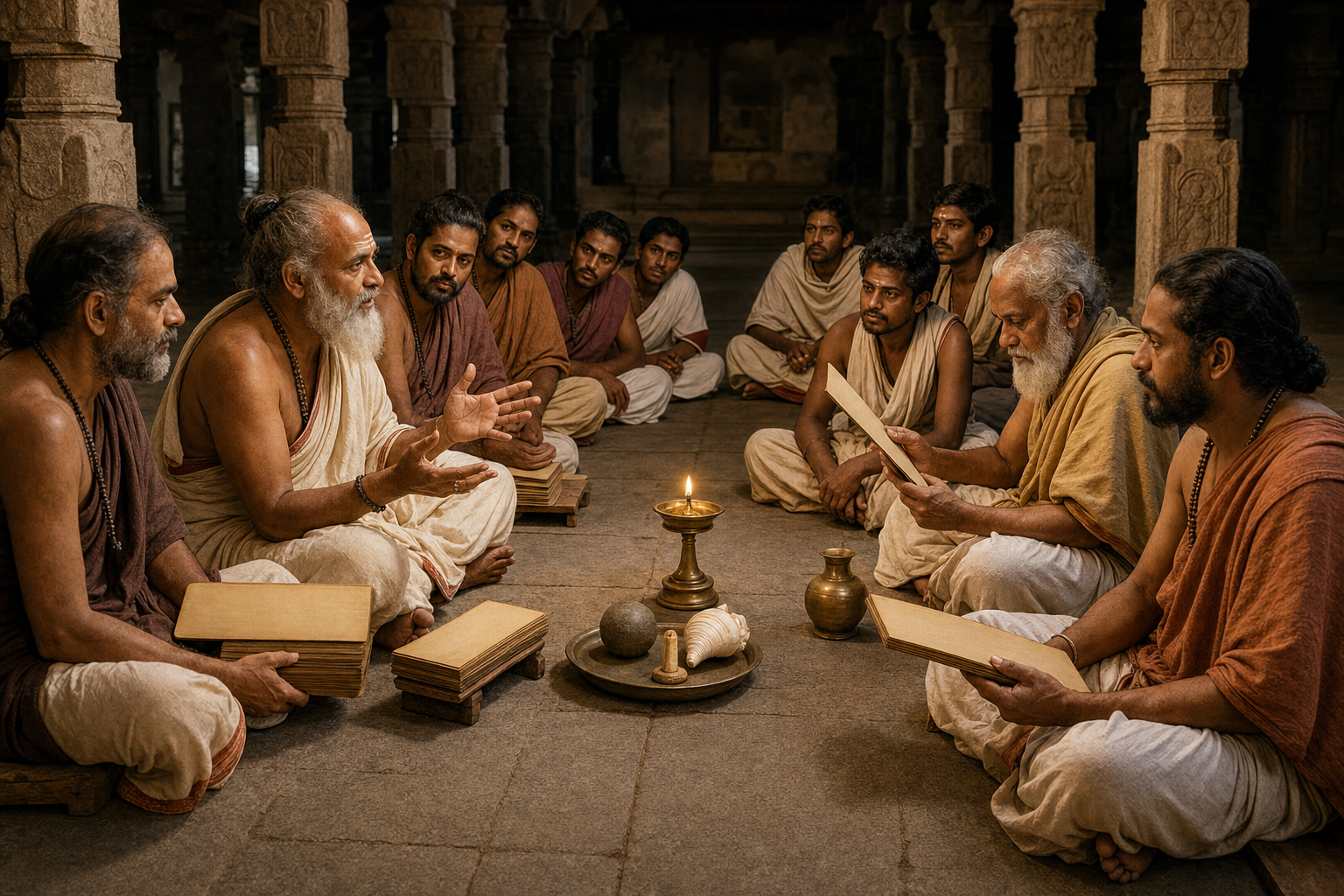
This method also explains the work’s engagement with rival traditions. The source reports that Jayatirtha addresses Advaita Vedanta, Visishtadvaita, Nyaya, Mimamsa, Sankhya, Buddhist thought, and Jain positions. Such exchanges belong to a classical culture in which objections test definitions, expose consequences, and force doctrines to become more precise. Debate is therefore part of Nyayasudha’s constructive work, not merely an appendix of refutations.
The source especially highlights Jayatirtha’s challenge to Advaita accounts of maya. The questions concern whether the ultimate unreality of difference can adequately accommodate persistent plurality, moral responsibility, devotion, and scriptural instruction. The deeper issue is hermeneutical: an interpretation of non-duality must explain why texts teach, persons seek knowledge, and devotion relates one conscious subject to the Supreme. Nyayasudha uses these pressures to argue for a reading in which difference and spiritual relationship are ultimately meaningful.
Argument culminates in devotion and liberation
From scriptural harmony to spiritual practice
The source reads Nyayasudha through four conventional movements associated with the Brahma Sutras. Under samanvaya, or harmonization, Jayatirtha defends the coherence of scriptural teaching around a personal, perfect, and independent Brahman identified with Vishnu. Under avirodha, or non-contradiction, competing accounts of creation, causality, and agency are tested against scripture and reason. These movements show that metaphysical conclusions depend upon both interpretive detail and their wider consequences.
The movement concerned with sadhana shifts attention toward spiritual means. As reported in the source, knowledge, ethical discipline, ritual action, and meditation acquire their fullest orientation through bhakti. Logic consequently serves a practical religious purpose: it clears conceptual obstacles to knowing the Supreme and understanding the soul’s dependence. Liberation is not treated as an achievement produced by reasoning alone, because divine grace remains decisive.
Moksha as fulfilled relationship
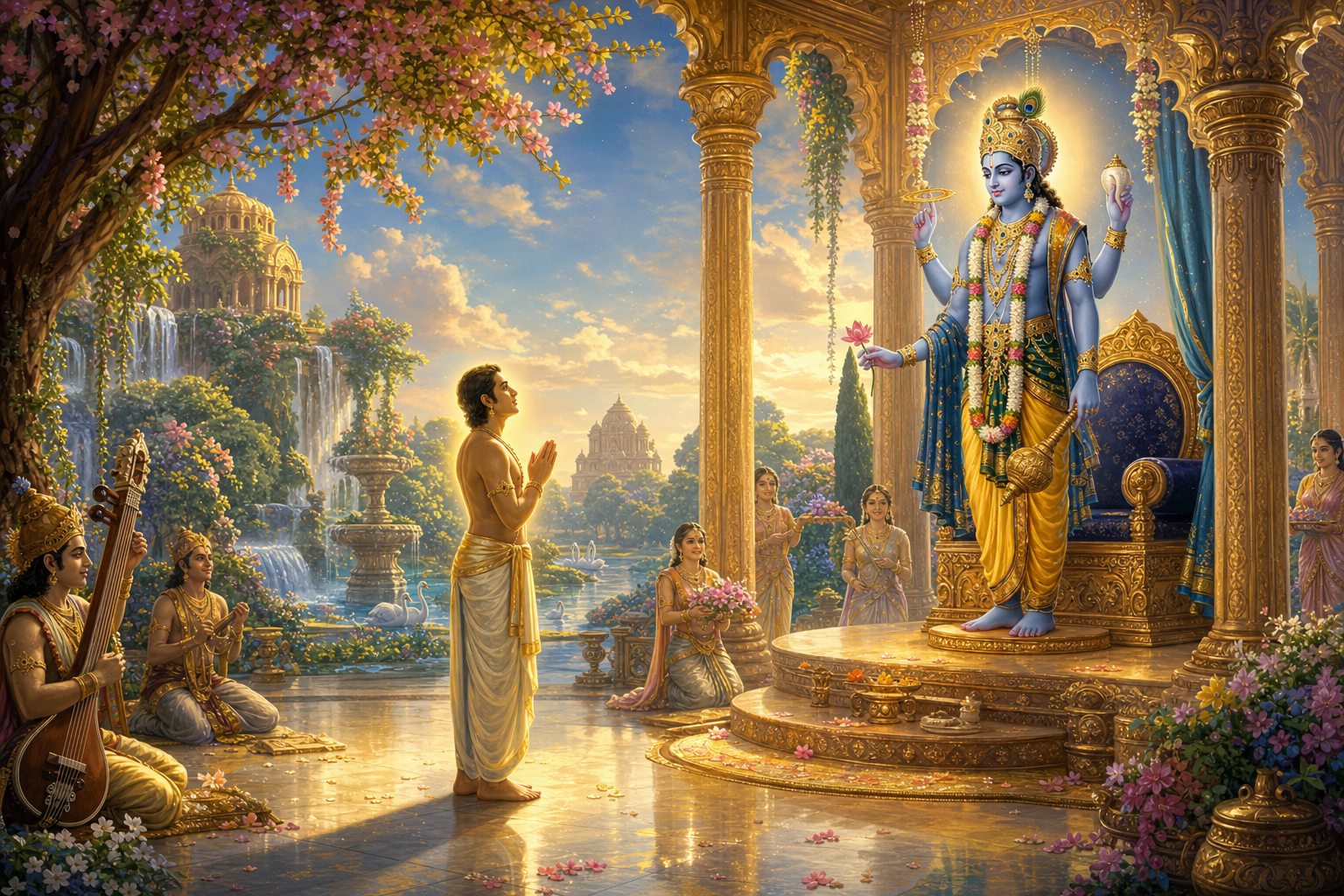
In the source’s account of phala, the fruit of spiritual realization, the liberated soul does not lose its individuality by becoming absolutely identical with Brahman. It remains distinct, fulfilled, and dependent upon the Supreme. This conclusion brings Dvaita’s metaphysics and devotional life into alignment: the distinction that makes devotion possible is not discarded when liberation is attained.
Nyayasudha’s logical density therefore supports a relational understanding of salvation. Knowledge corrects error about reality, bhakti properly directs the soul, grace makes liberation possible, and moksha perfects rather than erases the relation between devotee and Supreme.
Key takeaways
- Nyayasudha develops Madhva’s compact formulations into a systematic defense of Dvaita Vedanta.
- Dvaita realism recognizes one independent Supreme Reality alongside genuinely real but dependent souls and matter.
- Pancabheda treats difference as part of reality’s enduring structure rather than a provisional appearance.
- Perception, inference, and scripture cooperate in Jayatirtha’s approach to philosophical and theological knowledge.
- Bhakti, grace, and liberation follow from the same metaphysics that preserves the distinction between the soul and the Supreme.
Future engagement with Nyayasudha can proceed most fruitfully by reading its arguments and devotional purpose together. Its continuing challenge is to consider whether difference, dependence, and divine supremacy can form one coherent vision of reality rather than competing claims.