
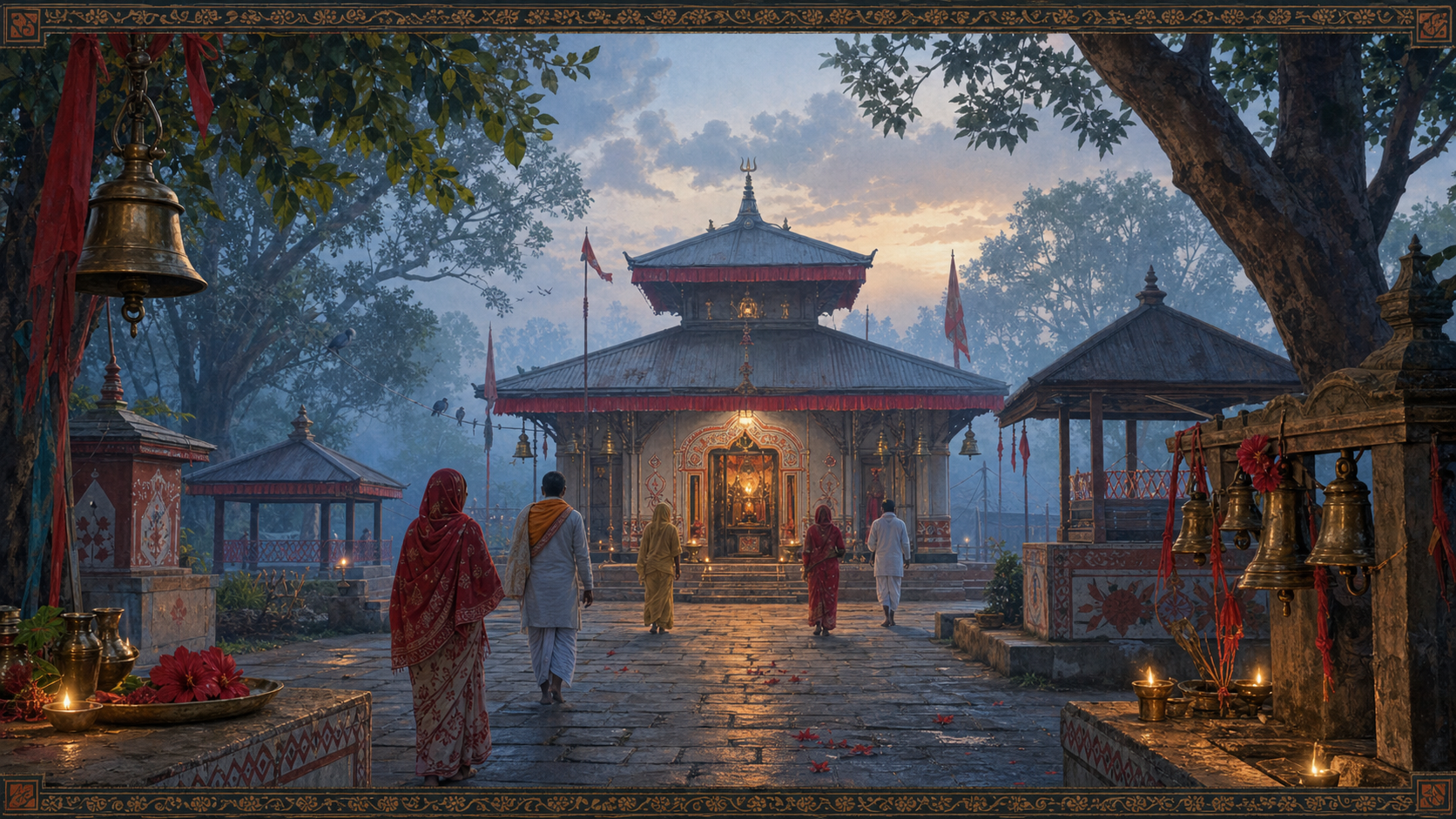
Sakhada Bhagavati Temple is best understood not through a single origin story, but through the convergence of place, royal memory, a damaged sacred image and Chhinnamasta theology. Distinguishing those layers reveals why the shrine can carry historical uncertainty while retaining a clear and compelling religious identity.
The available DharmaRenaissance account presents the temple as both a regional centre of devotion and a site where apparent loss has acquired sacred meaning. Its most important contribution is not a definitive reconstruction of every event, but an explanation of how communities preserve history by interpreting it through theology and ritual.
Key takeaways
- The temple stands at Sakhada in Saptari district, near Rajbiraj and the Indo-Nepal border, within the devotional landscape of Nepal’s Madhesh region.
- Local tradition connects the shrine with the Karnata ruler Shaktisimhadeva, also remembered as Shakrasimhadeva, but the supplied account does not offer independent documentary or archaeological verification of the foundation story.
- The headless or damaged image carries two kinds of memory: recollection of historical rupture and identification with Chhinnamasta, the severed-headed form of Devi.
- Chhinnamasta symbolism brings together apparent opposites, including life and death, nourishment and sacrifice, desire and self-mastery, and destruction and renewal.
- The shrine remains a living place of pilgrimage, particularly during Bada Dashain, rather than merely a monument to a medieval past.
Place, names and the memory of Karnata patronage
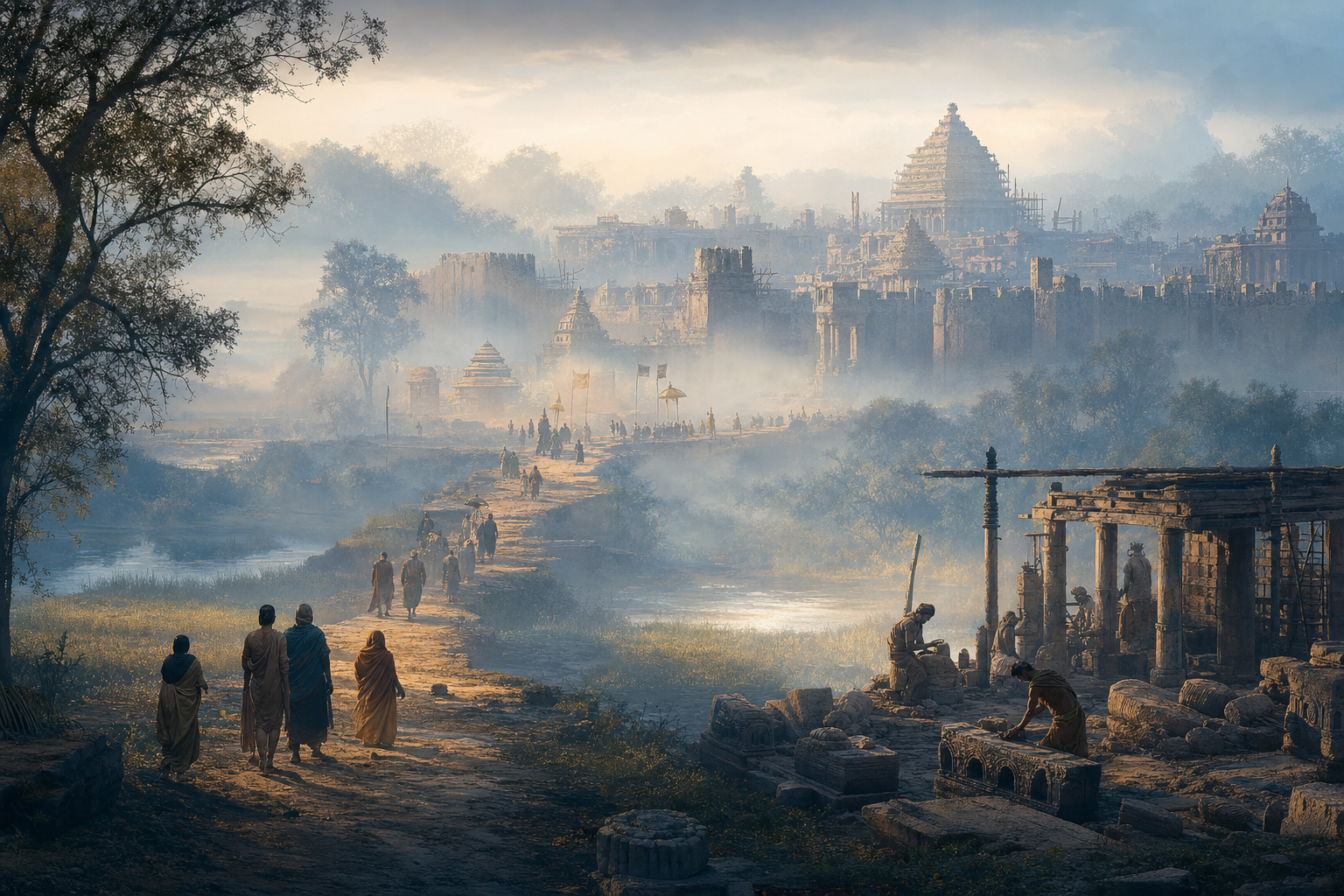
The DharmaRenaissance article locates Sakhada Bhagavati in Chhinnamasta Rural Municipality of Saptari district in eastern Nepal. It describes the shrine as an important Shakti Peetha tradition of Madhesh and notes its proximity to Rajbiraj and the Indian border. That location is significant to the article’s interpretation: the temple belongs to a devotional geography connecting Maithil, Nepali and north Indian religious life rather than to an isolated locality.
The names associated with the shrine preserve several dimensions of its identity. The account calls it Sakhada Bhagavati, Chhinnamasta Bhagawati and Shakhadeswori, while also recording the form Sakhreswari. It presents the connection between Sakhada and the names Shakra or Shaktisimha as a local explanation rather than a settled linguistic conclusion. The naming tradition therefore links the place, its goddess and its remembered royal patron without by itself proving the precise chronology of the shrine.
The reported dynastic background begins with Nanyadeva, identified in the source as the founder of the Karnata line at Simraungadh in the late eleventh century. The dynasty is portrayed as an important power in Tirhut and Mithila, associated with religious patronage, learning, administration and temple culture. Against that background, the article places the establishment of the Sakhada shrine in the thirteenth century and associates it particularly with King Shaktisimhadeva.
According to the traditional account reported there, Shaktisimhadeva came to the Saptari region after losing or relinquishing political authority and entering a retirement resembling vanaprastha. Read symbolically, this movement changes the meaning of temple patronage. The shrine is no longer only a royal project; it becomes a setting in which temporary sovereignty yields to the enduring sovereignty of Shakti.
The nearby place remembered as Gadhi Gaachhi is likewise associated in local memory with the king’s fort. Temple and fort consequently form a meaningful pair in the narrative. One represents defence, territory and temporal rule; the other represents divine protection and continuity. This is a valuable interpretation of the tradition, although the supplied article does not present material evidence establishing the date or ownership of the remembered fort.
The broken image and the limits of historical reconstruction
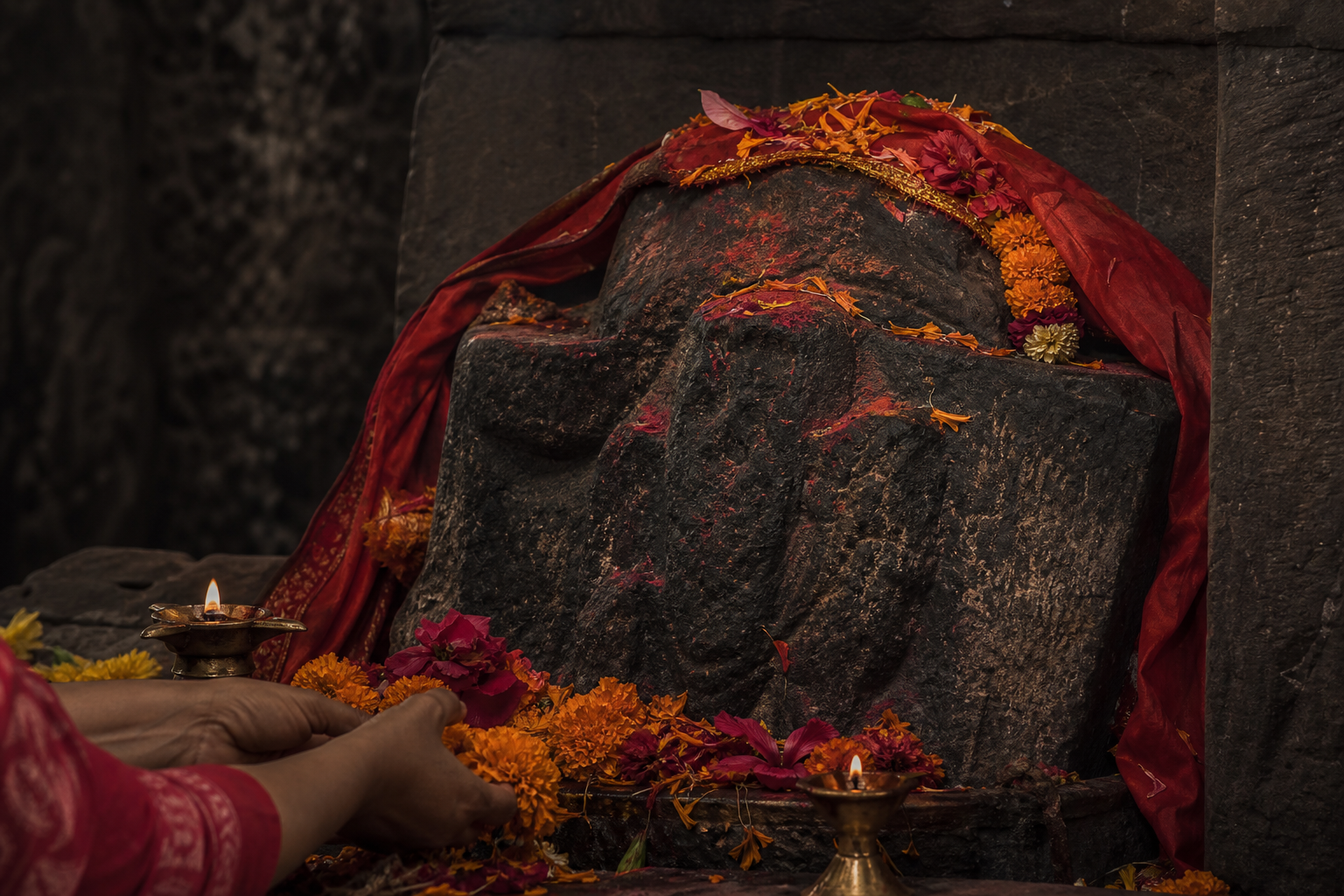
The temple’s central interpretive problem is also the source of its distinctive power: how should a headless or damaged image be understood? The DharmaRenaissance account reports a tradition connecting injury to the image with fourteenth-century upheaval, particularly military movements associated with Ghiyasuddin Tughlaq’s campaign toward Bengal and Simraungadh. The article itself advises historical caution, and its wording does not establish an independently documented chain from that campaign to the present condition of the murti.
Three propositions must therefore remain separate. The first concerns the observable or remembered condition of the sacred image. The second is a community narrative about when and how damage occurred. The third is the theological recognition of the headless Goddess as Chhinnamasta. Treating all three as one proven event would erase the difference between material history, oral memory and religious interpretation.
Keeping those categories distinct does not make the tradition less meaningful. It clarifies how sacred memory works. Damage that might ordinarily signify defeat did not terminate worship. Within the account, the altered form became capable of expressing a theological truth: divine presence is not cancelled by physical incompleteness. Historical injury and sacred identity can inhabit the same image without becoming identical explanations.
This distinction also prevents two opposite errors. A narrowly literal reading can reduce the murti to evidence of violence, overlooking the generations of devotion that followed. An exclusively symbolic reading can dissolve the community’s memory of historical rupture into abstraction. Sakhada Bhagavati is more intelligible when both registers are retained and their different standards of evidence are acknowledged.
Chhinnamasta theology in a living devotional setting
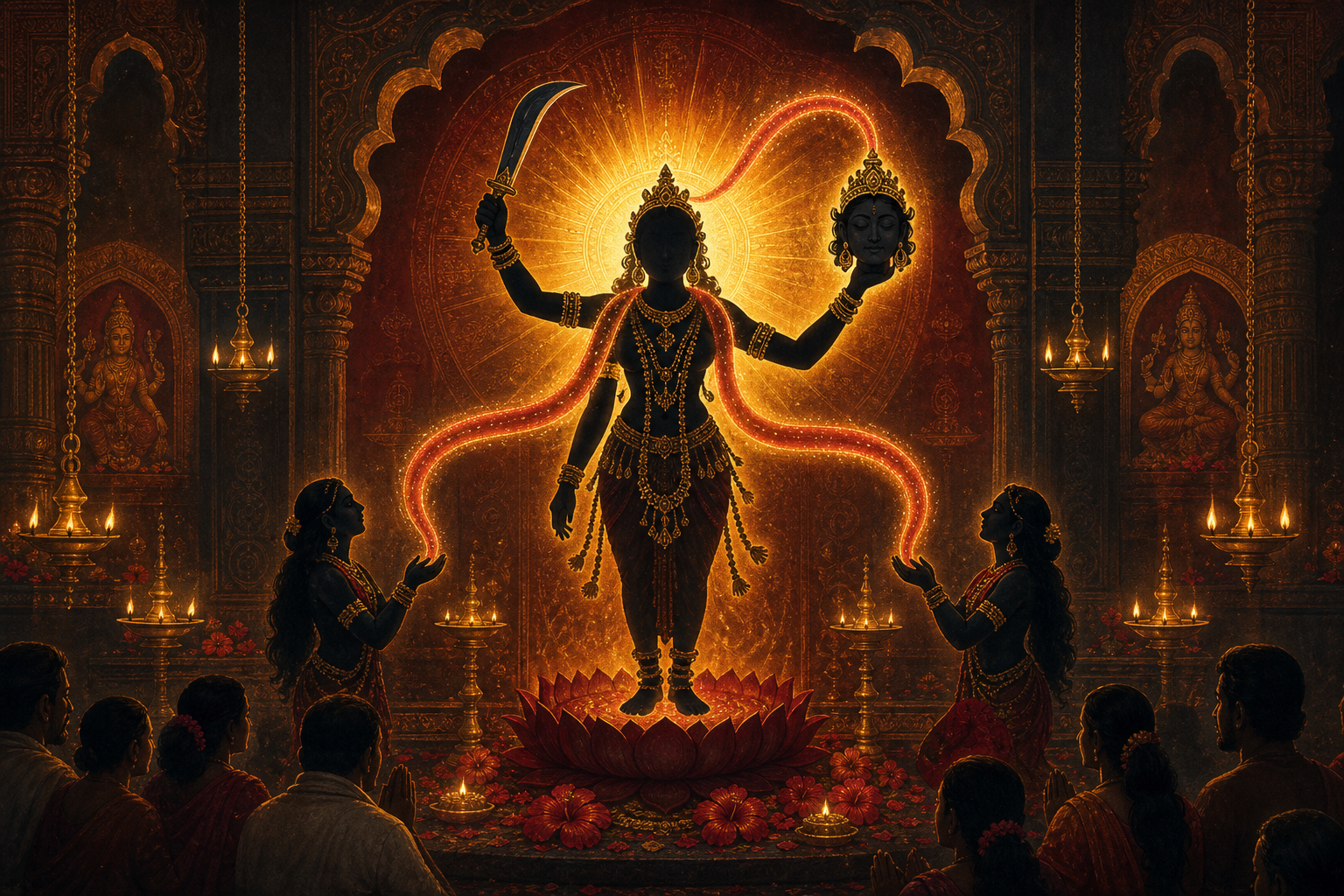
In the wider Shakta and Tantric vocabulary described by the source, Chhinnamasta means the Goddess whose head has been severed. The image is intentionally paradoxical rather than merely frightening. It places death beside vitality, sacrifice beside nourishment, and destruction beside regeneration. The severity of the form concentrates attention on forces that ordinary religious language may soften: mortality, hunger, desire, fear, power and compassion.
The severed head is interpreted in the article as a sign of release from constricted identity. Because the head represents the constructed self with its pride, memory, arguments and desire for control, its symbolic removal can signify the cutting of ego rather than the rejection of life or the body. Chhinnamasta is fearsome to the limited self that demands permanence, but liberating within a discipline directed toward self-mastery.
The account also gives this symbolism a yogic dimension. Chhinnamasta represents an intense awakening of spiritual energy and the transformation of desire into illumination. Such a reading does not require the temple’s historical image and classical Tantric iconography to have identical origins. Instead, it explains why the Chhinnamasta tradition provides a powerful theological language through which devotees can encounter the headless form at Sakhada.
Underlying that interpretation is a Shakta understanding of Devi as the dynamic power through which existence manifests, changes, dissolves and renews itself. Divine power is therefore not limited to an intact bodily representation. At Sakhada, the Goddess can be understood as present through the marked and incomplete form, not despite it. The murti’s condition becomes a reminder that sacred continuity may survive political displacement, material damage and changes in historical explanation.
The source reports that the temple attracts devotees from Nepal and India, especially during Bada Dashain. It interprets the festival through the victory of Devi over disorder and the restoration of balance. In this ritual setting, the headless Goddess is not simply an object of philosophical reflection. She is approached as an active sacred presence within pilgrimage, seasonal observance and shared regional memory.
Further study of Sakhada Bhagavati would benefit from keeping documentary history, material investigation, oral accounts and present-day ritual practice in conversation without asking one form of evidence to substitute for all the others. That approach can preserve both critical discipline and the religious insight at the heart of the shrine: a form marked by rupture can continue to generate devotion, resilience and meaning.