
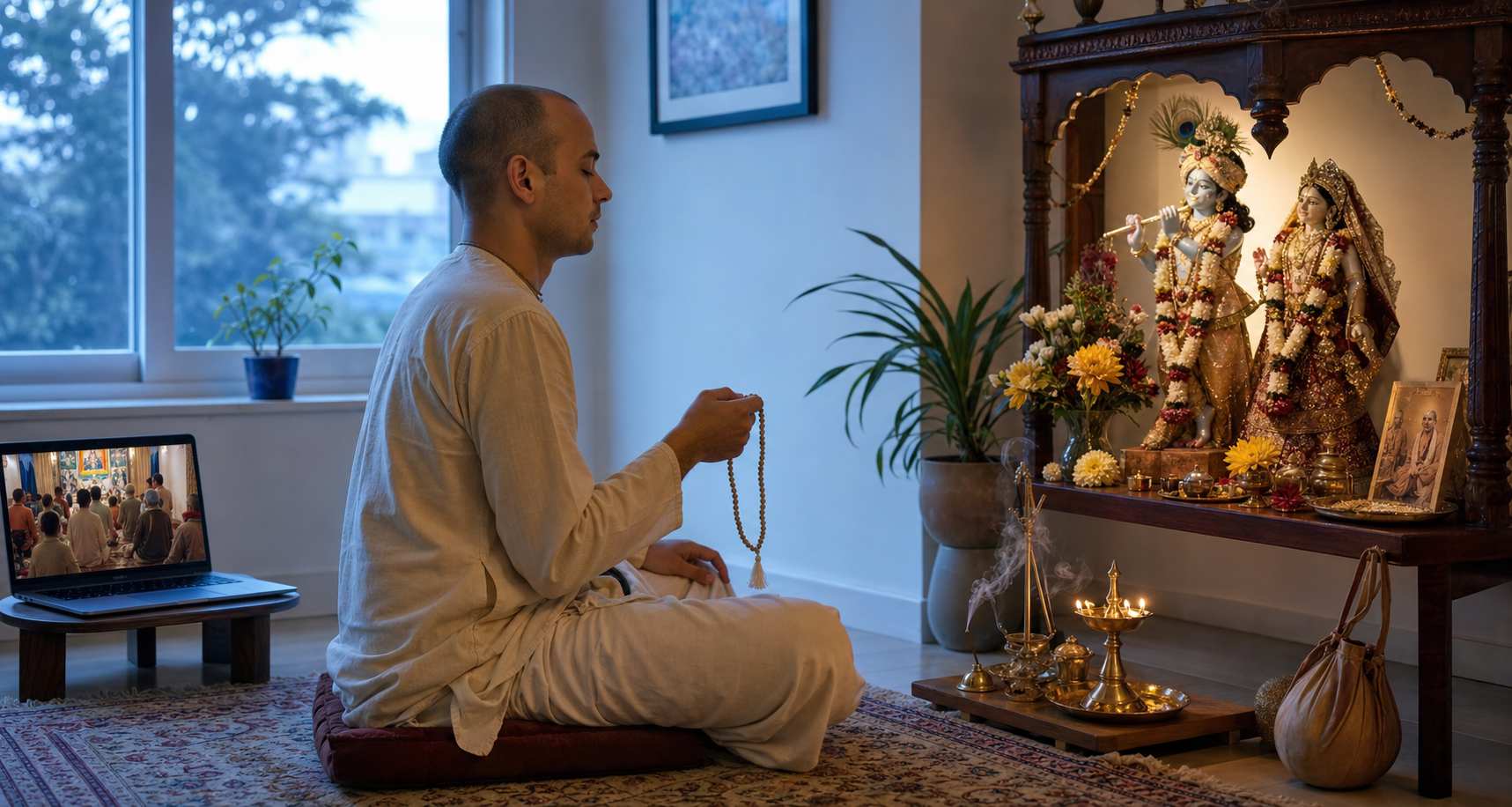
Remote Krishna consciousness now operates on two connected levels: a personal discipline practiced in the home and a digital connection to worship taking place in a temple. The source articles show that neither depends entirely on the other. A household can sustain chanting and remembrance without constant online access, while a livestream can provide association, instruction, and a shared devotional rhythm across distance.
The useful question is therefore not whether home practice or temple participation is superior. It is how each can serve its proper function, especially for householders, students, elders, caregivers, travelers, diaspora families, and others who cannot regularly attend a temple.
Personal practice and remote participation meet different needs
The article on Srila Prabhupada’s method for home-based Krishna consciousness reports an instruction given at Conway Hall in London in November 1969: a practitioner could keep a picture of Lord Caitanya with His principal associates and chant the Hare Krishna mantra at home. The same source identifies those associates as Nityananda, Advaita, Gadadhara, and Srivasa, collectively worshipped with Lord Caitanya as Sri Panca-Tattva. Its central point is that devotional life can begin without an elaborate building, costly arrangement, or residence near a temple.
That article also reports a February 1975 conversation in Honolulu in which Prabhupada distinguished residence from practice. Living inside or outside a temple was not presented as the decisive issue; following the devotional process was. This places responsibility and opportunity in the household itself. A simple altar, chanting, hearing, food offerings, and regulated conduct become parts of ordinary domestic life rather than activities postponed until the next temple visit.
The Ljubljana morning-stream article and the ISKCON of DC article address a different need: connection with a worshipping community. They interpret livestreaming as a bridge through which sacred sound, altar imagery, teaching, and the rhythm of temple worship can reach people elsewhere. Together, the three sources suggest a clear division of labor. Home practice supplies continuity; a temple stream supplies connection, guidance, and a wider sense of participation.
What a temple livestream can carry—and what it cannot
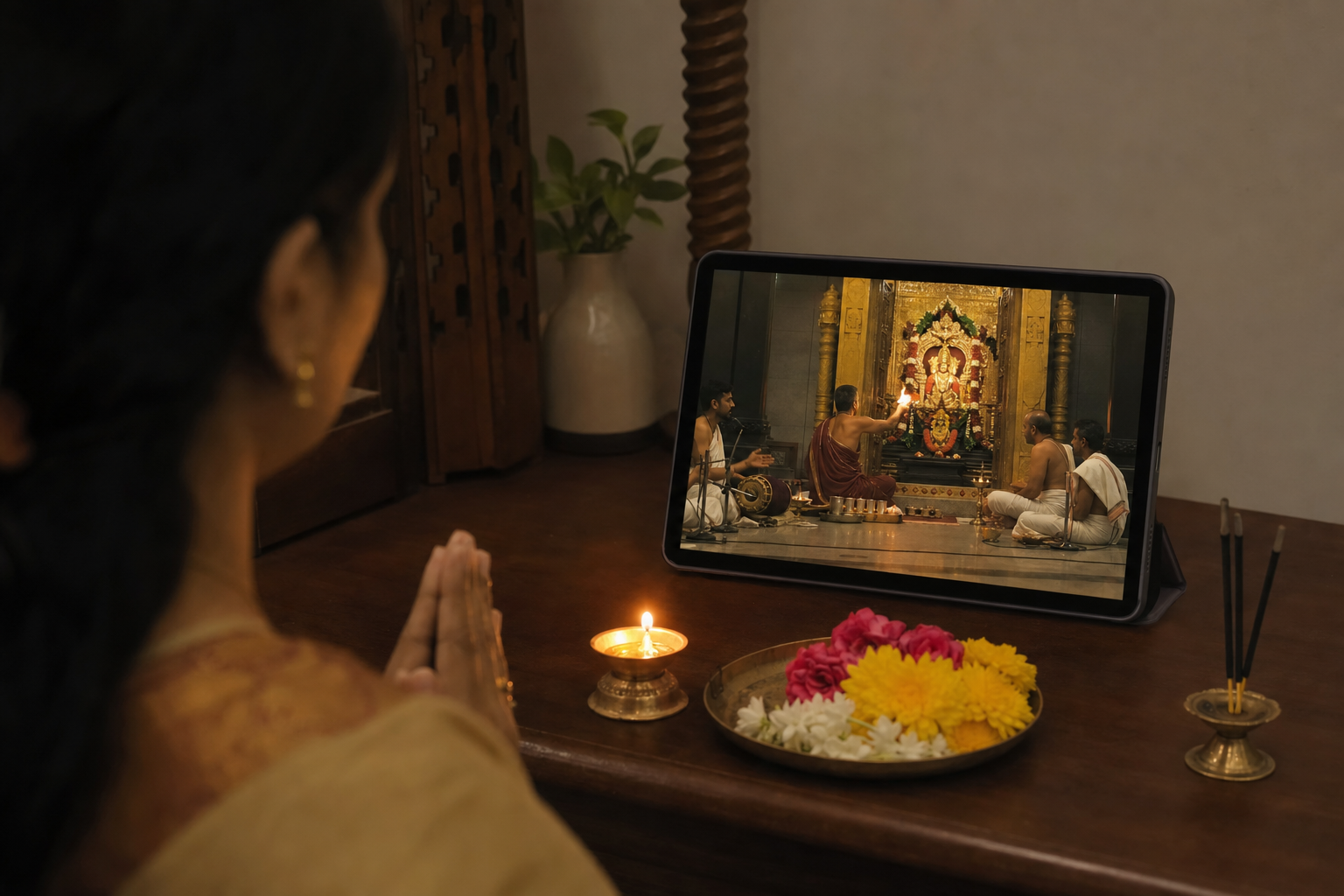
Both livestream articles describe the potential religious meaning of seeing and hearing temple worship remotely. The Ljubljana article associates a morning broadcast with the established ISKCON pattern of early worship, mantra meditation, kirtan, and scriptural hearing. The DC article similarly discusses streams as possible channels for arati, chanting, discourse, and a view of the altar. Sacred sound is particularly important within the Gaudiya Vaishnava framework described by the sources because chanting is treated as spiritual practice, not merely as devotional entertainment.
There is an important evidentiary limit. Both articles acknowledge that their underlying listings were sparse and centered on video thumbnails. They use familiar ISKCON practice to explain what such broadcasts commonly represent, but they do not independently document every element of a particular transmission. A viewer should therefore distinguish between the general purpose of an ISKCON livestream and verified claims about what occurred in any one video.
Within that limit, the two accounts identify several credible uses. A stream can help a newcomer become familiar with the cadence of kirtan, the form of arati, the organization of a discourse, and other visible features of temple life. Recorded broadcasts can also preserve lectures and celebrations for later viewing. For geographically dispersed communities, repeated exposure can maintain familiarity with devotional sounds and practices even when work, health, study, caregiving, or distance prevents attendance.
The DC article is equally clear that a screen does not reproduce embodied temple life. It cannot deliver prasadam, place a person amid congregational singing, recreate the fragrance and acoustics of the temple, or supply the informal relationships that grow through service and conversation. Nor can a livestream chant on the viewer’s behalf. Remote access is most accurately understood as an extension of temple life, not a replacement for either physical community or personal discipline.
A durable home practice begins with a small core

A place for remembrance. The home-practice article proposes a clean, respectful altar centered on Sri Panca-Tattva. It also mentions possible additions such as a picture of Srila Prabhupada, a copy of the Bhagavad Gita, and simple offerings of water, flowers, incense, or vegetarian food prepared devotionally. The principle is focus rather than display: the space gives remembrance a visible place within household routines.
A recurring practice of sacred sound. Chanting is the element shared most strongly across the sources. The home article presents the Hare Krishna maha-mantra as immediately available to a person in an apartment, rented room, hostel, family home, or other ordinary setting. The livestream articles show how temple kirtan can reinforce that practice. The distinction matters: listening can encourage chanting, but it should not quietly displace attentive personal participation.
Hearing that supports practice. The sources connect Krishna consciousness with teachings from texts such as the Bhagavad Gita and Srimad Bhagavatam, as well as with instruction associated with Srila Prabhupada. A recorded discourse or streamed class can make such hearing accessible, while personal reading prevents spiritual learning from becoming dependent on whatever a platform happens to recommend next.
A rhythm suited to real responsibilities. None of the articles supplies one universal duration, equipment list, or household timetable. Their combined logic favors a modest pattern that can be repeated over an ambitious schedule that is quickly abandoned. Morning practice receives particular attention in the Ljubljana article, but the home article also recognizes chanting during other quiet parts of the day. Regularity is the governing principle.
Digital access works best as devotional scaffolding
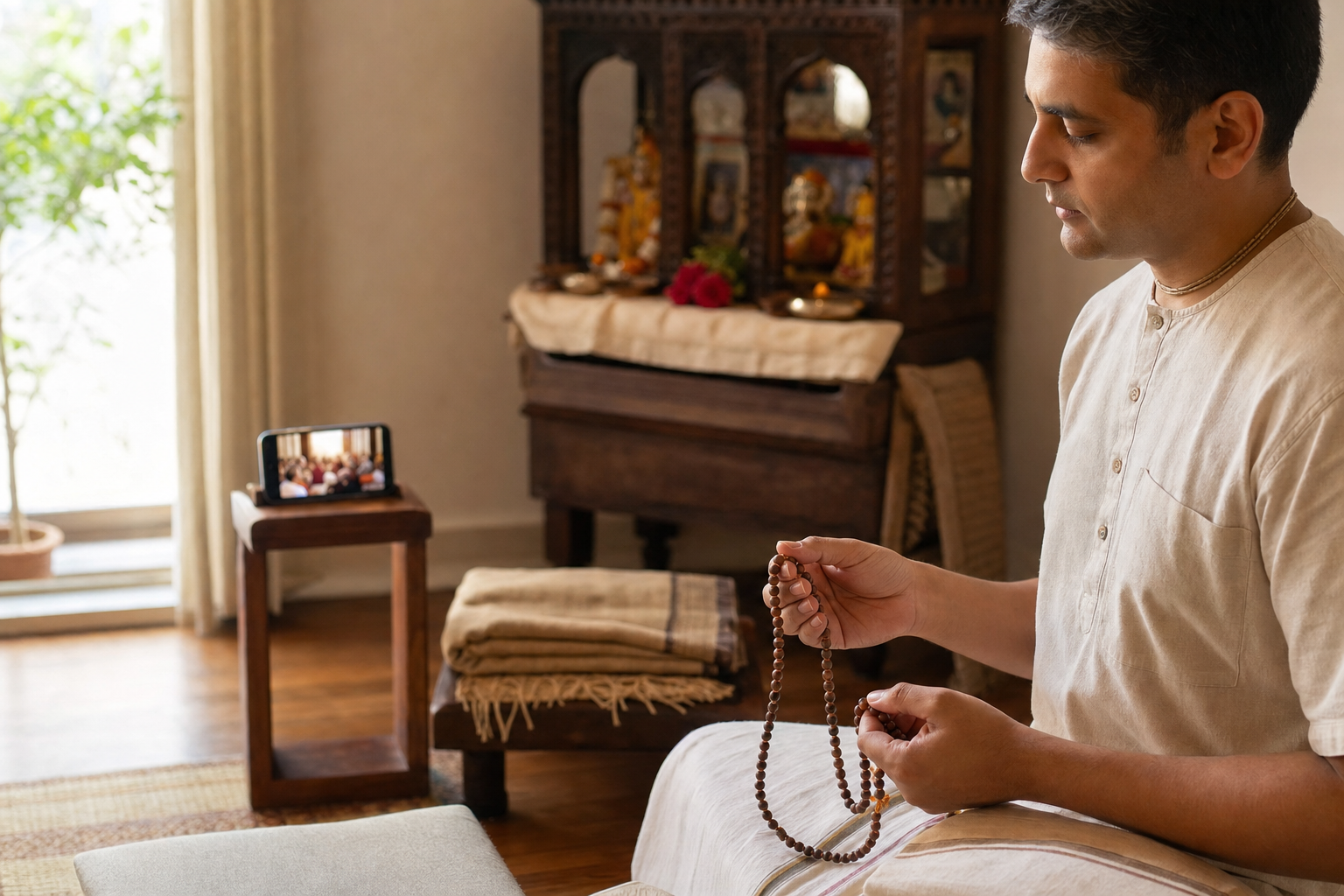
The strongest synthesis across the three accounts is that technology should reinforce intentional practice. A selected temple broadcast can establish a point of connection in the day, provide a kirtan in which the household actively participates, or offer a class chosen for careful hearing. Used this way, the stream serves a defined devotional purpose rather than becoming continuous background media.
This approach also preserves the local character of the temples involved. The Ljubljana article presents a European community carrying a Gaudiya Vaishnava tradition into Slovenian cultural life, while the DC article emphasizes the needs of a dispersed community around the American capital. Digital transmission allows each local temple to reach beyond its immediate geography without requiring every viewer to have the same schedule, language environment, or level of familiarity.
A practical test follows from the sources: remote participation is beneficial when it leads to more attentive chanting, hearing, remembrance, service, or eventual community engagement. If it produces only passive consumption, the availability of religious media has been mistaken for the performance of religious practice. The home remains the place where streamed inspiration must become conduct.
Key takeaways
- Home-based Krishna consciousness can begin with a respectful focal space, sincere chanting, hearing, and simple worship; elaborate facilities are not presented as prerequisites.
- Temple livestreams can transmit sacred sound, visible ritual patterns, teaching, and a sense of community across distance.
- The source articles describe the customary possibilities of such streams but provide limited evidence about the contents of the individual thumbnail-based listings.
- Digital access complements rather than replaces personal practice, physical association, service, and the embodied experience of temple life.
- A small, repeatable household rhythm supported by intentionally chosen broadcasts is more sustainable than dependence on constant religious content.
As temples refine their digital outreach, the most constructive future is a two-way bridge: broadcasts that invite active practice at home, and home practice that gradually deepens meaningful connection with teachers, devotees, and local communities.
References
- DharmaRenaissance Blog — ISKCON Ljubljana Morning Live: A Powerful Window Into Bhakti and Devotion
- DharmaRenaissance Blog — ISKCON of DC Live Stream: A Powerful Digital Window Into Bhakti and Community
- Dandavats — Srila Prabhupada’s Simple Method for Powerful Home-Based Krishna Consciousness