
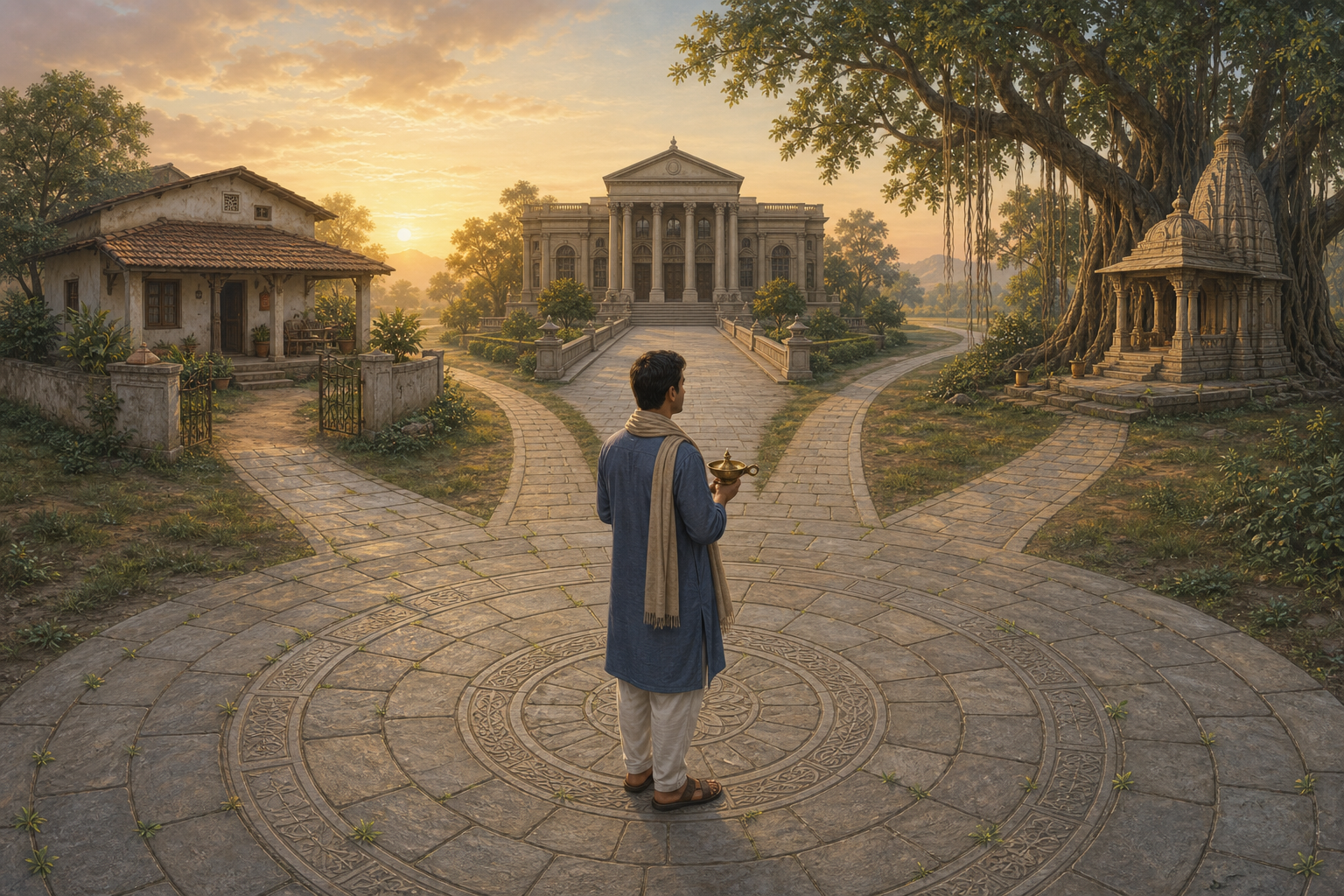
Dharma becomes most difficult precisely when several valid obligations point in different directions. Loyalty may conflict with justice, continuity with compassion, and public ritual with responsibility toward living beings. In such cases, the central question is not simply whether to preserve or reject a practice, but how to identify which duty should govern a particular person, role or institution.
Two seemingly distant cases illuminate this problem: an interpretive account of Balarama’s neutrality during the Kurukshetra war and a report on Kerala temples adopting robotic elephants. One concerns refusal to enter a conflict; the other concerns changing the form of a tradition. Read together, they offer a practical way to think about dharma without reducing it either to rigid repetition or unrestricted innovation.
Two different conflicts can hide inside the same dharmic question
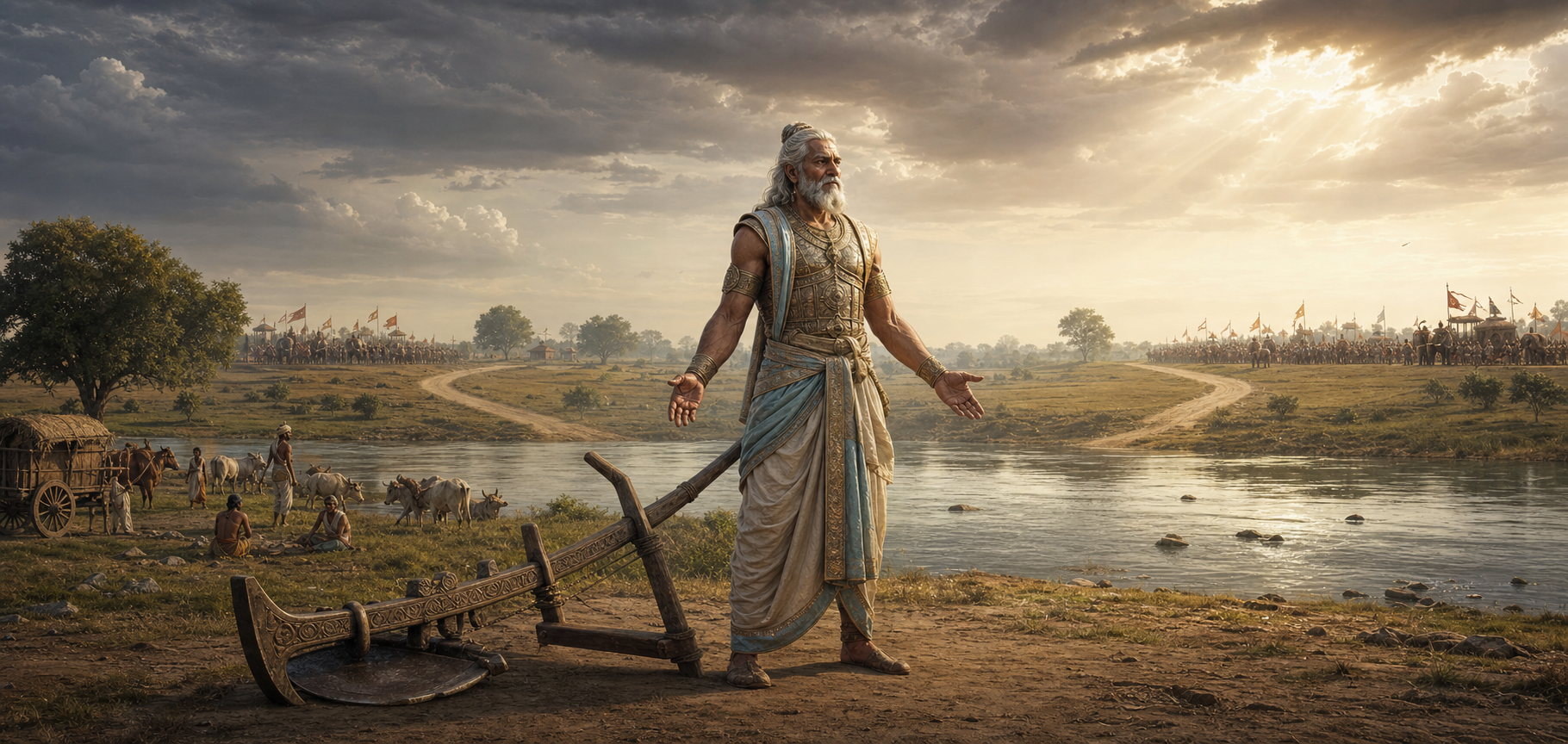
The article about Balarama presents a conflict among personal duties. Balarama was connected to the Pandavas through family relationships, but he was also the martial teacher of both Bhima and Duryodhana and retained affection for Duryodhana as a student. According to the article’s reading of the Mahabharata, joining either army would have placed his strength and authority behind the destruction of someone toward whom he carried a legitimate obligation.
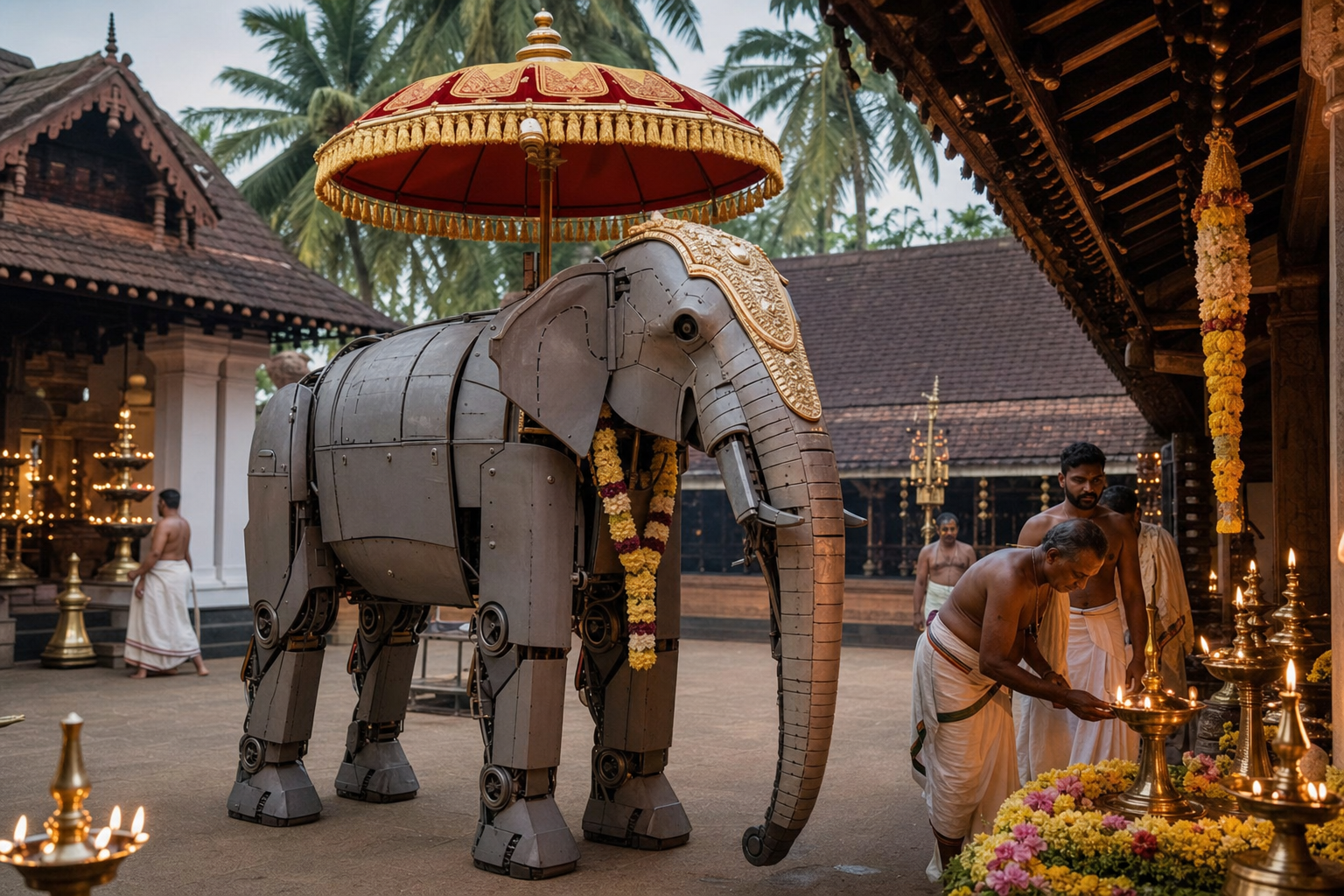
The Kerala case presents a different kind of conflict. The source describes selected temples using animatronic elephants to retain a familiar ceremonial presence without exposing living elephants to captivity, chains, prolonged standing, loud gatherings, heat and other reported sources of distress. Here the tension is not primarily between two personal loyalties. It is between continuity of ritual form and duties arising from ahimsa, animal welfare, public safety and responsible temple administration.
These distinctions matter. A conflict of roles may require a person to decline an assignment that cannot be performed with integrity. A conflict within a practice may instead call for redesigning the means by which a valued purpose is pursued. Treating every dilemma as a simple contest between tradition and reform obscures the actual moral work.
Preserving moral purpose does not always preserve every mechanism
Both source articles converge on a foundational idea: outward continuity is not the only measure of fidelity to dharma. The Balarama article does not portray neutrality as a declaration that the competing sides were equally righteous. It portrays his decision as a judgment about the role he could personally occupy without betraying the obligations created by kinship, teaching and trust. His pilgrimage during the war becomes, in that interpretation, an alternative discipline rather than passive indifference.
The robotic-elephant article similarly distinguishes sacred symbolism from a particular material arrangement. It reports that the machines can reproduce parts of the ceremonial vocabulary associated with temple elephants, including visual presence, controlled movement and, in some cases, a platform for priests or ritual objects. It also stresses that these devices are not sentient elephants or autonomous agents. They are limited tools intended to carry a symbolic and ceremonial function.
That substitution is not emotionally neutral. As the source acknowledges, devotees may regard a living temple elephant as a participant connected with blessing, memory and community identity, rather than as decoration. A serious reform therefore has to understand what people believe is being preserved or lost. Yet attachment alone cannot settle the ethical issue. If reverence for elephants is central to a practice, the conditions imposed upon actual elephants become part of the test of that reverence.
The synthesis is not that inherited forms are expendable. It is that form and purpose must be examined separately before they can be responsibly reunited. A changed form may protect a tradition’s ethical purpose; an unchanged form may sometimes contradict it. Conversely, an innovation that retains appearances while emptying a ritual of its understood meaning would not become dharmic merely because it is modern.
A disciplined test for decisions under competing duties
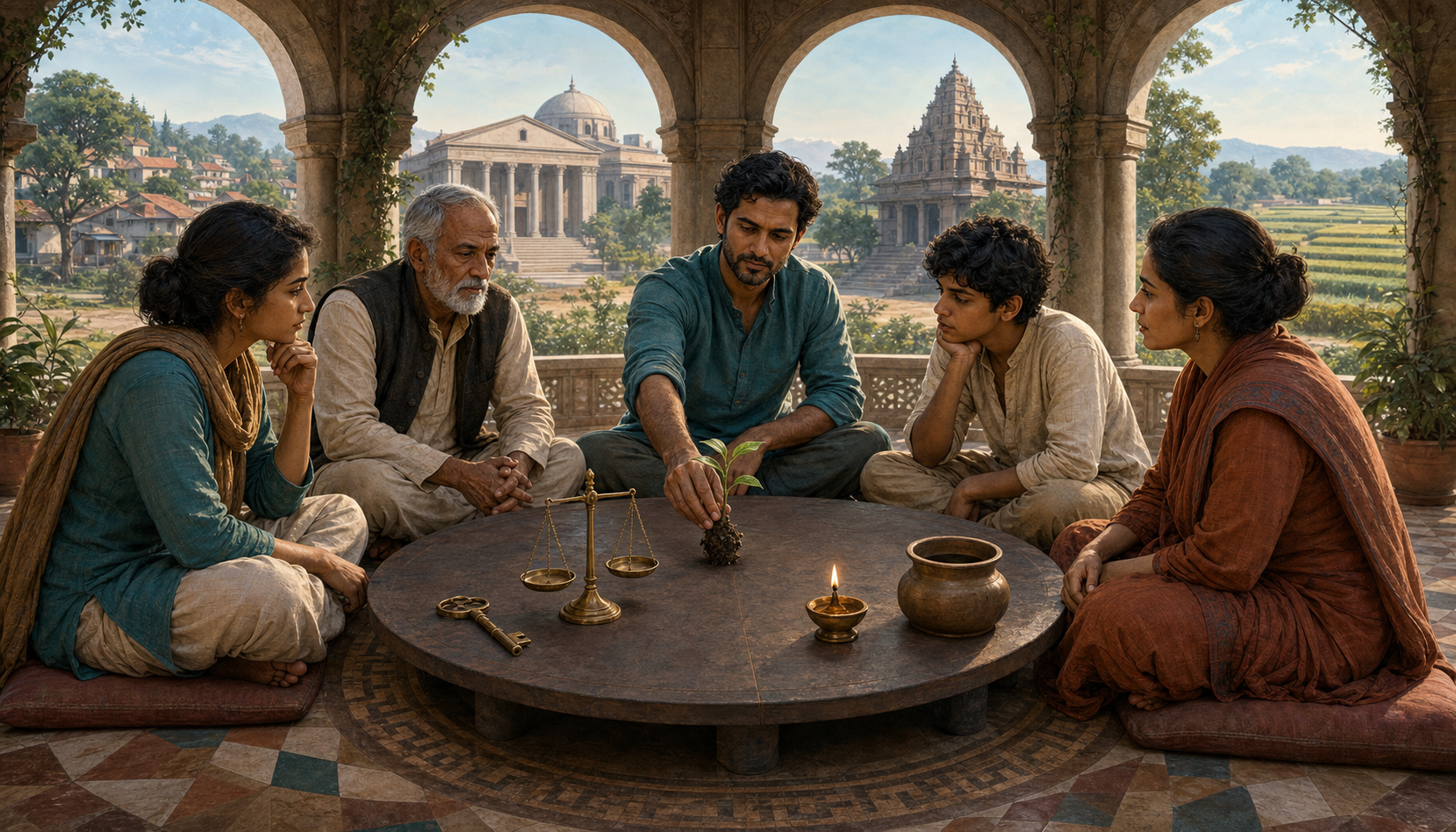
Map the obligations before choosing a side
The first task is to identify all morally relevant relationships, including those that are inconvenient. In the Balarama account, justice in the political dispute did not erase the duties associated with discipleship and family. In the temple case, obligations to devotees and ritual continuity coexist with responsibilities toward animals, crowds and the institution itself. Naming these claims does not make them equal, but it prevents a convenient duty from becoming the only visible one.
Separate the end from the inherited means
A community considering reform must ask what a practice is intended to honour, communicate or accomplish. It must then ask whether the established means are indispensable to that purpose. The robotic-elephant proposal rests on the claim that important ceremonial and visual functions can continue without using a captive animal. That claim should be assessed in the context of each ritual rather than converted into a universal assumption.
Test avoidable harm and integrity together
Ahimsa supplies one test: if comparable ritual dignity can be maintained while reducing avoidable suffering, the less harmful option deserves serious consideration. Balarama’s example supplies another: even a defensible cause does not automatically make every possible participant the right agent. Dharma concerns not only the desired outcome, but also whether a person can pursue it without corrupting the responsibilities of a particular role.
Choose a proportionate response and keep responsibility visible
Neither case supports an unlimited escape from obligation. In the source’s interpretation, Balarama withdrew from combat without campaigning for Duryodhana, sabotaging the Pandavas or pretending that the dispute had no moral content. The temple innovation is also narrow: it changes how an elephant-associated ceremonial presence is supplied, not the entire ritual world around it.
Technology does not remove the need for stewardship. The Kerala article notes practical responsibilities involving structural stability, batteries, motors, wiring, protection from rain and humidity, transport and safety inspection. Replacing an animal with a machine may remove one category of harm, but it leaves human decision-makers accountable for ritual suitability, engineering care and public safety.
Key takeaways
- Conflicting duties should be identified before one obligation is treated as absolute.
- Principled neutrality is a judgment about role and responsibility, not a claim that every side is equally right.
- Traditions can change their means while preserving their purpose, but that continuity must be demonstrated rather than assumed.
- Reverence for a living being is ethically incomplete if it ignores the conditions imposed upon that being.
- Neither pilgrimage nor technology transfers moral responsibility away from the people and institutions making the decision.
Neither neutrality nor innovation is self-justifying
Balarama’s example cannot be turned into a general endorsement of standing aside. Neutrality can protect comfort, status or complicity when a person actually has a clear duty and a clean capacity to act. What gives his neutrality ethical significance in the source’s account is the combination of competing legitimate bonds, restraint despite great power, and refusal to manipulate the conflict from outside the battlefield.
Robotic elephants likewise should not be treated as proof that every technological substitution is humane, ritually appropriate or administratively sound. The available source describes an emerging option in selected temples, not a universal settlement for Kerala’s temple culture. It presents an ethical case for the alternative and acknowledges practical limitations, but it does not eliminate the need for temple-specific deliberation or careful evaluation of community concerns.
The strongest common lesson is methodological. Dharma under pressure requires truthful attention to relationships, consequences, role boundaries and the purpose beneath a customary form. Future changes will be most credible when communities explain those judgments openly, examine their results and remain willing to revise arrangements that fail either compassion or sacred meaning.
References
- DharmaRenaissance Blog – Robotic Temple Elephants in Kerala: Powerful Dharma, Ahimsa and Humane Innovation
- DharmaRenaissance Blog – Balarama’s Powerful Neutrality: The Hidden Dharma Behind Avoiding Kurukshetra