
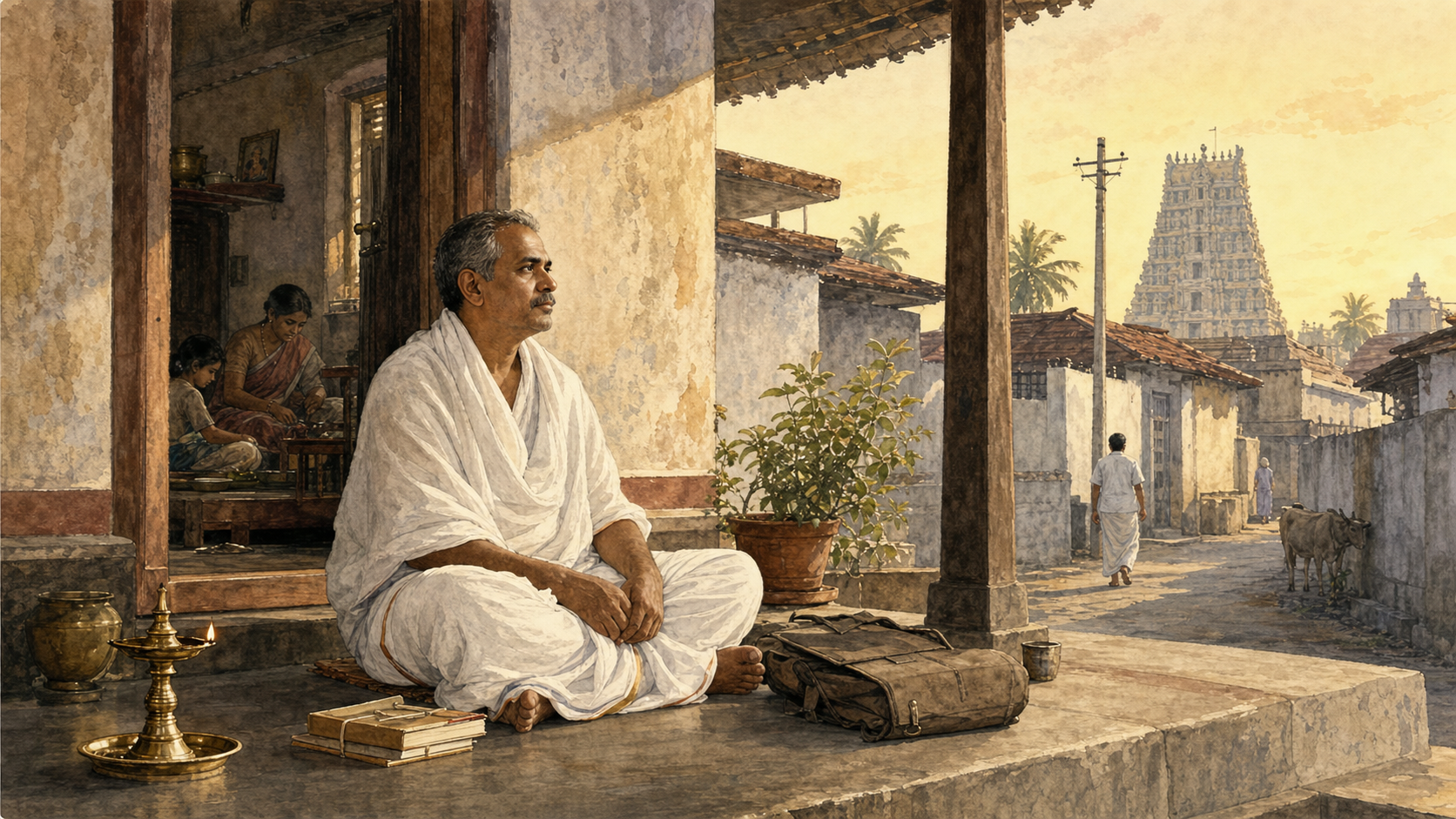
Sadguru Subrahmanyam Garu is remembered as a realized householder whose spiritual life unfolded through family duties, school teaching, service to his Guru and an increasingly quiet influence on seekers in Srikalahasti. His story is especially valuable because it places self-realization within ordinary responsibilities rather than outside them.
The available account combines a modest biographical outline with memories preserved by devotees. Read carefully, these strands illuminate both his path and the way Indian spiritual communities remember teachers whose authority rested more on presence and conduct than on institutions or public prominence.
A teacher and family man shaped by spiritual discipline
The source account reports that Subrahmanyam was born in Konathaneri in Andhra Pradesh’s Chittoor district. His parents, Sri Siddaiah and Smt. Vijayalakshmi, belonged to an agricultural family characterized by piety and simplicity. Although little about his childhood is documented, the remembered setting suggests that reverence, restraint and faith formed part of his early moral environment.
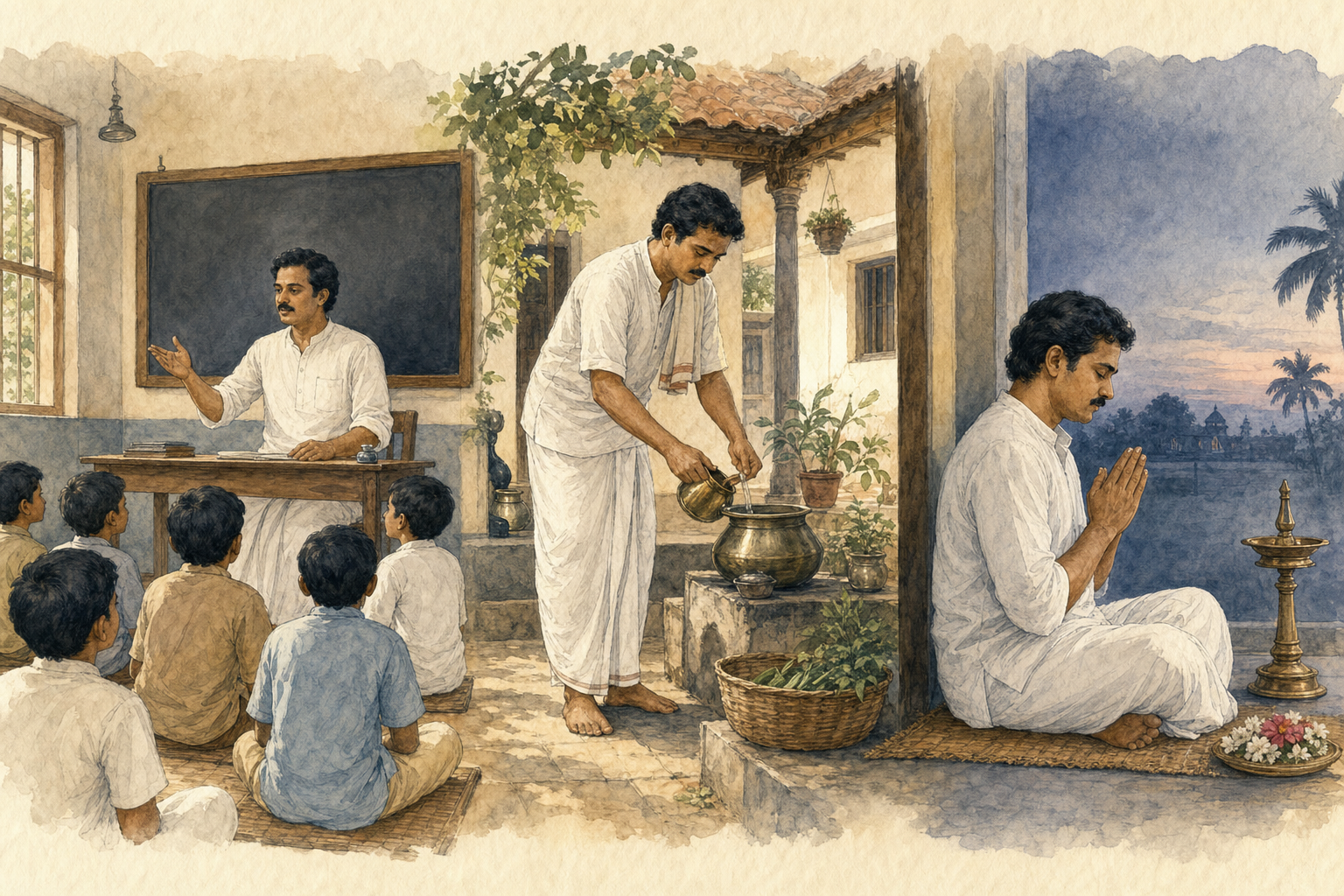
At nineteen, he married Smt. Padmavati, affectionately called Vayyamma, and they raised three sons. He became a schoolteacher, combining professional and domestic responsibilities with meditation, reflection and time spent in the company of saints. This combination matters: teaching required patience and regularity, while family life continually tested whether inward discipline could survive practical demands.
Following his father’s death and the division of ancestral property, the family moved to Srikalahasti in 1975, according to the profile. The town is traditionally associated with the Vayu, or air, element among the Pancha Bhoota Shiva Kshetras. That association provides an interpretive image for Subrahmanyam Garu’s later influence: subtle, difficult to measure and experienced principally through its effects.
His home gradually became a gathering place for seekers and was associated with Sri Ramana Satsangs. Yet the account does not portray this development as an attempt to build an organization. It presents a retired teacher and gentle elder whose stillness drew attention without an accompanying claim to status. In the vocabulary of the Bhagavad Gita, devotees understood this composure through the ideal of the sthita-prajna, a person whose wisdom remains steady amid changing circumstances.
Guru-bhakti as trust rather than personal achievement
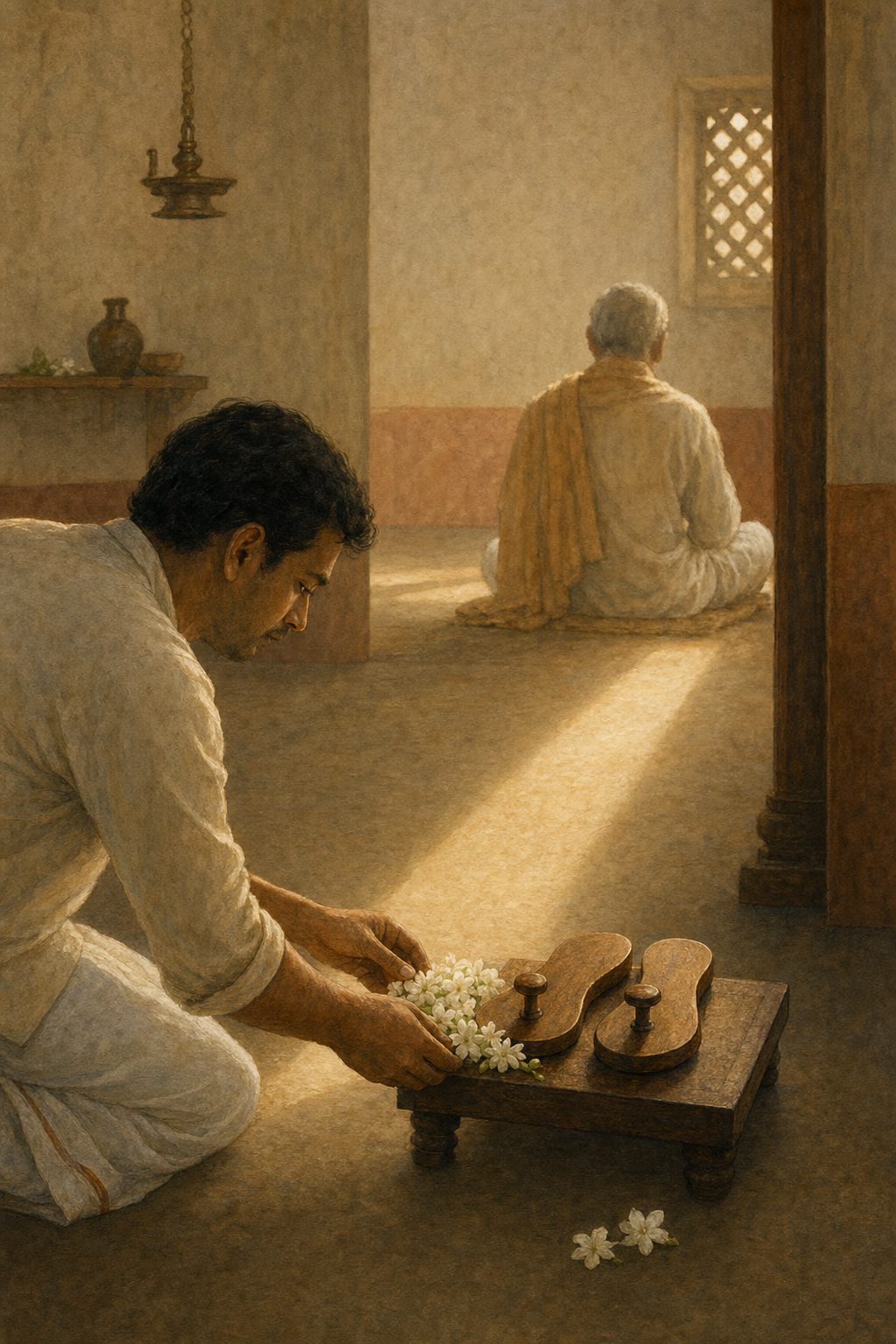
The decisive relationship in Subrahmanyam Garu’s remembered spiritual life was with Tat Baba Garu, also called Thatha Garu Swamy. The profile does not describe his development as a standardized program of techniques or initiations. It instead emphasizes confidence in the Guru and a willingness to obey without making personal preference the final authority.
One devotional narrative recounts Tat Baba Garu asking him to read from a book concerning Pothuluri Veerabrahmendra Swamy. The reading continued for hours. Subrahmanyam Garu reportedly resolved inwardly to continue until told to stop, at which point the Guru immediately ended the exercise. The point preserved by the community is not the duration of the reading but the disciple’s movement from resistance toward undivided resolve.
Another remembered episode has Tat Baba Garu bowing before his disciple. Within the source’s non-dual interpretation, the gesture signifies recognition of the same realized Self beyond conventional rank; it need not be read as a reversal of their practical Guru-disciple relationship. Subrahmanyam Garu summarized his path in correspondingly impersonal terms: I had full faith in my Guru. I abided by his word. Everything else happened on its own.
This statement redirects attention from spiritual accomplishment to receptivity. In its original devotional setting, surrender did not mean passivity or a refusal to discern. It meant allowing loyalty, patience and the Guru’s guidance to weaken the impulse to treat realization as an achievement owned by an individual ego.
Padmavatamma and the spiritual labor of the household
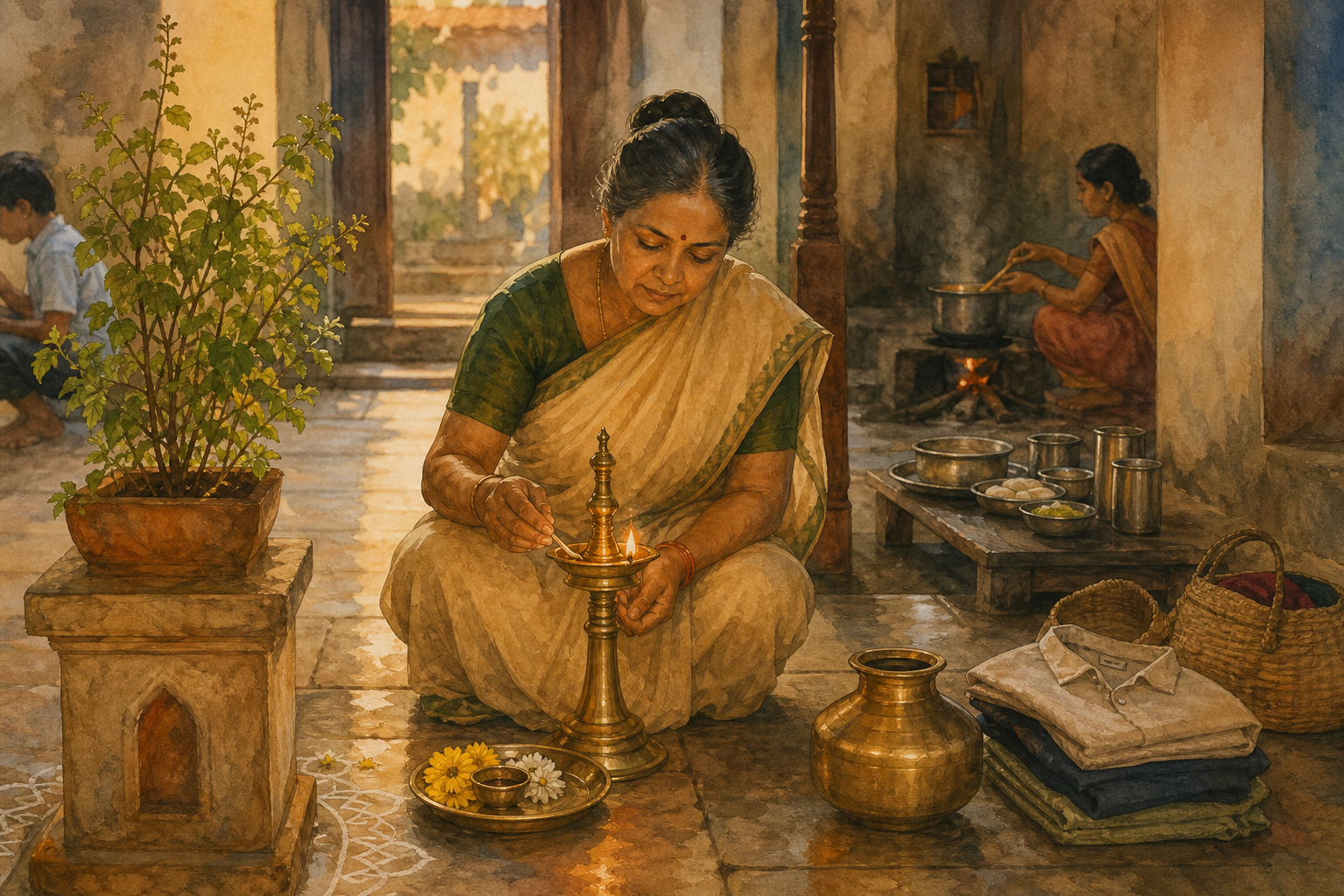
Padmavatamma’s place in the story prevents the phrase householder-saint from becoming an abstraction. The source remembers her as the person who managed family life with patience and cheerfulness while also accommodating the difficult or unconventional demands surrounding Tat Baba Garu. Hospitality, endurance and practical care created the conditions in which satsang and spiritual discipline could continue.
Some remembered instructions challenged ordinary expectations: relatives could be sent away without explanation, while stray dogs could be welcomed as divine guests. Padmavatamma reportedly received such incidents as expressions of Guru leela. Whether read devotionally or symbolically, the stories reveal a household repeatedly asked to loosen its assumptions about possession, social preference and who deserves care.
The account reports that Padmavatamma died on 14 January 1999 with Om Siva
on her lips. Her body was placed in a resting site beside the Swarnamukhi River, where a small Samadhi Mandir became associated with daily worship. Subrahmanyam Garu attributed her liberation to lifelong Guru Seva. Within the profile’s spiritual framework, her service was therefore not secondary support for another person’s realization; it was itself a complete path.
This emphasis broadens the meaning of spiritual practice. Visible teaching is only one form of transmission. Cooking, receiving visitors, bearing uncertainty and sustaining family life can also become disciplines when they are performed without resentment or a demand for recognition.
Reading a life preserved through devotional memory
The source acknowledges that much of Subrahmanyam Garu’s early life is undocumented and that the writings of Sri T.V.N. Babu provide an important window into his character and teachings. This distinction is essential. Details such as his occupation, marriage and move to Srikalahasti form the reported biographical frame, while encounters with his Guru are transmitted as oral-devotional memories carrying theological meaning.
Such narratives should be neither treated automatically as independently verified history nor dismissed because they function symbolically. Their first evidentiary value lies in showing what the community considered spiritually important: patience that outlasts discomfort, obedience without self-display, recognition beyond hierarchy and service without public reward.
The same care applies to devotees’ description of Subrahmanyam Garu as a jnani, one established in knowledge of the Self. The source presents this as the perception and conviction of those who encountered him, not as a status established by an external test. His reported conduct is consequently more informative than the label: he fulfilled responsibilities, encountered grief and change, and was remembered for remaining inwardly unagitated rather than for cultivating a dramatic persona.
Key takeaways for a householder path
- Ordinary duties need not obstruct realization. Subrahmanyam Garu’s remembered life joins employment, marriage, parenthood and contemplation within one field of practice.
- Steadiness is tested in circumstances. Inner stillness becomes meaningful when it persists through work, loss, obligation and uncertainty.
- Guru-bhakti displaces spiritual self-importance. The central question in these accounts is not what the disciple acquired, but how completely personal insistence was surrendered.
- Household service has spiritual agency. Padmavatamma’s story presents hospitality, endurance and care as a path rather than as background labor.
- Devotional memory requires responsible reading. Biographical reporting, community testimony and symbolic interpretation can be distinguished without stripping the tradition of meaning.
Subrahmanyam Garu’s legacy invites future seekers to examine spiritual maturity where it is hardest to imitate: in the quality of attention, the handling of responsibility and the absence of a need to appear exceptional.