
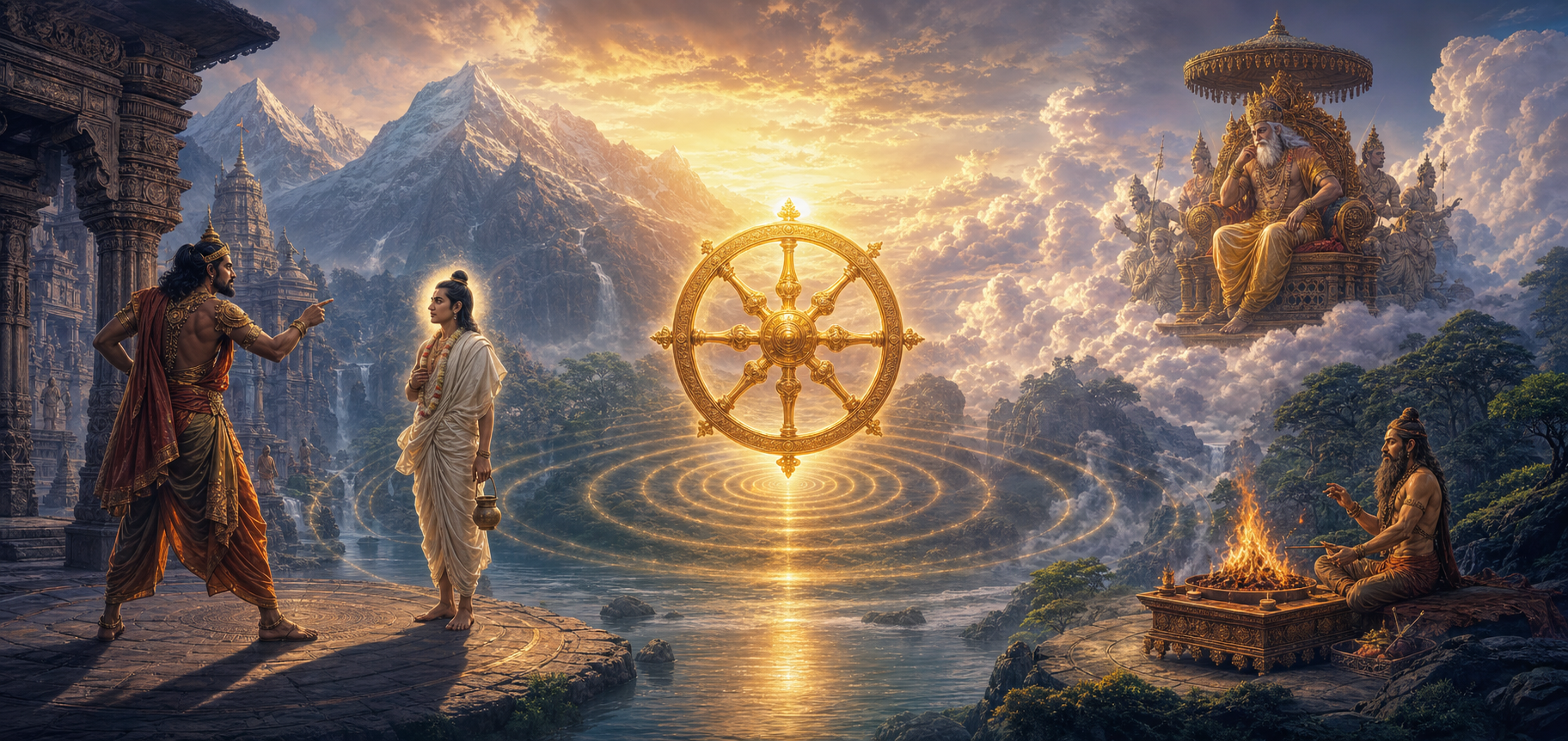
Ego in sacred narrative is rarely just vanity. It appears as a way of seeing: anger assumes it already knows the truth, while insecure authority treats another being’s growth as a threat. The resulting harm begins before a weapon is raised, in the unexamined interpretation that makes violence seem necessary.
The legend associated with Changu Narayan and the Mahabharata account of Indra and Trishira approach this problem from different directions. One concerns a Brahmin who fails to recognize Vishnu; the other concerns a celestial ruler who fears the power accumulated by an ascetic. Read together, they show how status, perception, and responsibility interact in a moral universe where power cannot cancel consequence.
When perception becomes possession
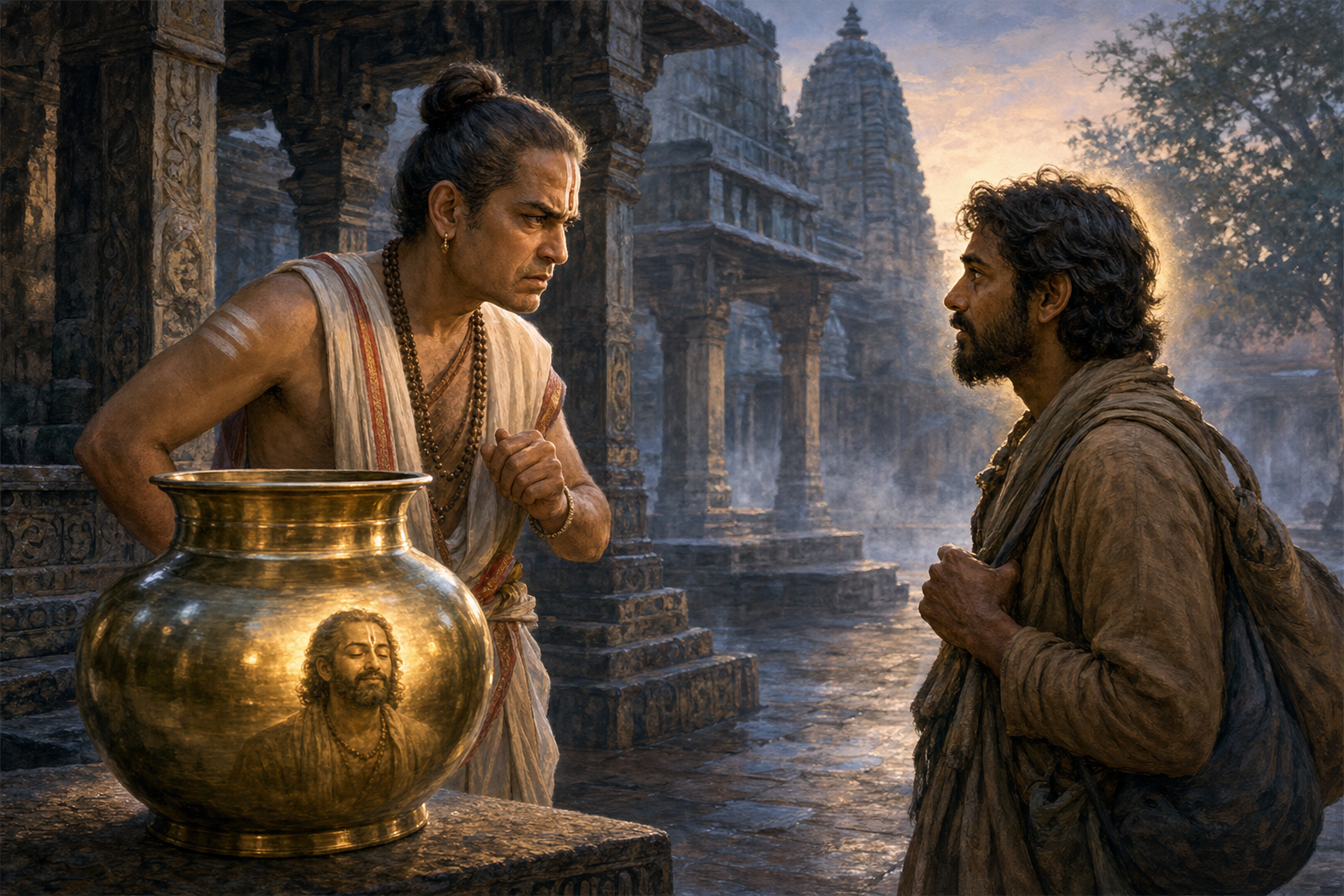
The Changu Narayan article recounts a local tradition in which the Brahmin Sudarshan follows his Kapila cow after its milk repeatedly disappears. He sees a radiant figure emerge from a champaka tree and drink the milk. Believing that he has found the culprit, he attacks with a sword and severs the figure’s head. Only afterward does he recognize the figure as Vishnu.
Sudarshan’s error is not a lack of evidence in the ordinary sense: the milk is gone, and he observes someone drinking it. His failure lies in treating a partial observation as a complete moral judgment. Ownership, ritual concern, and anger combine to exclude the possibility that the event may have a meaning beyond theft. The narrative therefore places recognition after action, when knowledge can produce remorse but cannot undo the blow.
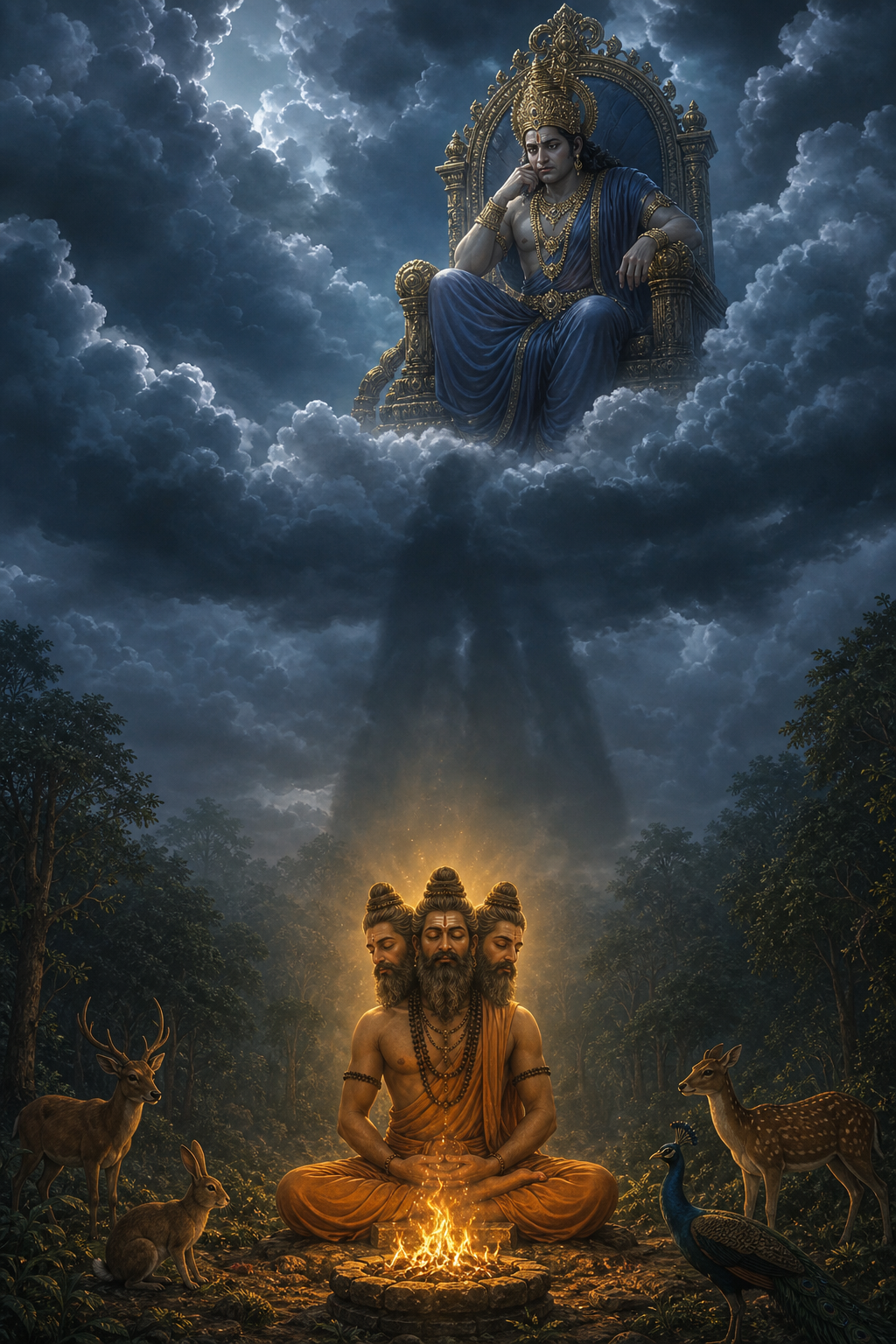
The article on Indra and Trishira presents a related distortion at a higher level of authority. As reported there, Trishira, the three-headed son of Tvashta, practices formidable tapas. Indra interprets the ascetic’s growing power as a possible challenge to his position and eventually kills him, although Trishira is not portrayed as attacking Indra at that moment. Here too, possibility hardens into certainty: spiritual achievement is read as political aggression because the observer is already afraid of displacement.
The comparison exposes two forms of ego. Sudarshan’s is reactive certainty: he assumes that what affects him must be understood on his terms. Indra’s is defensive sovereignty: he evaluates another being primarily by what that being might do to his rank. Neither character first creates the interior space needed for inquiry, counsel, or restraint.
What authority can and cannot exempt
The two narratives do not equate authority with wickedness. The Changu Narayan tradition centers Vishnu as Narayana, while the Mahabharata episode retains Indra’s identity as king of the devas. Their point is subtler: sacred or political stature does not make every act performed by a powerful figure righteous, and participation in cosmic order does not mean immunity from its demands.
According to the Changu Narayan article, Vishnu explains that his beheading is connected to an earlier episode in which a Brahmin named Sumati died during a battle with the demon Chandra. Shukracharya had pronounced that a descendant of Sumati would one day behead Vishnu. The temple legend consequently frames the shocking event not as the defeat of divinity, but as the arrival of a previously established consequence. Vishnu’s acceptance of that connection makes cosmic integrity, rather than invulnerability, the sign of higher authority.
Indra occupies the opposite position in the comparison. He is not shown receiving an old consequence with composure; his attempt to protect authority initiates a new crisis. The source reports that Tvashta responds to Trishira’s killing through a sacrificial act from which Vritra emerges as an avenger. Indra’s office gives him the capacity to act, but it cannot transform fear into justice or prevent an unjust act from generating resistance.
Together, the accounts distinguish legitimate authority from possessiveness about authority. A role may carry real duties and powers, yet its moral legitimacy depends on judgment, restraint, and accountability. Once office is treated as personal property, another person’s discipline can look like rebellion and uncertainty can look like permission for preemptive force.
Two different architectures of consequence
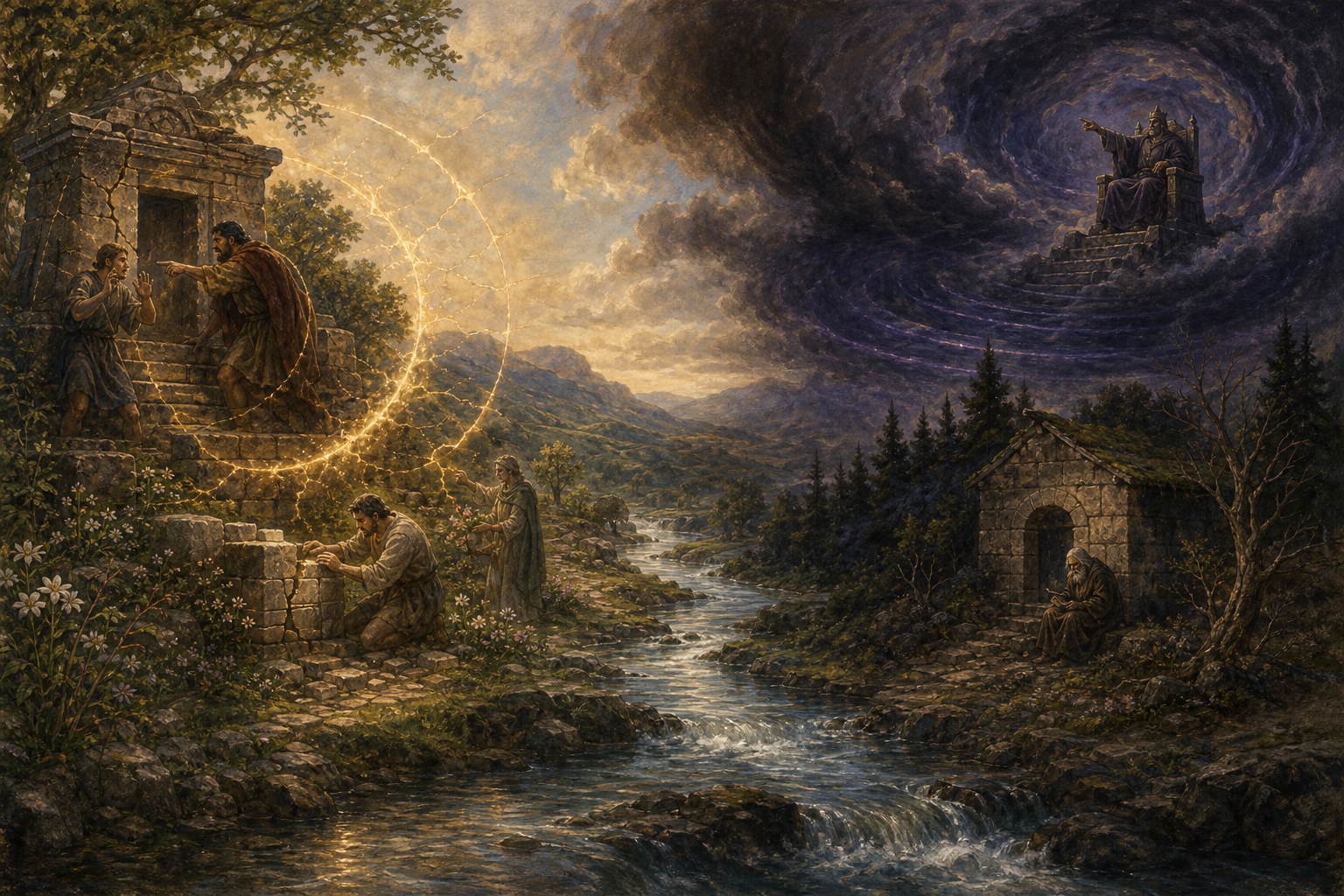
Consequence does not operate identically in the two stories. The Changu Narayan legend looks backward. Sudarshan’s blow is morally troubling, but the source also places it within an older chain involving Sumati’s death and Shukracharya’s pronouncement. The present moment discloses a history that the human actor did not know.
The Trishira narrative moves forward. Indra fears a potential rival and removes him, but the killing produces Tvashta’s grief and anger; the father’s ritual response then produces Vritra, a danger far greater than the one Indra had anticipated. The attempted prevention of instability becomes its cause. Consequence is therefore not merely punishment imposed from outside. It also develops through injured relationships, memory, intention, and the powers available to those who have been wronged.
This difference prevents a simplistic formula in which every misfortune can be assigned to one visible deed. The Changu account warns that the origins of an event may precede the immediate participants. The Mahabharata account warns that a present decision may create conditions whose scale the decision-maker cannot foresee. Both challenge the ego’s preference for a short causal story centered on the concerns of the moment.
Neither structure erases personal responsibility. Sudarshan’s unknown role in an older sequence does not make uncontrolled anger admirable, and Indra’s concern about the political potential of tapas does not justify killing a non-aggressor. Sacred causality complicates judgment without abolishing it: an actor can be situated within a larger order and still remain responsible for the quality of perception and intention brought to an act.
Tapas and devotion challenge status without seizing it
The source on Trishira defines tapas as concentrated discipline, restraint, knowledge, and inner power rather than mere physical hardship. It emphasizes that such power is not presented as the monopoly of title or office. This explains why Trishira unsettles Indra: disciplined merit introduces a form of authority that cannot simply be bestowed or withdrawn by the established ruler.
Yet the narrative, as reported, does not establish that Trishira has already used this power against Indra. The gap between capacity and hostile intent is crucial. Insecure authority collapses that distinction, treating the ability to challenge as proof of a plan to challenge. The episode thereby asks whether a ruler can recognize excellence outside the hierarchy without immediately converting admiration into surveillance or fear.
The Changu Narayan article supplies a complementary model through the temple’s visual and devotional setting. It describes forms of Vishnu in the complex and highlights Garuda’s posture before Narayana as an image of attentive surrender. In the source’s interpretation, this visual theology answers Sudarshan’s haste: the sacred is approached through disciplined attention rather than a demand that it appear in an expected form.
Tapas and devotion thus unsettle ego in different ways. Tapas demonstrates that genuine capacity can arise beyond institutional rank. Devotion trains perception so that the unfamiliar is not immediately reduced to an offense. Both require restraint, but neither is passivity: each gathers the mind before action and relocates authority from self-assertion to disciplined alignment.
A practical ethic of pause, scrutiny, and repair

These narratives are not procedural manuals for modern institutions, but their moral psychology remains recognizable. A loss can provoke accusation before investigation; another person’s achievement can be treated as disloyalty; and the ability to use force can be mistaken for sufficient reason to use it. Their shared corrective begins with a pause between perception and judgment.
Key takeaways
- Separate observation from interpretation: Sudarshan sees the milk being consumed, but his certainty about the event’s meaning proves disastrously incomplete.
- Distinguish capacity from intent: Trishira’s spiritual power may alter the balance of authority, but the source does not present his austerity itself as an attack.
- Judge power by restraint: Rank expands the consequences of fear-driven action; it does not make such action righteous.
- Trace causes in both directions: present events may carry an older history, while present decisions may generate larger future crises.
- Make remorse productive: the Changu narrative treats recognition and repentance as openings toward humility rather than excuses for denial or despair.
The most durable application is therefore not suspicion of authority itself, but a higher standard for its exercise. Communities that honor inquiry, tolerate earned merit, and preserve paths for acknowledgment and repair are better placed to interrupt the sequence by which ego becomes policy and policy becomes consequence.
References
- DharmaRenaissance Blog — Changu Narayan’s Headless Vishnu: Sacred Legend, History, and Humbling Power
- DharmaRenaissance Blog — Indra and Trishira: Powerful Mahabharata Lessons on Envy, Tapas and Consequence