

Family duty and spiritual growth are often treated as competing demands: one pulls attention toward relationships, income and care, while the other appears to require silence, detachment and uninterrupted practice. The three source accounts suggest a different relationship. Household responsibilities can become the setting in which devotion is made practical, tested under pressure and corrected when it becomes self-centred.
Read together, the discussions of married life, Dhruva Maharaja’s exile and Vidura’s return to Hastinapura offer a demanding standard. Spiritual maturity is not demonstrated only by worship or knowledge, but also by fairness toward dependants, disciplined speech, responsible use of authority and the willingness to serve people whose needs interrupt personal preference.
The household is evidence of spiritual formation

The report on balance in married life, based on an address attributed to Bhakti Rasamrita Swami at Vivah Samelana Pune on 14 March 2026, presents the grihastha ashrama as more than a private arrangement between spouses. It describes the household as supporting children, elders, guests, teachers, temples and the wider community. Affection matters within this vision, but it matures through service, restraint and shared responsibility rather than remaining romantic sentiment.
The discussion of Srimad-Bhagavatam 4.8.65 gives that principle a painful negative example. King Uttanapada recognises that attachment and partiality led him to neglect Suniti and their five-year-old son, Dhruva. The article’s central ethical claim is that public status or religious activity cannot compensate for the abandonment of people entrusted to one’s protection. Dharma is compromised when authority operates without compassion inside the home.
The study of Srimad-Bhagavatam 1.13.11-16 adds a constructive model. It presents the Yadavas, the Pandavas and Vidura in different social roles while describing each as oriented toward Krishna. Yudhisthira remains responsible for governance, and Vidura stays in a difficult family setting to awaken Dhritarashtra’s spiritual intelligence. Devotional orientation is therefore not confined to external renunciation; it can govern administration, counsel and care.
All three accounts converge on one point: conduct toward nearby people reveals whether spiritual ideas have entered character. Marriage exposes impatience and pride; parenthood tests fairness and protection; responsibility for elders tests compassion and courage. The household does not automatically sanctify every attachment, but it provides a daily field in which attachment can be disciplined by dharma.
Attachment becomes harmful when it distorts responsibility
Affection is not identified as the problem in these sources. The danger is affection that becomes selective, possessive or morally blinding. Uttanapada’s attachment to one relationship reportedly left him unable to act justly toward another. His failure shows how private preference can become family-wide adharma when the person holding authority refuses to protect the vulnerable.
His confession also distinguishes repentance from discomfort. He does not merely grieve because events have become painful; he identifies his own hard-heartedness and failed judgement. Such recognition cannot erase what Dhruva and Suniti suffered, but it opens the possibility of correction. Within family life, remorse becomes spiritually meaningful when it produces truthful acknowledgement, changed conduct and renewed protection.
Dhruva’s response supplies another part of the synthesis. According to the Bhagavatam discussion, the rejected child is guided by Suniti and later instructed by Narada Muni, redirecting his pain into discipline, mantra meditation and devotion to Vishnu. The source explicitly avoids romanticising the injury. The lesson is not that family harm is desirable because a victim might grow through it. It is that injustice need not determine the injured person’s final identity when suffering is met with wise guidance and purposeful practice.
This distinction prevents two opposite errors. A family should not excuse neglect by calling suffering spiritually beneficial, and a wounded person need not accept resentment as the only possible future. Responsibility remains with the person who caused or permitted the harm, while spiritual agency remains available to the person who endured it.
Speech connects inner discipline with family trust

The married-life report applies satya and ahimsa to communication between spouses. Truthfulness without kindness can become cruelty, while apparent kindness without honesty can become avoidance. Because relatives regularly encounter one another while tired, anxious or unguarded, the home tests whether speech is governed by timing, restraint and concern for the listener rather than by the desire to win.
The account of Vidura develops the same principle through a different situation. It reports that Vidura does not immediately disclose the destruction of the Yadu dynasty to the Pandavas because he does not wish to increase their distress unnecessarily. The article interprets this as compassionate timing rather than dishonesty. Information may be true, yet its delivery can still be careless if the speaker ignores context, readiness and foreseeable pain.
Together, these perspectives define spiritual speech more carefully than either blunt disclosure or permanent silence. The relevant questions are whether the truth must be spoken, whether the moment serves understanding and whether the manner preserves another person’s dignity. Restraint should not conceal abuse or evade responsibility, but disclosure should not be used to discharge anger under the cover of honesty.
This is also where meditation becomes observable. The Vidura article argues that contemplation of Krishna’s form should gradually refine perception and soften aggressive habits. The married-life discussion similarly maintains that bhakti must appear as patience, gratitude, forgiveness and reliability. Both sources therefore treat compassionate speech as an outcome of practice, not as a secondary social skill unrelated to spiritual life.
Shared practices can give ordinary duties a sacred centre
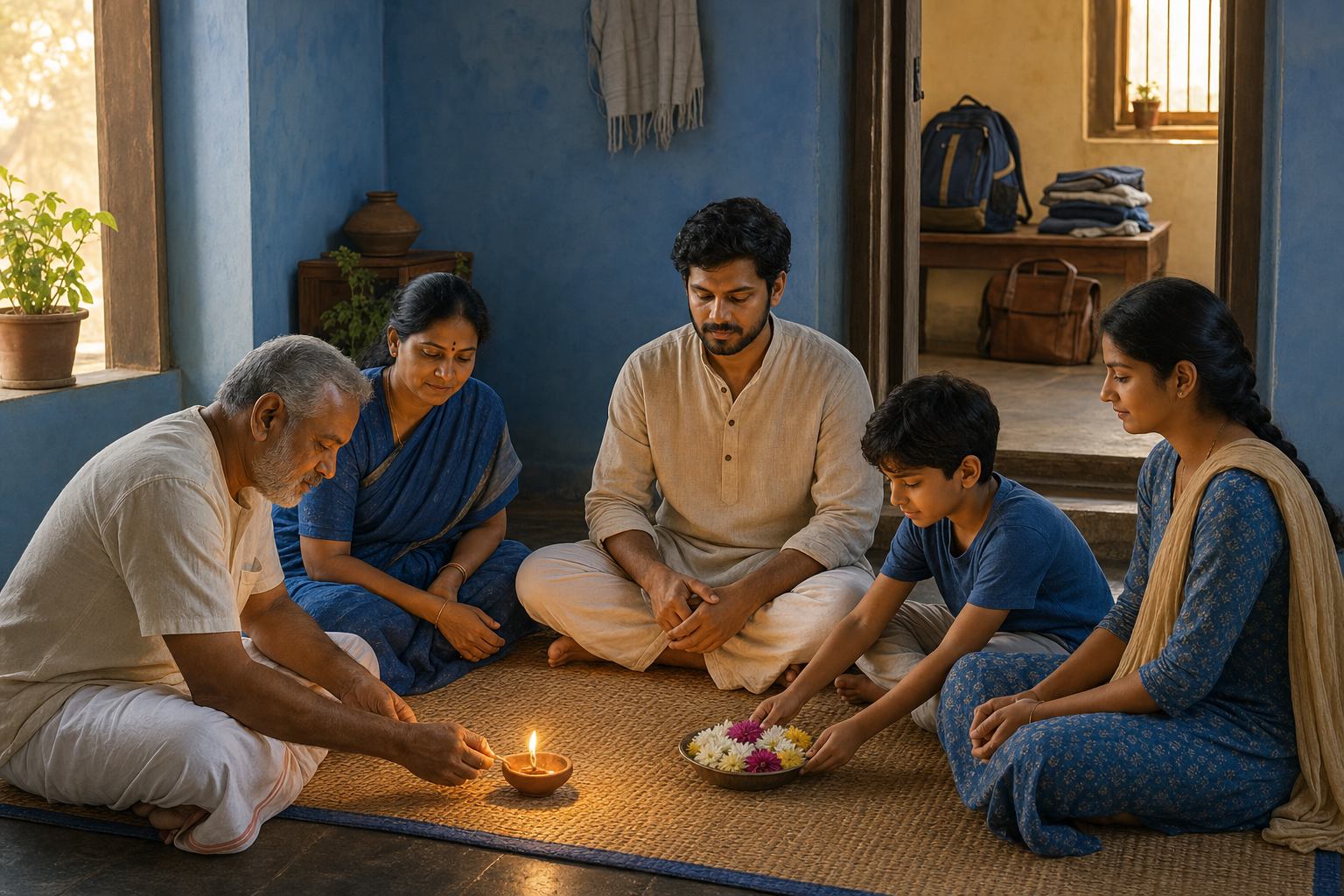
Integration does not mean adding an ambitious religious programme to an already exhausted household. The married-life source recommends regular spiritual and relational rhythms, however modest, amid work demands, financial pressure and digital distraction. It mentions practices such as lighting a lamp, offering food, chanting, observing festivals, reading scripture, visiting temples, serving guests and teaching children sacred narratives. Their value lies partly in repetition: they give family life a centre not set entirely by employment, consumption or screens.
The meditation article explains why such rhythms can matter. It presents remembrance of Krishna as being formed through hearing, sacred recitation, remembrance and service rather than through visualisation alone. Study, satsanga, kirtan and japa create an environment in which attention repeatedly returns to the divine. In a household, service then carries that remembrance into meals, caregiving, earning, teaching and difficult conversations.
Material responsibility remains part of this discipline. The married-life report does not reject the pursuit of resources; it places earning and financial planning under dharma. Food, shelter, education, healthcare and security require stewardship, while greed and comparison can consume the attention a family needs for worship and relationship. Spiritual balance therefore concerns not only how money is earned, but what it serves and how much emotional energy its pursuit absorbs.
Nor does shared spiritual culture require identical personalities. The married-life account invokes svabhava and svadharma to recognise differences in temperament and responsibility. One family member may express care verbally and another through practical work; one may prefer predictability while another adapts easily. Cooperation develops when these differences are interpreted accurately and coordinated around shared duties, rather than treated automatically as disrespect.
A useful standard emerges: practice should make a person more dependable, not less available. Time devoted to worship does not justify ignoring a spouse’s distress, a child’s need for guidance or an elder’s moral and material welfare. Conversely, family busyness should not be allowed to eliminate every space for prayer, reflection and scriptural hearing. Integration protects both sides from becoming excuses for avoidance.
Key takeaways
- Family duty is not separate from spiritual life when protection, earning, caregiving and communication are consciously governed by dharma.
- Affection becomes destructive when partiality overrides fairness, especially where one person holds greater authority than another.
- Repentance begins with naming one’s own failure, but it becomes credible only through correction and renewed responsibility.
- Truthful family speech requires compassion, timing and restraint without using kindness as a pretext to conceal harm.
- Regular worship, hearing and remembrance should become visible as patience, attention, service and reliability at home.
A spiritually serious household need not wait for ideal circumstances. Its next stage of growth can begin with one protected period of shared practice, one neglected obligation repaired, or one recurring conflict approached with greater truth and mercy. Repeated consistently, such choices allow duty to become a form of devotion rather than a rival to it.
References
- DharmaRenaissance Blog — Powerful Dharmic Lessons on Balance in Married Life and Spiritual Growth
- DharmaRenaissance Blog — Dhruva Maharaja’s Painful Exile: Powerful Lessons from SB 4.8.65
- DharmaRenaissance Blog — Powerful Krishna Meditation: How Vidura Teaches Form, Memory, and Devotion