

A Varahi pilgrimage during Ashadha is easy to misunderstand when it is reduced to a shrine checklist. The observance brings together a lunar festival, regional forms of Shakti worship, public temple darshan and, in some communities, the more guarded disciplines of Sri Vidya.
Reading these elements together clarifies which temples belong on an itinerary, why local calendars matter and where open devotion ends and lineage-based practice begins.
Ashadha has several overlapping devotional maps
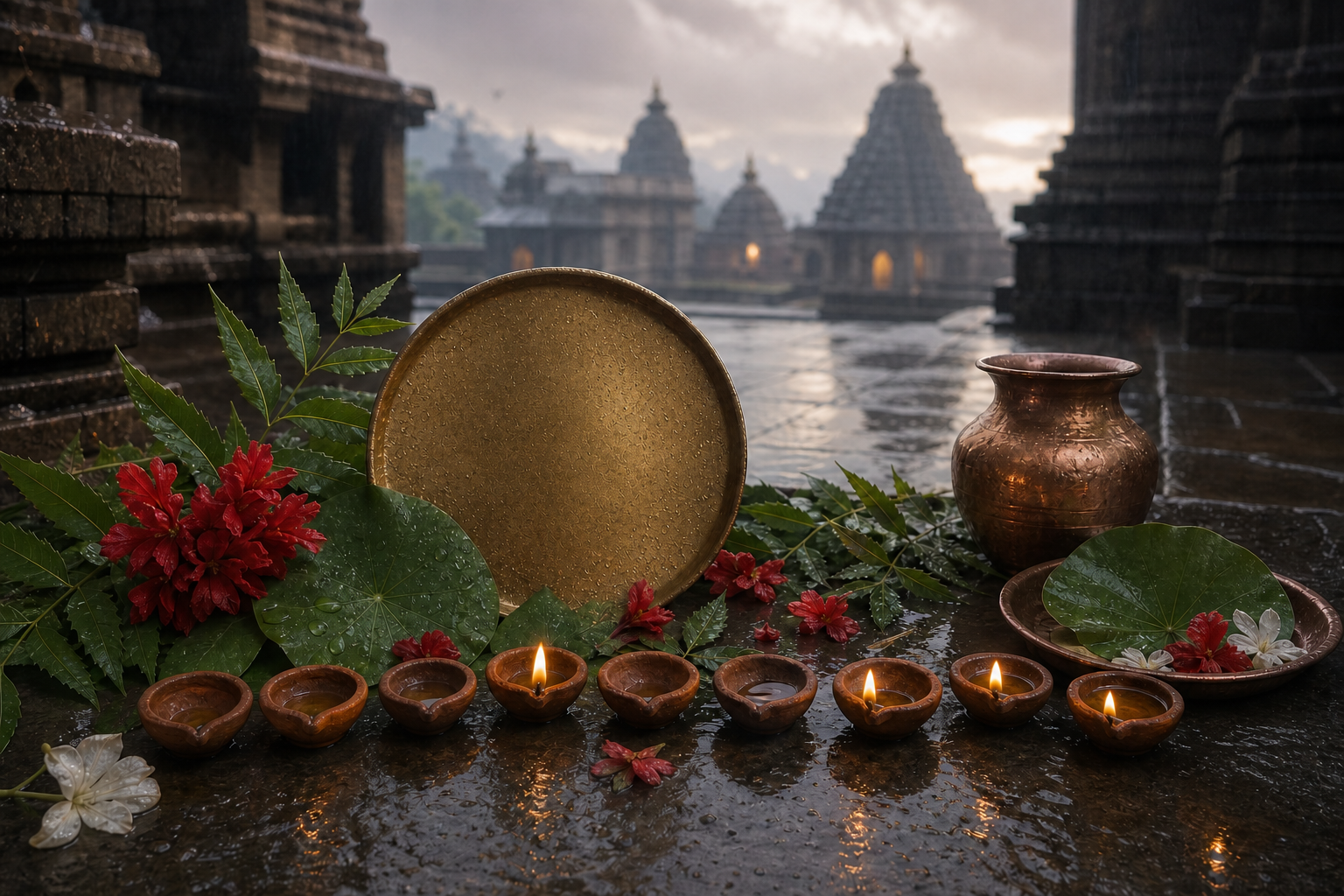
The Hyderabad temple guide and the separate 2026 festival guide both report that Varahi Navaratri will run from Wednesday, July 15, through Thursday, July 23, 2026. They also stress that these civil dates are an orientation rather than a universal timetable. A tithi can begin or end during a civil day, and its relationship to local sunrise can affect the applicable ritual date. Temple notices and a panchang calculated for the devotee’s location therefore take precedence over timings copied from another city.
Ashada and Ashadha are alternate English renderings of the lunar month’s name, while Navaratri and Navratri are both commonly used. The expressions Gupta Navaratri and Guhya Navaratri point to a comparatively inward or guarded cycle of worship. According to the two festival articles, however, gupta should not be interpreted as a prohibition on public darshan or as evidence that every participant must perform esoteric rites.
Regional plurality is equally important. Some communities organize the nine nights around the Navadurgas, others give attention to the Dasha Mahavidyas, and several South Indian Shakta and Sri Vidya communities emphasize Varahi. Varahi Navaratri is consequently a meaningful name within living traditions, but it is not the sole pan-Indian interpretation of Ashadha Navaratri.
The Hyderabad pilgrimage guide places the observance within a broader Ashadha landscape that includes Bonalu, Mahankali and Yellamma worship, Shakambari celebrations and neighborhood Devi rituals. Shared season and sacred geography do not make these festivals interchangeable. Bonalu has its own offering-centered ritual history in Telangana, while Varahi Navaratri is a nine-night observance whose content depends on temple, region and lineage.
Varahi stands between the Matrikas and Sri Vidya
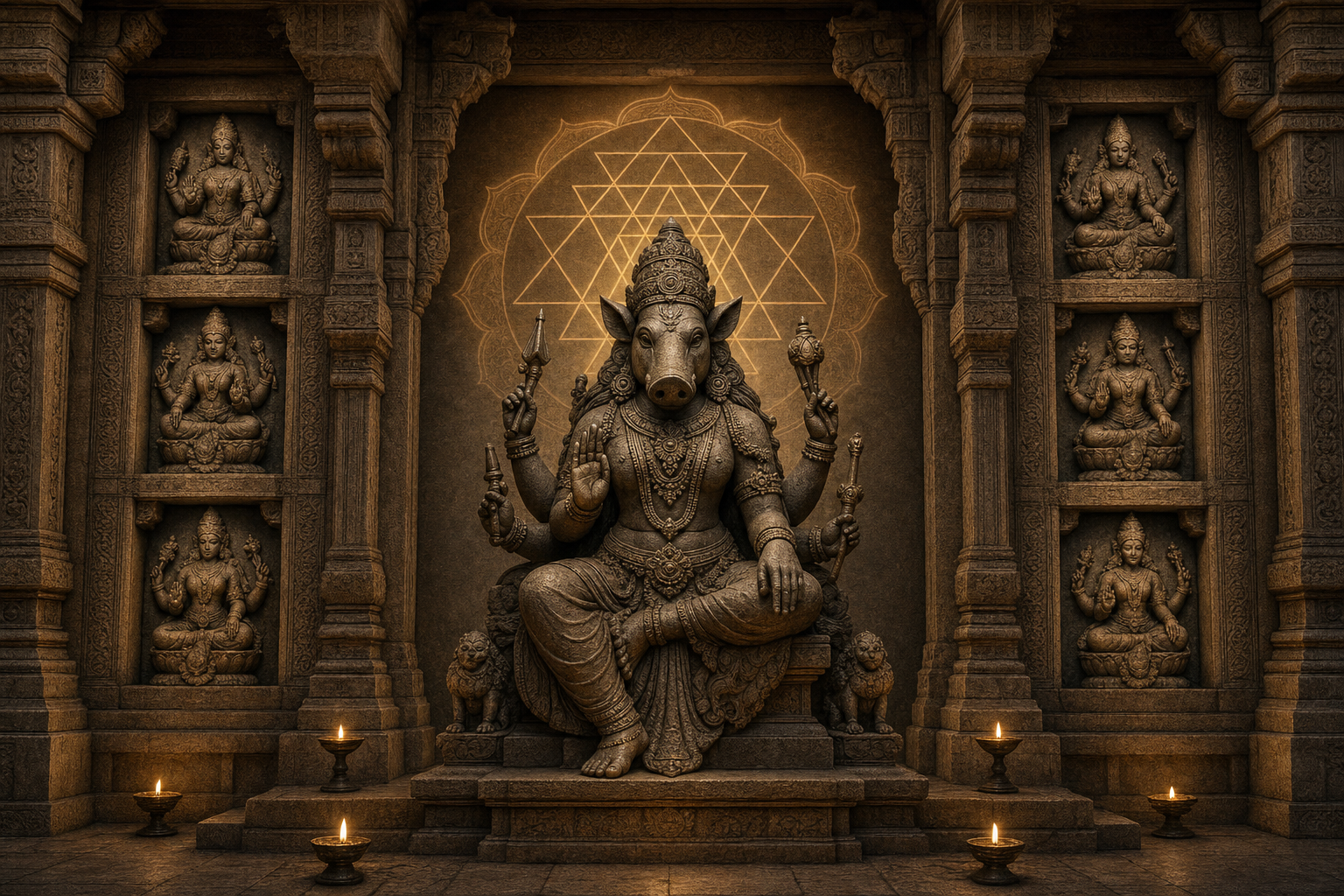
Across the source articles, Varahi is consistently identified by a boar-like face joined to a divine female form. Her imagery relates her to Varaha, the boar manifestation of Vishnu, but the Tamil Nadu guide cautions against treating the two deities as interchangeable. Varahi is the active divine power associated with that form and possesses her own identity within Shakta, Shaiva, Vaishnava and Sri Vidya settings.
She also belongs to the Matrikas, commonly presented as seven Divine Mothers. The sources name Brahmani, Maheshvari, Kaumari, Vaishnavi, Varahi, Indrani and Chamunda as a widely recognized sequence, while noting that order and membership can vary. This collective setting helps explain why Varahi can appear naturally inside a Shaiva complex, a Shakta sanctuary or an ensemble that crosses modern sectarian categories.
The sources locate two especially important theological frames. In the Devi Mahatmya, Varahi appears among the differentiated powers that assist the Goddess in confronting destructive forces. In the Lalitopakhyana tradition, she is Dandanatha or Dandini, the boar-faced commander associated with Lalita Tripurasundari’s ordered exercise of divine power. The second identity is especially significant within some Sri Vidya lineages, but it should not be imposed as an identical definition in every temple tradition.
Her iconography likewise resists a single internet template. The Tamil Nadu and Hyderabad guides describe images with varying numbers of arms, postures, vehicles and implements, including the plough, pestle, staff, sword, shield, noose and goad. Protective and gift-bestowing gestures can accompany martial attributes. These combinations present maternal care and defensive force as complementary rather than contradictory: power is directed toward restoring order.
This theological complexity also supplies a safeguard against commercial exaggeration. The Hyderabad guide distinguishes devotional hopes concerning protection, clarity or the removal of obstacles from claims that a ritual can guarantee wealth, legal victory, political success or control over other people. Pilgrimage can carry profound religious meaning without turning faith claims into measurable promises.
Sri Vidya gives pilgrimage an inward dimension

The guide to the Yogini Hridaya describes Sri Vidya as a tradition centered principally on Lalita Tripurasundari in which mantra, sacred geometry, ritual, the cosmos and the consecrated human body correspond to one another. The Sri Chakra is approached as the geometric body of the Goddess, mantra as her sonic body and embodied worship as a field in which these dimensions are brought into relation.
The article presents the Yogini Hridaya as an advanced medieval map rather than a self-contained beginner’s manual. It reports that the work is arranged in three major sanketas concerned with chakra, mantra and puja. Their sequence makes an important contribution to understanding pilgrimage: a visible diagram, a spoken formula and a ritual action are not independent religious accessories but coordinated modes of approaching Shakti.
Read alongside the Varahi sources, this framework suggests two simultaneous movements. The pilgrim travels outward toward a consecrated place, encounters the deity through image and temple practice, and enters a community’s sacred calendar. Sri Vidya directs attention inward toward the patterned relationship among perception, sound, body and consciousness. The temple is not reduced to a symbol of the mind, nor is inward contemplation treated as a replacement for communal worship; each can deepen the interpretation of the other.
The distinction between public devotion and initiated practice must nevertheless remain firm. Temple darshan, ordinary prayer, listening to publicly offered recitation and participation permitted by temple authorities are not the same as undertaking specialized mantra, nyasa, mudra or Sri Chakra disciplines. The sources repeatedly associate advanced practice with competent guidance and lineage transmission. Reading about an esoteric method does not by itself confer authorization to perform it.
A temple itinerary should begin with classification
The most useful synthesis of the Hyderabad and Tamil Nadu guides is not a single ranked list but a way to distinguish sacred sites. Varahi may be the presiding deity of a dedicated temple, occupy a separate sannidhi in a larger complex, appear within a Sapta Matrika ensemble or receive attention during Ashadha at a temple principally devoted to another form of Devi. Each setting can support meaningful darshan, but they should not be described as though they were institutionally or ritually identical.
For a direct Varahi visit in Hyderabad, the city guide identifies the Kothapet-Sri Rama Krishnapuram complex as its strongest starting point. It reports that local listings use the name Sri Varahi Pratyangira Devi sametha Sarabeshwara Peetam, while the institution’s own site identifies the Road No. 1 temple as Sri Maha Prathyangira Parameswari Devi Mandiram. The naming difference illustrates why locality, presiding deities and an official contact should be checked together rather than relying on a map label alone.
The Tamil Nadu guide describes an even more varied landscape of dedicated shrines, subsidiary sanctums, Matrika images and newer devotional centers. It also supplies an essential exclusion: the Varaha Cave at Mamallapuram and the Bhu Varaha Swamy Temple at Srimushnam are important Varaha sites, but they are not primarily temples of Goddess Varahi. Similar names or shared boar imagery cannot substitute for identifying the actual deity.
| Question before travelling | What it clarifies |
|---|---|
| Who is the presiding deity? | Whether the destination is a dedicated Varahi temple, a Varahi sannidhi, a Matrika setting or a broader Devi temple. |
| What programme has the temple announced? | Whether the current observance includes public darshan, alankaram, puja or other events, without assuming that every temple follows the same nine-day schedule. |
| Which local panchang is being followed? | The applicable tithi, opening observance, concluding rite and location-specific timing. |
| Which practices are open to visitors? | The boundary between ordinary participation and disciplines reserved for initiated practitioners. |
| How does the temple identify its image? | The local iconographic and theological tradition behind variations in attributes, posture and associated deities. |
A careful pilgrim therefore confirms the current temple notice, checks the route using more than a name match and follows local rules for offerings, photography and access. At the shrine, variation should prompt a respectful question about tradition rather than a verdict that the image is incorrect. Where several Devi temples are visited, the itinerary can acknowledge each presiding deity on her own terms instead of relabeling every Ashadha celebration as Varahi worship.
Key takeaways
- The source guides agree on July 15-23 for Varahi Navaratri in 2026, but local tithi calculations and temple announcements determine the applicable timings.
- Gupta Navaratri can include public devotion even though specialized Sri Vidya practices may require initiation and qualified guidance.
- A Varahi pilgrimage can include dedicated shrines, subsidiary sanctums and Matrika settings, but a Varaha temple should not automatically be classified as a Varahi temple.
- Sri Vidya connects outer worship with mantra, sacred geometry and contemplative embodiment without making temple pilgrimage merely symbolic.
As public interest in Varahi grows, the most durable form of pilgrimage will combine devotional openness with precise naming, local calendrical knowledge and respect for the boundaries maintained by temples and living lineages.
References
- DharmaRenaissance Blog – Sacred Varahi Navaratri in Hyderabad: 7 Essential Temples and a Complete Darshan Guide
- DharmaRenaissance Blog – Sacred Power Revealed: A Definitive Guide to Varahi Temples in Tamil Nadu
- DharmaRenaissance Blog – Yogini Hridaya Tantra Explained: The Essential Guide to Sri Vidya Sadhana
- DharmaRenaissance Blog – Varahi Navratri 2026: Powerful Dates, Meaning, Puja and Sacred Practice Guide