
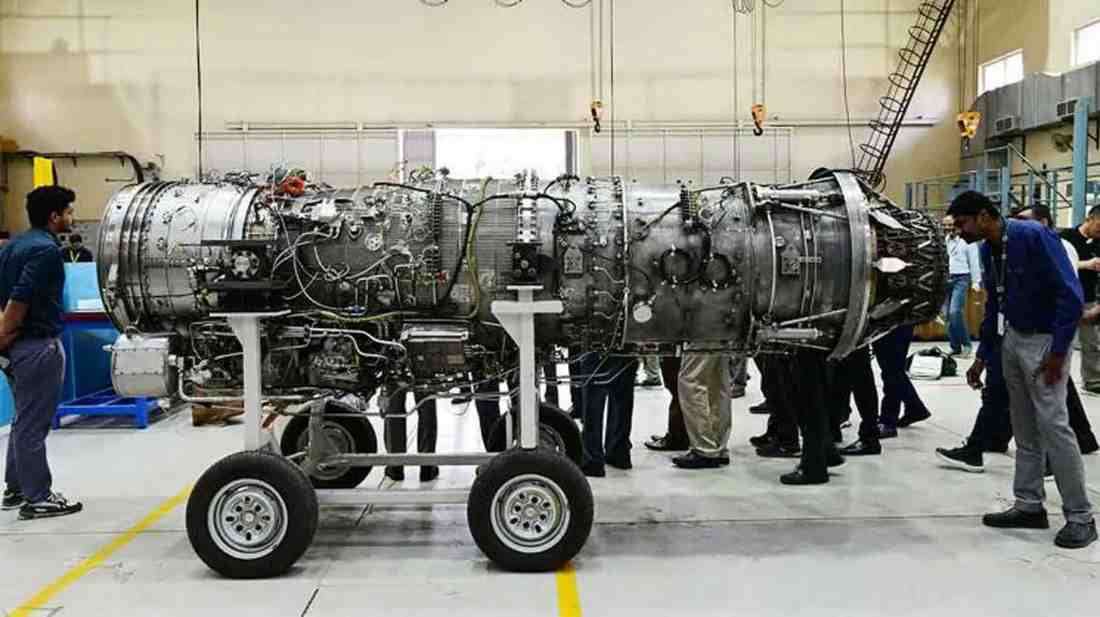
The reported revival of the Kaveri aero-engine program matters because a fighter aircraft is only as sovereign as its most difficult imported components. For Bharat, developing an indigenous engine is therefore not merely an engineering ambition; it is a test of whether national defence planning can be insulated from external supply disruptions.
Hindu Post presents the initiative commonly described as Kaveri 2.0 as a response to delays, rising procurement concerns and the strategic limits of dependence on overseas manufacturers. The available source material is brief, however, so the announcement should be examined as a statement of direction rather than proof that a deployable engine is close at hand.
Why the engine is a strategic chokepoint
Aero-engines sit at the intersection of materials science, precision manufacturing, thermal management, control systems and demanding reliability standards. Producing one domestically requires much more than assembling imported parts. It depends on an industrial ecosystem capable of repeated testing, diagnosing failures and converting laboratory progress into consistent manufacturing quality.
Foreign sourcing can provide proven equipment and shorten some development paths, but it also exposes a defence program to export controls, end-user conditions, price negotiations and the supplier’s production schedule. An indigenous engine would not remove every external dependency from an aircraft, yet it could reduce one of the most consequential constraints on production and future design choices.
What the source reports about Kaveri 2.0
Hindu Post’s item, reproducing material attributed to Beats in Brief, says that the Defence Research and Development Organisation has restarted the indigenous Kaveri project and identifies the Gas Turbine Research Establishment as the institution behind the effort. It connects the decision to reported General Electric F404 delivery delays affecting the Tejas Mk1A program.
The source also reports that prices quoted for the heavier F414 engine were nearly three times higher. It does not provide the comparison baseline, contract documentation or detailed commercial terms in the supplied extract. That claim should consequently be read as source-reported context, not as an independently established cost comparison.
Key takeaways
- The reported Kaveri revival reflects a strategic desire to reduce dependence on foreign aero-engine suppliers.
- Delivery delays can affect domestic aircraft production even when much of the aircraft is built within Bharat.
- Indigenous capability must be demonstrated through testing, reliability and repeatable manufacturing, not announcements alone.
- The limited source extract provides no development timeline, performance target or confirmed aircraft-integration plan.
How the revival should be judged
The most useful question is not whether Kaveri 2.0 can be declared a success immediately, but whether the renewed program builds durable capability. Meaningful progress would involve disciplined testing, transparent identification of technical obstacles, retention of specialist knowledge and a credible path from prototypes to engines that can be manufactured consistently.
Expectations also require restraint. Aero-engine development is an iterative undertaking in which failed tests can generate essential knowledge. Strategic patience should not mean freedom from scrutiny; it should mean maintaining a long-term mission while assessing milestones honestly. Foreign collaboration and indigenous development need not be treated as absolute opposites either. External expertise can be useful when it strengthens domestic design authority, skills and production capacity rather than preserving permanent dependence.
National capability as dharmic responsibility
A constructive Hindutva perspective treats self-reliance as organized responsibility, not technological isolation. Across their important differences, Hindu, Buddhist, Jain and Sikh traditions each possess strong languages of disciplined learning, ethical duty, service and care for the wider community. Applied to public institutions, that shared dharmic thread encourages patient craftsmanship, honest evaluation and the transmission of knowledge across generations.
That civilizational frame is especially relevant to a demanding program such as Kaveri. National pride can sustain ambition, but only rigorous work can convert ambition into security. Scientists, manufacturers, administrators and political leaders therefore carry a common obligation to place institutional capability above short-term publicity.
The real test lies beyond the restart
Kaveri 2.0 may become an important step toward greater aerospace autonomy, but the supplied reporting does not yet establish its eventual performance or deployment. Its significance will be determined by whether the restart produces tested knowledge, dependable manufacturing and greater freedom for Bharat’s future aircraft programs. The next phase calls for confidence joined to evidence, continuity and accountability.
Inspired by this post on Hindu Post.
