

When another person’s suffering cannot be solved, care does not disappear. It can remain in the body as tension, vigilance, and an urgent search for something useful to do. Deliberate walking offers one way to give that energy a safe, bounded form without pretending that movement can determine another person’s outcome.
A personal account published by DharmaRenaissance Blog illustrates this practice through walks associated with love, family, work strain, and parental helplessness. Read carefully, the account offers neither a clinical treatment nor a formula based on distance. Its value lies in showing how movement can help a person acknowledge limits, recover perspective, and return to a relationship with steadier attention.
Helplessness leaves the body prepared for action

Caregiving is commonly expressed through practical acts: protecting, transporting, advocating, comforting, or solving a problem. Helplessness becomes especially painful when that familiar pattern breaks down. Concern remains intense, but no available intervention can guarantee the desired result. The mind may continue searching for an overlooked answer while the body remains braced to act.
The source account places this conflict at the center of a father’s response to his daughter’s difficult period. Daniel and his wife reportedly pursued the forms of support they could identify, yet eventually confronted a limit: devotion could motivate care but could not secure a particular outcome. His subsequent walk did not overcome that limit. It gave him a physical activity through which he could face it.
This distinction separates embodied care from disguised control. A walk cannot transfer suffering from one person to another, settle uncertainty, or make an outcome deserved. It can, however, contain the caregiver’s otherwise directionless urge to act. The task becomes walking safely and attentively, rather than repeatedly trying to force an answer from circumstances that have yielded none.
The journey gives emotion duration, transition, and scale

Across the reported episodes, walking performs several related functions. It extends attention over time, creates a transition between emotional states, and places private concern within a larger physical setting. These effects appear in different contexts rather than in a single dramatic event.
The account says that Daniel once walked approximately seven or eight miles to visit the woman who later became his wife, despite having access to a car. He also walked about five miles to see his parents and, during a period of professional strain, covered fourteen miles until he reached the beach. In each case, the destination mattered, but so did the interval before arrival. Effort slowed the passage from intention to encounter, leaving time for anticipation, memory, or rumination to change shape.
The walk undertaken during his daughter’s struggle carried the same pattern into a situation where direct control had reached its limit. According to the source, Daniel headed west through increasingly sparse development until he reached a fence at the edge of the Everglades. The expansive landscape did not answer his worry. Instead, it confronted him with a scale that did not conform to one family’s hopes, making it harder to sustain the assumption that sufficient effort should control every painful event.
The useful principle is not that a remote destination possesses special power. A neighborhood circuit, accessible path, or short indoor route can also provide rhythm and transition. Distance has meaning only in relation to the person’s capacity and circumstances; it is not a measure of sincerity.
Embodied care is nontransactional
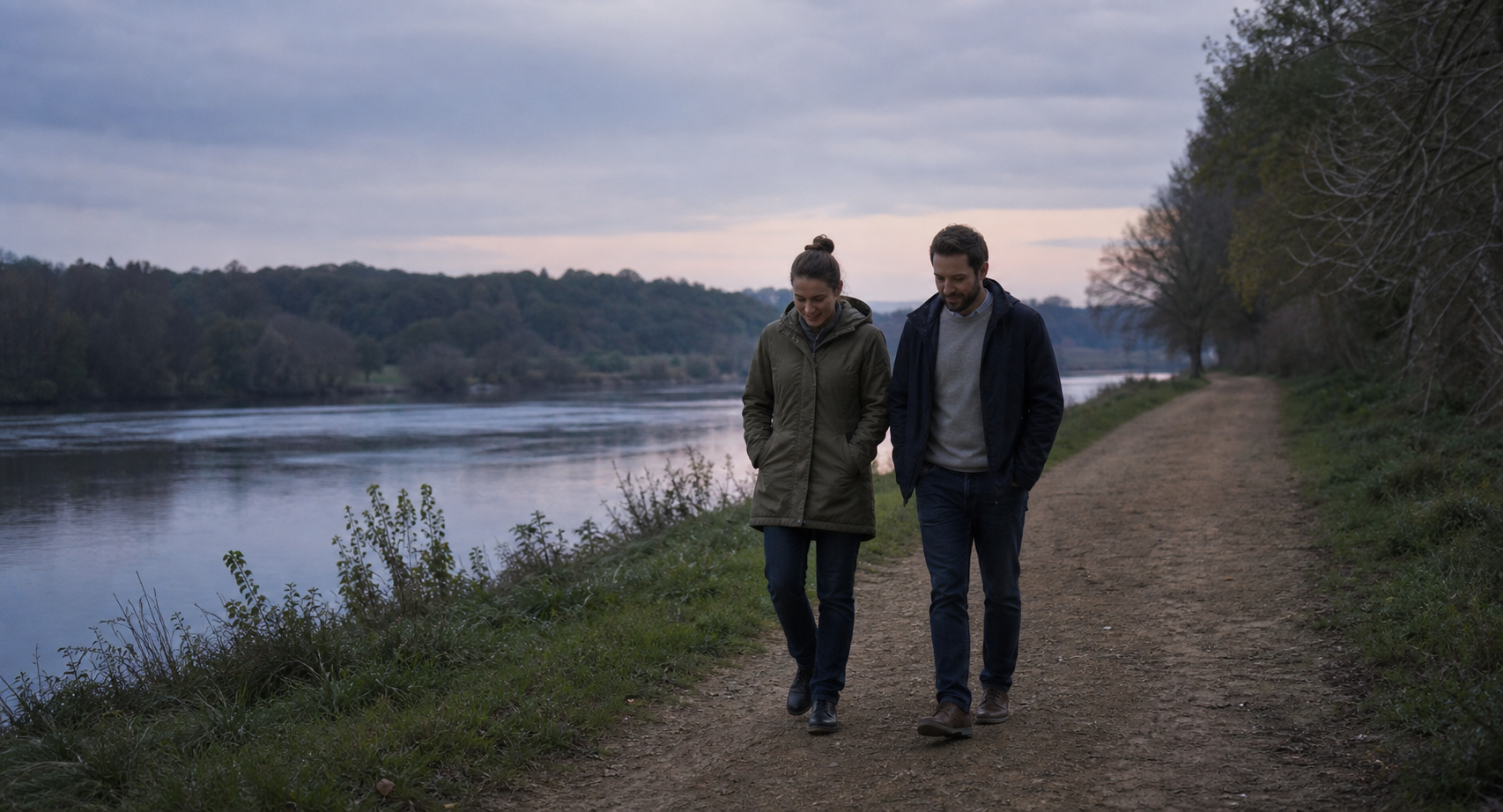
A demanding gesture can become unhealthy when it is used to create debt: the walker suffers so that someone else must respond, recover, forgive, or offer recognition. The source account explicitly frames Daniel’s earlier journeys differently. His long walk to his future wife’s apartment was not presented as a test she had to reward. The physical effort made affection tangible to the person walking rather than imposing an obligation on the person he loved.
That same ethical boundary matters in helplessness. Walking can prepare a caregiver to be present, but it should not become a silent bargain with fate or with the suffering person. No number of miles purchases safety. No ordeal proves that one person’s love is deeper than another’s. When the journey is understood as self-discipline rather than leverage, it can reduce the pressure placed on the relationship.
The most meaningful result therefore occurs after the walk. A caregiver may return less compelled to fill every silence, offer another unrequested solution, or demand reassurance that prior efforts were worthwhile. Movement becomes care when it supports a more patient encounter, not merely when it produces exhaustion.
Safety marks the boundary between ritual and ordeal
The account’s most physically severe episode also supplies an important caution. It reports that after returning from the Everglades walk in unusually cold South Florida weather, Daniel entered his backyard pool and treated the immersion as a final act of concentration. The article does not present this as medically beneficial or necessary. It specifically warns that sudden cold-water immersion can cause involuntary gasping, rapid breathing, disorientation, and cardiovascular strain.
Subjective meaning does not cancel physical risk. A practice intended to support care should remain proportionate to health, mobility, weather, traffic, available light, and the safety of the route. Turning discomfort into a test of devotion confuses intensity with usefulness. If another person faces immediate danger or still needs practical assistance, obtaining that help also takes precedence over a symbolic journey.
The source is a reflective personal narrative, not evidence that walking will have the same effect for every person. Some may find steadiness through another accessible form of repetitive movement or quiet attention. The relevant criterion is whether the practice helps the caregiver accept reality and return responsibly, rather than avoid the person, postpone necessary action, or cause harm.
Key takeaways
- Walking can give helpless concern a bounded physical expression without claiming to solve another person’s suffering.
- Its value lies in rhythm, attention, transition, and perspective rather than in covering an impressive distance.
- A caring journey remains nontransactional: it creates no debt and earns no guaranteed outcome.
- Safety and proportionality are essential; pain, exposure, and exhaustion are not proofs of love.
- The practical test is the quality of the return: greater patience, humility, and readiness to be present.
Used within these limits, walking can become a modest discipline for difficult seasons. It gives love somewhere responsible to move until the walker is ready to come back, accept what remains uncertain, and meet the next available act of care.