
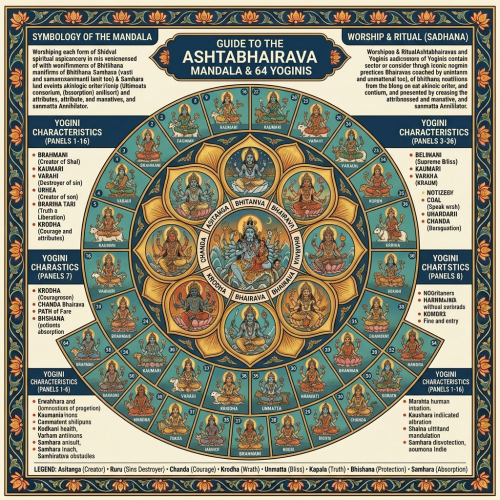
How should the eight Bhairavas and 64 Yoginis be understood when they appear together in a Tantric mandala? The available source offers a clear organizing claim, but not the detailed correspondences needed to reconstruct the full system.
This guide separates what Hindu Pad actually reports from what can reasonably be inferred, helping readers appreciate the pattern without turning a brief excerpt into unsupported doctrine.
What the available report actually establishes
Hindu Pad frames the Ashta Bhairavas, meaning the eight Bhairavas, and the 64 Yoginis as connected within Tantric mandalas. Its supplied excerpt characterizes their relationship as a “highly systematic, mathematical, and metaphysical grid.” That is the central factual claim available here.
The excerpt ends before explaining the grid. It does not provide the names of the figures, assign particular Yoginis to particular Bhairavas, identify directions, describe ritual functions, or cite a specific textual passage. Any detailed chart presented from this material alone would therefore go beyond the evidence.
Why the numbers suggest an ordered mandala
The basic arithmetic is straightforward: sixty-four can be arranged as eight sets of eight. This makes an eightfold organizing pattern a plausible way to visualize the mathematical aspect of the source’s claim. It does not, by itself, prove which sacred figure belongs in any position.
A mandala is generally understood as a structured sacred diagram rather than a random collection of images. Its arrangement can communicate relationships among a center, surrounding regions, directions, powers, or stages of contemplation. Those are general possibilities, however, and the supplied report does not say which of them governs this particular Bhairava-Yogini relationship.
Key takeaways
- Hindu Pad places the eight Bhairavas and 64 Yoginis within a shared Tantric mandala framework.
- The numbers permit an eight-by-eight arrangement, which helps explain the reported mathematical coherence.
- Arithmetic reveals a possible structure but cannot establish names, directions, hierarchy, or ritual roles.
- A complete mapping requires fuller textual or lineage-based evidence than the supplied excerpt provides.
Coordinated plurality is the deeper interpretive clue
The language of a grid encourages a relational reading. In any ordered pattern, a position gains meaning partly through its connection with other positions. Applied cautiously, this suggests coordinated plurality: numerous sacred forms can participate in one intelligible order without losing their distinct identities.
This is a philosophical interpretation of the structure reported by Hindu Pad, not a claim about a particular ritual assignment. It nevertheless helps explain why counting matters in sacred diagrams. Number can serve as a language of relationship, allowing diversity to be contemplated as an integrated whole rather than as fragmentation.
A Dharmic lens that respects distinct traditions
The Yogini-Bhairava system belongs to its own Hindu Tantric setting and should not be imposed upon other traditions. Buddhist mandalas, Jain cosmographic contemplation, and Sikh disciplines of remembrance are not versions of this system. Yet they offer a careful common thread: spiritual plurality can be ordered through disciplined practice without demanding that every path use identical symbols or doctrines.
That distinction matters for Dharmic unity. Hindu, Buddhist, Jain, and Sikh traditions can recognize one another as participants in a broad civilizational conversation while preserving their own teachings, communities, and modes of practice. Unity becomes durable when it is grounded in respect rather than manufactured sameness.
What a fuller account would need to supply
A responsible reconstruction would identify the relevant text or lineage, present the complete mapping, explain the organizing principle, and clarify whether the arrangement is directional, ritual, symbolic, or some combination of these. It would also distinguish a lineage-specific model from a claim about every Tantric tradition.
Until that evidence is available, the sound conclusion remains narrow but meaningful: Hindu Pad reports an ordered relationship between eight Bhairavas and 64 Yoginis in Tantric mandalas. Future study should test any detailed chart against a complete primary or lineage-specific explanation.
Inspired by this post on Hindu Pad.
