
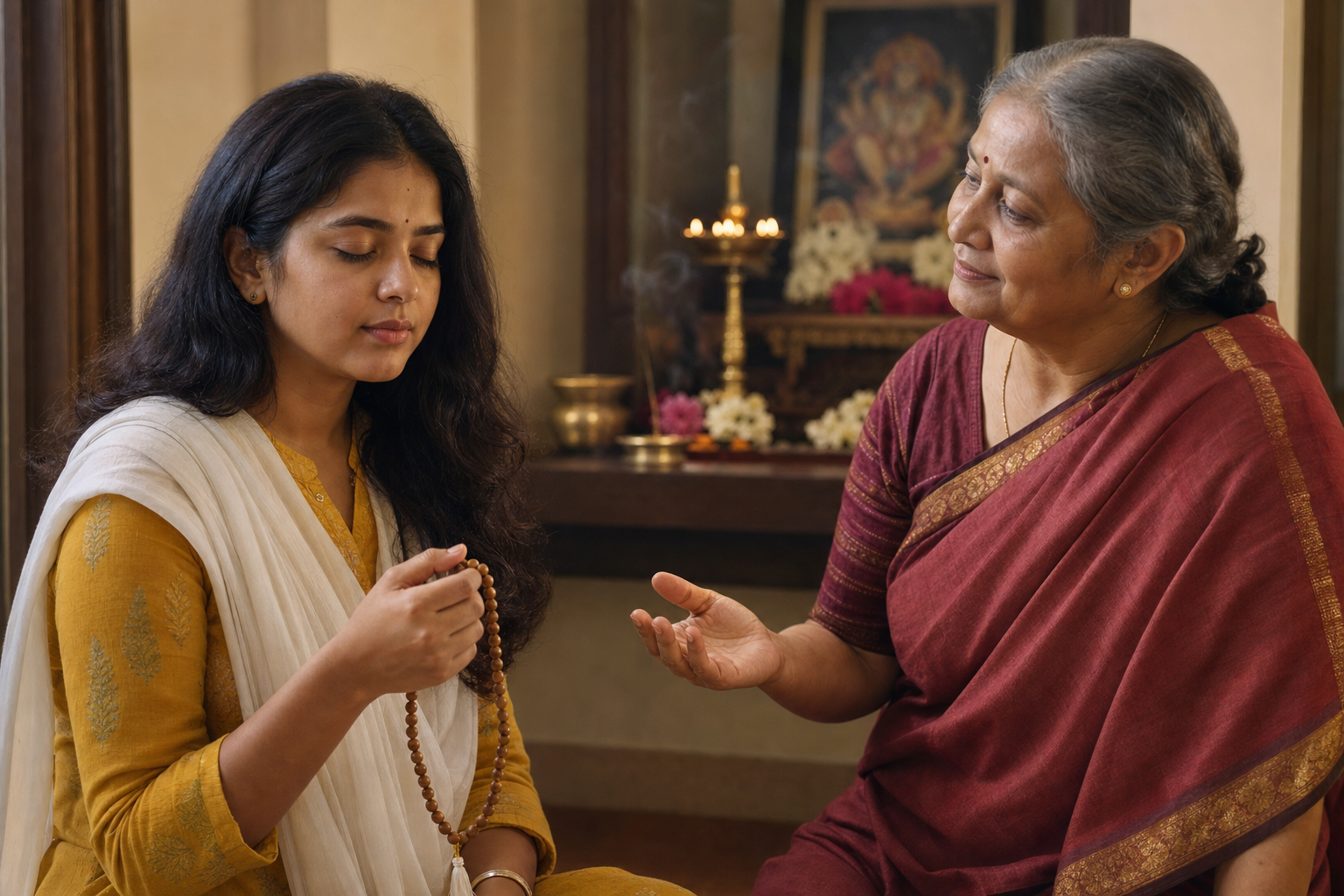
A prayer does not become spiritually empty because the voice trembles, the melody is plain, or a Sanskrit syllable is imperfect. The central question is whether the practitioner approaches the sacred with sincerity, reverence, and a willingness to grow.
This distinction can help newcomers chant without fear while also helping experienced practitioners preserve traditional disciplines without turning them into barriers.
What the source is actually claiming
Hindu Blog presents devotion and sincerity as the essence of prayer and chanting, rather than musical quality, volume, or flawless pronunciation. It also challenges a form of spiritual gatekeeping in which people are warned that an imperfectly pronounced mantra will automatically bring misfortune or invalidate their practice.
This is best understood as an argument against fear, not against learning. A beginner’s honest effort and a trained practitioner’s careful recitation may sound very different, yet technical inequality does not prove spiritual inequality. Treating every mistake as a threat can discourage precisely the people who are trying to establish a relationship with dharma.
Technique and devotion serve different purposes
Pronunciation, rhythm, and melody can still have value. They support concentration, preserve inherited forms, and allow a community to chant together. In a formal setting or a practice received through a sampradaya, careful guidance from a knowledgeable teacher deserves respect. Discipline can itself become an expression of devotion when it is pursued with humility.
The error lies in confusing a means with the whole purpose. Sound can shape a practice, but polished sound cannot manufacture sincerity. Conversely, imperfect technique need not cancel reverence. Bhakti and disciplined learning are therefore not rivals: devotion supplies the inward orientation, while technique can refine its outward expression.
Key takeaways for a welcoming practice
- Sincere devotion should be the foundation of prayer and chanting.
- Beginners should not be frightened away by demands for instant perfection.
- Pronunciation and musical training can deepen practice without becoming tests of spiritual worth.
- Traditional instruction is most helpful when offered patiently and without threats.
- Different voices, languages, abilities, and forms of worship can all contribute to Dharmic continuity.
How to begin chanting without fear
A practitioner can begin with a short prayer or mantra that feels spiritually meaningful, learn its general meaning, and recite it at a manageable pace. Attention matters more than performance. If uncertainty about pronunciation arises, the constructive response is to seek a reliable teacher or recording and improve gradually, rather than abandon the practice.
Correction should also be proportionate to the setting. Personal japa, a family bhajan, and formal liturgical recitation do not necessarily place identical demands on the participant. Recognizing the context allows communities to maintain standards where they matter while keeping ordinary devotion open to children, elders, diaspora families, converts, and anyone still learning a sacred language.
Devotional confidence strengthens Dharmic unity
Sanatana Dharma has room for silent remembrance, spoken prayer, mantra, music, temple worship, and intimate household practice. That plurality is a source of civilizational resilience. Communities can honor distinct sects and lineages without ranking devotees by accent, musical ability, or access to specialist education.
The same generous principle can guide relations across the wider Dharmic family: inherited forms deserve care, while sincere seekers deserve welcome. Teachers protect tradition most effectively when correction invites deeper participation. The enduring task is to help devotion mature into disciplined practice without allowing the fear of imperfection to silence prayer before it begins.
Inspired by this post on Hindu Blog.
