
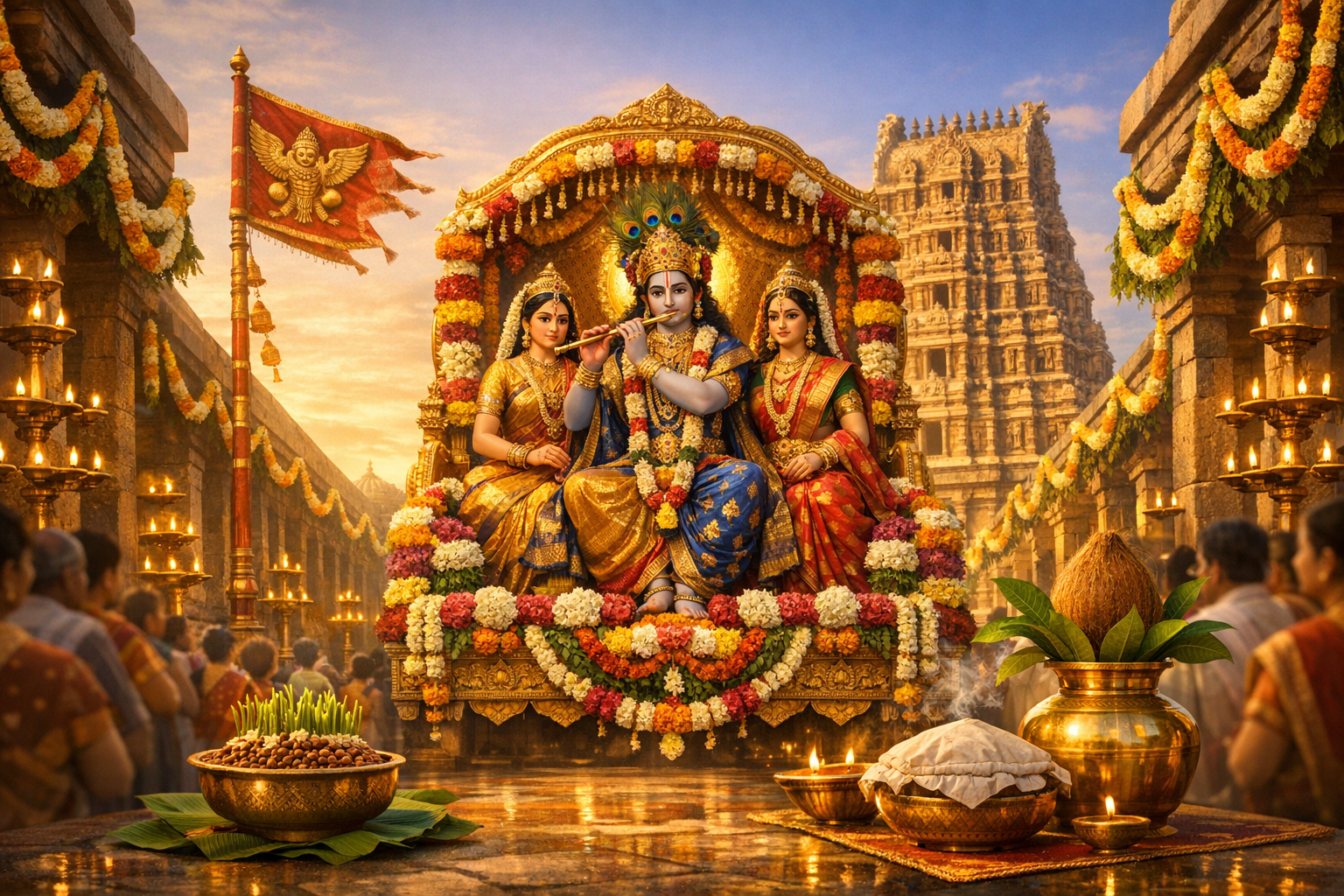
Karvetinagaram will host the annual Brahmotsavam of Sri Venugopalaswamy with Sri Rukmini and Satyabhama from June 6 to 14, 2026, marking nine days of richly layered Vaishnava worship and community celebration. Festivities commence with Ankurarpanam on the evening of June 5, and Koil Alwar Tirumanjanam will be observed in the lead-up to the festival in accordance with established temple practice. These dates allow devotees to plan darshan, seva, and community participation with clarity and reverence.
Situated in Andhra Pradesh, the Karvetinagaram Venugopalaswamy Temple is a revered kshetra where Sri Krishna as Venugopala is venerated alongside Sri Rukmini and Satyabhama. The Brahmotsavam here preserves the living continuity of Vedic and Vaishnava traditions, uniting scriptural precision with the emotive power of bhakti. Pilgrims routinely describe an atmosphere of devotion deepened by temple streets alive with music, lamps, and reverential chants.
Brahmotsavamliterally the “great festival” (Brahma + Utsava)is anchored in Vaishnava Agamic frameworks (notably Vaikhanasa and Pancharatra traditions) that regulate consecration, procession, and communal worship. Its theological core recalls the puranic motif that Brahma himself performs the festival to honor the Lord, a narrative that underscores the sanctity of these rites across Vaishnava temples in South India. At Karvetinagaram, the festival serves as a living pedagogy: doctrine becomes experience through darshan, procession, and collective hymnody.
Ankurarpanam, the inaugural rite, is a seed-sowing ceremony invoking auspiciousness, fertility, and spiritual renewal. By sanctifying select seeds and ritually preparing the earth, priests express the principle that the cosmos, the temple, and the devotee’s inner life germinate together under divine grace. Performed on the eve of the festival, this act ritually “plants” the Brahmotsavam so that each subsequent day unfolds as a maturing of blessings for the community.
Koil Alwar Tirumanjanam is the temple-wide sanctification traditionally performed prior to major festivities. The spaces of worshipsanctum environs, thresholds, and ritual pathwaysare cleansed and purified, often using a perfumed herbal mixture known as parimalam. This practice embodies two intertwined aims: ensuring ritual purity in line with Agamic injunctions and preparing an atmosphere conducive to sublime darshan and disciplined devotional attention.
Across nine days, Brahmotsavam customarily features a structured sequence of sacred actions: flag hoisting (Dwajarohanam) to invite divine presence; daily homas and archana aligned to Agamic timings; and morning–evening processions (vahana sevas) of the utsava murti through the temple precincts. The specific vahana roster and day-wise schedule are issued by the temple; devotees are advised to consult the official notice for precise timings, as local custom determines the order and emphasis of events, including the concluding rites such as Dhwajavarohanam.
Devotion at Karvetinagaram is experiential as well as doctrinal. The iconography of Sri Venugopalaswamythe divine flautist who enchants creationshapes the festival’s affective landscape. Vedic recitation and Divya Prabandham chanting frame the processions, while kirtans and bhajans cultivate collective remembrance (smarana) and loving service (seva). Families often speak of generational continuity during Brahmotsavam, when elders teach children the rhythms of darshan, pradakshina, and respectful observance.
In addition to its ritual depth, the Brahmotsavam strengthens bonds across dharmic traditions by exemplifying shared values such as ahimsa, dana, self-discipline, and community service. The festival’s emphasis on seva, respect for sanctity, and harmony in collective worship resonates with the broader ethos that animates Hinduism, Buddhism, Jainism, and Sikhisminviting all to recognize common ground in ethical living, compassion, and the pursuit of inner clarity.
Practical planning enhances the pilgrimage. Arriving early for key sevas improves the darshan experience, and modest dress that covers shoulders and knees aligns with customary temple etiquette. Devotees typically maintain silence near the sanctum, follow queue instructions, and avoid photography where restricted. Carrying only essentials, using designated shoe counters, and keeping temple corridors clear during processions help ensure safety and a smooth flow for all participants.
Environmentally mindful practices honor the sacred geography of the temple town. Reusable containers, minimal single-use plastics, and respectful disposal of offerings reflect the dharmic principle of caring for creation. Those traveling from afar may plan rest breaks between morning and evening events and coordinate with the temple office for any updates to the vahana-seva roster, ensuring alignment with the officially published schedule.
Karvetinagaram Venugopalaswamy Temple Brahmotsavam 2026 thus offers devotees an opportunity to experience the fusion of precise Agamic ritual, luminous aesthetics, and heartfelt bhakti. With dates confirmed for June 6–14, preceded by Ankurarpanam on June 5 and sanctification through Koil Alwar Tirumanjanam, the festival invites a disciplined, joyful participation that deepens personal devotion while celebrating the unifying spirit of the dharmic family.
Inspired by this post on Hindu Pad.
