
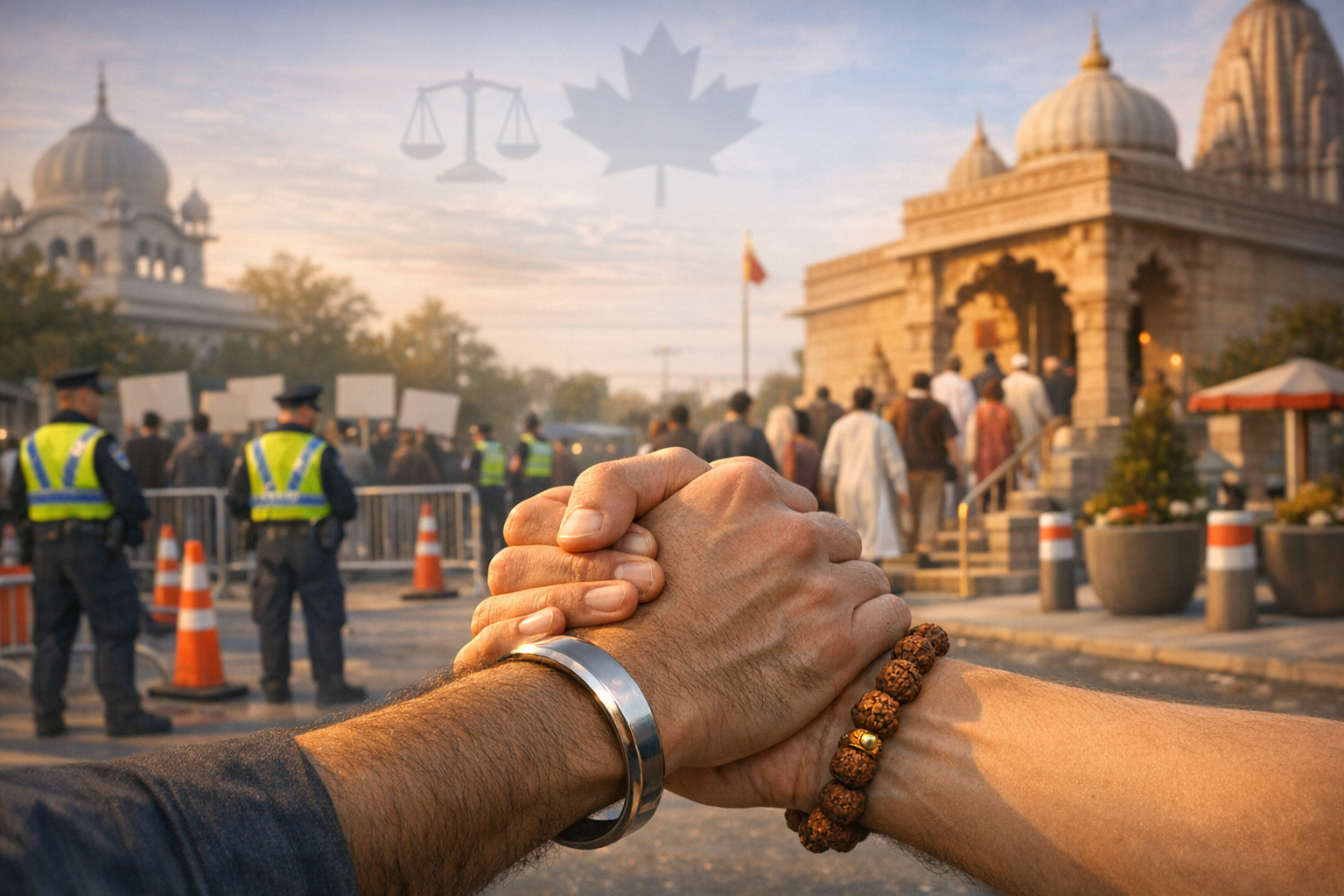
On 5 April, coordinated demonstrations by supporters of the Khalistan movement, including individuals associated with the proscribed-in-India outfit Sikhs for Justice (SFJ), convened outside Triveni Mandir in Brampton, Ontario (the Brampton temple protest), and Lakshmi Narayan Mandir in Surrey, British Columbia (the Surrey temple rally). Local police rapidly deployed public-order units, erected barricades, and enforced 100‑metre safety buffers to shield worshippers and minimize confrontation. The gatherings were advertised as protests against the Hindu Canadian Foundation (HCF), yet their timing and optics placed Hindu places of worship squarely in the crosshairs.
The mobilizations occurred days after Canada’s House of Commons advanced Bill C‑9, described by supporters as an anti‑hate measure designed to strengthen protections for places of worship. Regardless of legislative nomenclature, the juxtaposition of an anti‑hate push with demonstrations at mandirs sharpened community anxieties over Hinduphobia, Hindu temple security in Canada, and the broader information environment that enables intimidation without necessarily crossing the criminal threshold.
Field reports and available footage indicate police presence arrived well before peak footfall, a best practice in public-order management that likely averted escalation. Officers established ingress/egress lanes for devotees, segregated protest zones, and maintained a visible, de‑escalatory posture. No major injuries were reported at either site during the policing window, an outcome that underscores the value of early liaison between temple boards and municipal divisions.
Rally messaging concentrated on HCF and India‑related geopolitics, yet the proximate targets were unmistakably local: Triveni Mandir and Lakshmi Narayan Mandir as community anchors. For priests, volunteers, and families with children, the immediate experience was not geopolitical debate but a palpable sense of vulnerability at the threshold of worship.
These scenes resonate with a pattern documented since 2021: vandalism and threats directed at Hindu temples across the Greater Toronto Area and the Lower Mainland, sometimes accompanied by slogans such as ‘Hindustan Murdabad’. While incident typologies varyfrom graffiti to aggressive hecklingthe cumulative effect has been a chilling impact on attendance, fundraising, and the perceived safety of cultural programming.
It is essential to delineate actors. The Sikh community in Canada is diverse, civically engaged, and overwhelmingly committed to interfaith harmony rooted in sarbat da bhala. Numerous Sikh voices and organizations have publicly rejected intimidation and violence, and collaborative Hindu–Sikh initiatives continue to affirm the shared dharmic ethos of seva, satya, and daya. Conflating an extremist fringe with Sikhism or Sikhs writ large is analytically unsound and ethically corrosive.
SFJ occupies a particular niche within the Khalistan movement’s transnational networked activism. The outfit is proscribed in India under the Unlawful Activities (Prevention) Act and has been linked to confrontational protest tactics abroad. In Canada, where SFJ is not designated as a terrorist entity, its speech and assembly activities are constrained primarily by general criminal law and municipal regulations, rather than by proscription. This split‑jurisdictional reality complicates both enforcement and community risk communication.
Canada’s legal framework provides multiple guardrails relevant to temple security. Criminal Code provisions on mischief targeting property used for religious worship (s. 430), public incitement of hatred (s. 319), intimidation (s. 423), unlawful assembly (s. 63) and related breach‑of‑the‑peace doctrines, alongside search and seizure tools for hate propaganda (s. 320), define the threshold at which protected protest becomes criminal conduct. Charter rights to expression and peaceful assembly (s. 2) remain robust but are circumscribed by section 1’s proportionality test, enabling time‑, place‑, and manner restrictions where demonstrably justified.
Bill C‑9, as discussed in community advocacy channels, is framed as an anti‑hate instrument to bolster protections for places of worship. Whether through amendments, funding levers, or enforcement guidance, the operative policy question is identical: can authorities pre‑empt targeted intimidation at religious sites without chilling legitimate dissent? The operational answers reside less in statutory titles and more in integrated doctrine, resourcing, and consistent application across jurisdictions.
Municipal police services increasingly rely on negotiated management of demonstrations: advance notice, protester liaison teams, buffer distances, and hard perimeters calibrated to site geometry. The 100‑metre safety zones used in Brampton and Surrey exemplify risk‑responsive design, protecting egress for seniors and families while preserving a protest’s audible visibility within constitutional bounds.
From a security‑engineering standpoint, Hindu temple boards can adopt a layered defence strategy tailored to diaspora risk profiles. Layer 1 (deter/detect): high‑resolution CCTV with wide dynamic range, license‑plate recognition at choke points, thermal/low‑light coverage of perimeters, and redundant recording offsite. Layer 2 (delay/deny): access‑control doors to sanctum areas, bollards or planters to defeat vehicle ramming, and CPTED elementslighting, sightlines, and signageto reduce ambush space. Layer 3 (respond/recover): trained volunteer marshals, incident logging protocols, and rapid liaison channels with divisional command.
A templated pre‑event checklist reduces chaos when protests are announced: notify police and insurers; set up clearly marked devotee and visitor lanes; deploy bilingual stewards; stage first‑aid and safe‑room access for children and elders; test public‑address systems; and assign evidence‑capture teams equipped to preserve chain of custody. Where legally feasible, seek site‑specific injunctions or municipal permits that codify buffer distances and noise limits.
Given the role of online mobilization, temples should maintain a digital risk posture: monitor event hashtags for time/location shifts; harden social channels against brigading; archive threats; and coordinate with platforms when posts cross from rhetoric into targeted harassment. Cyber‑physical fusionwhere online doxxing precedes in‑person intimidationrequires one playbook, not two.
Post‑incident, trauma‑informed care matters. Many devotees process such episodes as an attack on identity, not merely on property. Open town‑halls, counselling referrals, and visible support from elected officials, law enforcement, and interfaith partners help restore confidence and counter disinformation that thrives on fear.
Data clarity is a policy force multiplier. Encouraging police services to code anti‑Hindu bias explicitlyrather than burying incidents under generic ‘mischief’enables trend analysis, grants eligibility, and proportionate resourcing. A federal‑provincial round‑table on worship‑site security could standardize reporting and share best practices across Hindu mandirs, gurdwaras, churches, mosques, and synagogues.
Interfaith engagement is not an afterthought; it is a frontline prevention tool. Joint Hindu–Sikh statements that condemn intimidation at any mandir or gurdwara, reciprocal volunteer patrols during major festivals (e.g., Vaisakhi and Navaratri), and shared safety trainings re‑anchor public narratives in common dharmic values. These gestures blunt the polarizing incentives that fringe actors exploit.
Diaspora geopolitics widen the aperture. Rhetoric around Khalistan, India–Canada diplomatic strains, and online echo chambers can amplify grievances at the expense of local cohesion. Community leaders can help re‑localize the frame: the immediate issue is the right of Canadiansof every traditionto access places of worship without fear.
Media literacy also matters. Coverage that over‑indexes on spectacle and under‑reports Sikh condemnations of intimidation can distort risk perception. Responsible journalism standardsseparating facts from slogans, disaggregating communities from fringe groups, and centring the safety of worshippersimprove public understanding and reduce copycat dynamics.
For policymakers, three near‑term actions are achievable: scale the Security Infrastructure Program for small and mid‑sized temples; resource police community‑liaison units with subject‑matter expertise on South Asian diasporas; and publish clear guidance on when targeted protest activity at worship sites triggers enhanced conditions or injunctions.
Analytically and ethically, two guardrails should guide discourse. First, precision of language: identify SFJ and other actors by name and status, not by sweeping labels that stigmatize entire communities. Second, unity of dharmic traditions: Hinduism, Sikhism, Buddhism, and Jainism share civilizational commitments to non‑violence, compassion, and service; solutions that strengthen one community’s safety invariably strengthen all.
The April 5 protests in Brampton and Surrey were a stress test for Canada’s promise of both free expression and freedom of worship. Effective policing, resilient institutions, and interfaith solidarity can ensure that the right to dissent never mutates into the right to intimidate. Measured resolvenot fearshould define the next chapter.
Inspired by this post on Hindu Human Rights Blog.
