
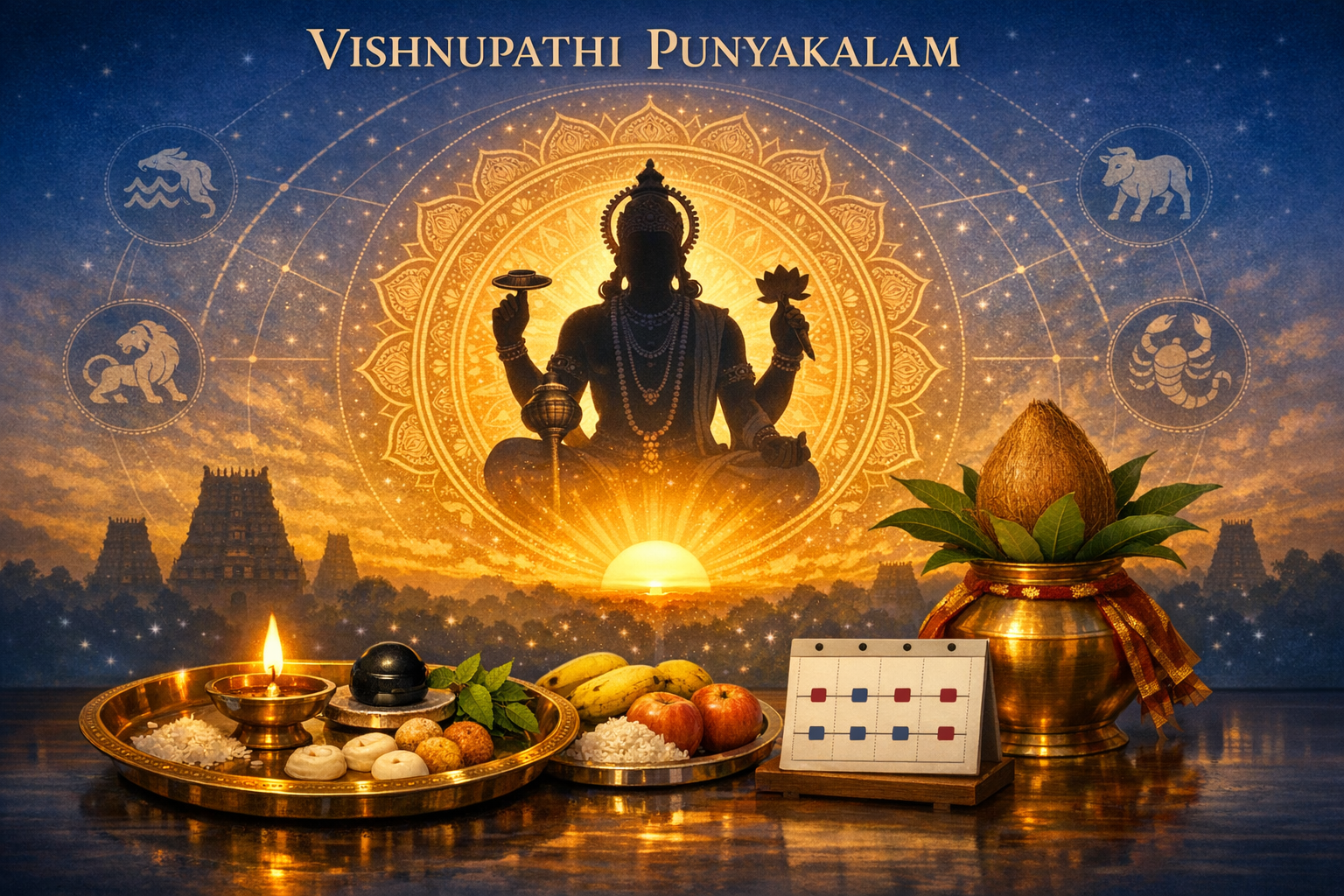
Vishnupathi, also known as Vishnupati Punyakalam or Haripada Punyakalam, designates one of the most auspicious windows in the Hindu calendar to worship Lord Vishnu. Observed four times a year at intervals of approximately three solar months, it aligns with specific solar transitions that the traditional panchang recognizes as especially meritorious for snana, dana, japa, parayana, and puja. For the 2026 cycle, the first Vishnupathi falls on 13 February 2026, corresponding to Kumbha Sankranti as observed in the nirayana (sidereal) system used in most Indian almanacs.
The term punyakalam refers to a concentrated span of time during which meritorious acts generate amplified spiritual benefit. In the Vaishnava devotional context, Vishnupathi is held to be particularly powerful for invoking grace through Vishnu Sahasranama japa, Purusha Sukta parayana, deepa, naivedya, and charitable giving. The devotional sentiment focuses on Hari’s all-pervading presence in time, with the sankramana, or ingress of the Sun into specific signs, honored as a cosmically harmonious moment for worship.
Astronomically and calendrically, Vishnupathi occurs when the Sun enters the four fixed signs of the sidereal zodiac: Kumbha (Aquarius), Vrishabha (Taurus), Simha (Leo), and Vrischika (Scorpio). These ingress points are called sankrantis in the panchang. Because the system is nirayana (sidereal) rather than sayana (tropical), the dates differ from Western ephemerides and must be read from a reliable Indian panchang that incorporates an accepted ayanamsa, commonly the Lahiri (Chitra Paksha) standard.
Traditionally, the Vishnupati punyakalam begins at the exact sankramana moment and extends for a prescribed window. Many panchang traditions define the Punya Kaal for sankrantis as approximately sixteen ghatis (about 6 hours 24 minutes) measured from the time of ingress, with local sunrise rules determining applicability for snana-dana and other observances. A narrower, highly potent sub-interval, often termed Maha Punya Kaal, may be identified when the sankramana occurs close to sunrise; temple almanacs and regional panchangs provide this finer subdivision where applicable.
For practical observance, it is best to consult a trusted regional panchang for the exact sankranti time in the local time zone. The date may shift by a day for regions outside India due to longitude and time zone differences. In India, however, the following schedule provides a reliable framework to plan worship and charitable acts for the 2026 cycle.
Vishnupathi 2026 dates in the Indian sidereal calendar are as follows. Kumbha Sankranti: 13 February 2026. Vrishabha Sankranti: 14 May 2026. Simha Sankranti: 17 August 2026. Vrischika Sankranti: 16 November 2026. The Vishnupati Punyakalam for each of these falls around the sankramana times indicated by regional panchangs, which should be checked for the Punya Kaal and, where given, Maha Punya Kaal windows.
Continuing into 2027, the pattern repeats with four Vishnupathi observances. Kumbha Sankranti: 12 February 2027. Vrishabha Sankranti: 14 May 2027. Simha Sankranti: 17 August 2027. Vrischika Sankranti: 16 November 2027. As with 2026, local panchang data should be followed for precise muhurta calculations, particularly for temple events and sankalpa wording.
Household observance is simple yet spiritually profound. After snana at or just before the Punya Kaal, one may light a deepa, perform achamana, and take a sankalpa referencing Vishnupati Punyakalam, such as the intent to worship Sri Hari and undertake dana during this sacred window. Abhisheka to a Saligrama or Vishnu murti with clean water and panchamrita, followed by tulasi archana, deepa, dhupa, and naivedya, composes a complete upachara sequence. Parayana of Vishnu Sahasranama, Purusha Sukta, Narayana Suktam, and selected chapters of the Bhagavad Gita is especially recommended.
Naivedya is traditionally sattvic and simple, reflecting the day’s focus on purity and devotion. Freshly cooked rice preparations, seasonal fruits, milk-based sweets, panakam, and tulasi leaves offered with devotion are appropriate. The guiding principle is cleanliness, sincerity, and adherence to one’s family or sampradaya conventions, as taught by gurus and as preserved in Grihya and Agama traditions.
Charity (dana) during Vishnupati Punyakalam is emphasized across the Dharma Shastra and Puranic ethos. Annadana, vastra-dana, and support to temples, educational endeavors, and community kitchens align with the day’s spirit. Many families also take this time to offer seva to the elderly and those in need. The underlying vision is inclusive: acts of care offered without distinction nurture social harmony and reflect the dharmic value of lokasangraha.
In South India, particularly in Tamil Nadu, the observance is often referred to as Haripada Punyakalam and is marked in temples with special alankarams, sahasranama archana, and distribution of prasada. Vaishnava temples in Tamil Nadu, Karnataka, Telangana, and Andhra Pradesh frequently organize morning and sankranti-time homas and parayanas, while householders coordinate their worship to intersect with the Punya Kaal as announced by local panchangs.
The calendrical rationale underscores unity across the broader dharmic family. Solar transitions, or sankrantis, structure puja calendars in Hindu traditions and find echoes in Buddhist, Jain, and Sikh communities through their own almanacs, seasonal observances, and dana-focused practices. This common rhythm of honoring cosmic time with compassion-driven action affirms a shared civilizational emphasis on inner discipline, social responsibility, and reverence for the sacred.
Those unable to observe precisely at the sankramana moment may still participate meaningfully. Many traditions permit worship any time during the broader day, emphasizing bhava, humility, and continuity of practice over clock precision. One may also perform the core puja at the next available sunrise with a kshama-prarthana expressing intent to align with Vishnupati Punyakalam and requesting forgiveness for any lapse in timing.
When a Vishnupathi coincides with amavasya, grahana, or other calendar phenomena, priority for snana-dana and puja usually follows established panchang rules. As conventions differ slightly by region and sampradaya, consulting a local almanac or the temple’s published muhurta guidance will ensure alignment with tradition. For sacred donations, the Punya Kaal remains the principal window unless a regional exception is noted.
From a technical perspective, using a panchang that specifies nirayana longitudes, the chosen ayanamsa, and exact sankranti times for the observer’s longitude safeguards accuracy. Daylight saving shifts, long-distance travel across time zones, and variations in regional panchangs can all shift the practical window. As a best practice, align with a reputable Indian panchang or the schedule released by nearby temples for the definitive time span of the Punya Kaal.
Ultimately, Vishnupathi Punyakalam integrates astronomy, ritual, ethics, and devotion. The quarter-year cadence forms a spiritual metronome for steady practicerecitation, reflection, service, and self-disciplineguided by a clear calendar anchor. Observed with sincerity, it fosters both inner clarity and outer compassion, affirming a dharmic vision in which personal worship and collective welfare move in harmony.
In summary, the 2026–2027 Vishnupathi cycle begins on 13 February 2026, with subsequent observances in mid-May, mid-August, and mid-November each year as the Sun enters the fixed signs of the sidereal zodiac. The auspicious Punya Kaal spans the sankranti-centered window announced by local panchangs, within which puja, parayana, and dana carry special fruit. This sacred pattern offers a dependable framework for families and communities to honor Lord Vishnu while nurturing unity across dharmic traditions through shared values of devotion, knowledge, and service.
Inspired by this post on Hindu Pad.
